

“I got bills to pay, I got mouths to feed, there ain’t nothing in this world for free”
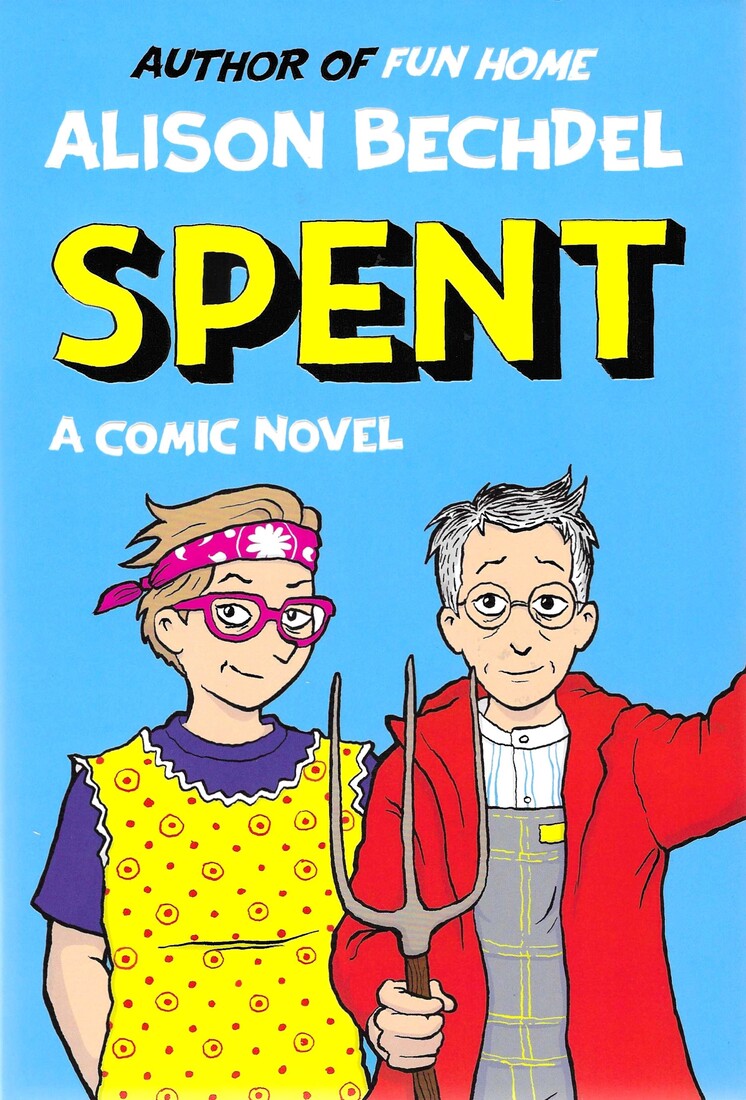
A new book from Alison Bechdel is cause for celebration, and here it is! Spent is from Mariner Books/HarperCollins, it’s 257 pages long, and it costs $32. Bechdel does the writing and drawing, of course, with Holly Rae Taylor coloring it and Jon Chad doing the “shadowing,” which, frankly, is a pretty cool credit. 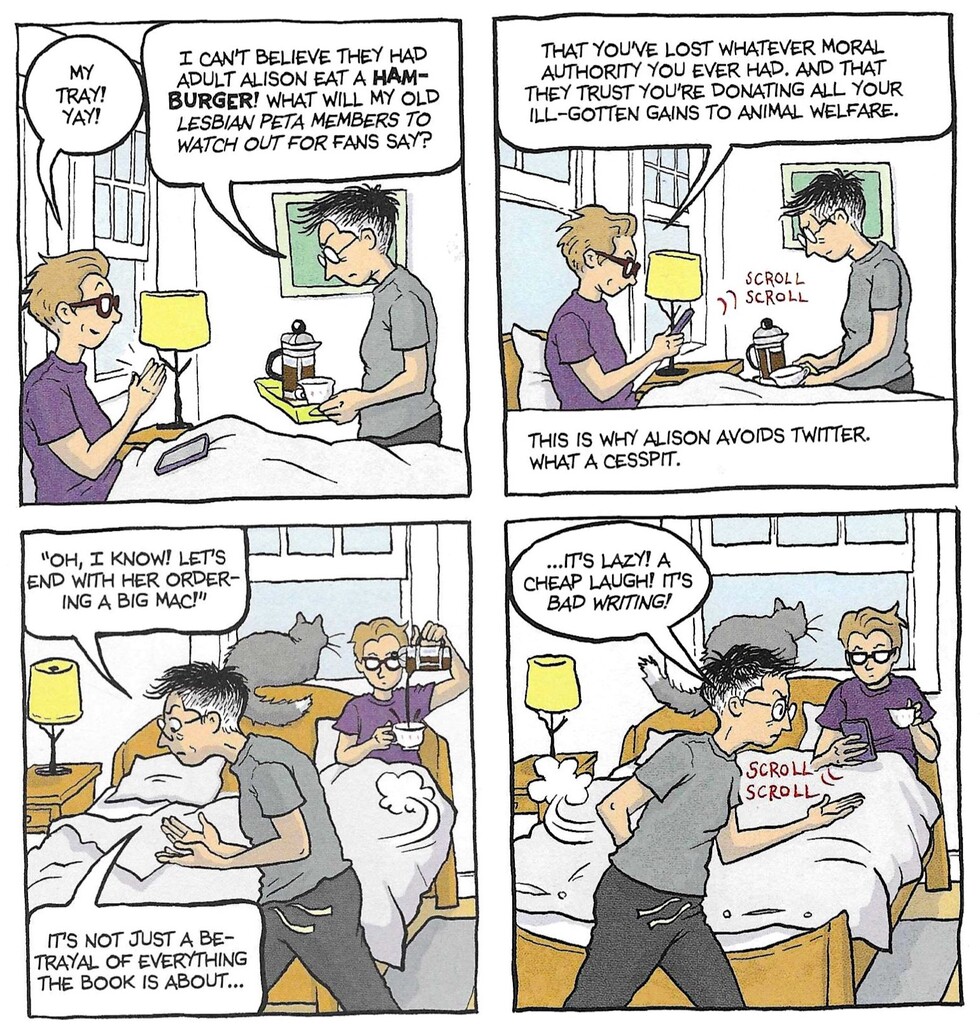 How about we dive into this one?
Spent is not Bechdel’s best comic (that remains Fun Home), but it is, probably, her funniest, so there’s that. This takes place in 2022-2023, when a fictionalized Alison and her fictionalized social group in Vermont are dealing with COVID and the aftermath of the first Trump Era. She does this in third person, which is a bit weird to get used to (the first caption of the book reads “Alison Bechdel wakes from a troubled dream,” for instance), but we quickly realize she’s doing a fictionalized version of herself, and it becomes easy to deal with. Alison and Holly, her long-time partner, own a goat farm in Vermont, and Alison is, of course, a cartoonist of some note. One of her books, Death and Taxidermy (the Fun Home analog in this universe), has been made into a television show, the third season of which is about to begin. Over the course of the book, we get the third and fourth seasons before it’s canceled. Alison’s literary agent has gotten her a deal with “Megalopub” for her next comic (which, instead of “Spent,” she’s calling $um: An Accounting, which has a whole host of subtext going on), which puts Alison in a bind because it’s “owned by that conservative media mogul who’s destroyed American democracy.” She means Rupert Murdoch, I assume, as he technically owns HarperCollins, it seems, although who knows if he even knows he does. This becomes the crux of the book, and it’s why it’s so funny yet still kind of depressing — Alison does not mind the money that comes with a publishing contract with Megalopub, but she also is wracked with guilt over it. Many characters in the book are presented the same way. Holly, who seems far more grounded than Alison in the beginning, makes videos about her life on the farm and seems happy with her tiny group of followers, but then one of her videos goes viral and she is tempted by the fame of being an influencer. 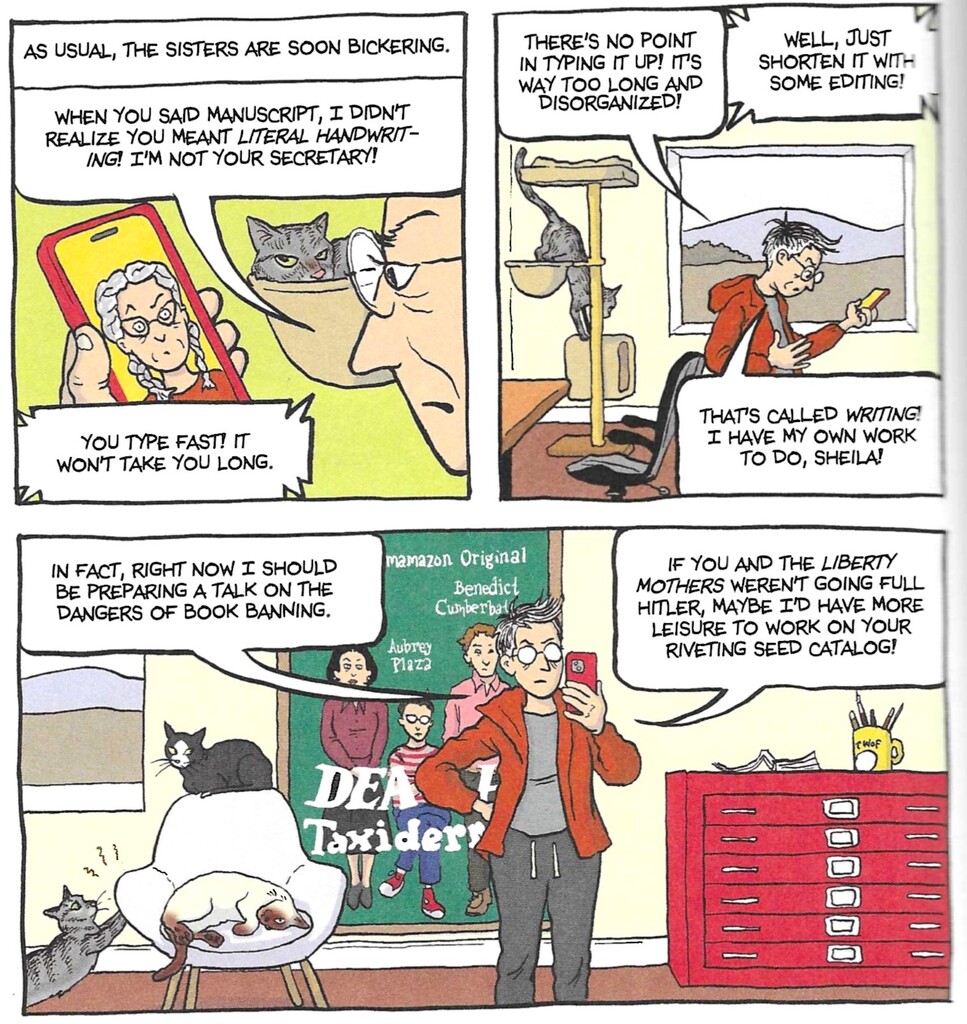 The various people they know are constantly trying to balance their disdain for late-stage capitalism with the benefits they receive from late-stage capitalism. Even the child of two of their friends, who is, like many young people, even more extreme in their thinking than their parents (in this case, they’re even more “woke” than their hippy parents), can’t quite give up all the comforts that the horrible ‘Murican system provides them.
It’s a satirical book, sure, but Bechdel doesn’t savage these people (maybe her fictional self a little), because the heart of the book is about good people just trying to do their best in a world that makes no sense to them. Coming out of COVID, they’re trying to figure out what kind of world it is now, which was not an easy thing to do, and as they’re all older (Bechdel was in her early 60s while doing the book, and the others are probably all about the same age), they’re trying to figure out the next stage of their lives, as well. So while she has fun with them, it’s a fairly gentle satire, and while she does make some good points about the lure of fame and the silliness of it and how some strident people can’t help being hypocrites, it’s ultimately a loving examination of people who want to do the right thing but can’t always figure out what that is. Alison herself doesn’t know — her great book has been twisted by the television show’s creator (the hilariously named Çedilla Ümlaut) into something unrecognizable, and Alison has no recourse because she wanted nothing to do with it. She actually goes to Hollywood to complain, but there’s nothing she can do, and she doesn’t stop taking the money for it, does she? Her editor at Megalopub wants her to be more active on social media, something Alison does not want at all (and which is, it seems, a depressingly real thing about publishing these days — books get published based on how popular the authors are on social media and not if the book is any, you know, good). Holly gets sucked into the fame loop — post something that goes viral, and the pressure builds to keep it up — and is only able to get out of it by taking an extreme step. The couple with the child begin exploring a relationship with another woman, but they’re terrified to tell their child even though she’s as unconventional as they are. The child, J.R., has little but scorn for their parents and others of their generation, yet they’re constantly asking them for money. And, interestingly enough, Alison’s sister, Sheila (the real Bechdel has two brothers, it seems, but not a sister), emerges as a fascinating character, a MAGA woman who bonds with people she wouldn’t like politically over more personal things. 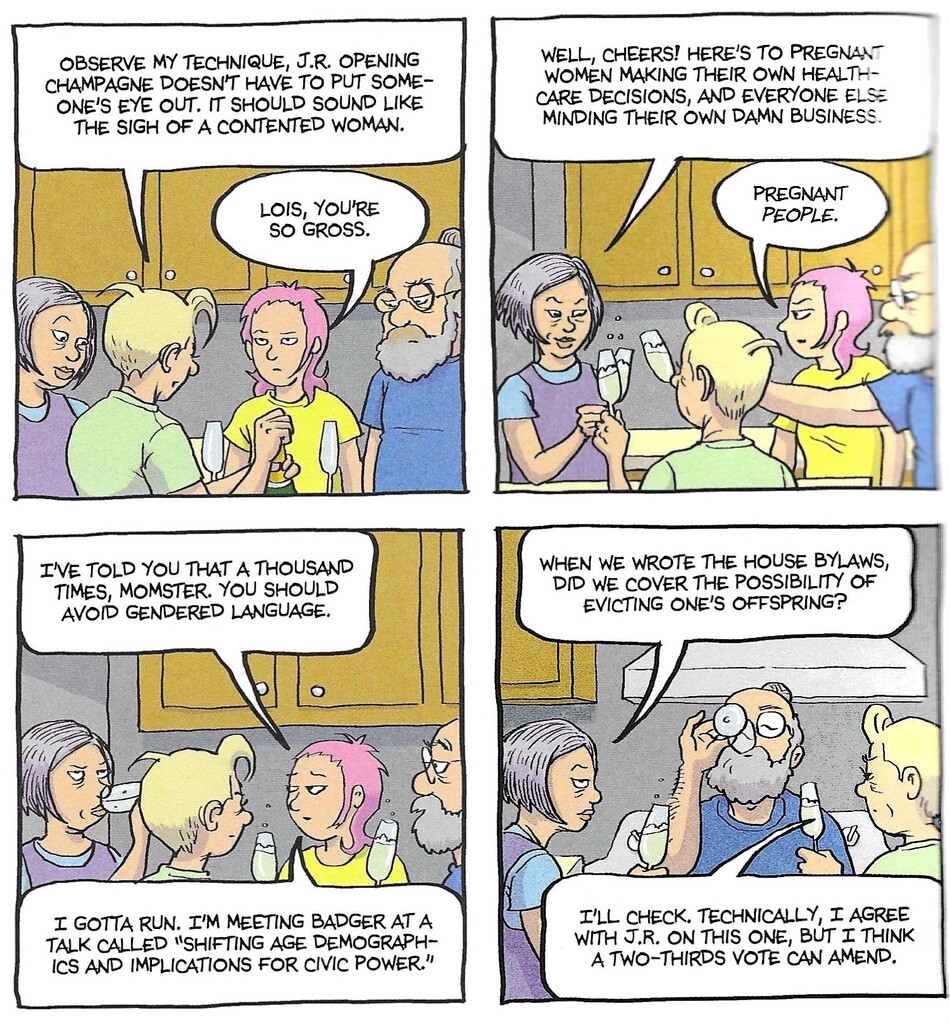 Sheila doesn’t like to talk about politics, but she doesn’t care if the people who share her hobbies are on the opposite side of the political spectrum than she is, while Alison and her friends seem to judge people solely based on their politics. Bechdel doesn’t absolve Sheila of her beliefs, but she does a nice job showing that people can be multi-faceted, and we might do better taking that into consideration.
As I noted, this is probably Bechdel’s funniest work. Alison, her fictionalized self, feels guilty about her choices, which is both easy to sympathize with but also somewhat funny. Alison’s and Holly’s adventures on the goat farm are funny, too. Bechdel manages to make the “Three’s Company”-esque sexual farce about Stuart, Sparrow, J.R., and Naomi, Stuart and Sparrow’s new paramour, both funny and adorable. The extreme hipster neighbors, who aren’t in the comic that often, are also very funny (unintentionally, of course, but still). Alison’s brief time in Hollywood is also very funny, and it’s the only time when you get the sense that Bechdel’s satire is more pointed and savage, as making a television show does seem a bit ridiculous to outsiders. Through it all, though, Bechdel shows us how much she cares about these people and what they’re doing. The humor doesn’t come from mockery, even if the characters are hypocritical sometimes. It’s just showing how difficult life can be, and how sometimes, it’s humorous. Because it is. Ultimately, this is a hopeful book — the characters come out of the COVID years with new ideas and new appreciation for things, and it’s kind of depressing reading it now, after the brief hope that the Orange Orangutan would shuffle off to the dustbin of history and what happened to crush that hope. Despite that, Bechdel knows that the best way to change things is to start locally, and we see that in this book.
I never have a lot to say about Bechdel’s art, because it’s always solid. She does make Alison look a bit older than she herself looks, which is interesting. 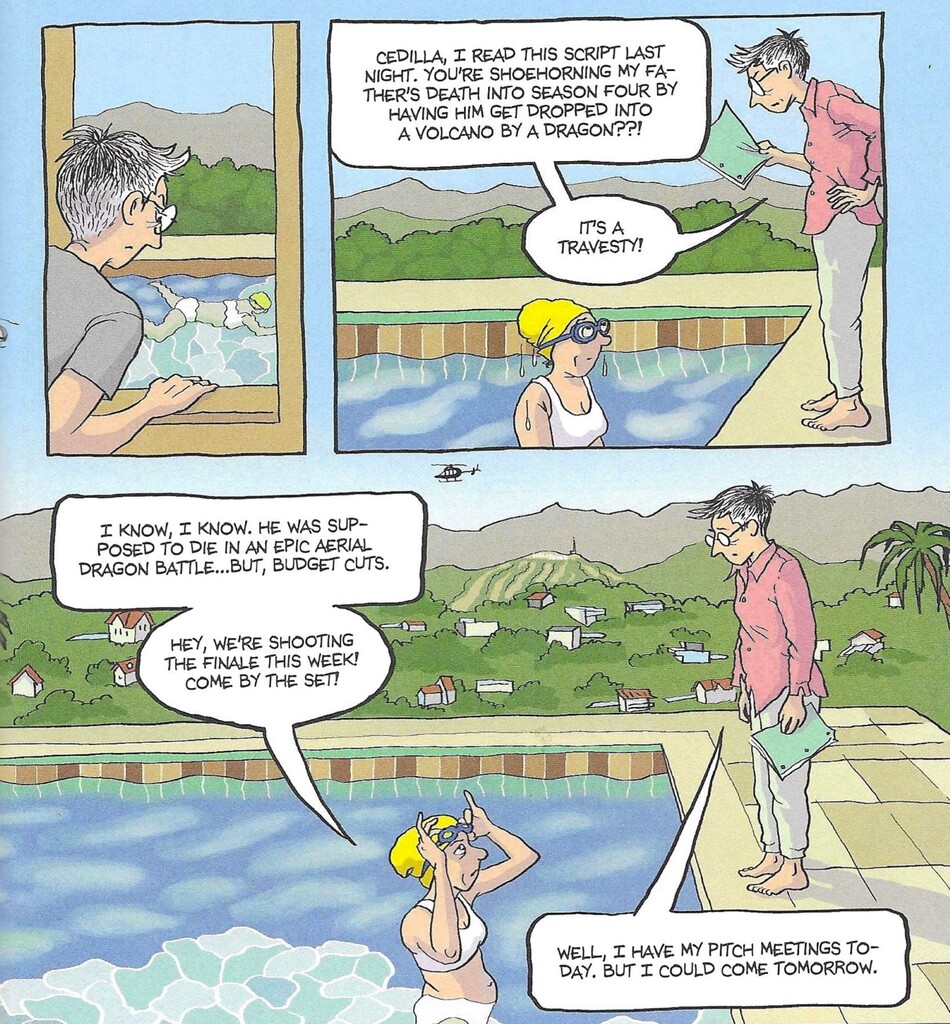 She always does a nice job creating spaces for her characters, so her corner of Vermont feels like a real, solid place, and the people who inhabit it feel like real, solid people. There are a lot of sight gags that help with the satire — at one point, Alison stands in front of a bank of non-dairy milk, and one of the options is “drywall milk” — and the small details she adds to the people often do that, too. She has a good sense of the COVID time, too, from the ubiquitous masks to the claustrophobia of the indoors to the paranoia that someone was going to make you sick. I often say that I missed out on the COVID experience, because here in Arizona, where we don’t let anyone tell us what to do, things didn’t change all that much — our stores didn’t close for very long, I took my tennis lessons all that summer of 2020 because we were on a court far away from each other, and even my older daughter didn’t do online learning for too long because special needs kids went back to class very early due to the fact that none of them could do online learning — so it’s interesting reading about the experiences others had, and Bechdel does a good job showing what it was like through the details in her art. As with all of Bechdel’s comics, it’s a very nice-looking book.
Spent might not be a masterpiece, but that’s ok — Bechdel has already done one of those, so she’s good. It is, however, a very good comic, and it’s very fun to read. That’s not a bad thing, is it?
Rating: ★ ★ ★ ★ ★ ★ ★ ★ ½ ☆
