
“They handed us down a dream to live in this lonely town; but nobody hears the music only the echo of a hollow sound”
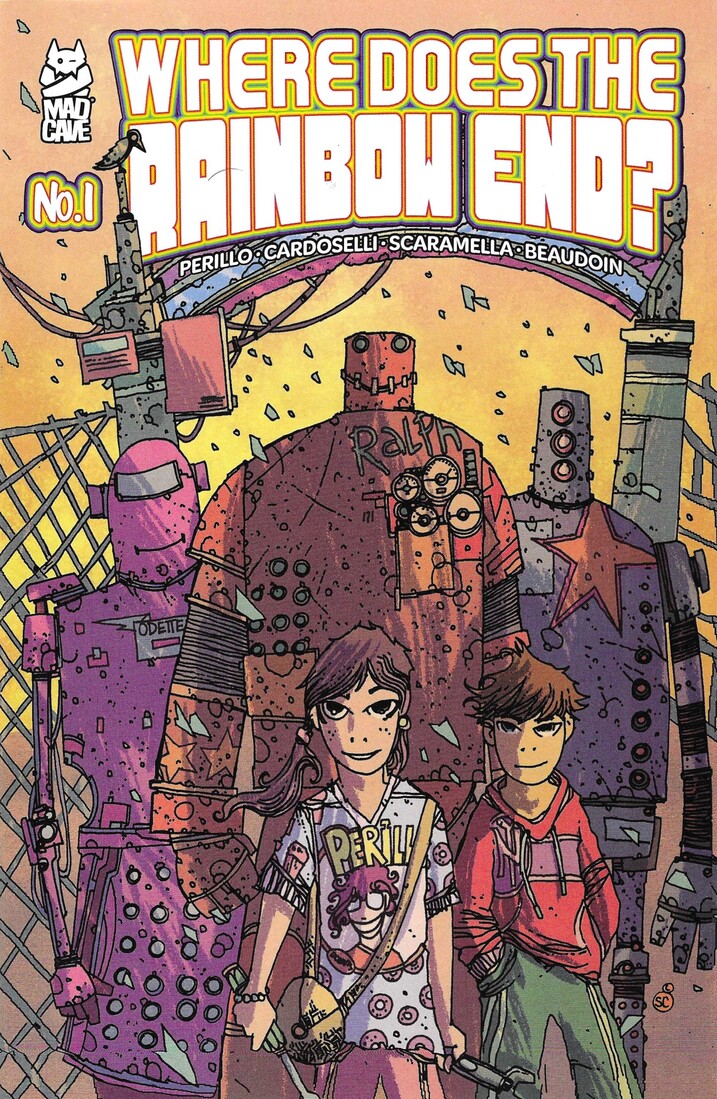
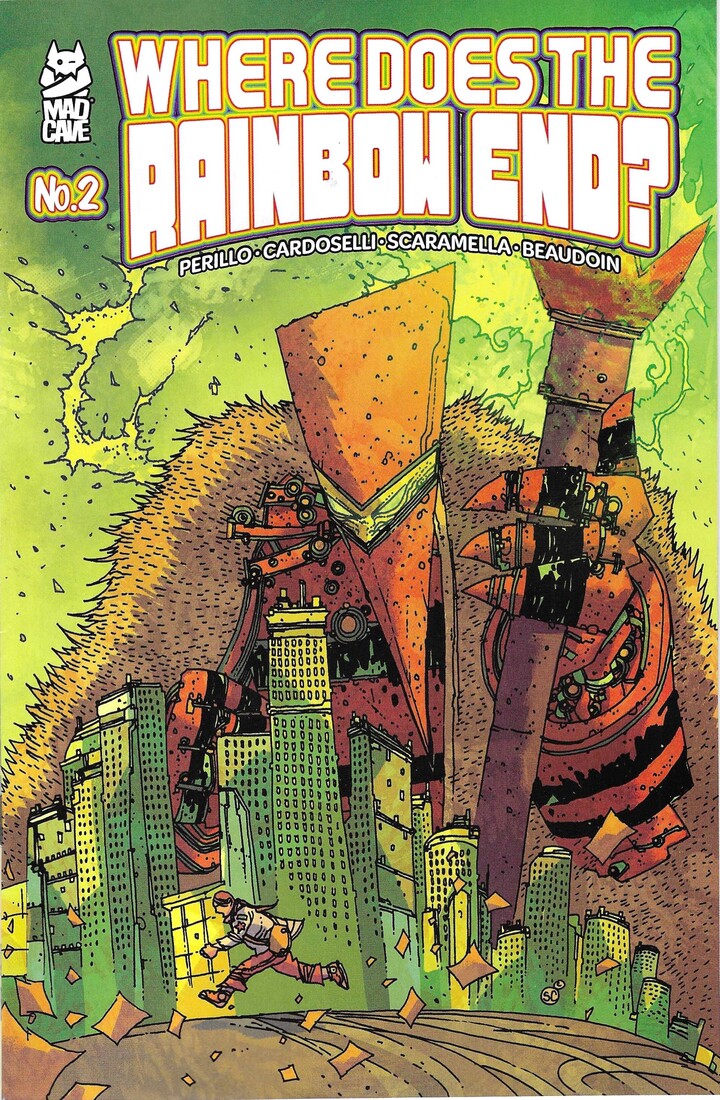
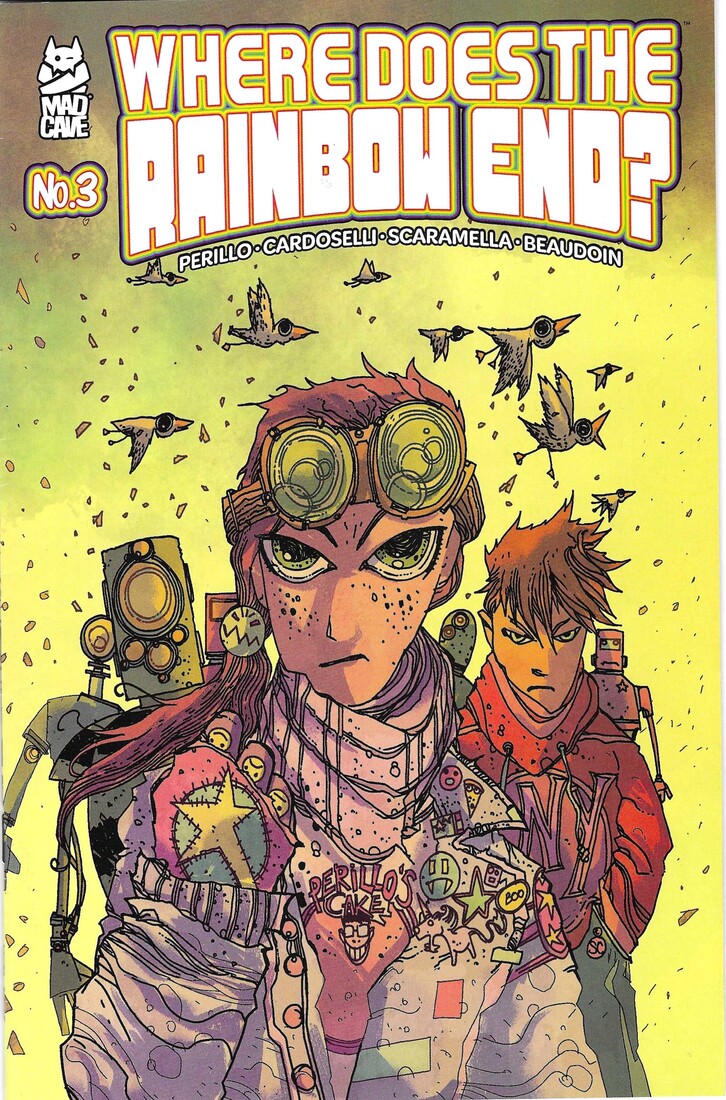
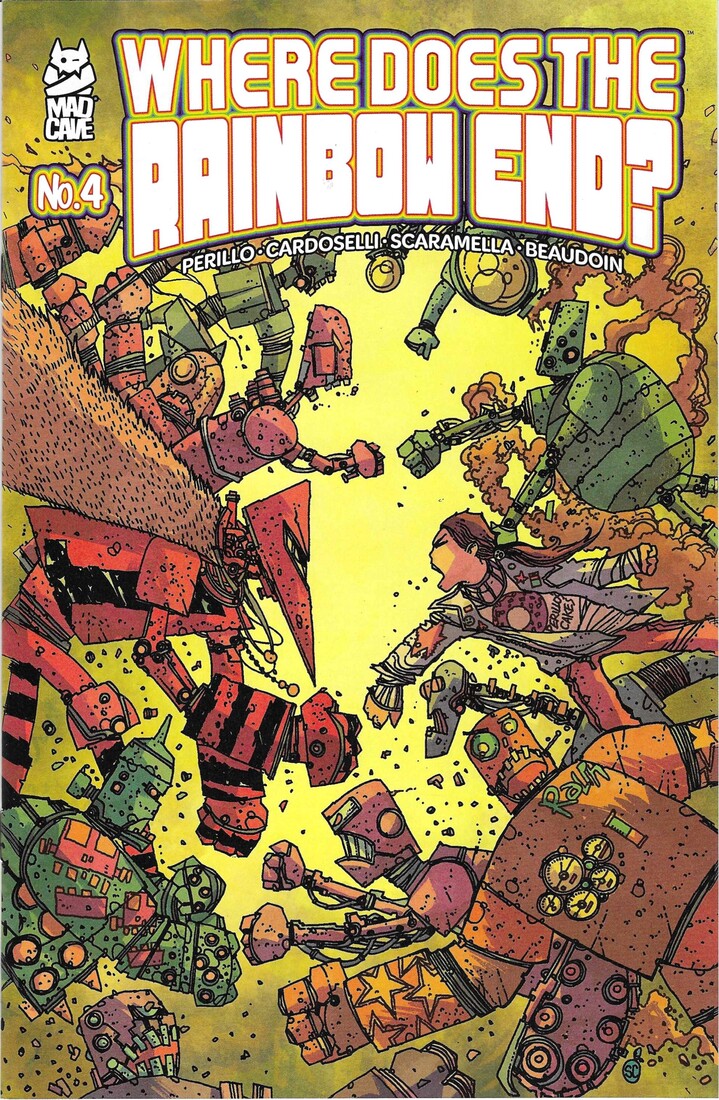
Where Does the Rainbow End? is the latest wacky adventure by Stefano Cardoselli, whose work brings me so much joy. It’s written by Francesca Perillo, colored by Lorenzo Scaramella, and lettered by Buddy Beaudoin. It’s published by Mad Cave, it’s 94 pages long, and while I don’t know how much the trade will be, each issue is $4.99, meaning it cost me $19.96 to pick this up. That’s a bit spendy, but I don’t care all that much.
It never really matters what a Cardoselli book is about, because they’re all kind of goofy and full of violence, whether he’s writing them or not. In this case, an abandoned girl is found by kindly robots who live in ghettos in New York, and they take her in and raise her. She becomes very good at fixing robots, but when she discovers other humans, she yearns to hang out with them. Meanwhile, an evil robot wants her for himself because he and all his minions are constantly breaking down. He wants to fight the “good” robots to take her away, but Gilda just wants everyone to get along. It’s not a depressing book, so I think you can probably figure out how it ends.
I just want to take a look at the art and show some things about why I love it so. It’s not traditionally “beautiful” art, but Cardoselli clearly knows what he’s doing and he never takes a panel off, which is just one reason why I dig his comics. So let’s see what’s going on here.
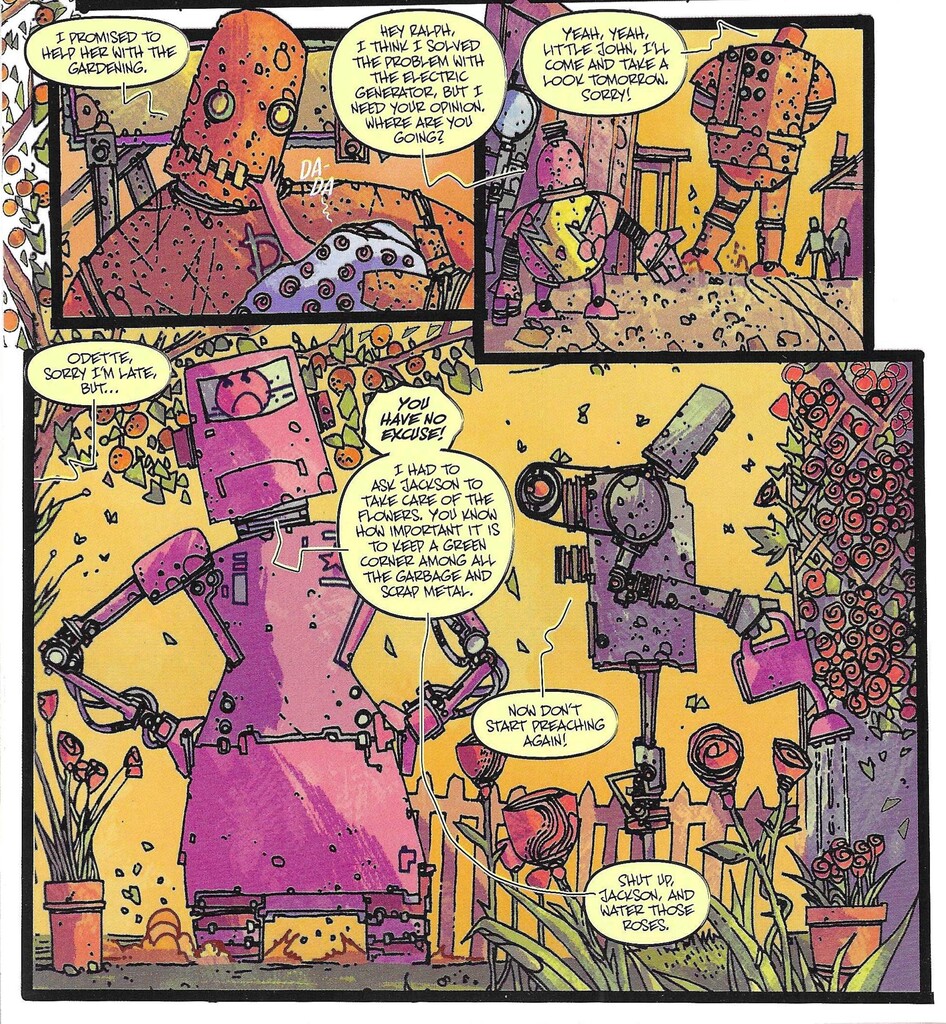
This is an example of how Cardoselli humanizes all his characters, whether they’re humans or not. Ralph has found a baby and decides to bring it home. In panel 1, we see that even though his mouth is just a line bolted together with metal plates, Cardoselli is able to show how happy he is that he’s found Gilda. In panel 3, Odette shows her displeasure not only by the display of an emoji on her face but the way Cardoselli draws her stance. With all three of the robots, Cardoselli is clear that they’re not human, as he does not fail to draw in the gears and the tubing that hold the robots together, but he still gives them personalities. He also gives us a gorgeous riot of flowers, and note how he breaks the panel border to show the tree bursting forth with fruit. Cardoselli also makes his comics gritty by scuffing up his characters and scenery a bit. Ralph is scored by lines, and Odette and Jackson have seen better days. They’re undaunted, though, which is nice. It’s a small scene, but a well-composed one.
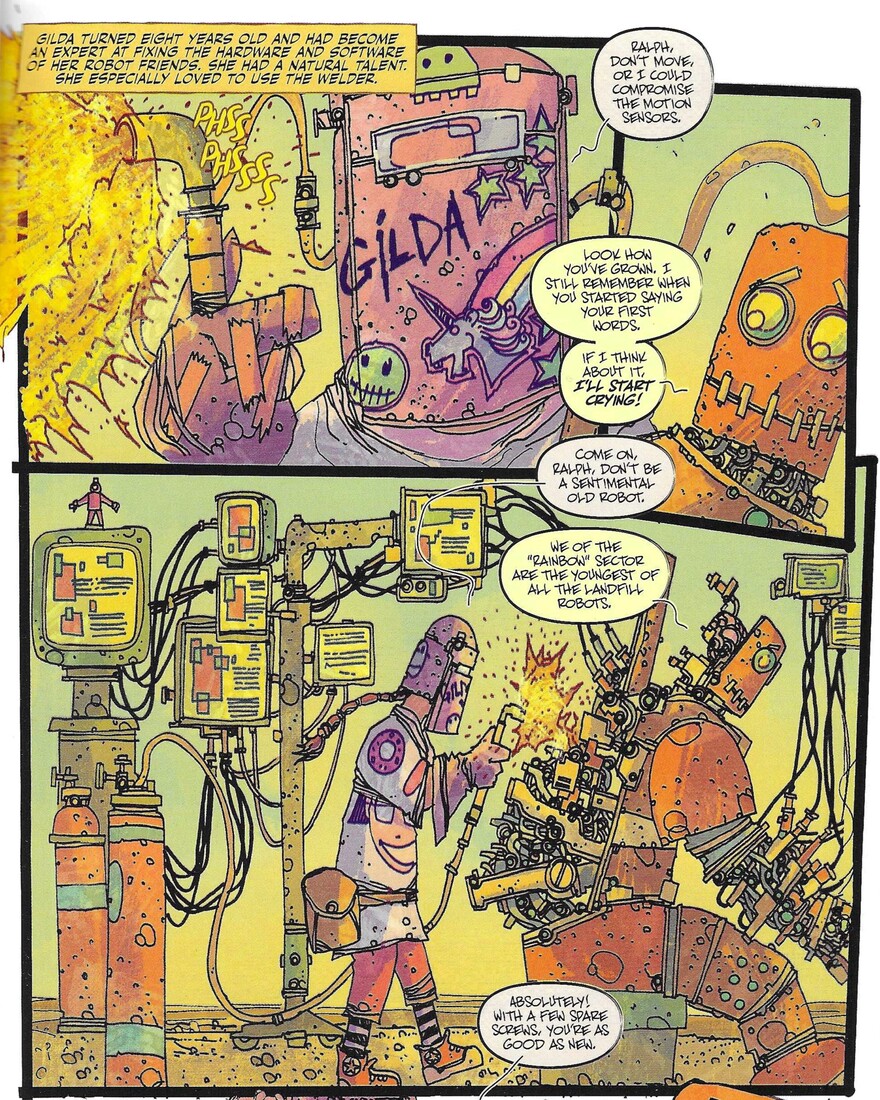
Gilda fixes Ralph up in this scene, and Cardoselli again has fun with it. He doesn’t forget that Gilda is a young girl, so she decorates her welder’s mask with things a young girl might like. He puts her in typical young-girl clothing but remembers to cover her up, because she’s working with flames. Again, we see the riot of details in each panel, especially panel 3. Cardoselli goes a bit nuts with the tubes connecting to Ralph and the exposed machinery, but it adds a good sense of realism to the cartoonish art.
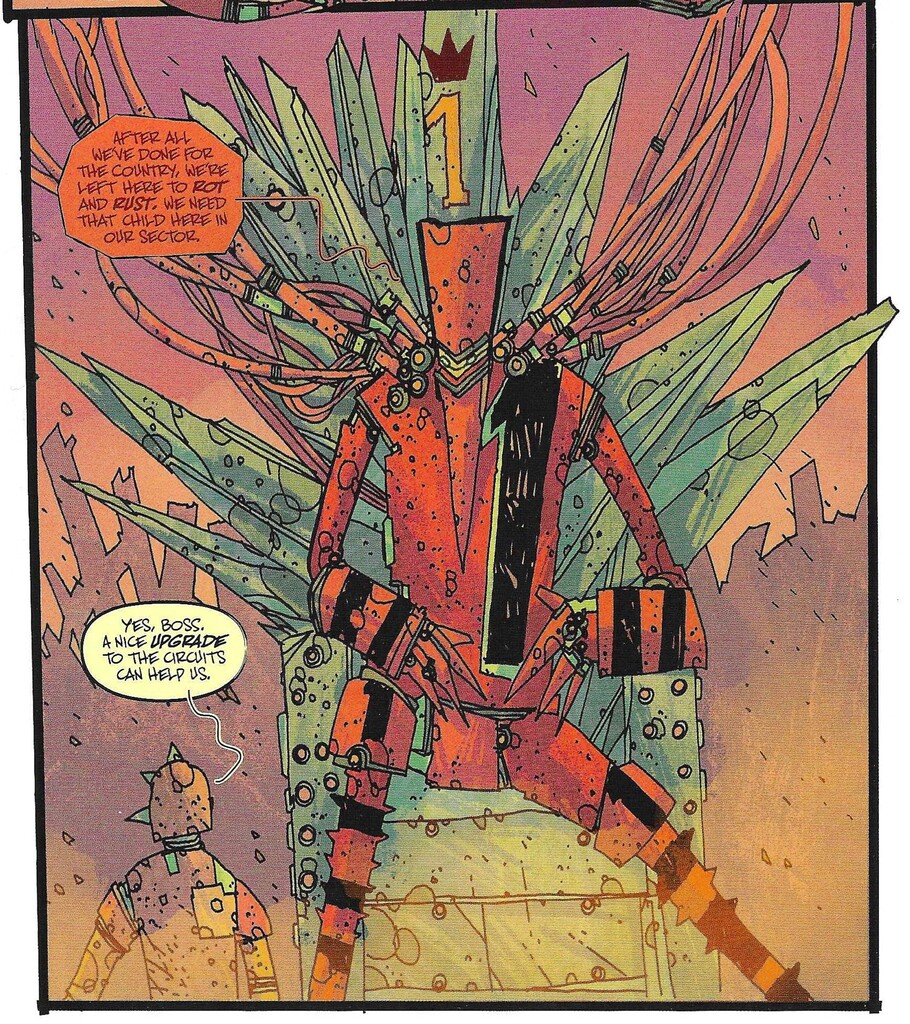
The bad guy is Victor One, and Cardoselli leaves no doubt that he’s kind of a jerk. He gives him a triangular, sharp face, which contrasts nicely to the rounded, softer faces of our “good” robots, and his fingers are claws, basically. He’s sitting on a hard, sharp throne, and even the tubing extending from him looks more sinister than in the other panels. Even he can’t escape the decay, as we can see, and you’ll notice that Cardoselli often draws parts of bodies disproportionately — his characters’ hands, for one, are often too big for their bodies. It’s definitely a choice, and while it looks odd sometimes, in this book, it feels right, as it feels like the robots have had to find extra parts that might not quite match. I doubt if Cardoselli was thinking that deeply about it — maybe he was, but I doubt it — but it feels right in this comic.
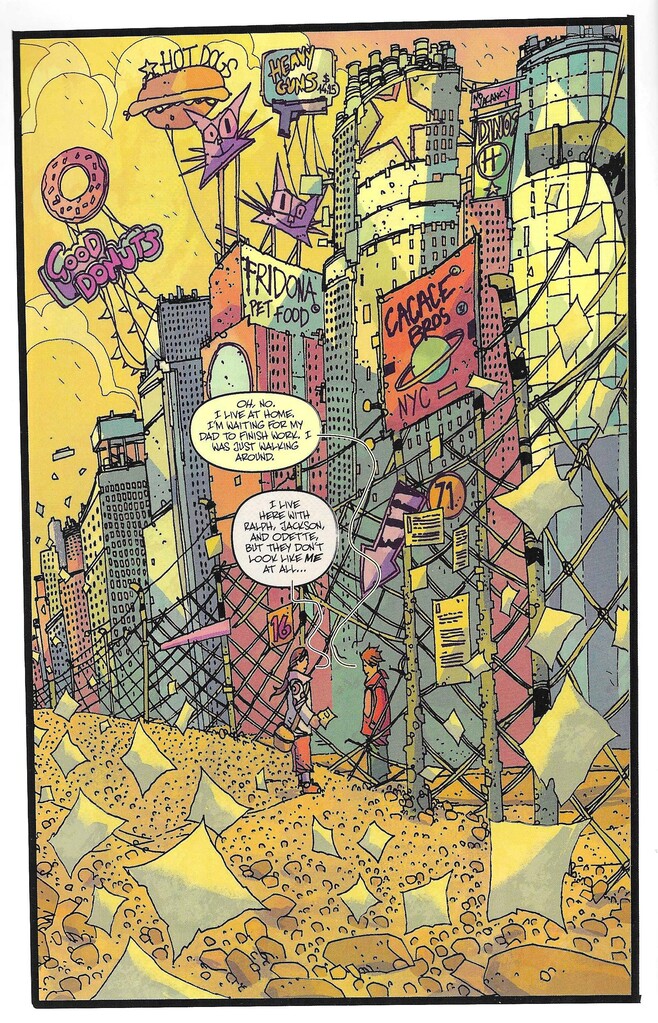
Here’s a typical splash page, as Gilda meets Travis. A lot of Cardoselli’s comics take place in the future, in cities that have become even shittier than Iowans claim they are now, and Cardoselli is never shy about showing that. We have the ubiquitous and obnoxious advertising, the massive buildings dwarfing the humans, and trash flying everywhere. Even the capitalism looks half-hearted, as the printing is sloppy and seemingly ignored. The shambolic nature of Cardoselli’s cities is one of the charming themes of his comics. Even so, Gilda and Travis are able to make a connection.
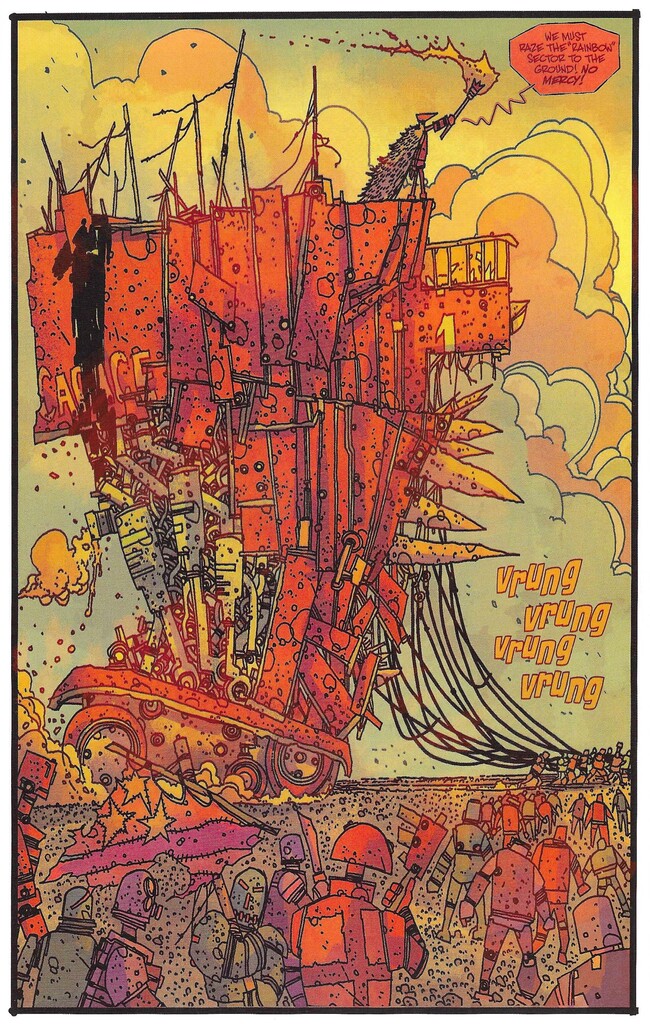
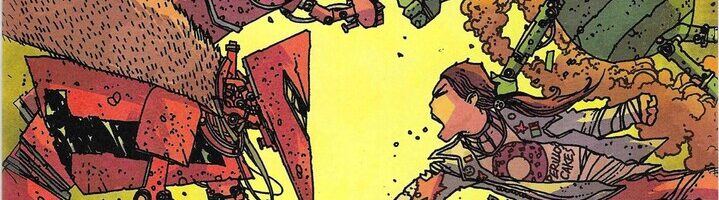
Another full-page spread, as Victor One gathers his troops. Cardoselli loves drawing hulking, clanking machines, and he goes all out with this one. Again, he uses simple circles to show the decay, as nothing escapes it in this world, and the way he tilts the machine makes it look like it’s about to crash to the ground, adding to the tension in the scene. On the back, he inks a black smear onto the side, obscuring the name of the machine’s original owners, and from the back, goop drips from an open pipe while it belches ugly orange smoke into the already polluted atmosphere. Victor One stands on top, a symbol of man’s ingenuity — he is a sentient robot, after all — but with his torch and his long, shaggy cape, he looks like a war leader from the distant past, urging his followers on to glory and bloodshed. On the ground, even the robots are dwarfed by the huge war machine, and in the foreground, we see a robot clutching a tattered flag, another example of the world breaking down even as everyone clings to vestiges of order.
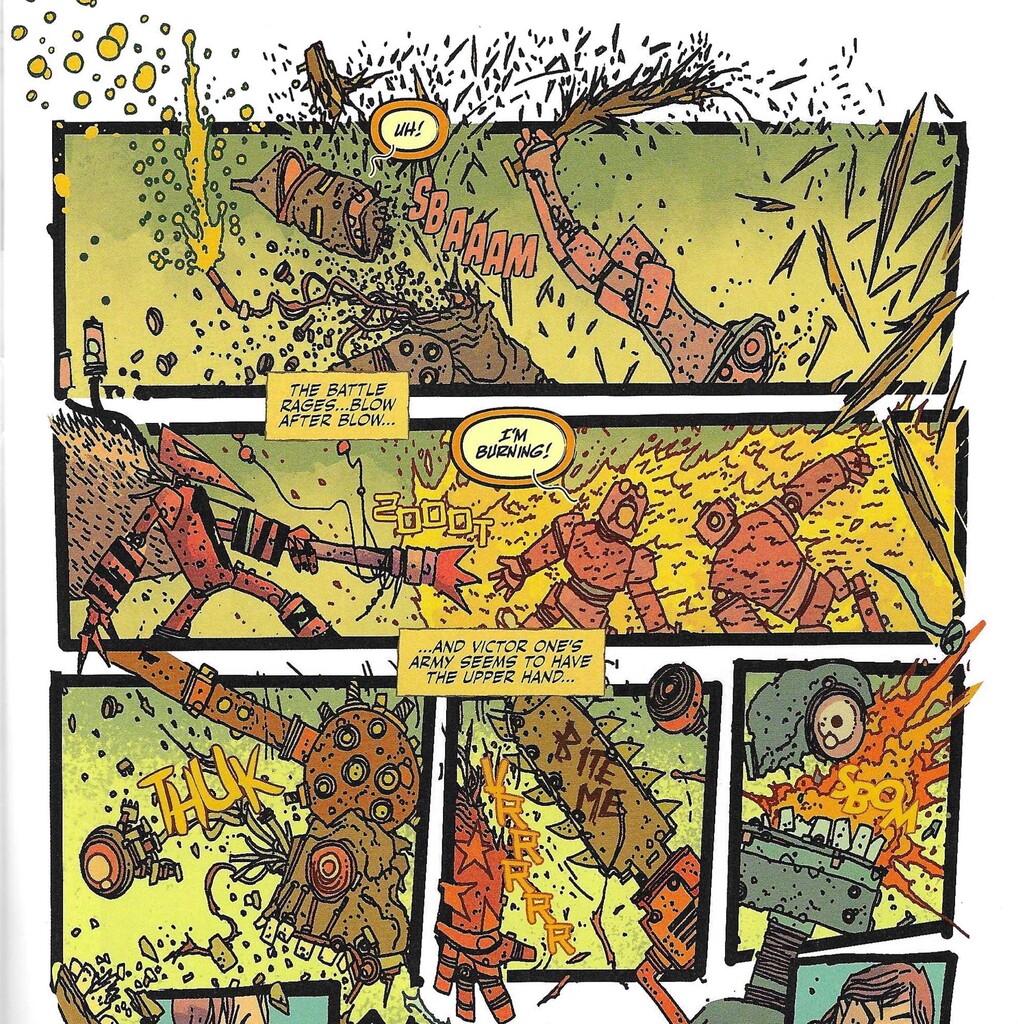
Cardoselli’s gonzo style lends itself well to violence, and, as usual, he gives us marvelous details even in a big fight. He draws every shard of wood as the robot’s stick explodes in panel 1, and draws in all the oil as it spews forth from the other robot. He shows the jaw of the robot in panel 3 flying apart and the eye bursting forth as the mace hits it. He continues to draw in all the wiring and metal plates as the robots come apart. There’s no blood, of course, but Cardoselli’s commitment to detail makes each panel much more visceral.
I’m still not sure if Cardoselli’s comics are any good. I mean, they’re entertaining, but they’re usually not terribly well-written and they’re a bit simplistic. Still, they provide a nice framework for his art, which is the reason to get his stuff. If you liked what you saw here, you’ll probably like Cardoselli’s comics, even if the stories aren’t the best. If you don’t like his art, you probably won’t like the comics, because the stories really are a bit ephemeral. I don’t know if I can recommend his comics, but I do dig them a lot, and I will keep getting them!
Rating: ★ ★ ★ ★ ★ ★ ☆ ☆ ☆ ☆
