
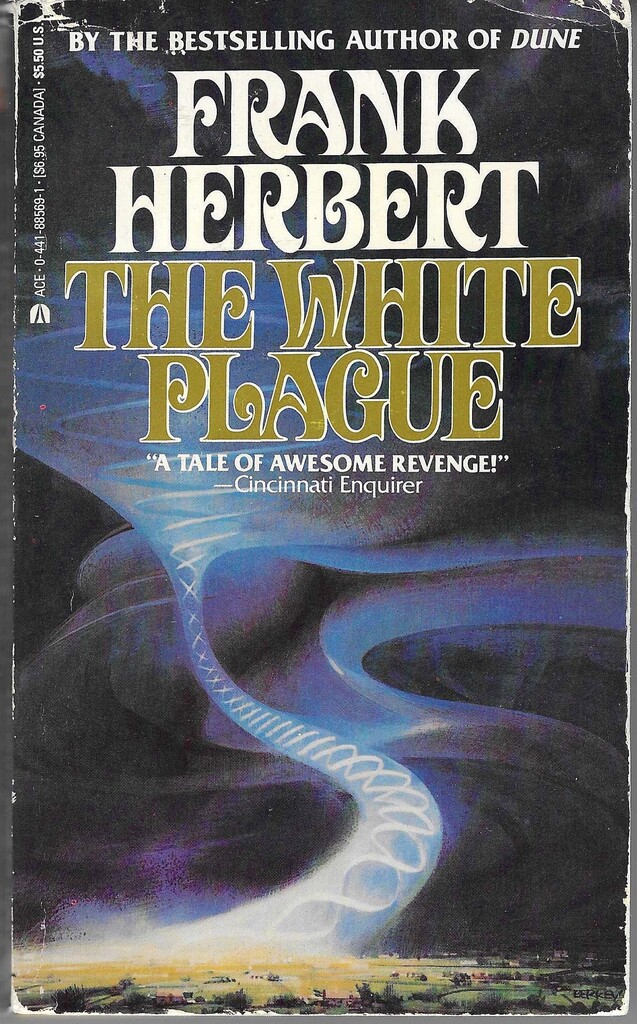
Today I’m checking out a Frank Herbert book! I always point to a few Herbert books when I mention I really don’t like Dune, because I can like Herbert books, I just don’t dig Dune. And that’s cool, right? The White Plague came out in 1982, and I read it a few years later, in junior high or high school, when I spent a lot of time at the Warminster Public Library and read a bunch of books. I read a lot of science fiction at that time, but, perhaps a bit counter-intuitively, I never got so into sci-fi that I simply read everything by, say, Herbert or Heinlein or Zelazny or even Clarke (I’ve read more Clarke than any of the others, but still not a ton of his stuff). But I did read The White Plague, and today I’m going to write about it, because I just re-read it!
The story is still extremely relevant, which is one of the reasons why the book is so powerful even today. John Roe O’Neill, an American molecular biologist in Dublin on a research grant, watches as his wife and two children are killed in a car bomb detonated by the IRA (he happens to be in a bank across the street as they’re crossing to meet him). This turns out to be a phenomenally terrible occurrence, as O’Neill goes back to the States and creates a plague that kills only women and girls and unleashes it in Ireland, England, and Libya (because they trained the terrorists of the IRA). It is extremely effective and very difficult to stop, and the world, of course, basically falls apart. O’Neill decides to go to Ireland to see the effects of his plague and stymie any progress in finding an antidote. He calls himself John Garrech O’Donnell and claims he’s a biologist who wants to help, but the Irish authorities are suspicious of him and try to figure out if he’s actually O’Neill, so they assign Joseph Herity and Father Michael Flannery to walk with him all over Ireland to try to figure him out. We know, but O’Neill does not (nor do many people), that Herity is the one who actually detonated the bomb that killed O’Neill’s family, so there’s that element, as well. The main focus of the book (which in my handy Ace Edition runs 501 pages of fairly small print) is O’Neill’s trek across Ireland and his gradual descent into madness (if he wasn’t insane already, of course), but Herbert also checks in on the outside world quite a bit, which is nice to see. One thing I dislike about most post-apocalyptic stories is the tight focus on one group, as I always wonder what’s happening elsewhere. Herbert devotes quite a lot of time to the rest of the world, so we can see how it falls apart and what the survivors are doing. The plague leaps out of its target areas, naturally, and begins killing women everywhere, but many places manage to get some into quarantine, which causes a power imbalance in the world. O’Neill warned governments not to use nuclear weapons to sterilize places, but they come up with other sterilization methods and apply them ruthlessly. The president of the U.S. has a heart attack and dies, and his successor needs to figure out what to do when a group of scientists in England, some of whom began their work in the States, make progress toward a cure. The Papacy abandons Rome and moves to Philadelphia, but the Pope is not as safe as he thinks he is. Israel abandons the Middle East and sets up a new state in the Brazilian rainforest. A lot of this we don’t see directly, we just learn it from conversations between powerful people, but Herbert does a good job filling us in and also punctuates what might be dry discussions with sudden violence and tense confrontations as those in power jockey for position in the new world.
In Ireland, bandits have taken over, and O’Neill’s journey becomes a voyage deep into the soul of the nation and of O’Neill, as he sees what he has wrought and must deal with it. There’s no “come-to-Jesus” moment for O’Neill — he’s fine with the carnage he’s created, for the most part, although the priest does try to work on his conscience. Herbert doesn’t let anyone off the hook: while Herity is eloquent and speaks of the English devils and seems completely unrepentant, Herbert also implies that the Irish — and any other people who pursue violence to such an extremity — are collectively insane, and all the beauty of the Emerald Isle can’t make up for that. The utter lack of introspection by the people running Ireland, many of whom are IRA, is somewhat refreshing — they refuse to accept any part of the blame for the absolute destruction of the world, and Herbert makes us almost admire their foolish single-mindedness. His writing is wonderful, as he gives us marvelous descriptions of Ireland as O’Neill and his minders walk through it, and he does a nice job with the many characters, sketching them out quickly but memorably. One woman, who hooks up with a student-scientist early on and is saved when she’s placed in a sealed tank, clings to Catholicism almost desperately, as she’s pregnant and can’t countenance giving birth to an “illegitimate” child. Her journey from rather flighty student to steely woman is subtle but powerful. O’Neill, meanwhile, goes the opposite way, from strong resolve to madness, but Herbert does a very nice job showing his slow degradation. Herbert’s a good enough writer that even when he only checks in on characters briefly, he gives us a lot about them and we get a good sense of how they fit into the world. In the end, the book becomes a bit depressing — as if the death of half of humanity weren’t depressing enough — because of how Herbert resolves the “one woman for thousands of men” dilemma that the world is faced with. It makes a lot of sense, but it shows that even in a new world, women would get screwed over by powerful men. Plus ça change and all that, eh?
Whenever I read speculative fiction (I don’t know if we can really call this “science fiction,” but maybe we can), I’m often impressed by how cutting-edge the writers can be, and Herbert does not disappoint. I have no idea how much of the science in here is even close to correct, but the way he describes the plague and how O’Neill created it and how the other scientists fight it is really well done, and it sounds right, which is all you want in fiction. I imagine Herbert did some research, but even if he made a lot of it up, his ability to make it sound like actual science is very cool, and it helps sell the entire book. He never lets it go too long, either, so the book doesn’t drag when he gets into the science, because it doesn’t last too long. But in a book as long as this, he has a lot of room to discuss the science, and it’s pretty keen. As I noted with my last post, I do like books written by forward-thinking writers in the 1980s, because they could hint at the amazing advances coming soon thanks to computers, and we see a bit of that here, too. It must have been neat being a scientifically-minded writer in the 1980s and reading about all this stuff, because it really did change the world.
I’ve read some other Herbert books, but this one is my favorite. I still won’t ever read Dune, I don’t think, but that’s ok. If you’re a Dune heretic like me, maybe check this book out and you might find out you really do like Herbert, just not his sprawling mess with the spice and the sand worms!
