
You’re always up for some historical fiction, am I right?
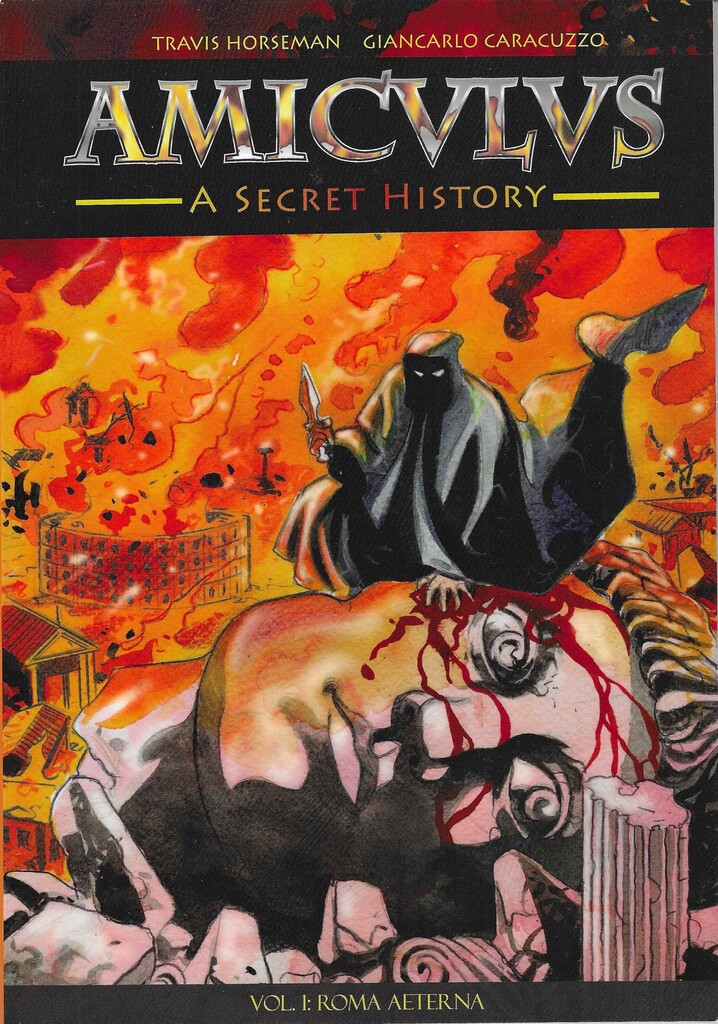
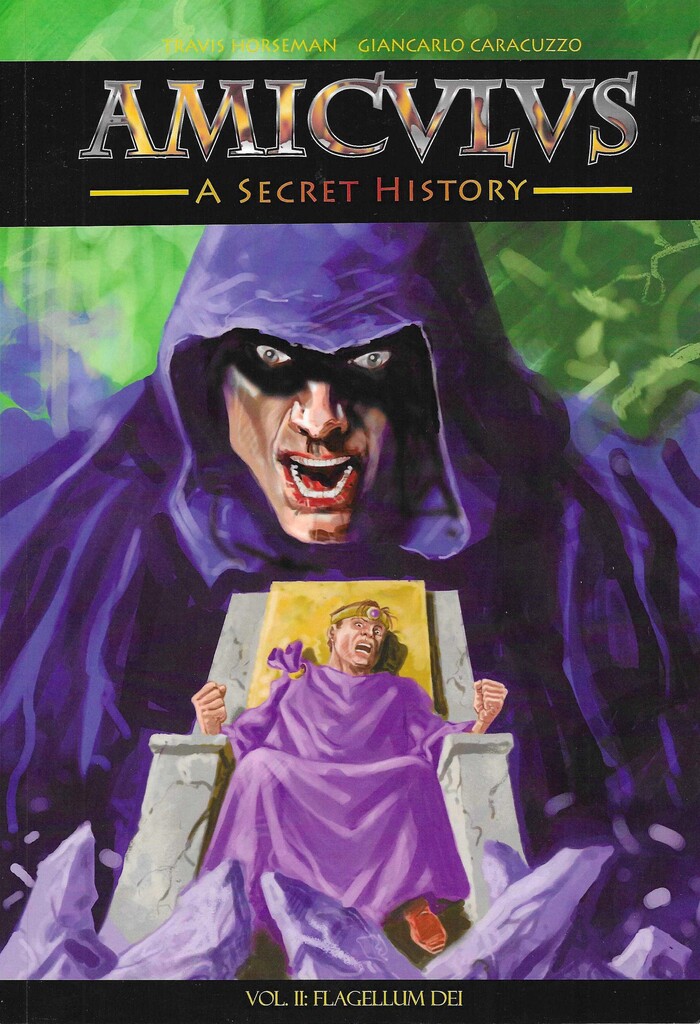
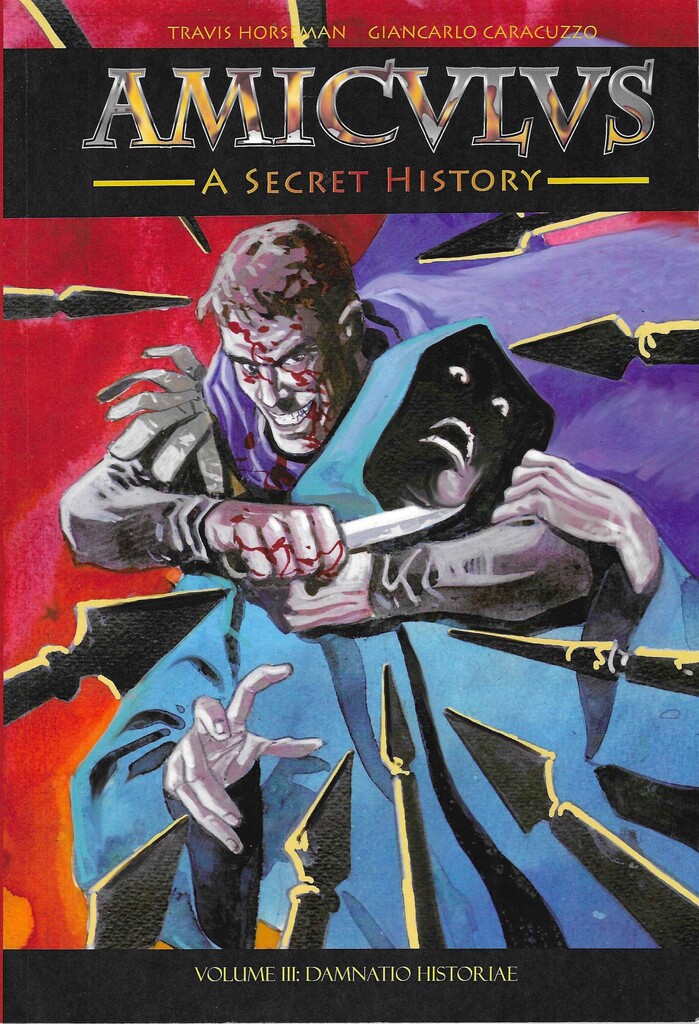
Amiculus: A Secret History by Travis Horseman (writer), Giancarlo Caracuzzo (artist), Flavia Caracuzzo (colorist), and Frank Cvetkovic (letterer).
Published by Amiculus Books, 3 volumes (“Roma Aeterna,” “Flagellum Dei,” and “Damnatio Historiae”), cover dated 2014, 2016, and 2017.
Click on the images to see them better, and beware of SPOILERS, although I do think I kept things spoiler-free!
Back in 2015, Travis Horseman was nice enough to send me his self-published book, Amiculus, and I wrote a review of it. 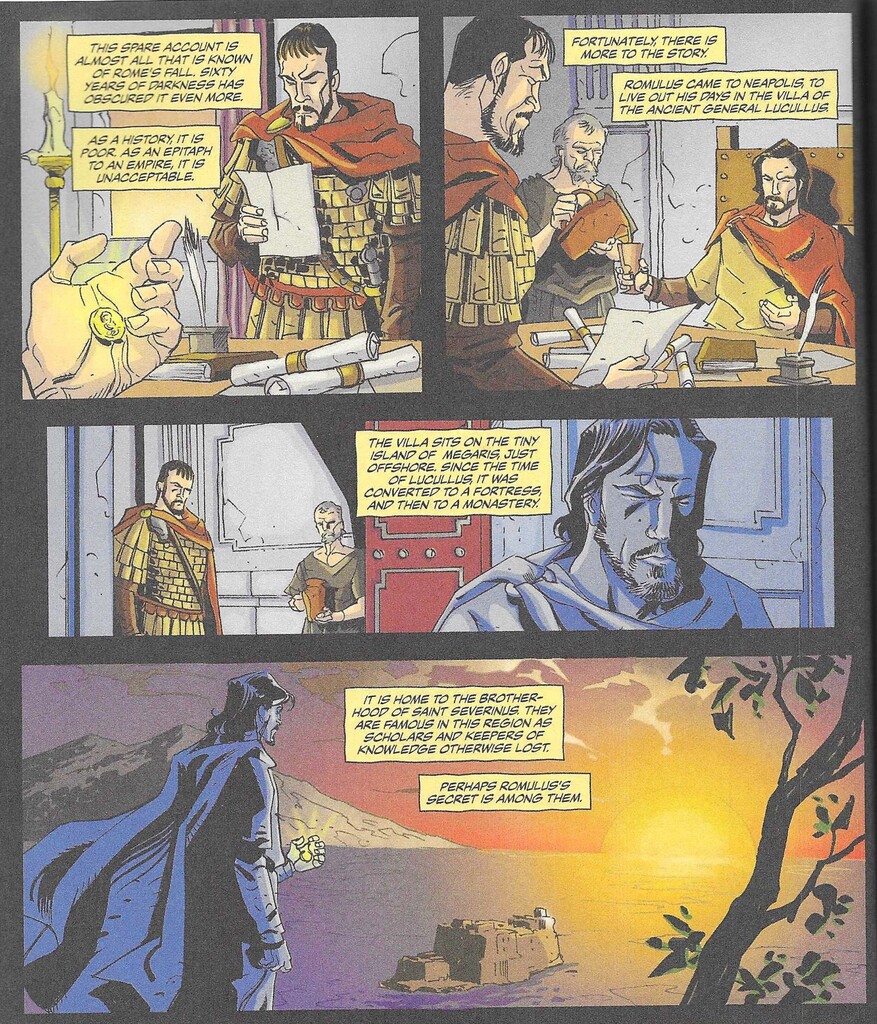 I said the only thing that was really wrong with it was that it was clearly part 1 of 3, so it was very incomplete. Horseman did publish the next two volumes, but he did not send them to me (so sad!) and I kind of forgot about it for a while. Whenever I re-shelved my books (which I do every year, putting the stuff I bought during the year in their proper alphabetical spot), I would think “I really need to get the next two volumes,” but I never did. But now, I’m re-reading my trade paperbacks and graphic novels, and I have no excuse! So I hied me to Amazon and found the second two volumes and read them. I’m glad I did, because this is a terrific comic.
The fascinating thing about history is that we know so little about it and can always discover new things. People who dismiss history (“It already happened, and we know it all!”) don’t seem to comprehend this — sure, we know who the first president of the United States was, but we can always learn new things about George Washington as a person. This becomes more prevalent as we move further into the past, as you might expect, and there is quite a lot we do not know about important historical events. As we learn more about the past, it helps inform the present (and the future) more, which helps us learn what to do and, more importantly, what not to do. For historical fiction, this dearth of information about the past helps a lot because, well, writers can fill in the blanks with their own ideas, and while we can’t know what exactly happened, a good writer can make some sense of what happened, even if they’re not specifically “factual.”
Amiculus is about the end of the Western Roman Empire, which has officially been pegged at 476 CE. The last emperor, Romulus Augustus, was no older than 15 when he was deposed in September of that year by Odoacer, a “barbarian” (his ethnic background is unclear) who took over Italy and ruled for several years afterward. 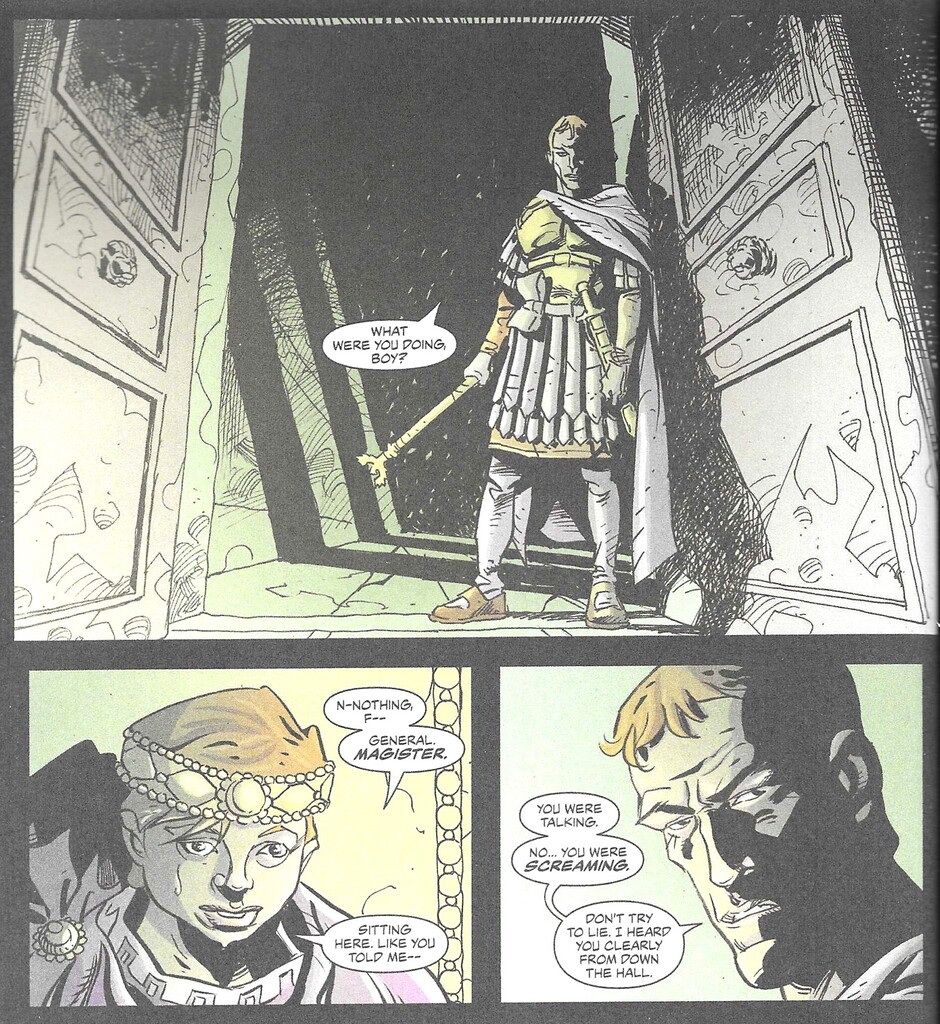 We know very little about Romulus: he was a teenager, he was placed on the throne by his father, Orestes, who was the real power in the empire, and he didn’t die until years later, after he had been deposed. His father had served in the court of Attila the Hun in the 440s and 450s, we know that (and it’s a plot point in this book), and when he became military leader under Emperor Julius Nepos, he promptly deposed Nepos and took power in the name of his son. Orestes is supposed to have died at the battle of Ticinum (modern Pavia) in August 476, but Horseman has him surviving that battle so he can organize the final defense of Rome against Odoacer. Horseman takes these kernels and expands them to tell his story, but he never goes so far away from what could have happened that it feels fantastical. It doesn’t really matter in the book if Orestes died in the battle or a few weeks later in Rome, and it makes some sense, as Romulus could not have been terribly strong as a ruler and therefore, once his father was dead, he would have been easily deposed by any Romans looking to placate Odoacer, who was in a supremely strong position in Italy at the time. That Romulus lasted until Odoacer took the city a week after a battle in Lombardy (which meant it would have taken him that long just to get there) isn’t too surprising, given the nature of communication in the 5th century, but Horseman does, at least, provide an explanation for it. So, while Amiculus is definitely a work of fiction and we should regard it as such, many things — Orestes’s time at Attila’s court, where Romulus went after he was deposed, the framing story with Procopius — are at least vaguely grounded in history. Horseman, in other words, did his research.
The story begins in 538, as the armies of Justinian, led by the great general Belisarius, are reclaiming Italy for the Eastern Empire (which we know as the Byzantine Empire, a name no one at the time used). 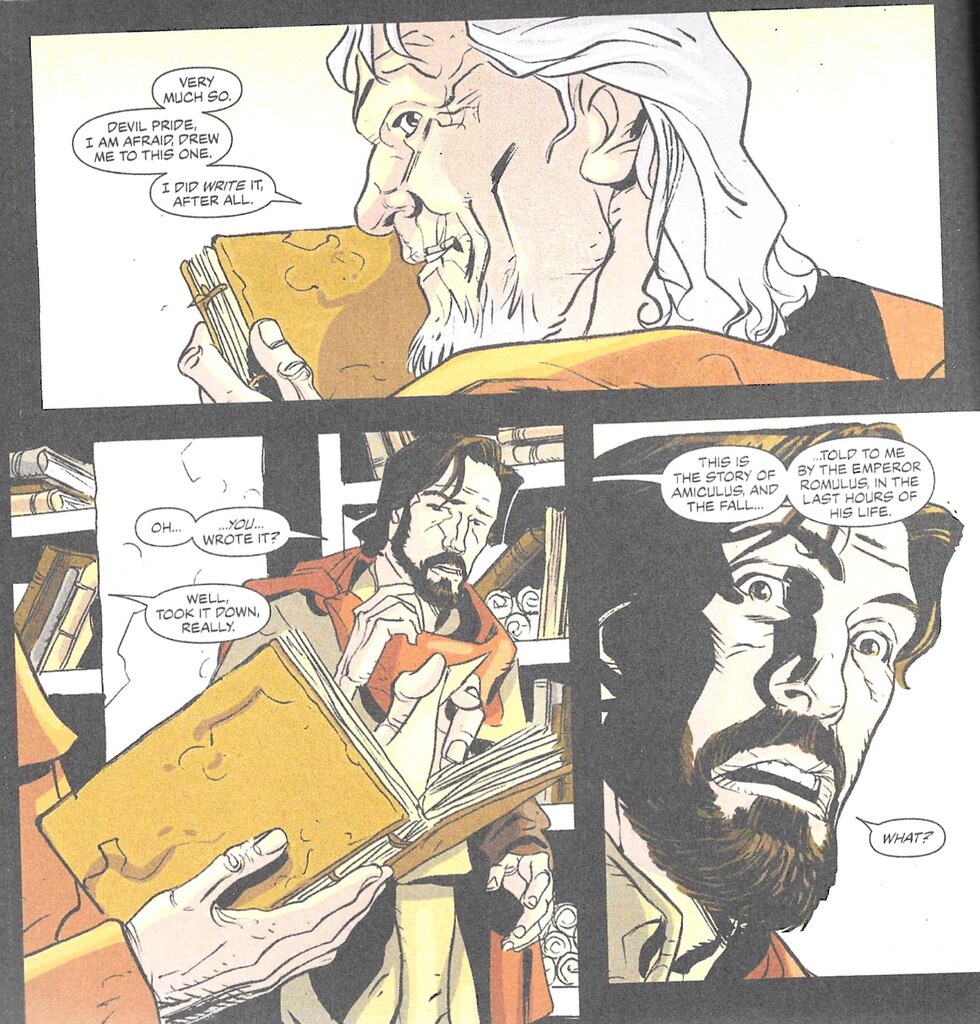 Procopius, Belisarius’s legal adviser, is in Rome with the general, and he decides he’s going to track down Romulus. Procopius is far more famous in history for his work as a historian than as a legal adviser, so his desire to figure out what happened to the “last” Roman emperor makes sense. Procopius heads to Naples, where Romulus was granted the use of the Castellum Lucullanum, a fortified villa on a small island right off the coast. The villa had, by Procopius’s time, been converted to a monastery, and the head monk, Anastasius (not, he notes, the abbot, as the bishop has not appointed one after the death of their previous abbot), takes Procopius to the library and gives him what he says is Romulus’s last testament, dictated to Anastasius himself before the former emperor’s death. This is what Procopius reads, and this is what we see in the comic.
The book Procopius reads is full of drama, not only because Odoacer is coming to seize Rome but because Procopius, as he reads it, becomes more and more suspicious of it and the monks. As a supposed first-person narrative, it’s full of things that Romulus could not possibly have known, and Procopius notes this angrily. Horseman doesn’t shy away from this contradiction, although he does fail to note that this kind of writing is not unusual in old histories. Procopius surely would have read histories by Herodotus and Thucydides and Suetonius and others, who put long speeches into the mouths of their characters that they could not have possibly heard themselves and for which no record (or recording) exists, but that’s what historians did then to get across their own interpretation of events as they examined the evidence. Historians today no longer do this, but they still synthesize their thoughts about historical events, just not in the same way. Procopius himself wrote about things for which he had no good source, but he did it because they were his own thoughts, just expressed by his characters. This account is slightly different, true, but as we discover, there’s a reason Romulus knows at least some of these things. 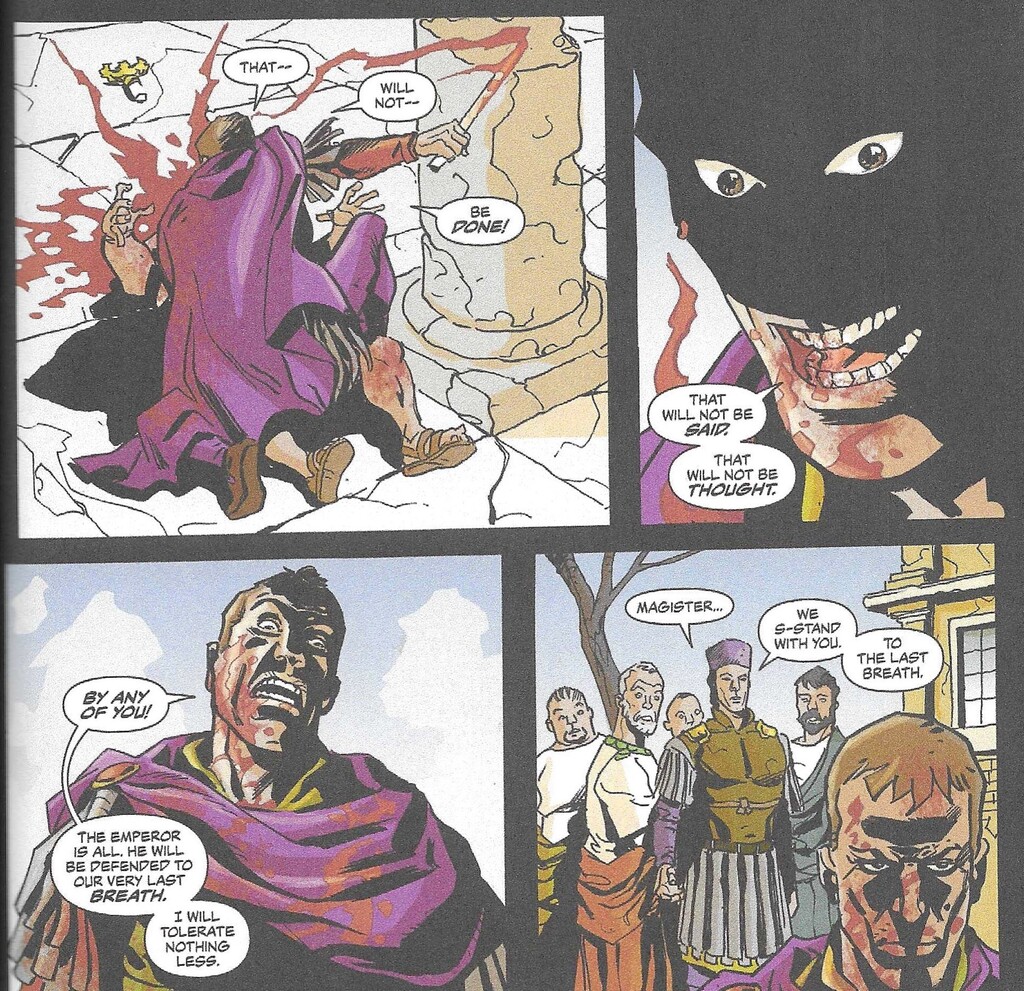 Meanwhile, Romulus himself isn’t that big a presence in the narrative — he’s kept in a gilded cage, the throne room, by his father, who’s organizing the defense of the city and trying to keep the few senators who haven’t fled the city in line. The scheming of the senators and Orestes’s attempts to counter them while still beating back Odoacer’s army form the main drama of the book. Romulus’s drama is more internal, as we’ll see.
But what of the title character? The book is called “Amiculus” (which means “little friend” in Latin — a Scarface joke by Horseman?), after all, so we expect there to be a character named that in the story. So there is, but Amiculus is more a mysterious presence, a bogeyman, who strikes fear into the hearts of the Roman rulers, as he seems to show up and portend disaster for them. He stands on the margins, seemingly knowledgeable about things he shouldn’t know, helping the barbarians where he can. Orestes thinks he’s a myth, but the senators are convinced he’s real, and they’re terrified of him. Horseman only shows him wearing a long blue cloak and hood, which hides his face, of course, and he seems to know exactly what’s going on at any moment, which leads the senators to believe they have a traitor in their midst. Early on, we learn that there is a traitor in their midst, but he is not the title character, very clearly. It’s a fraught time in Rome, of course, so each senator tends to look after themselves, and for some, that means selling out to Odoacer, while for others, that means tying themselves more closely to Orestes. Nobody is thinking much of duty and honor and the patria, naturally, except Orestes himself, but what that means to him is unclear. As events catch up to everyone, their desire to unmask Amiculus and their fear of him grows, and we see just how insidiously panic can work on people, as the senators become increasingly unhinged. We do find out, of course, who Amiculus is, and it’s a clever solution by Horseman. It ties in nicely with the themes he’s working with, and it’s both unexpected and unsurprising. 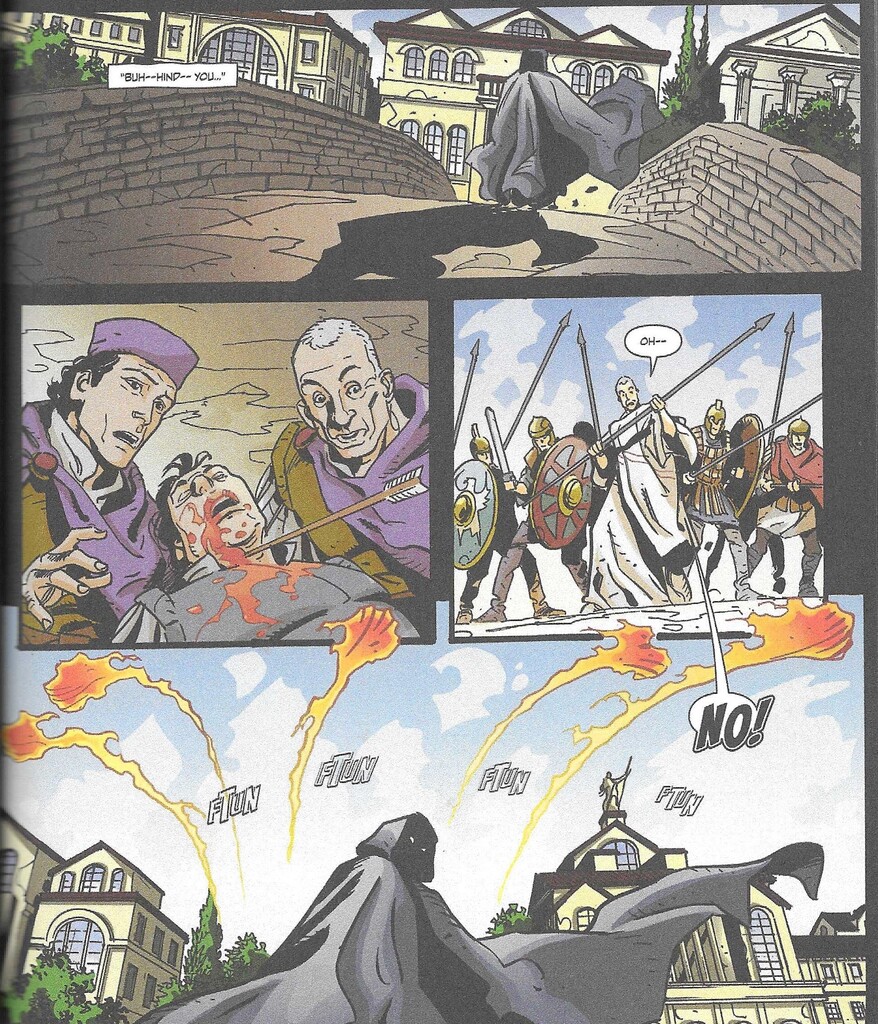 Amiculus achieves what it seems like he wants to achieve — Odoacer takes the city, the Roman senate is destroyed, and a new era in Europe begins.
Horseman wants to look at this era, it seems, at least partially because the fall of anything is always a good place to set fiction, as the drama comes naturally. As we don’t know a lot of Romulus and his time, Horseman can tell a story that fits the period but can reflect his own themes and motifs. As a story about the Romam Empire, it’s perhaps not surprising that Horseman wants to write about power and its use and abuse. Romulus has no power, despite being the emperor, because his father dominates him. As he sits in his throne room, alone, forbidden to leave or even speak by Orestes, he imagines the statues of dead Romans talking to him, mocking him for his powerlessness. He’s just a boy who wants his parents to love him, but his mother is dead and his father chose power over love. Romulus recalls a day a few years earlier when his family was waiting on the beach for Julius Nepos to arrive in Italy from Dalmatia. Romulus splashed his father with seawater, but before Orestes could get angry, Romulus’s mother also splashed him, and it turned into a game in the water, which, for Romulus, was a miracle because his father was actually acting like a father. But then Nepos shows up and scorns Orestes for his foolishness, and Orestes turns from a father into a kingmaker, destroying the man who mocked him (well, driving him away, as Nepos survived for some years after being deposed) and putting his immature son on the throne. Orestes becomes more and more unhinged himself as Odoacer advances, not because he’s afraid of Amiculus as the senators are, but because he feels power slipping away from him. He will do anything to hold onto his power, including basically imprisoning his son and scheming against the Senate. In his eyes, the senators don’t deserve their positions or his respect because they are only in it for themselves. 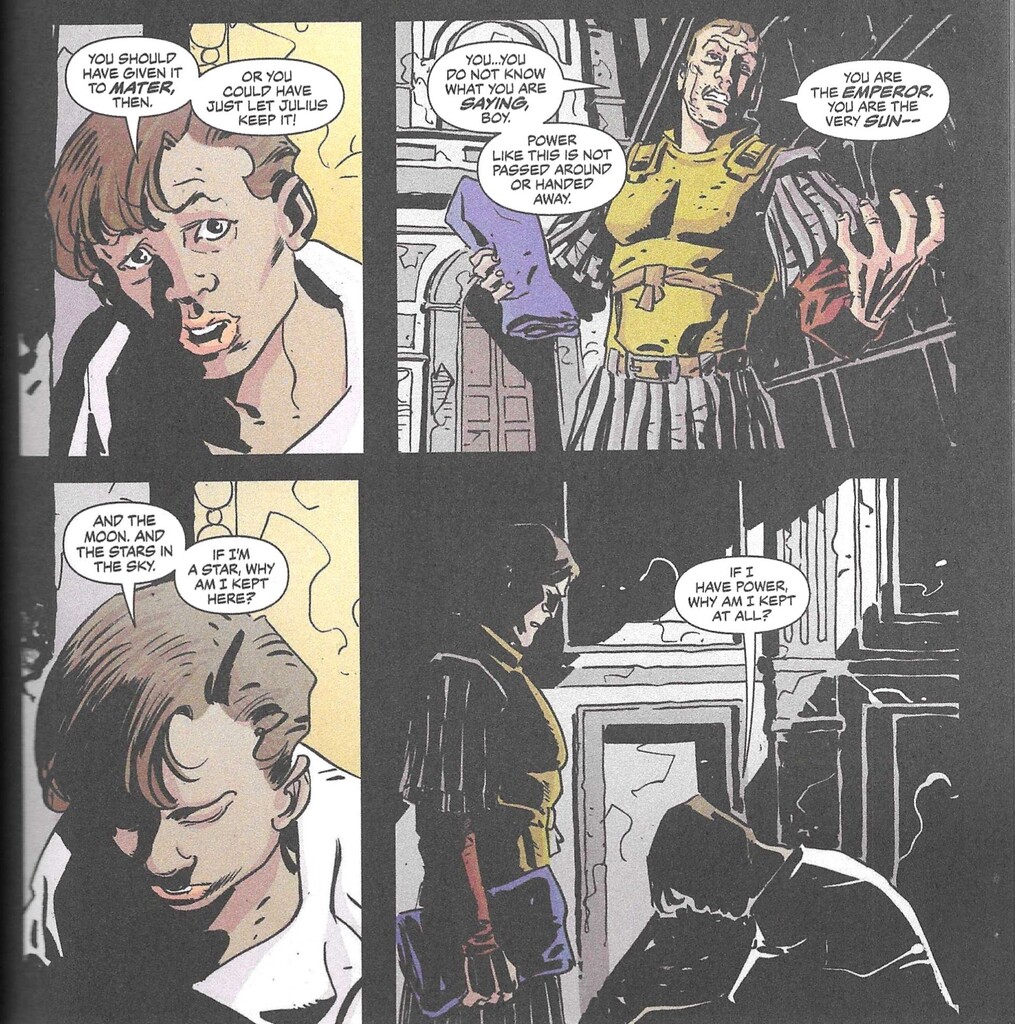 Orestes believes that he is doing all the things he’s doing for the Roman homeland, but Horseman makes it clear that he believes he himself is the Roman homeland, so everything he does becomes as selfish as what the senators are doing. Orestes clings to power and it kills him, while Romulus eventually learns important things about power and how not to be destroyed by it and survives. As Romulus sits in his room, he begins to understand what his father has become and he begins to gain the strength to oppose him. He can’t completely stand against him, because he’s still a boy and his father is stronger than he is, but he doesn’t allow his father to bully him quite as much. When Orestes is dead, Romulus has a choice to make, and he makes one that allows him to live. He concludes that power corrupts, which isn’t a novel idea, true, but because Romulus sees that, he is able to live past the destruction of the city.
Beyond just the powerless Roman Emperor, Horseman looks at power in other contexts, as well. In the present of the book, Procopius believes he has the power because he’s part of the conquering army, and he doesn’t consider weak, unarmed monks as any threat. They aren’t a threat to Belisarius or the conquerors, certainly, but Procopius has yet to understand the concept of “soft” power and what power secrets can hold. He is a vain, arrogant man who thinks bluster is all he needs to get his way, and the monks take advantage of his lack of foresight. In the end, he comes to understand what Romulus, in his account, was trying to tell them all, but it’s too late for the Empire, of course. Horseman never mentions Procopius’s Secret History — his Ἀπόκρυφη Ἱστορία — but it’s interesting because he ties this fictional account of Romulus and the last days of Rome to that later work (which is presumed to have been written around 550), as Procopius eschews grander history in it and focuses on the petty lives of the nobility, while Romulus’s fictional account focuses on the characters instead of the larger sweep of events (although it does that, too, certainly). The implication in Romulus’s account is that power can come from anywhere, and those who believe themselves immune to the vagaries of power should beware. 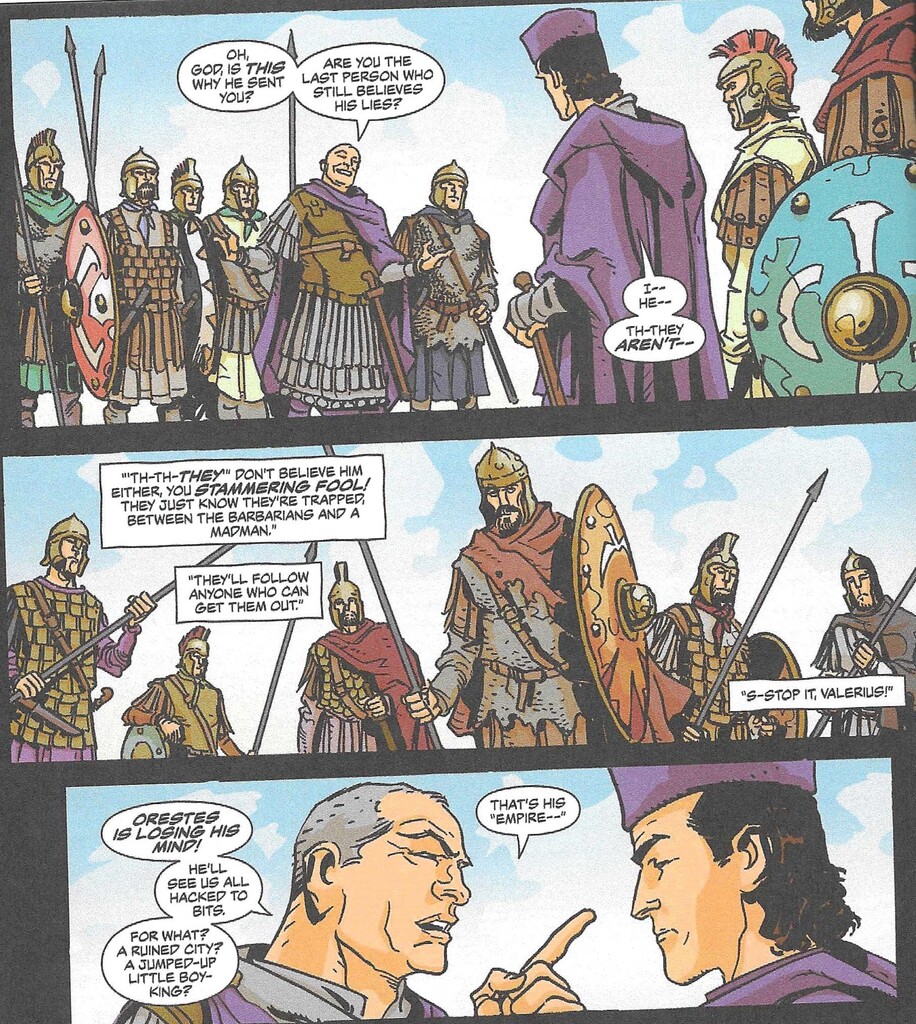 Horseman doesn’t focus too much on the common people (Rome lost something like 80% of its population through the fifth century), but he does offer some of their perspectives, and while this is not a pro-democracy book (it can’t be, of course), Horseman does nice work with the idea that a ruling class that ignores its working class is setting itself up for catastrophe. The irony of the book is that so many people think they’re powerful, yet Horseman does a nice job showing them where real power resides, and it’s not always where you expect it.
Horseman was able to get Caracuzzo to do all three books, which is nice. Caracuzzo had a moment in American comics back in the early 2010s, and while he’s still working, I’m not sure if he’s still doing comics or just commissions and other static art pieces. Still, he’s a good artist who had worked for bigger publishers, so the fact that Horseman was able to keep him around is a good thing, as the art is nice but also consistent, which you want with a seriously indie book like this. Caracuzzo is Italian, which isn’t the most important thing, but it does help, I think, because he can actually walk around Rome and get a good sense of what the city looked like 1500 years ago (obviously, most of it is gone, but not as much as you’d think). Caracuzzo has always had a somewhat jagged style, which makes him a good fit for a story in which the world seems to be falling apart. He gives us a good sense of the grandeur of the Empire by showing the marvelous marble buildings, but adds rough edges and cracks to show that, yes, this city is well past its prime. It adds a layer of sadness to the debates about what the Romans are going to do as Odoacer approaches, because there’s a sense of What are they fighting for? that permeates the discussions, as even in the most high-class areas, the rot has set in. 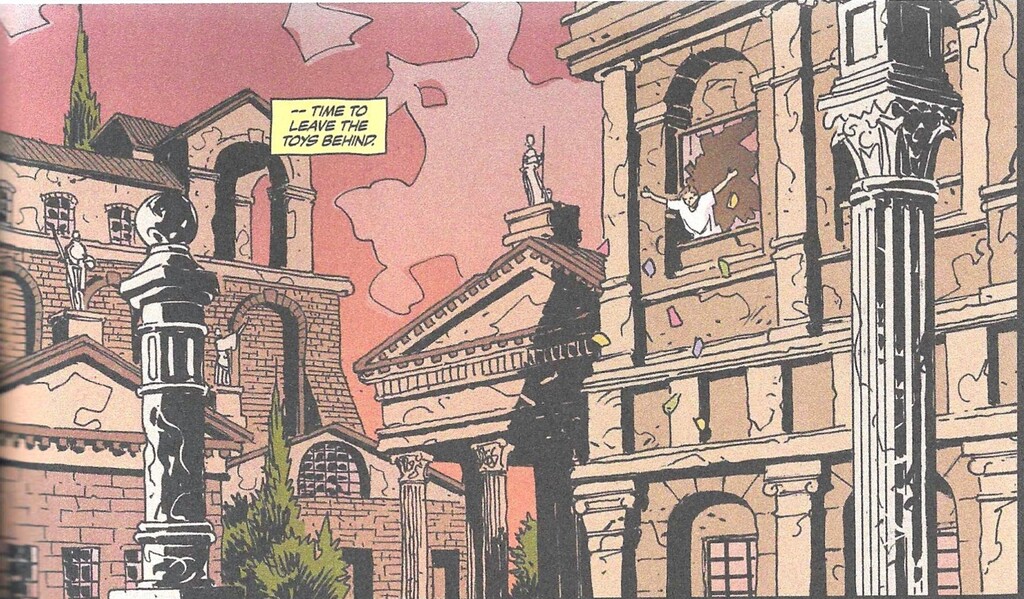 Procopius himself, as perspicacious a historian as he proves to be, can’t realize that Belisarius is fighting for a corpse — Rome is a symbol to Justinian and the Eastern Emperors, as so they send men to die for something that is certainly not worth the effort. Horseman does not make this explicit in the text, but Caracuzzo does a wonderful job showing it in the art. He does an excellent job with the characters, too. Romulus is a young teen, and Caracuzzo makes him look as such, someone who is dominated by his father, terrified of disappointing him, and unsure of anything. When we see Romulus playing in the surf with his parents, he looks happy, and Caracuzzo contrasts that well with the scared boy sitting on the lonely throne. He does a very good job with the throne room, as it’s decrepit like the rest of the city, but cavernous too, so it shrinks Romulus down and isolates him, making him even more paranoid than he already is. We get a good sense of the social hierarchy of the time, as the senators wear crisp white togas even as the city collapses around them, while Orestes remains clad like a soldier (although, significantly, occasionally he wears a purple — royal — sash and cap). There’s a nice contrast between the Roman soldiers and Odoacer’s forces, as the Romans, even at this late date, were better equipped for battle, while Odoacer’s army seems a bit more ragtag, although that ultimately didn’t stop them. Caracuzzo shows us the differences between the cultures, as well, from the dress to the way the men style their hair, and it gives us a good sense of the gulf between the two sides, as they were somewhat alien to each other. In the “present,” the Byzantines are more professional-looking and equipped better, as the Easterm Empire, by this time, was far wealthier than either the pitiful Roman forces had been 60 years earlier or the “barbarian” armies that Belisarius was fighting. Caracuzzo does a good job showing that.
 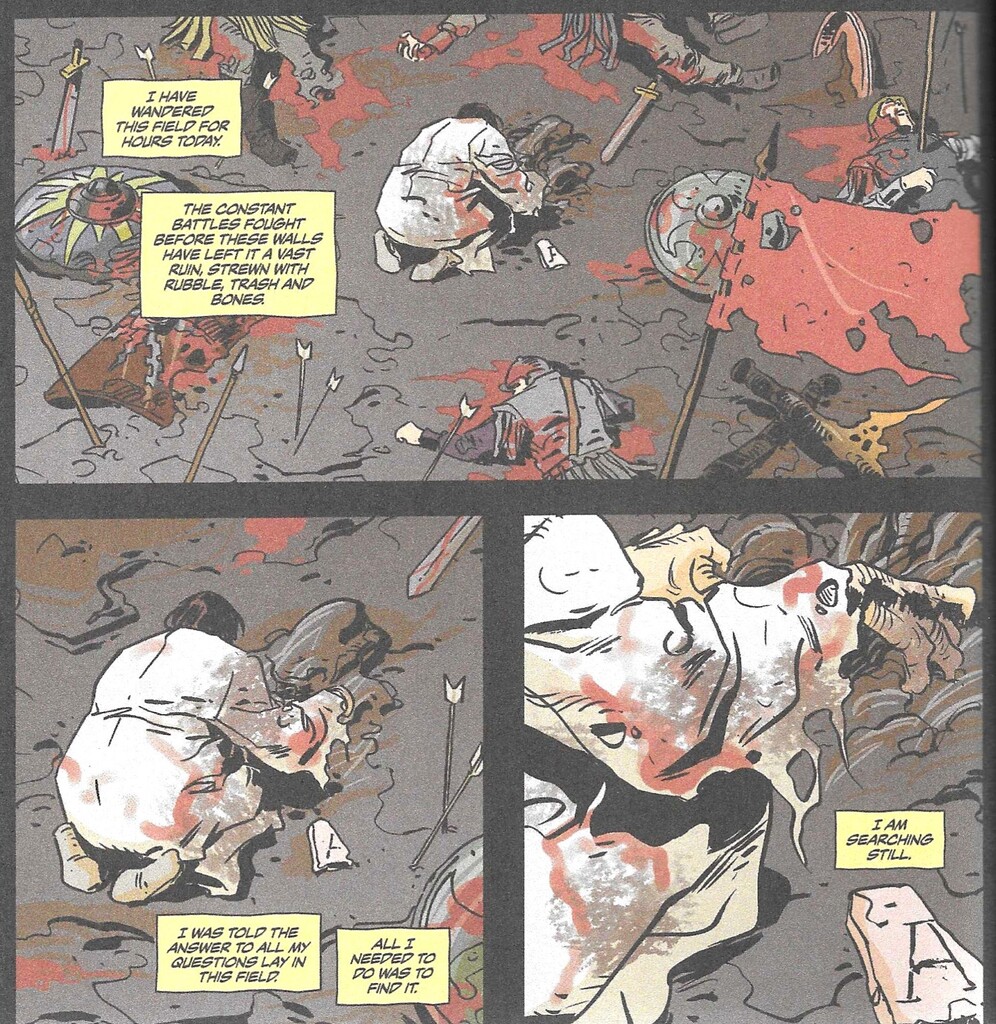 He does well with the violence in the book, as it is often sudden and very bloody — they used blades, clubs, arrows, and fire to inflict damage, and all of those will leave a mess. It brings home the horror of warfare quite well, as most of the people do not die easily, as they cling to life even as their bodies break down. Caracuzzo is very good at giving us a sense of what life was like in the 5th and 6th centuries, from the brutality of warfare to the calmness of the monastery. It’s well done.
Without spoiling things, I must say that I don’t quite get the momentous event that happens toward the end, as the abbot bids farewell to Procopius, who has been somewhat stymied in his attempts. It doesn’t matter too much, because Horseman’s overall conclusion is clear, but the tangible symbol of that conclusion confuses me a bit. It’s a minor thing that doesn’t ruin my enjoyment of the book in any way, but it is a bit puzzling. Maybe you will have better luck with it! Besides that, though, Amiculus is a terrific historical fiction, a rousing adventure story that has a lot on its mind and can illuminate quite a lot about the present, as all good historical fiction can do. There’s actually an Omnibus of all three volumes, which you can find here. It’s a keen comic about a time period we still don’t know much about, and who says it can’t be true?
Be sure to check out the archives for more entries! It’s always good to get groovy comics!
