

It was soooo damn cool 50 years ago when my brother received Origins of Marvel Comics for a Christmas present.
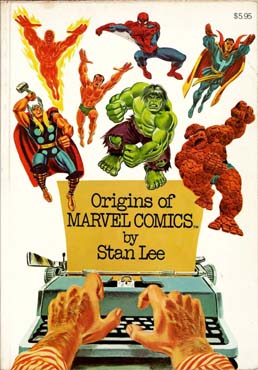
How could it not be cool? Even though I was a DC kid, I’d grown fond of the Marvel characters during the Bronze Age. Now here was Stan Lee, their creator, explaining how he’d come up with the ideas for the Fantastic Four, the Hulk, Spider-Man, Thor and Dr. Strange. While he gave credit to Jack Kirby and Steve Ditko for writing many of the plots on their own, Origins made it clear that Stan was the genius who’d created the characters. No wonder he was a legend.
I think you can see why the book is no longer so cool.
I reread Origins recently for the first time in years because I’m including the Hulk in Watching Jekyll and Hyde. I wanted to read exactly what Lee had to say about the inspirations he used, rather than relying on online references quoting the book. Of course I went on to read the whole thing. In between the stories themselves — despite having them all in other reprints, they still felt cool collected like this — Lee’s retelling of his triumphant ascension to God of Comics (sorry Mr. Morrison) reads very differently than it did back then.
Take Spider-Man. According to Origins Lee came up with the concept of a teenage spider-powered hero, a mix of his desire to write a young, insecure teenager and his fondness for the pulp hero the Spider. He gave the concept to Kirby who drew the first five pages; Stan decided Jack drew Peter too strong and heroic and asked Steve Ditko to give it a shot. Ditko nailed Stan’s vision and a legend was born.
Except as Tom Brevoort has blogged about, Lee liked Kirby’s pages enough to give them to Ditko to ink. The reason Lee subsequently turned them down was that Ditko spotted they were too close to some of Kirby’s work for other companies for comfort. Lee and Ditko started over.
Does that mean Kirby came up with Spider-Man? From what I’ve read, his version is noticeably different from the Peter Parker we know. Did Lee come up with the basic concept and ask Kirby to plot the story? We’ll never know but we can be certain the official account underplays Kirby’s contributions.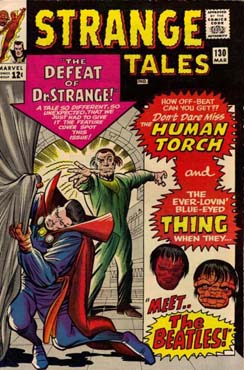
Likewise Lee takes full credit for Dr. Strange, even though when the character debuted, Lee referred to him as an idea of Steve Ditko’s (according to a quote in John Morrow’s Stuf’ Said)
Then there’s the Silver Surfer. Along with the origins (FF, Hulk, Spider-Man, Thor and Dr. Strange) Lee included a second story for each character to show 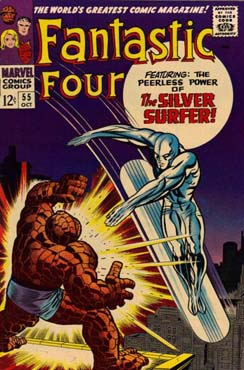 how much Marvel over time. For the Fantastic Four (totally the product of his genius), he used #55, in which the Surfer battles Ben Grimm. It’s not a good story — hero vs. hero fights rarely are — but as Stan loved writing the Surfer, I can understand him picking a one-and-done clash of titans.
The trouble is, while Stan doesn’t claim credit for Norrin Rad’s genesis, he doesn’t acknowledge he was Kirby’s creation either. In the context of the book, I confidently assumed when I first read it that Lee must have invented the surfer like everything else in Marvel Comics.
All that said, reading the book did serve my purpose. In the introduction to the Hulk’s origin, Lee claims he wanted Marvel’s second book to include a monster, modeled on the Thing as he was the Fantastic Four’s breakout star. Like the Thing, he’d be superhumanly strong. Like Mary Shelley’s monster in Frankenstein, he’d be the product of science, though in this case the scientist and the monster would be the same person. And hey, since he was borrowing from the classics, why not throw in Jekyll and Hyde?
I have no idea how much of that is true. Kirby’s claimed the Hulk was his inspiration, based on an earlier story of his (Brevoort offers one possibility here). The Hulk bears less resemblance to Shelley’s tragic creation than to the genesis of The Amazing Colossal Man (1957): someone’s stuck at ground zero of a new superbomb test, the protagonist tries to save them, transforms into a superstrong, unstoppable brute. I don’t blame Lee for claiming a classier concept as his source.

The Colossal Man, however, doesn’t change back; once he becomes a monster he only becomes more monstrous. Whether Lee or Kirby came up with the Jekyll and Hyde aspect, I think it was a vast improvement. It was a long while before the Hulk had personal drama beyond wanting to hit everything that pissed him off. It was Bruce Banner who suffered; as Greg Hatcher once put it, he wakes up after each transformation like a drunk with a hangover, wondering what he smashed during his blackout? Only with the U.S military and the Leader frequently on his tail, not something the average drunk has to deal with. Even after the idea of the Hulk having his own torment came about —

— Bruce’s suffering was important. And earns him a place in my book.
Comics covers by Jack Kirby, Hulk art by Marie Severin.

When Marvel reprinted this recently, they had several other people write appreciations/reflections that gently set the record straight about Lee’s self-centered recollections. It’s as close to a corporate rebuke as they’ve come.
Good. A small thing but definitely worth doing.
I have my own theory on Stan’s contribution to the Hulk’s creation:
“Hey Jack, what else you got for me?”