

 I don’t think I’ve ever worked on a film book where I didn’t have to cover some film or TV series that was lost or unavailable. When I was writing about time travel films and TV, one of those blank spots was the 1979 series Time Express. An anthology series about people who take a train ride back to turning points in their past, it lasted exactly four episodes. It wasn’t out on DVD, wasn’t available on TV and I couldn’t find episodes on YouTube. As I’ve mentioned before, some things aren’t accessible even in the age of peak streaming.
That wasn’t a problem for the book as I had enough information about the series from various print references. Still, the unavailability gave me a perverse desire to see it. When I stumbled across it on YouTube last year, I couldn’t resist. Having seen it, I can see why, even with Vincent Price as the lead, nobody made any great effort to preserve it for the ages (I’m pretty sure the source was someone’s old videotapes of the episodes, judging by the grainy quality).
The series followed the anthology format Aaron Spelling had used effectively in his hits The Love Boat and Fantasy Island. We have the core cast, headed by Vincent Price as Jason Winters, the Mr. Roark-like figure in charge of the Time Express (Price’s wife Coral Browne plays Winters’ wife and co-host, Margaret). Then we have the guest cast providing the drama in the two segments of each episode: they’re in desperate need of a life do-over and a ticket on the Time Express fills that need, giving them a chance to put right what once went wrong.
In the first episode the travelers are millionaire Edward Chernoff (Jerry Stiller) and doctor Mark Toland (James MacArthur). Years earlier, Chernoff was a common garbage man; when he stumbled across a garbage bag stuffed with cash, it became the basis of his business success. At heart he’s an honest man: he almost turned the money into the cops but his wife (Anne Meara) talked him out of it. He wants to go back in time and do the right thing.
Toland’s situation is more desperate: his wife is terminally ill and only a transplant from her twin brother can save her. Trouble is, they were orphans adopted separately as infants and the orphanage records were lost in a fire. If he goes back to before the fire, perhaps he can learn enough to track her brother John down.
Chernoff hands the money off to the police. As nobody claims it so in 90 days it’s his. His life is back on track … except now it’s public knowledge he has the money and the mobster who hid it in the bag wants it back. Fortunately Mrs. Chernoff figures out how to con the mob. The Chernoffs hang on to the money and he returns to the present still a millionaire. Toland, after a great deal of detective work, learns enough to return to the present and track down brother John (John DeLancie). To Toland’s dismay, John sees no reason to undergo a medical procedure to save a sister he doesn’t remember…oh, wait, he changed his mind! Mrs. Toland’s going to live!
In subsequent episodes, a sht copywriter who broke a date with his dream girl goes back and keeps it; a woman learns what happened to the dream man who vanished from her life after his accident; a rodeo cowboy conquers the bronco that put him in the hospital; a cop sets out to determine, once and for all, if the biggest bust of his career sent an innocent man to jail. All serviceable stories for this kind of show … so what went wrong?
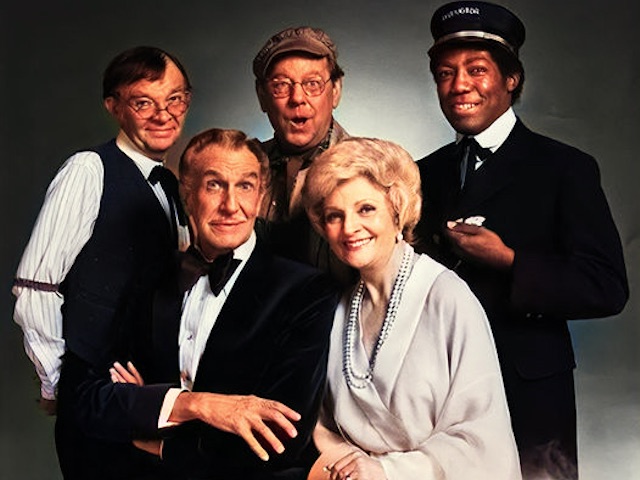
For starters, where Roark actively oversees and guides visitors to Fantasy Island, Jason Winters and his team are on the sidelines. Jason isn’t in charge; as he explains every episode, he runs the train on behalf of “the head of the line,” presumably God. He and Margaret have the passengers in for tea, explain the rules and that’s it, no real involvement in the story. And having them explain the rules every single episode gets old fast.
A bigger problem is that Time Express‘s approach to time travel is limited. As everyone has to be alive in 1979, there’s only a limited range of destinations. Of course, Quantum Leap a decade later was limited to time travel within Sam Beckett’s (Scott Bakula) lifetime and that didn’t stop the show becoming great. Still it is a factor.
Another limit on the use of time travel is that in most episodes, the past doesn’t change: the time trip simply sets up a resolution in the present, as when Toland tracks down John. Likewise the cowboy returns to the present and with his deeper understanding, reconnects with his long-lost daughter; the cop learns the man he busted was innocent but fixes things after returning to Now; the copywriter reconnects with his lost love and discovers she’s never stopped hoping for that. In one episode a boxer does change the timeline by refusing to take a dive, but we don’t see what effect it has.
Nobody claims Aaron Spelling made great art but he knew how to make this kind of show work. Watching the existing episodes of Time Express shows that’s harder than it looks.
