


The condition of a country’s public toilets — or the lack of them even — says something about its progress toward civil society. (Robert Kaplan, from The Ends of the Earth)
COMICS
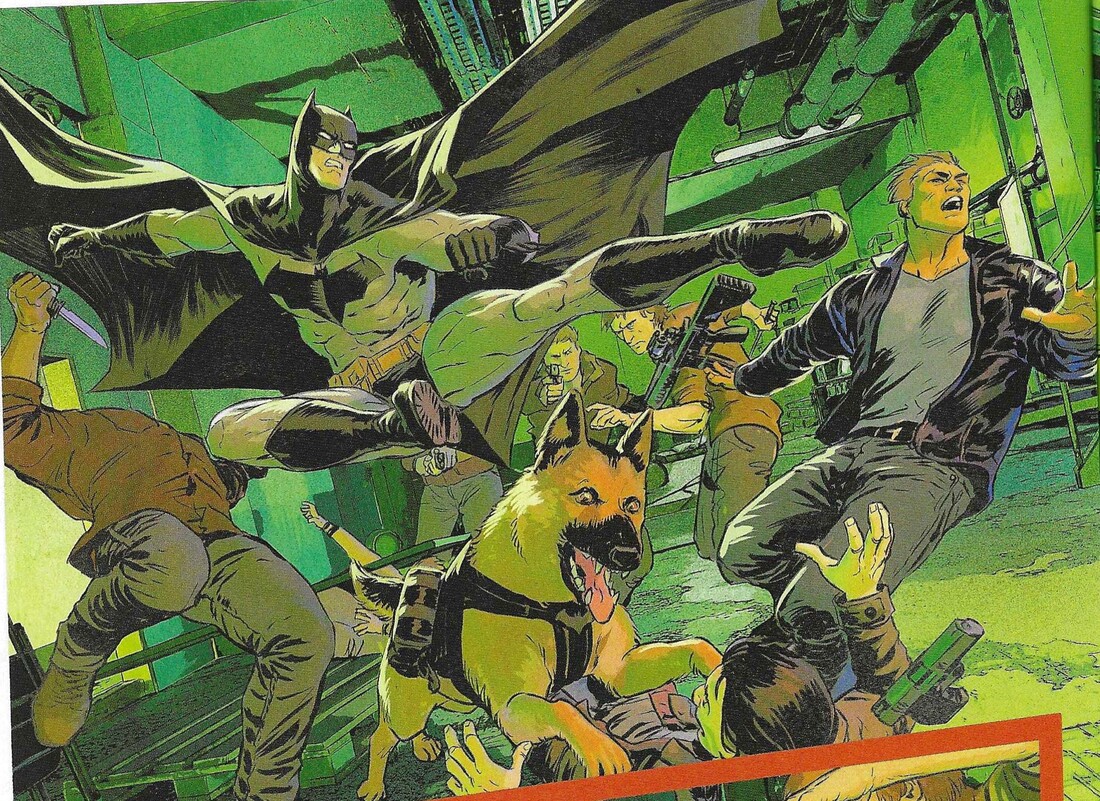
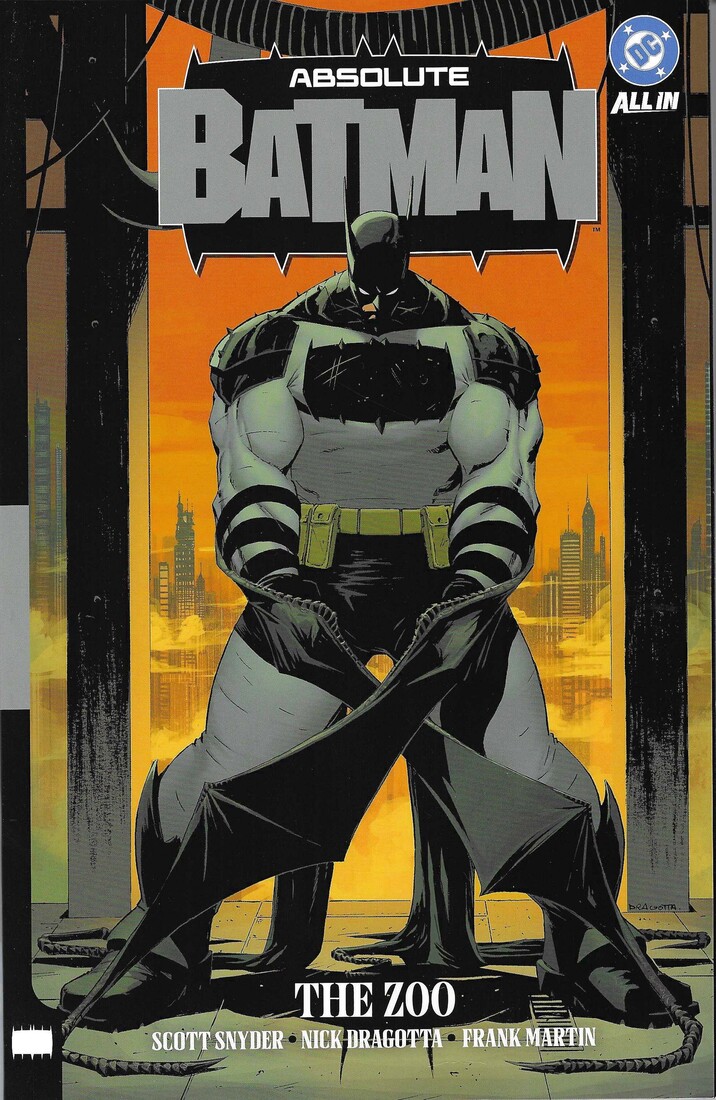 Absolute Batman volume 1: The Zoo by Scott Snyder (writer), Nick Dragotta (artist), Gabriel Hernández Walta (artist), Frank Martin (colorist), Clayton Cowles (letterer), and Katie Kubert (collection editor). $17.99, 148 pgs, DC.
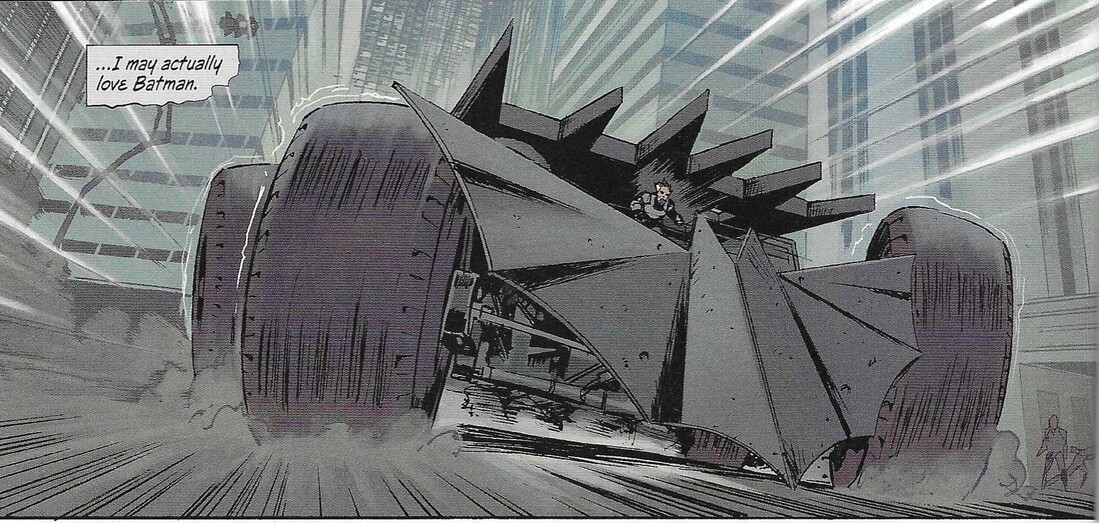
Snyder has written one good Batman story, as far as I can tell, and this ain’t it, unfortunately. It’s not terrible, certainly, but it’s just kind of there. As I noted when I read the first issue, I’m sure smart people all over the interwebs are swooning over this, but I just don’t get it. What’s interesting about this book? I mean, literally the only things that might be interesting is the fact that Martha Wayne is still alive and that Bruce is friends with various characters who are villains in the “real DCU,” but Martha doesn’t have a ton to do in this book and it seems like Snyder can’t resist turning those childhood friends into bad guys. Other than that, it’s just Batman turned up to 11, and it feels far more like an early 1990s Image book than anyone wants to admit. I mean, Dragotta’s art is stunning, sure, and Waltz does a really nice job with his fill-in issue (his design for “early Batman” is very keen), but I’m not sure if that’s enough to overcome the bland story. It’s still ridiculous to think that Bruce would be able to do all this stuff without the benefit of a chunk of money, even if he’s a super-genius (and gets some help from “Eddie” Nigma). Snyder makes Gotham even worse, if possible, than the one in the DCU, which always begs the question of how Gotham is a functioning city. I mean, yes, I know people would have to live there, because some people are just stuck, even in failed cities, but why would anyone legitimate (besides, you know, gangsters), do business in Gotham? Why would any artists perform there? What is the culture even like? Writers always try to show these fancy events in Gotham, but why would anyone go there for anything? It’s like Detroit, I guess — it’s still a city, but is it on anyone’s radar? Snyder shows us a Gotham that’s basically a war zone, and people with any money would have moved out long ago. Even Martha Wayne probably would have taken little Brucie away to live in the damned suburbs after her husband was killed. It’s frustrating, because no one ever thinks about this stuff. I know it wouldn’t make a very exciting comic, but you know what? Giant Steroided Batman smashing faceless bad guys (and, let’s face it, killing some of them, even though Alfred comments on how he’s not killing them — at the very least, Roman Sionis is deader than dead) isn’t that exciting, either. Snyder ripping off Heath Ledger’s scheme isn’t that exciting, either. Snyder giving us another fraught father-son relationship — you knew it would be here! — isn’t exciting, either. Snyder has written some amazing comics in his life, but this is just kind of there. It gets by on the strength of the art and the very small twists we get to the Bat-mythos, but that’s not nearly enough.
Rating: ★ ★ ★ ★ ★ ½ ☆ ☆ ☆ ☆
One totally Airwolf panel:
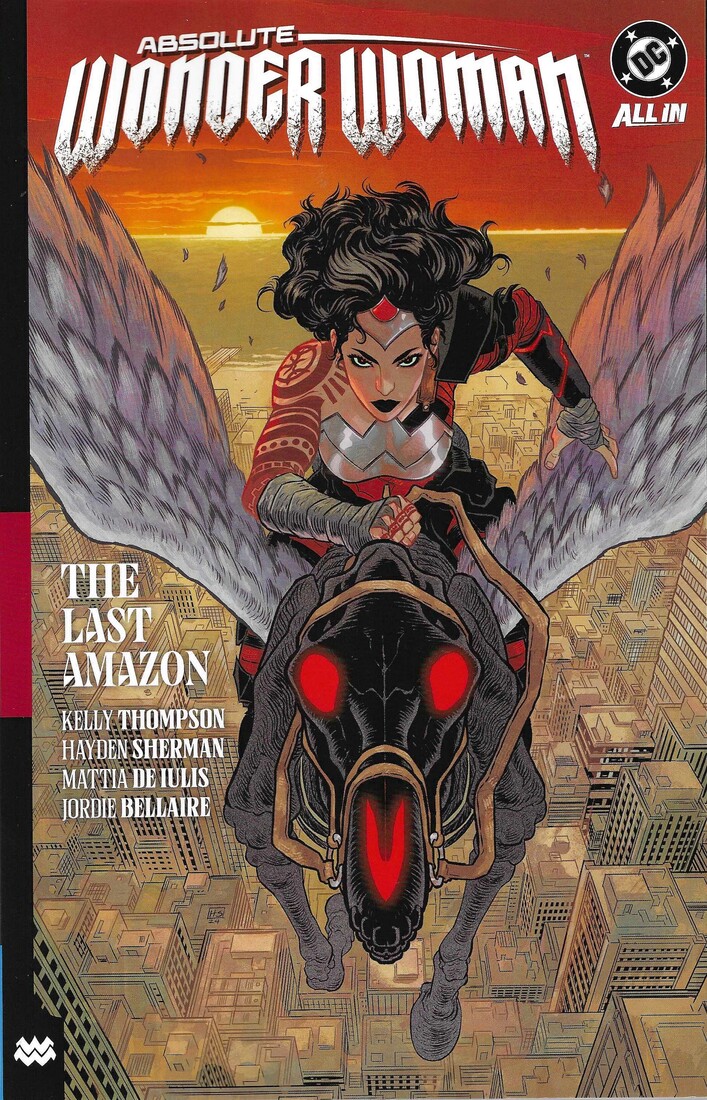 Absolute Wonder Woman volume 1: The Last Amazon by Kelly Thompson (writer), Hayden Sherman (artist), Mattia De Iulis (artist), Dustin Nguyen (artist), Jordie Bellaire (colorist), Becca Carey (letterer), and Chris Conroy (collection editor). $17.99, 166 pgs, DC.
Thompson, on the other hand, does try to make significant changes to Diana’s story, with pretty good if not perfect results. Severing Diana from the Amazons is not a bad idea, as she’s taken to Circe in Hell to be raised (as I noted in issue #1) by a douchebag Apollo who forbids Circe to mention the word “Amazon.” This isn’t a bad thing, but, as usual, I’m thinking too much about it. First of all, Diana was raised by a single woman in a solitary place, surrounded by weird demons that she befriends (which is adorable, in both the main story and in the very short “L’il Diana” tales in the back of the collection, which are drawn by Nguyen). Fine and dandy. But why would “Amazon” have such an impact on her, then? At the end of issue #1, she says the word and reclaims it, and it’s supposed to be a powerful moment. But we don’t know anything about the Amazons, except a brief description Circe gives her. I get that Diana is supernatural to a degree, and so she feels a magical connection to the Amazons, but, really, she doesn’t know anything about them, either. She’s supposed to have a deep connection to a group she’s never interacted with, and so are we, but I’m just not feeling it. Thompson is relying on us to do some heavy lifting with regard to the Amazons, because we’re supposed to have some prior knowledge of Diana’s connection to them. I’ve said this before and I assume I’ll say it again, but writers can’t always rely on old comics for us to make emotional connections, especially when this is, technically, a shiny new series. The emotional resonance of “Diana of Themyscira” announcing herself just isn’t there. Look, I have Polish ancestry, right? I dig a good pierogi and I also wonder why the Polish navy puts screen doors on their submarines. I used to dig going to Czestochowa in Doylestown for their nifty festival (Bill Reed knows what I’m talking about!). But I don’t have an emotional connection to Poland or the Poles in general. They’re just part of my old cultural make-up. I know I’m weird about this kind of thing and some people are so embedded in whatever culture they’re from that they can’t separate themselves from it, even for a moment, but it seems to me that Diana being raised in Hell by a person who can’t even mention the Amazons would make her much less of an Amazon. But that’s just me.
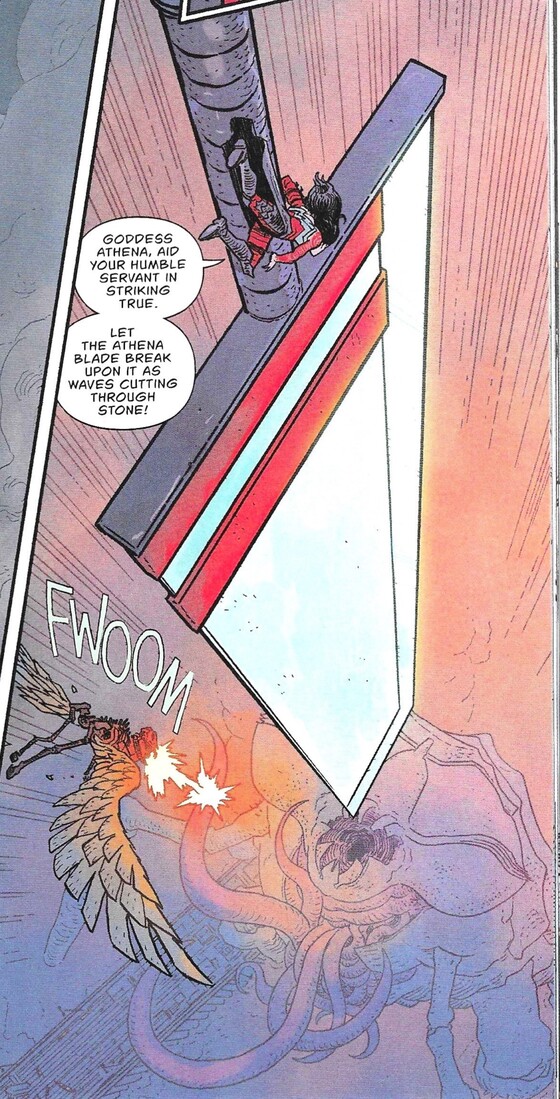
That’s a minor thing, though, even if it’s part of the crux of the book. Thompson does a nice job overall with Diana, who shows up in (sigh) Gateway City to fight weirdo demons set on wiping out humanity because … well, it’s kind of a dumb reason, but, I mean, when Godzilla shows up, you don’t worry about why, you just fight! So that’s what Diana does, as the demons get bigger and bigger until she’s fighting a very weird and creepy monster. Thompson does a terrific job with the video-game-like nature of the plot, and she’s utterly committed to making Diana try to be pacifistic before she starts kicking ass, and it’s neat to see. I never like seeing Steve Trevor show up, even though I know he will (why not make him a woman, like “Stevie” Trevor? or a slovenly middle-aged dude writing comics reviews on the internet? or kind of a douchebag? or someone who ends up marrying Etta Candy … sorry, that Steve Trevor is still my favorite one), but the way Thompson not only introduces him but also shows how that affects Diana is really well done. There’s a Barbara Minerva sighting, too, and like Snyder, I can’t believe Thompson will resist making her evil, but I can only say, “RESIST, KELLY!!!!” We shall see. The entire plot is well done, and Thompson does a nice job giving Diana an interesting personality as she deals with both the demons and the U.S. military, as well as Etta Candy and Etta’s sister, who is crucial to Diana’s solution to the problem. Despite the MacGuffin of a plot starter, the actual story is both very intense and nicely heart-warming, as Diana goes through some things and also tries to make sure no one is hurt. In the second story, she’s at a meeting with Hades, and it’s also a nicely done story about trying to come up with a solution to a problem that doesn’t involve punching. I mean, there’s plenty of violence in both stories, but the point is that Thompson wants to make it clear that Diana uses it only as a last resort. I know that’s kind of Wonder Woman’s thing these days, and that’s cool, but Thompson does it very well.
She also leans heavily into the Greek myth-ness of it all, which is keen to see. There’s a lot going on with Greek heroes and gods, and Thompson does a good job both introducing and explaining them (although I don’t buy a character not knowing who Medusa is — come on!) and using them. Myths are metaphors, of course, and Thompson digs into them a bit and puts some good spins on them. Some writers go more into the mythic nature of Wonder Woman than others, and it doesn’t always work. It’s working so far in this book.
Sherman’s work on the book is amazing, which isn’t surprising. Despite the slight cartoonish nature of their work, they still make each character feel real and human, and their attention to detail is staggering. I already mentioned the impressive six pages in issue #1, in which Sherman shows the same exact spot over the course of the years as Diana grows up — we get a wonderful sense of time passing, but also Circe becoming more maternal as she grows to love Diana. Sherman’s layouts are always nifty, as they use differently-sized and -shaped panels to focus our attention and make the reading experience a bit more interesting, and their design of the Big Bad and the way Diana fights it is very impressive. Honestly, though, I think my favorite part of the art is the way Diana’s armor and … other stuff (I don’t want to spoil it, but if you’ve read this, you know what I’m talking about!) looks homemade, because, I guess, it would be. It’s well done, but it just looks slightly clunky enough to believe that blacksmithing is not Diana’s or Circe’s forte. Maybe Sherman wasn’t aiming for that, but that’s what it looks like to me. De Iulis, whose work with Thompson on The Cull was nice but a bit sterile, has gotten better — he’s hatching just a little bit more, and his coloring seems to be a bit more nuanced, and it works nicely with his very thin line. There’s nothing wrong with the art in this volume!
Man, I do go on, don’t I? I liked this more than Absolute Batman, as you can probably tell. I think the only other “Absolute” trade I’m getting is Martian Manhunter, which most people at my store have not liked, because it’s too weird for them. They’re a bunch of squares, I tells ya! But until that trade comes out, get this one instead of the Batman one. It’s pretty nifty.
Rating: ★ ★ ★ ★ ★ ★ ★ ★ ☆ ☆
One totally Airwolf panel:
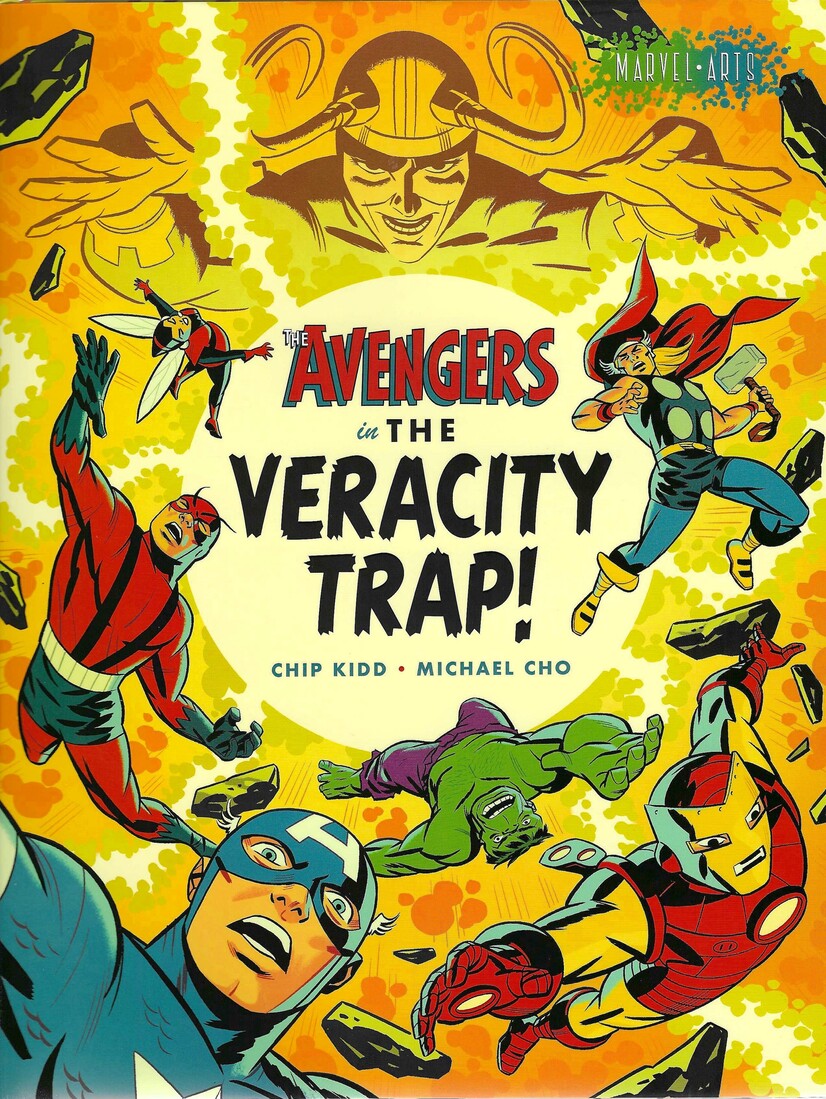 The Avengers in the Veracity Trap! by Chip Kidd (storier/scripter), Michael Cho (scripter/artist/colorist), and Joe Caramagna (letterer). $25.99, 63 pgs, Abrams ComicArts.
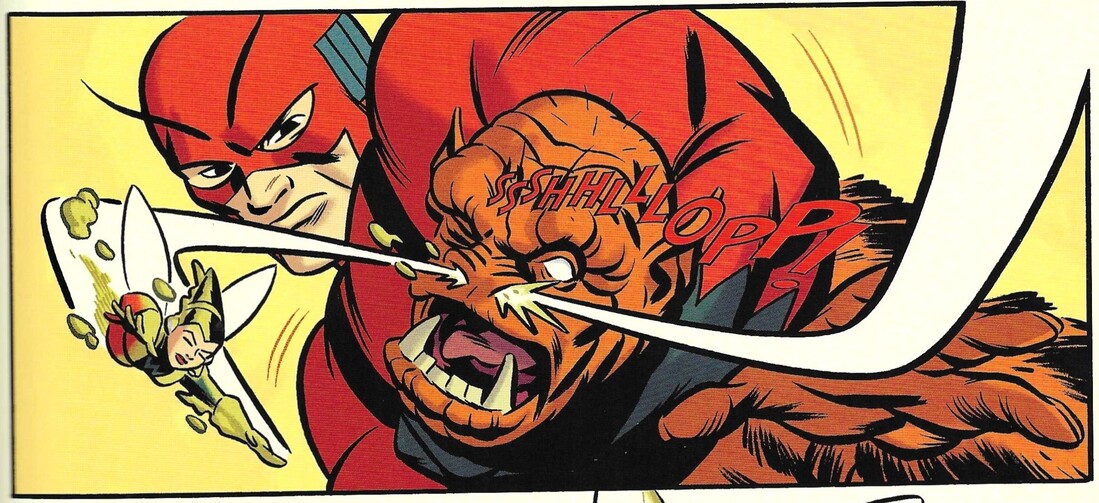
Abrams does this graphic novel thing with Marvel again, as Kidd and Cho bring us a groovy Avengers story, much like they did with Alex Ross’s Fantastic Four GN (Ross is listed as the “series consultant” in the indicia, indicating that there will be more of these?). Much like Fantastic Four: Full Circle, this is much more an artistic showcase than a story one, but the story is still pretty fun. Cho doesn’t do nearly enough interior comics work, and he does a very nice job with it, giving us “1960s Avengers” fighting Loki and getting sucked into the “real world,” meaning the world Kidd and Cho inhabit as comic book creators in this book. Cho channels Kirby well, with cool 1950s Timely/Atlas monsters, a nifty Kirby-esque machine that the Avengers use to defeat Loki, some Kirby Krackle™ (of course), and some neat off-register coloring. He does several full-page pin-ups that flow within the story, which is a very Sixties thing to do. He also does a really nice job shifting between the comic-book world of the Avengers to the “real world,” so we get some rougher drawings with blue lines as the Avengers “pass between” the two worlds, which is keen. His coloring is excellent, too, as it’s specifically not like the 1960s, with its flatter and less variety, as Cho uses nice gradients and shading to add very good nuance to the artwork, as the Avengers’ costumes look more like clothing than we usually see in superhero comics. The coloring and Cho’s luscious brushed inks make this a very lush comic, despite Cho’s relatively angular pencil work, which would seem to work against a lusher presentation. Cho needs to do more work, dang it!
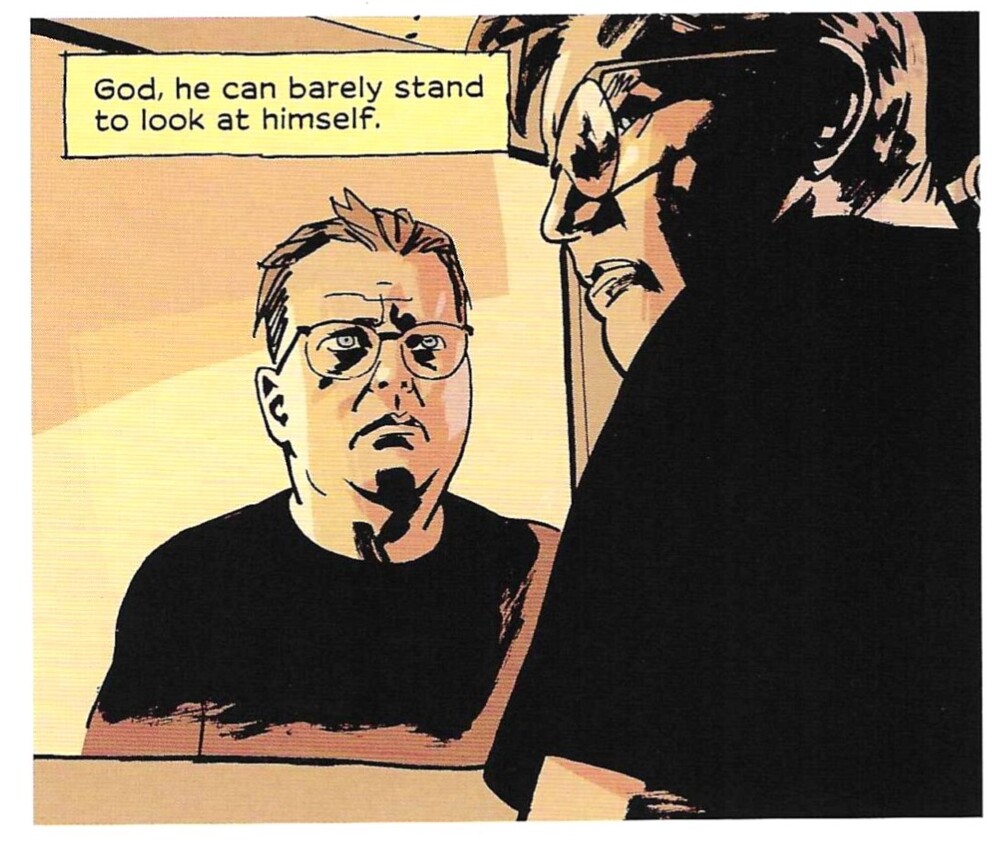
Kidd’s story is fine, although nothing super-special. Loki and a bunch of monsters are just hanging out, waiting for the Avengers to show up (not really, as Loki does have a scheme, but it’s funny that, at the beginning of the book, Loki just seems to be hanging out waiting for them), and when Thor gets inside his Kirby-esque stronghold and comes across the “Veracity Vortex.” Oh dear. Thor passes through it quickly and realizes that he’s not real, he’s just a comic book character. To fix Thor, all the Avengers go through the vortex and meet Kidd and Cho, who are in the process of creating the comic (Cho is telling Kidd that the whole metatextual thing isn’t really working, which is pretty funny), and they tell our creators that they need to help them. When Kidd and Cho go into the comic-book world, they transform into children, which is a nice touch, and they help the superheroes defeat Loki, of course. They do stuff with What It Means To Be A Hero™ and We Can All Be Heroes™ and Ideas Are Cool, Aren’t They?™ and it’s very uplifting, and it’s fine, but Kidd doesn’t do too much too unique with it, but it’s still a fun book. I’m sure Marvel will bring out a softcover version soon enough, so that might be a better value, as 26 bucks is a bit much for it!
Rating: ★ ★ ★ ★ ★ ★ ★ ☆ ☆ ☆
One totally Airwolf panel:
 The Knives: A Criminal Book by Ed Brubaker (writer), Sean Phillips (artist/letterer), and Jacob Phillips (colorist). $29.99, 178 pgs, Image.
I mean, it’s Brubillips doing a Criminal book, so of course this is pretty fucking awesome! We get some different short vignettes about different characters that gradually move together, which is something Brubaker does quite well. Jacob Kurtz, creator of “Frank Kafka, Private Eye,” goes to Hollywood after his creation gets optioned as a television show. Back in his hometown, Angie is a ward of Jake “Gnarly” Brown, the boxer, and she turns to cat burglary when Gnarly gets cancer, which kills him before she can steal enough money to get him into an experimental program in Switzerland. These two characters eventually intersect, and Tracy Lawless shows up in the book’s final third, and it’s just a well-done comic, as you might expect.
Brubaker knows a thing or two about working in Hollywood, so while the first section is a bit clichéd (Jacob finds that Hollywood isn’t quite what he expected, and Pop Culture Rule #1 rears its ugly head once again!), it’s still done well. I know a very tiny bit about how Hollywood works (second-hand knowledge, to be sure, but still), and it feels real. Jacob returns to Bay City a bit broken, but the first section takes place some years before the rest of the book, and we see how he rebuilds his life and finds some happiness. He knows Angie because a friend asked him to allow her to live in his basement for a while, and he did, and they became friends because COVID forced them to stay together for a while. Then Angie disappeared for a while, but she would show up occasionally when she needed a place to escape, like she did when a relatively bad relationship ended in the worst way possible. Back in Hollywood years earlier, Jacob had reconnected with his very old aunt, and in the present, she is kidnapped and he and Tracy Lawless have to figure something out. Meanwhile, Angie is having problems with the crime boss of the town, because of course she is. Brubaker, as always, ties it all together so well, and he’s so comfortable with these characters, so he doesn’t go crazy with over-writing, and he has some fun with tangents and such, which is part of why Criminal has always been so much fun, as Brubaker often just does a few pages about random stuff. There’s some crime, of course, because, you know, it’s Criminal, but it’s about interesting people trying to live their lives. As always, it’s just a fine comic.
Of course, Phillips is tremendous. He creates interesting looking characters who feel real, even in Hollywood, where they’re slightly more attractive than normal but not ridiculously so. He contrasts the more wide-open spaces of Los Angeles with the more decrepit Bay City really nicely, but he knows that L.A. can be seedy, too, and he gives that to us. Everything looks lived-in, and Phillips’s use of spot blacks continues to be superb — it’s always been good, but he uses the blacks with, it seems, a bit more nuance than he used to. His son continues to do amazing work with the colors, as he uses shading really well and chooses nice bright colors for Hollywood, masking some of the rot beneath it, and he does very good work with the blues and purples in some of the darker scenes. Phillips the Elder usually works with good colorists, but it seems that Phillips the Younger can use modern coloring techniques and not screw with the linework, which is occasionally what happens. It’s a good blend.
Anyway, it’s another excellent Criminal book. Quelle surprise!
Rating: ★ ★ ★ ★ ★ ★ ★ ★ ☆ ☆
One totally Airwolf panel:
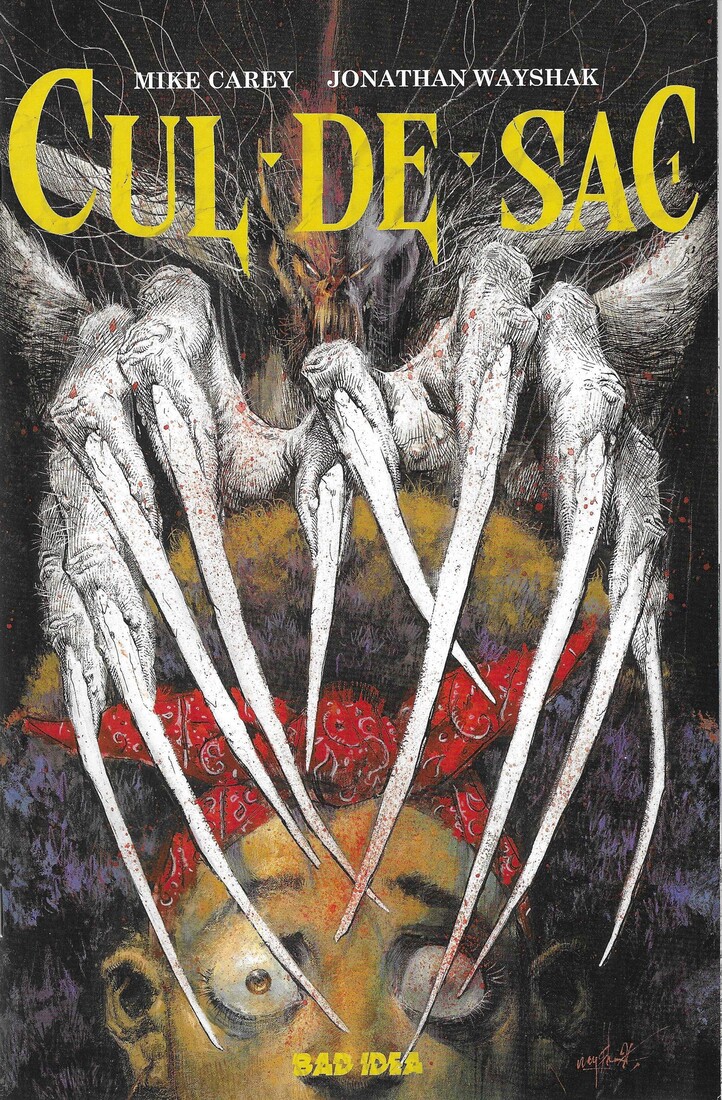
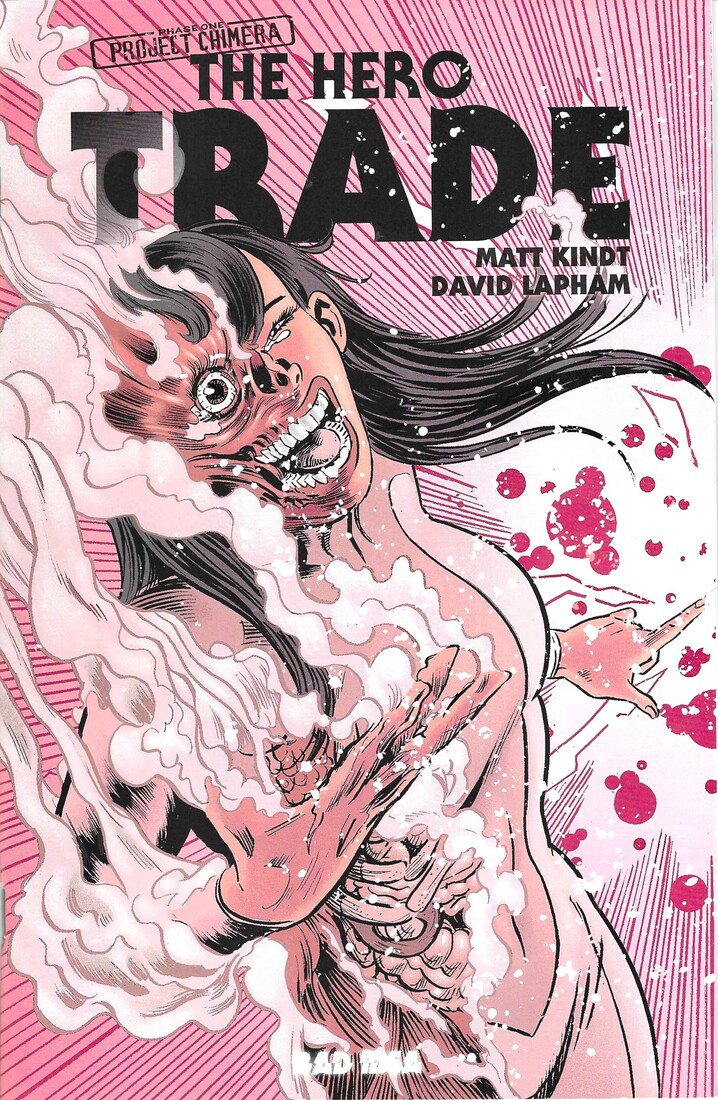 Cul-De-Sac #1 (“All That Eat Get Eaten”) by Mike Carey (writer), Jonathan Wayshak (artist), and Tom Napolitano (letterer); The Hero Trade: Project Chimera #1 by Matt Kindt (writer), David Lapham (artist), and Dave Sharpe (letterer). $5.99 each, 46 and 63 pgs, respectively, Bad Idea.
Ok, so Bad Idea decided their business model, which was designed, it seems, to keep their comics away from as many people as possible, wasn’t really the best way to go about it, so they’ve begun advertising by putting their books in “Previews” (which doesn’t exist anymore, but Lunar has their own on-line catalog now which is pretty much the same thing) and collecting their comics into trade paperbacks. I know, what a concept. I haven’t read many Bad Idea books because of their opaque and confounding business model, but whenever I did, I was impressed with the talent they had and the comics they made, so I decided to give these two issues a try when they showed up at my store (and I saw somewhere that The Hero Trade trade paperback is already out, but I don’t know that for sure, but if it is, what the heck, Bad Idea?). Let’s have a look at them, shall we?
Well, first of all, these are terrific comics. They’re six dollars each, yes, but the main stories are quite long, and they both have back-up stories, with Cul-De-Sac including a preview of another new comic. They back-ups (by Doug Wagner and Adam Pollina in Cul-De-Sac and by Joshua Dysart and Kano in The Hero Trade) are very different, tonally, from the main stories, which is kind of nifty. Plus, they use old-school pulpy paper, which hits me in the nostalgia bone (after which I should really see a doctor, but I have things to do!). So they’re good packages all around. I’ve never been the biggest fan of Carey, but he does a nice job with Cul-De-Sac: there’s a tight-knit group of families who live in the suburbs (on a short street that ends in a bit of a circle … I wish someone knew the name of such a configuration!) whose kids go on annual camping trips. This time, one of the moms takes them, and reveals to them that they’re vampires … but higher-order vampires, ones that can reproduce (hence the children) and they don’t suck the blood out of living things, they just … kind of suck the life energy out of them, which disintegrates them. She does this with a bunny, which is probably not the best thing to do with children — she couldn’t have used a disgusting animal, like a bunch of cockroaches? Her demonstration freaks the kids out (well, most of them), and the mom leaves them alone to deal with it and returns home. Unfortunately for her, a team of vampire hunters has tracked them down, and when the kids return, all their parents are dead. Oh dear. The kids, of course, swear revenge!!!! It’s a decent hook, and Carey does a good job introducing the various characters (there’s a nice sequence introducing the vampire hunters), and Wayshak’s art is superb. It’s sort of a Sam Kieth vibe, which is neat, and he uses colors to very good effect, as not all of the issue is colored, so the black-and-white contrasts with the colors very well. I’ve never seen his art before, and it’s very, very keen. Meanwhile, Kindt and Lapham have an interesting story about two people who work for a corporation that seems to be developing superheroes, or at least trying to turn superheroes into agents of corporate policy. Our two workers, Hank and Ingrid, are the contacts for the two teenagers, who have powers but are kept under lock and key inside the corporate headquarters. Hank and Ingrid are also having an affair, which is strictly forbidden by the company, so they’re being careful about that. It’s unclear how much of what they tell the two kids — brother and sister — is the truth, as they keep the kids docile by telling them that the world is basically a wasteland, but we don’t see much of the world, so it’s unclear how much of their story is a lie. The brother — Trey — is clearly not right in the head, while the sister — Trina — is a bit more mature than her age (they’re not 18 yet, which is how the company justifies keeping them confined in their rooms). Kindt does a nice job building tension throughout, as the corporation is extremely serious about security, so Hank and Ingrid really need to be careful, and when the company does let Trey and Trina out to be their superhero selves, the results are pretty horrifying (and also somewhat hilariously familiar, but I don’t want to spoil anything). It’s a paranoid thriller in the best tradition of these stories, just with superheroes. Lapham is always good, of course, and he brings a grounded realism to it all.
These two books are very good, and I’m not sure if I’m going to get the trades or get the single issues. I assume it will depend on whether my shop gets the next issues or not. We shall see. I knew that Bad Idea had at least some very good comics; I’m glad they’re figuring out that it helps if they’re available to people to, you know, actually read!
Rating (Cul-De-Sac): ★ ★ ★ ★ ★ ★ ★ ★ ☆ ☆
Rating (The Hero Trade): ★ ★ ★ ★ ★ ★ ★ ★ ½ ☆
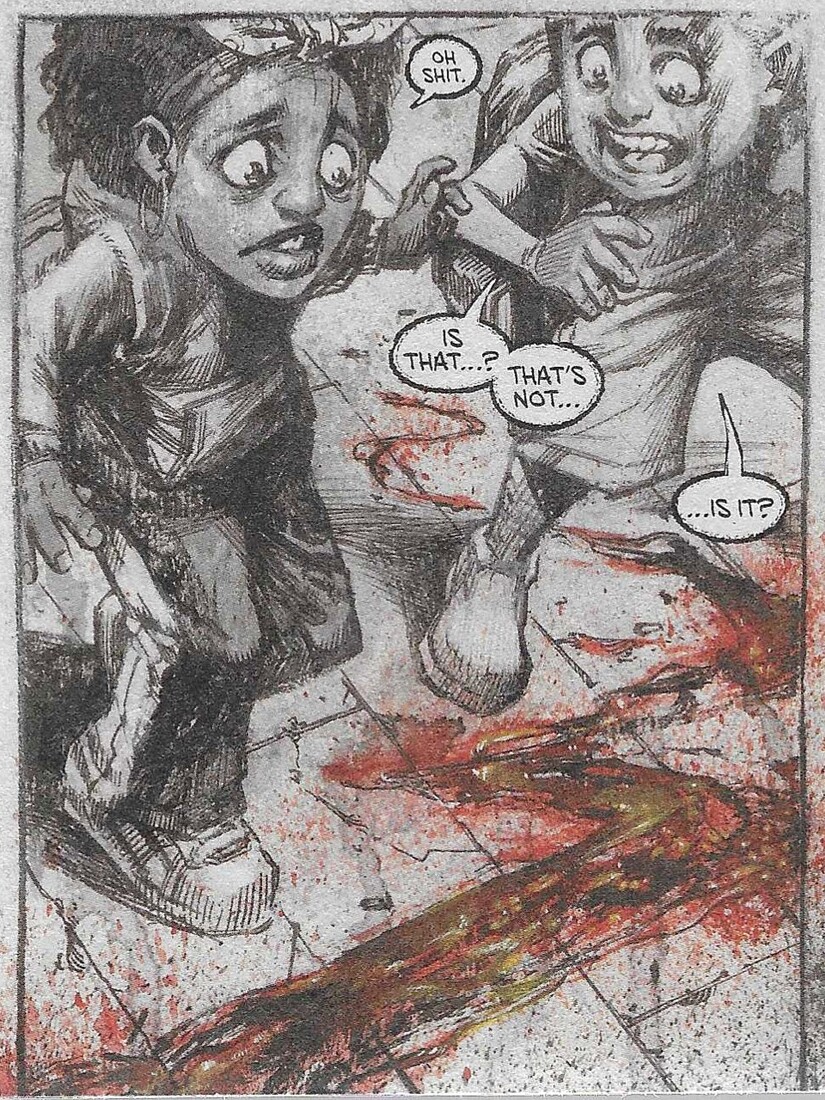
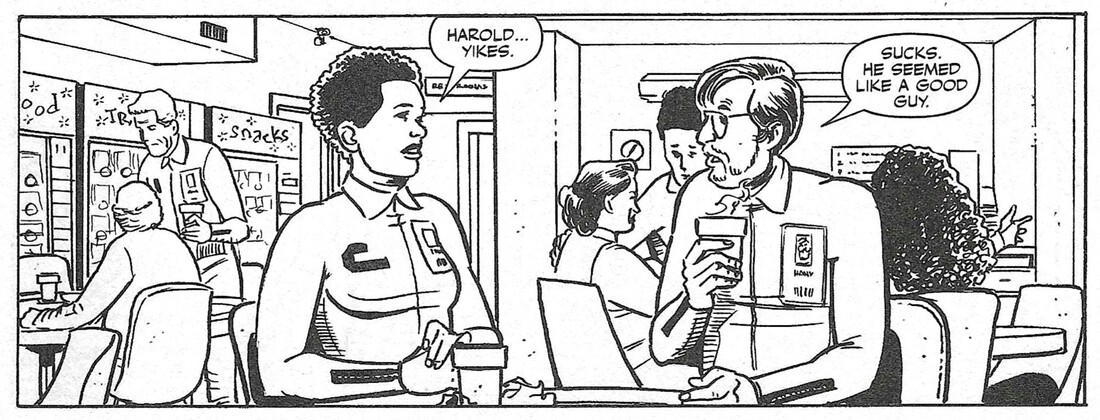
One totally Airwolf panel(s):
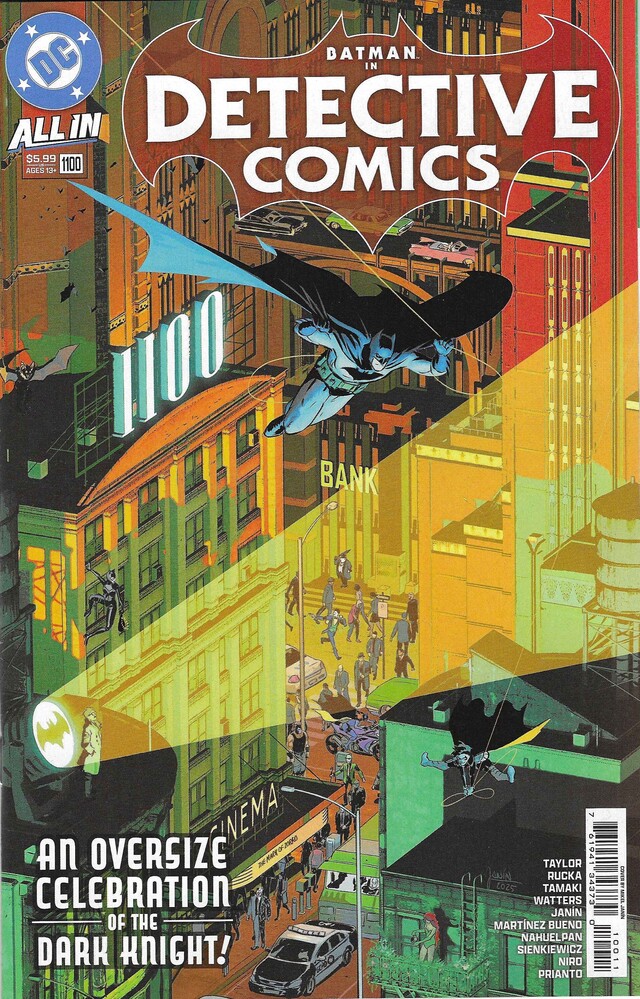 Detective Comics #1100: “Lost and Found” by Tom Taylor (writer), Mikel Janín (artist)/colorist), and Wes Abbott (letterer); “Your Role in the Community” by Mariko Tamaki (writer), Amancay Nahuelpan (artist), Arif Prianto (colorist), and Ariana Maher (letterer); “The Knife and Gun Club” by Greg Rucka (writer), Álvaro Martínez Bueno (artist), Giovanna Niro (colorist), and Tom Napolitano (letterer); “The Fall” by Dan Watters (writer), Bill Sienkiewicz (artist), and Tom Napolitano (letterer); and Ben Meares (editor). $5.99, 48 pgs, DC.
I’m not sure if a comic has pissed me off more in recent memory than Detective Comics #1100. It’s not that it’s a bad comic; it’s actually an excellent comic, and a pretty keen “anniversary” issue. It’s the way in which it is so good that pisses me off. After years and years of the Joker cutting his own face off and the Riddler becoming a mass murderer and Alfred getting killed (he’s still dead, right?) and Batman being goddamned fucking gloomy all the fucking time, this entire issue is … nice? I mean, Taylor and Janín’s lead story is — and I don’t wish to alarm you — about Batman finding a lost dog. In the fucking middle of the day. The dog’s owner is deaf, so there are no words in the entire story, just 20 pages of Batman accidentally coming across the flyers about the lost dog (after chasing down a bad dude in the, again, middle of the day), saving the deaf kid from being run down by a truck (and really, the kid show know better than to hang out in the middle of the street), getting the story on how the dog was lost (punks took it because they’re punks, and of course Batman speaks ASL), and tracking down the punks. I won’t give away how it ends, but, come on — even Geoff Johns wouldn’t slaughter a dog that Batman tries to track down (he might have the dog become a mutant dog and eat some people1, but he won’t slaughter it!)! This is really just a showcase for Janín’s amazing art, and it really is amazing. So that’s one story.
Then, Tamaki gives us a story with the Joker. Oh yes, a Joker story — let’s get some good old-fashioned DC massacres in this one, please! Well, nope. The Joker stuff is in flashback, as Bats just chases the villain around before letting him go because the Joker smashed into a van from the “Gotham Community Center” and it’s about to go off the bridge and Batman has to save the people inside. In the present (meaning a few hours after the chase), Bruce Wayne is at a gala honoring Gotham’s heroes, and he gets grilled by a reporter about how he uses his money to make Gotham better. Of course, we’re supposed to think the gala is honoring Bruce for the way he throws money around, but it turns out they’re honoring a woman who works in the community, who happened to be driving the van that was about to fall in the river and whom Batman saved so she could make it to the gala! Oh, the irony! It’s a nice story, as Tamaki doesn’t exactly let Bruce Wayne off the hook, but makes the point that it doesn’t always take money to make things better (although, of course, it certainly doesn’t hurt). Rucka then gives us a tale in which an experienced ER doctor tells a newer ER doctor to shut up about Batman being a bad influence, as the newer doctor says Batman sends too many people to the ER and that sooner or later he and his ilk will murder someone. The older doctor has a different perspective, and it’s not a bad one. More good art, too, which is nice. Finally, Watters gives us a story in which a serial killer jumps off a building (to kill himself, sure, but also to escape Batman) and Bats jumps after him and tries to figure out to catch up to him and save him. That’s it. Sienkiewicz, who’s not as good as he was in his heyday, still does amazing work with the art, making us feel each moment as the two hurtle toward death, and the final page is a reminder about how well Sienkiewicz can go from concrete to abstract with very little effort. Overall, this is just a terrific issue.
So why does it piss me off? All of these stories are good Batman stories, and they don’t shy away from the darkness of Gotham (in the Watters/Sienkiewicz story, the guy is a serial killer), but they’re not bleak as fuck. This pisses me off because it’s clear that DC wants their regular Batman books to be bleak as fuck, yet there’s no reason for that except that DC editorial is made up of nihilistic jerks. I often said that Batman ’66 could have easily been the regular Batman comic with a few tweaks (just take out a little of the camp), because Jeff Parker and the other writers were just telling good Batman stories, just without all the slaughter, and it’s clear that with this issue, DC has no problem with their writers doing more “feel-good” Batman stories, they just don’t want that on a regular basis. I mean, we all suspected that, but I thought it might have been the writers doing it, but it’s clear that it’s DC editorial. Why? I mean, I know the shit sells, but does it sell that super-well that DC couldn’t try something a bit different every now and then? I mean, if Taylor started writing a Detective Comics where people don’t die horribly and maybe not as frequently, would it really put a dent in sales? Beats me. It seems like a lot of people buy Batman comics because they like the character so much, and only if it’s really, you know, shitty would they not buy it. Would making Batman a tick less fucking grim be that hard? When John Layman was writing Detective, he specifically told me he was writing it as “kid-friendly,” meaning not that it was all cheery and toothless, but that it didn’t feature the Joker slicing off his own fucking face. And it’s a pretty good run on the book! I don’t want Batman to be all “Adam West-ified,” of course — one of the best Batman stories of the past 30 years is David Lapham’s “City of Crime,” which is fucking bleak, but maybe not make these kinds of stories so shocking that they only show up in “anniversary” issues and inspire random bloggers to devote far too much time to them? I just read the first part of Taylor’s Nightwing, which is acclaimed as one of the better runs of the 21st century. There’s a villain who steals the hearts out of people while they’re still alive, but even so, the first part of the run, at least, is not bleak. Taylor knows how to do this, and I hope DC lets him bring a bit of light into Batman’s world. His first arc wasn’t super-bleak, but it was still pretty dark, so maybe he can work up to it!
Anyway, this is a good issue. Go get it!
1 Yes, I know Johns didn’t have Wonder Dog eat Marvin and Wendy, but work with me, people!
Rating: ★ ★ ★ ★ ★ ★ ★ ★ ☆ ☆
One totally Airwolf panel:
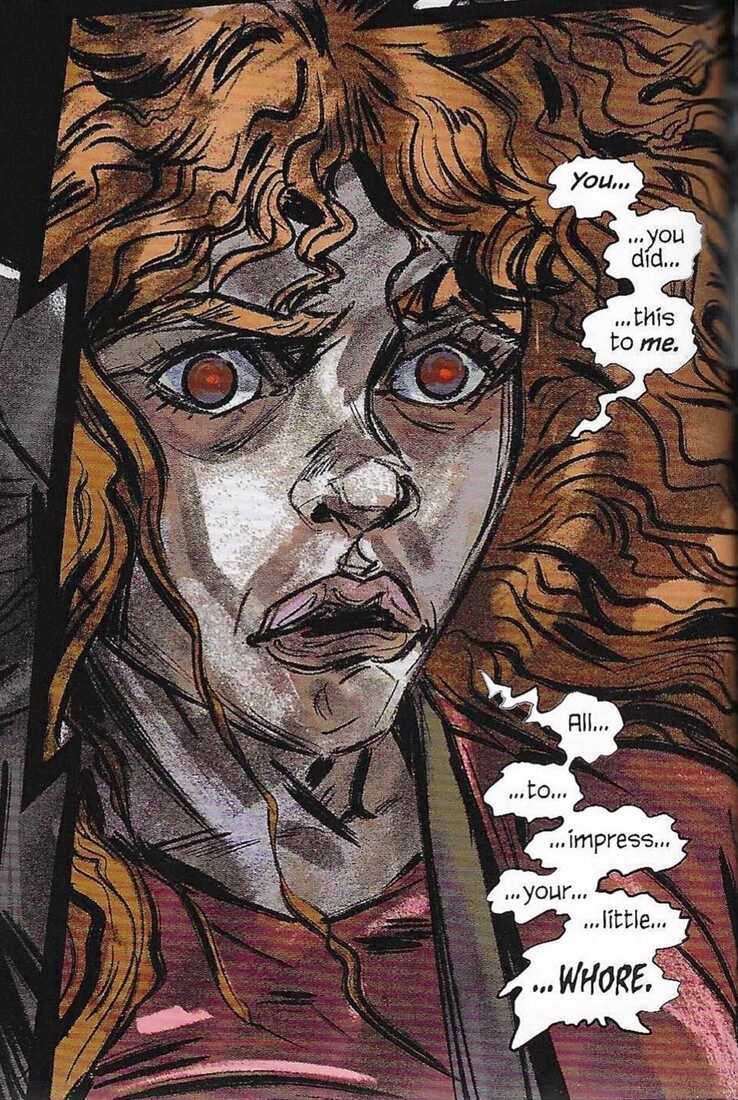
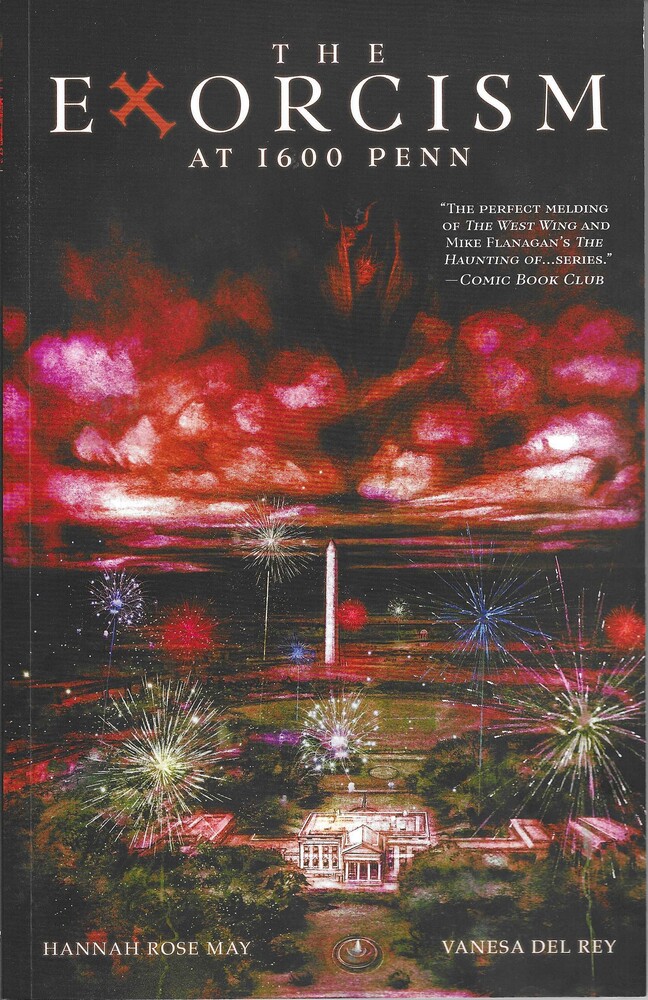 The Exorcism at 1600 Penn by Hannah Rose May (writer), Vanesa Del Rey (artist), Jordie Bellaire (colorist), Hassan Otsmane-Elhaou (letterer), and Alonzo Simon (collection editor). $21.99, 110 pgs, IDW.
I’m never super-happy with fiction that lets assholes get away with it because they’re being influenced by outside forces, and May doesn’t quite do that, but she comes close. Kelly Doyle is the first female president, and she immediately finds herself beset by a douchebag senator who wants a war, a rumor of Havana Syndrome (which they never define, which is odd, because I have heard of it but didn’t really know what it is), and, well, her daughter getting possessed by a demon. Yeah, that sucks. The demon, of course, is the cause of a great deal of the issues in the book, but May does make it clear that the douchebag senator is, in fact, a douchebag, so not everything can be pinned to the demon. President Doyle’s kids go to a Catholic school, of course, and her daughter, Mara, is a bit odd, so she doesn’t make any friends, and eventually, you know, she gets possessed. It’s not a bad horror story — it hits some familiar beats, as it has to, but May twists it in some interesting ways, so that’s nice. Nobody believes Kevin, the son, who figures it out and tries to get people on his side, but they’re not completely dismissive of him, either, as they know something is wrong with Mara, and when the proof is given, they accept it. It’s not the most amazing story, but it’s pretty good. Del Ray is an interesting artist, too, and she really does a nice job using scratchy lines to make the world look much grittier, and some of her page layouts are very neat — she uses jagged panel borders and unusually-sized panels to manipulate the tone of the story really well. Del Ray is a solid artist, and she really does some nice things to make the book creepier, which is nice.
This is a pretty good comic. It’s not great, but it is entertaining. So there we go!
Rating: ★ ★ ★ ★ ★ ★ ½ ☆ ☆ ☆
One totally Airwolf panel:
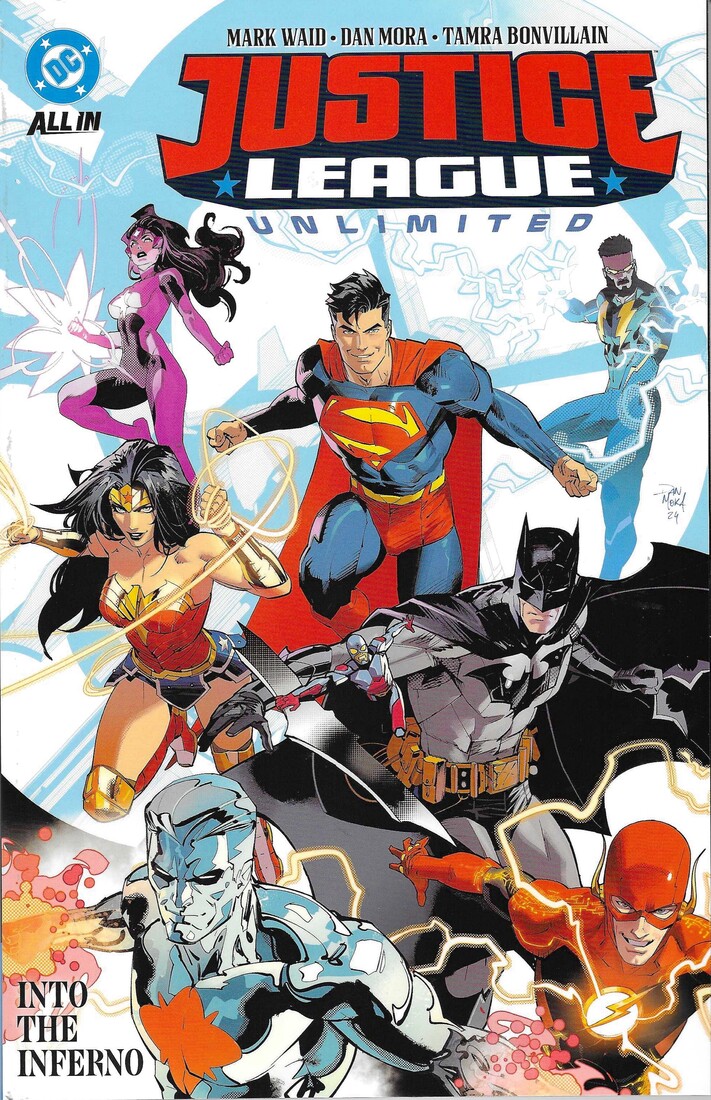 Justice League Unlimited volume 1: Into the Inferno by Mark Waid (writer), Dan Mora (artist), Tamra Bonvillain (colorist), Ariana Maher (letterer), and Paul Kaminski (collection editor). $17.99, 104 pgs, DC.
Waid is a solid writer, but I’ve never been his biggest fan, as so many of his books always seem vaguely disappointing, and it’s always hard for me to pinpoint exactly why. Take JLU vol. 1, which is a perfectly good superhero epic, but it’s less than the sum of its parts. We think he’s introducing a new villainous group to the DC Universe, but as we go along, we find out it’s not, really (the covers spoil it, but I won’t), and it’s a bit disappointing that he goes to a familiar well, no matter the path he takes to get there. He throws in a lot of stuff that feels extraneous just to fill up the page count and give Mora stuff to do (and Mora, as you might expect, does NOT disappoint in the least), and it needs to be either more developed or dropped completely from the book (the parademon stuff, specifically, which feels like it should be more important, but ultimately isn’t). Waid came up with this “Hey, Everyone’s in the Justice League” thing (at least I assume he had some hand in it), but because he wants to do an epic storyline right off the bat, the book feels overstuffed and it’s a bit overwhelming. I know that a Justice League book tends to put characterization on the back burner, and that’s not the worst thing in the world, but because there are so many characters, it feels a bit like a plug-and-play situation, where Waid just wants to show us a random character he digs without really caring how they fit into the narrative. I don’t know — it just feels like some characters would just not be in the Justice League, but Waid wants them there, so they show up. See? It’s hard to explain, for me, because Waid does a good job setting up the threat and having it be really bad so the League needs to call in all sorts of interesting characters, but it just … doesn’t cohere for me. It feels off, and like a lot of Waid’s books, I can’t quite articulate why. It’s very frustrating.
Mora and Bonvillain are on fire, though, so that’s nice. They’re an excellent team!
Rating: ★ ★ ★ ★ ★ ★ ★ ☆ ☆ ☆
One totally Airwolf panel:

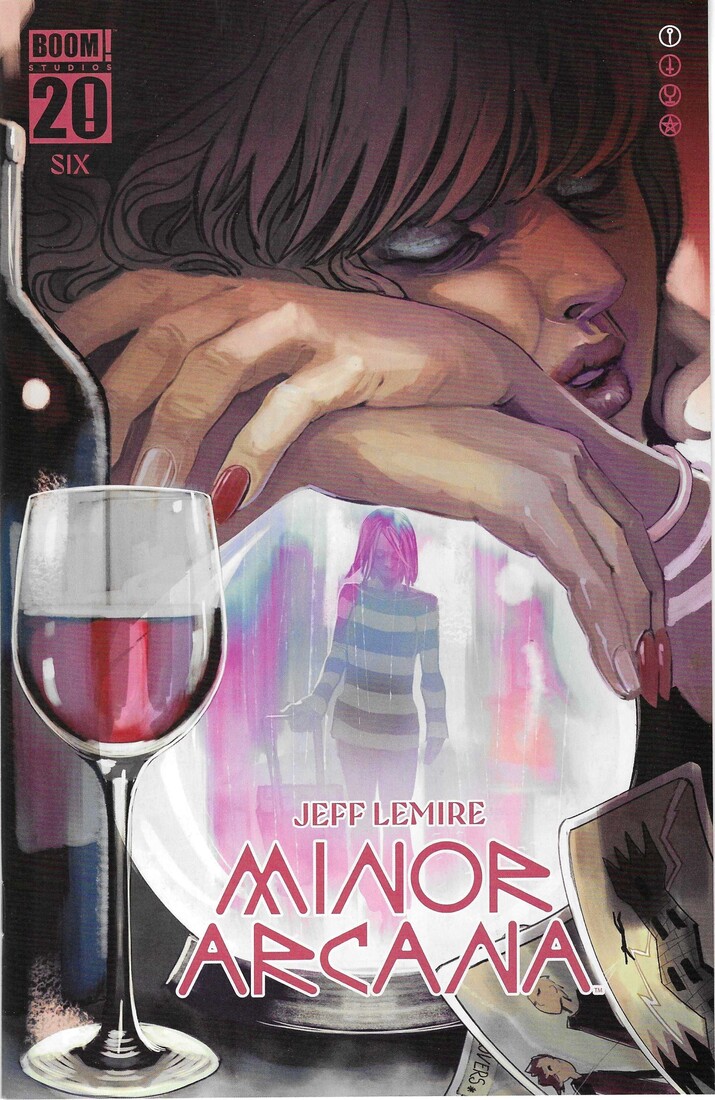
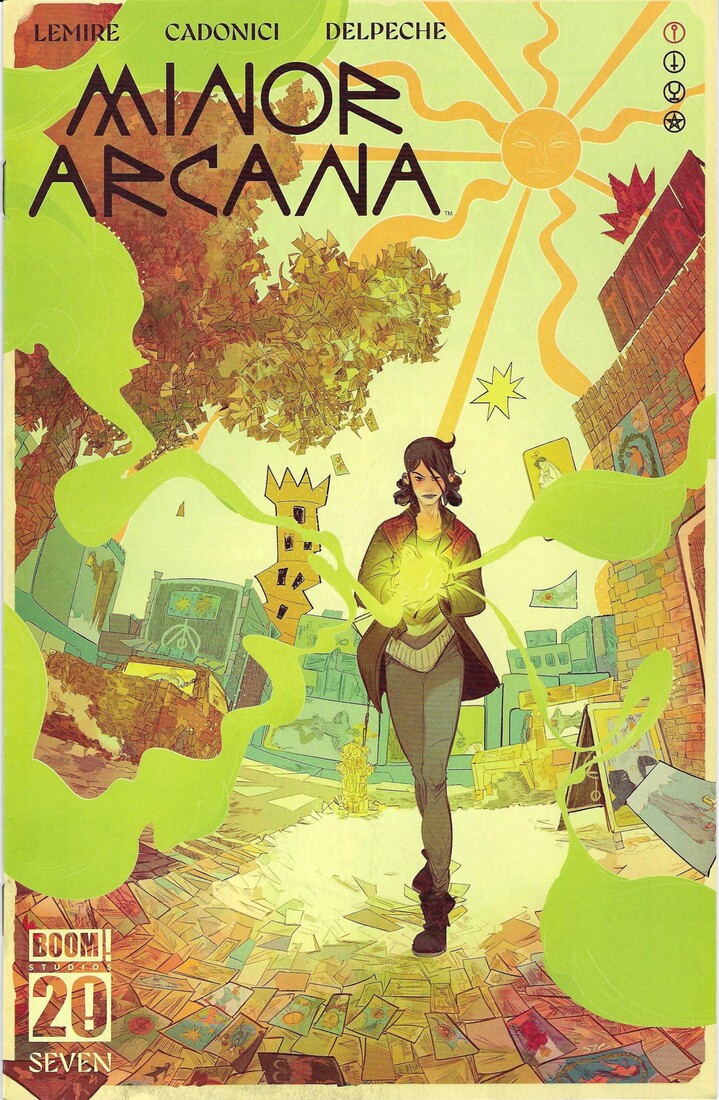
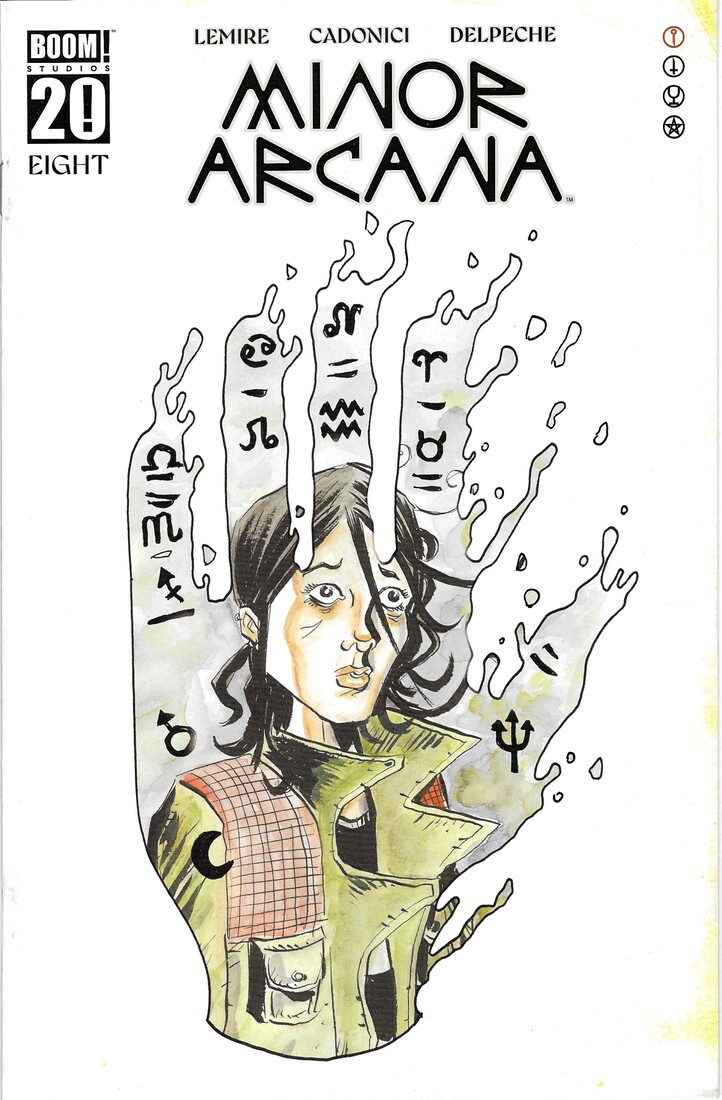
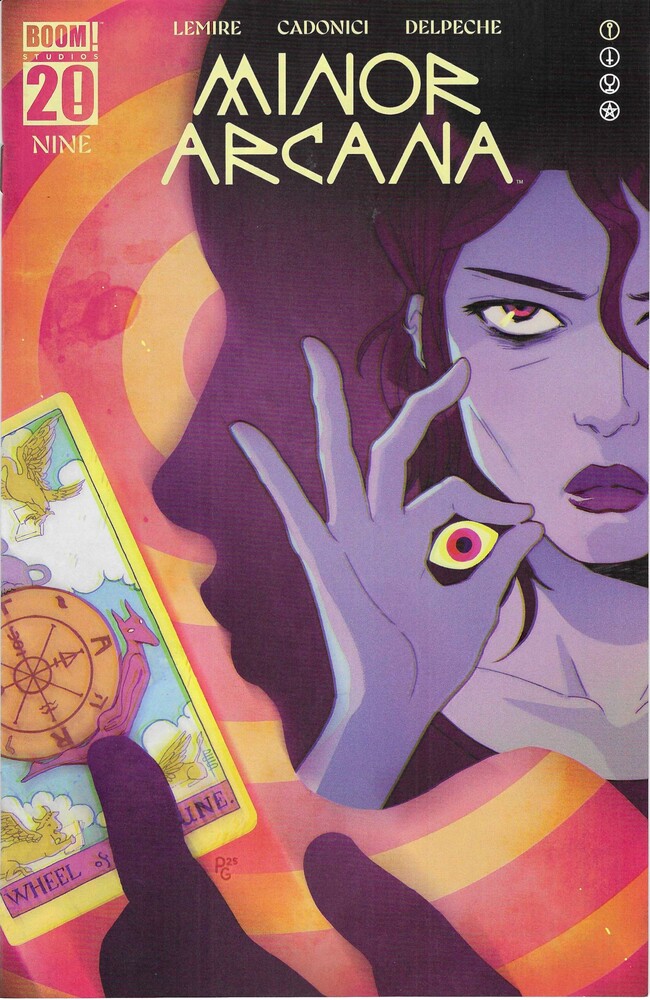
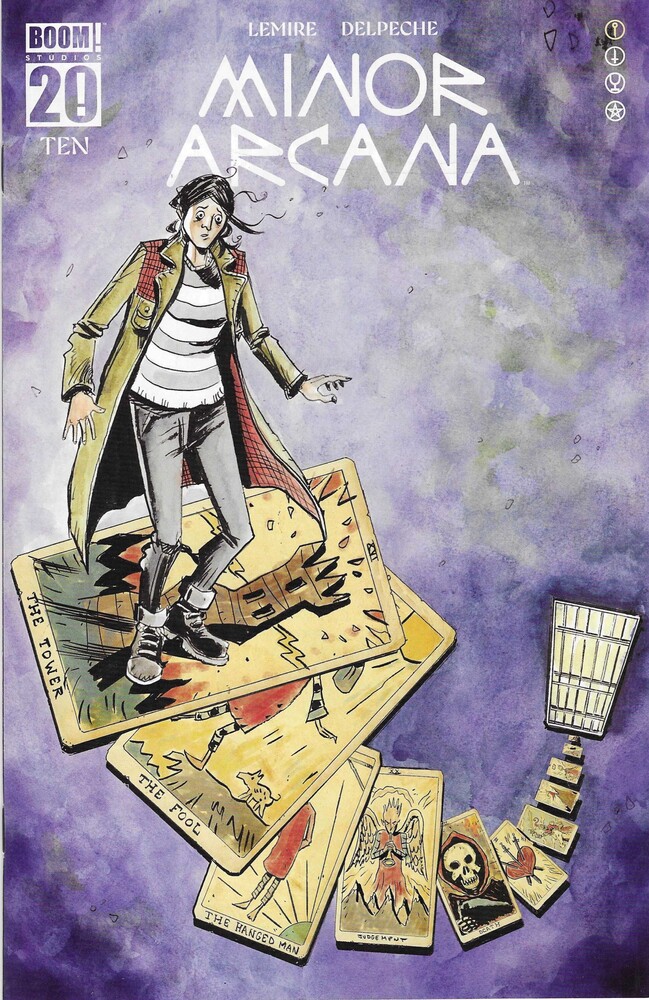
Minor Arcana #6-10 by Jeff Lemire (writer/artist/colorist), Letizia Cadonici (artist), Patricio Delpeche (colorist), Steve Wands (letterer), Eric Harburn (editor), and Matt Gagnon (editor). $24.95, 120 pgs, Boom! Studios.
Why didn’t Lemire draw this entire arc? He drew issues #6 and #10, but not #7-9, and I’m not sure why. I don’t quite get the vagaries of publishing, so I don’t know when this was put on the schedule, but it seems that if Lemire wasn’t able to finish the artwork, Boom! would be happy to push it back, right? I mean, there certainly could be something behind the scenes that didn’t allow Lemire to draw the entire arc, and that’s fair, but it just seems odd. Lemire does write some things that he doesn’t draw, of course, but it seems like he does dig drawing those indie books that he creates all on his own, and it’s weird to see someone else step in. Cadonici isn’t as good as Lemire is (of course, a lot of people don’t like Lemire’s art, so they will say it’s good that there’s a guest artist!) — she apes Lemire to a degree, although her line is thinner and cleaner, so it doesn’t look quite as … ugly (in the best way possible) as Lemire’s? Lemire’s art works really well with the gritty stories he’s telling, and Cadonici does a decent job trying to keep it that way, although it doesn’t quite work as well. That’s ok, though, and Cadonici does some nice things with the way Theresa’s power works, and she does some nice, rough inking for some of the more emotional scenes. I’m just curious why she was needed.
Anyway, this is still a solid series. We get some more psychic stuff, we find out there’s a Top Secret Group who doesn’t like that Theresa has psychic powers (I know, you might need to sit down when you learn about the existence of a Top Secret Group), and we get a nice standalone issue in #10 about Theresa’s grandfather and his time in prison. We’re just moseying along, and It’s just done well. I don’t have much more to say about it!
Rating: ★ ★ ★ ★ ★ ★ ★ ☆ ☆ ☆
One totally Airwolf panel:

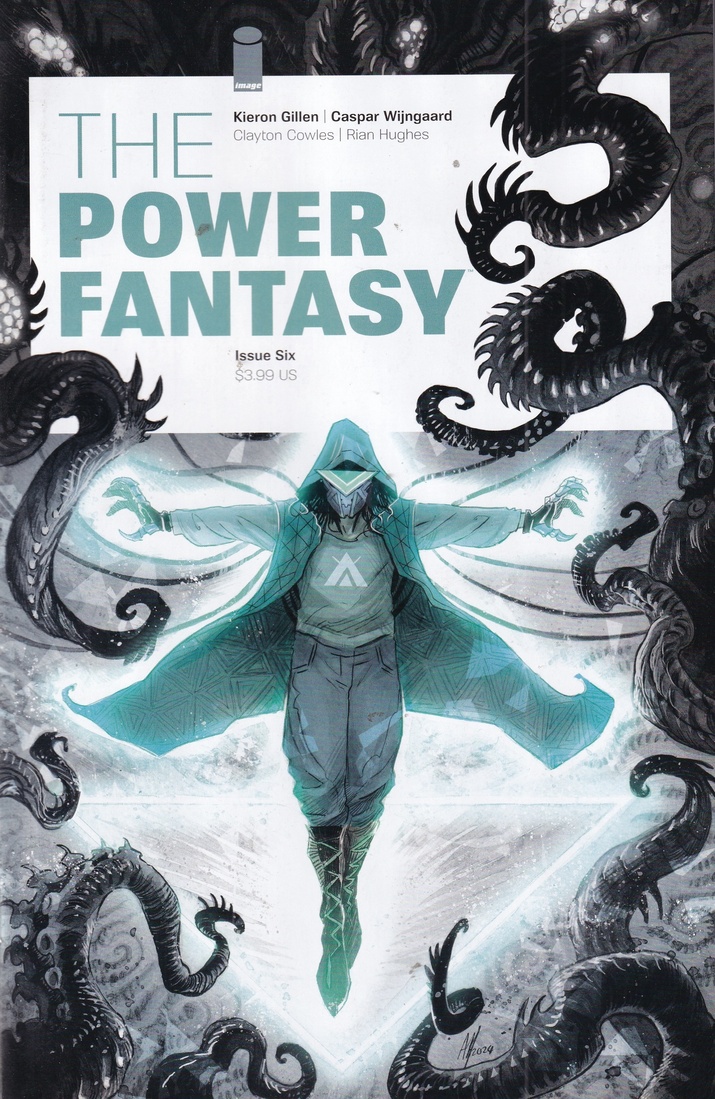
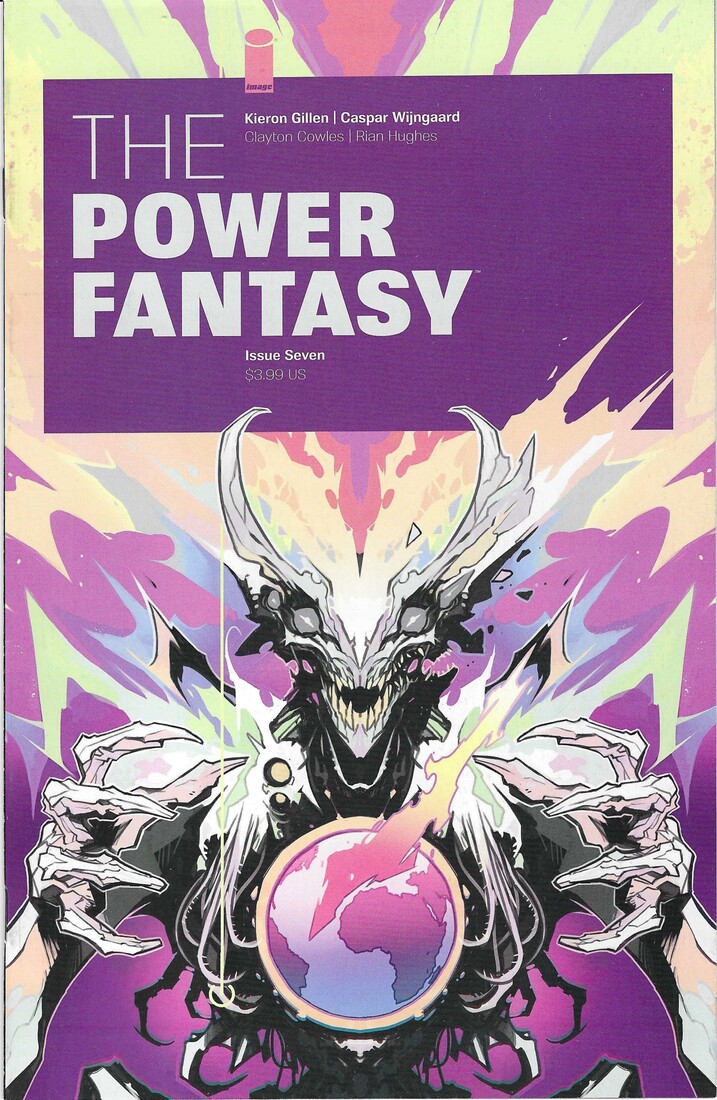
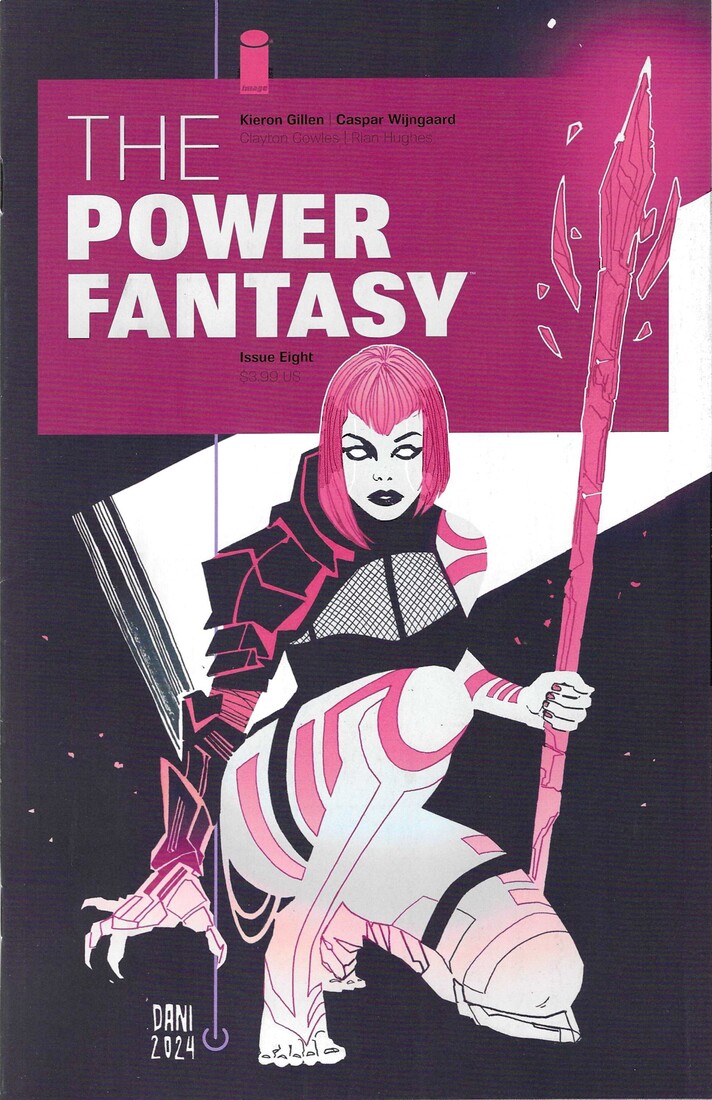
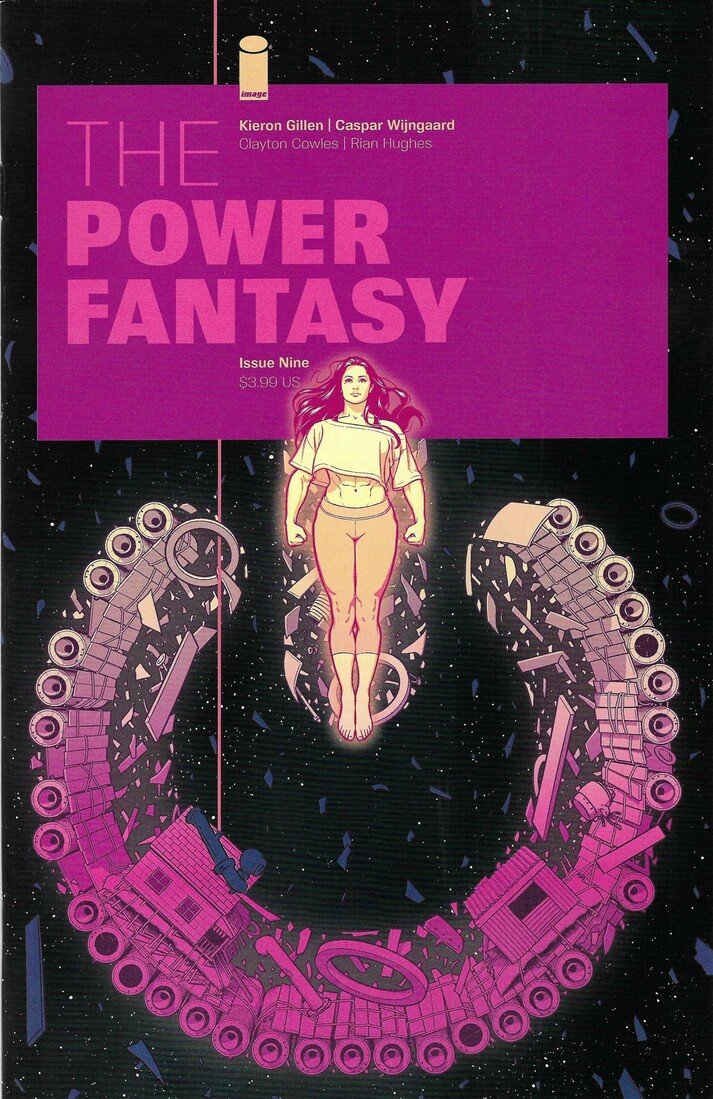

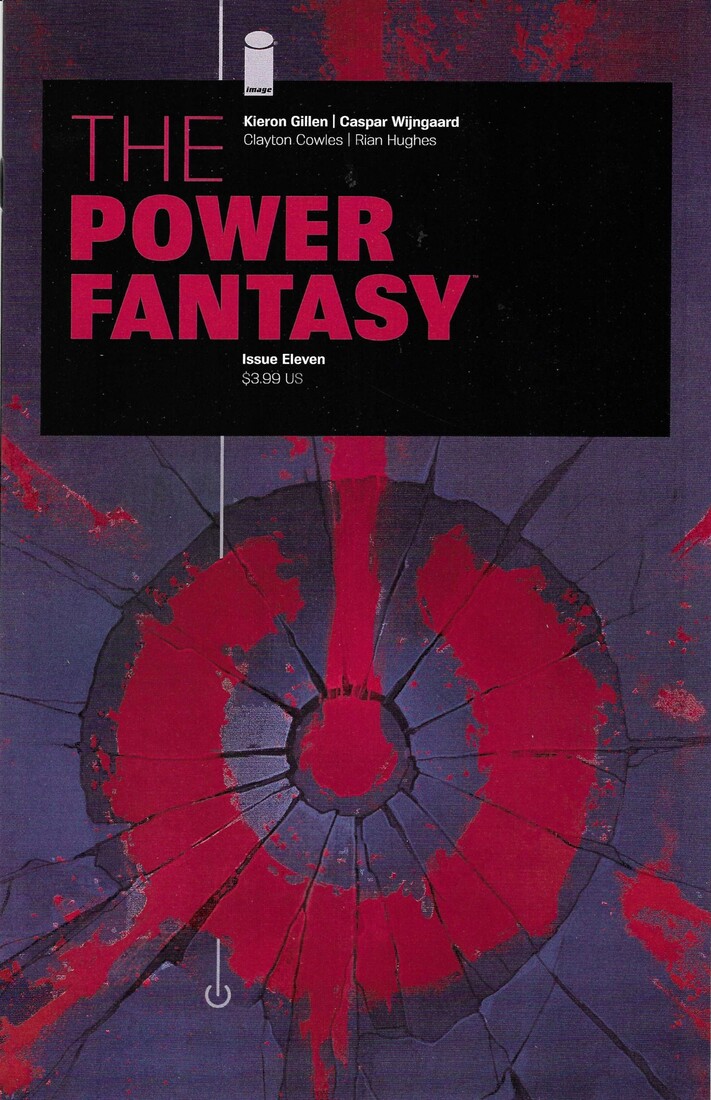
The Power Fantasy #6-11 by Kieron Gillen (writer), Caspar Wijngaard (artist/colorist), and Clayton Cowles (letterer). $23.94, 123 pgs, Image.
I know I’ve been in the bag for Gillen for almost 20 years, but the dude is a really good writer, so it’s hard for me not to be. In The Power Fantasy, he wants to write a superhero epic with no punching, which, I mean, isn’t the most unique idea, but because Gillen’s biggest strength is his characterization (his plotting has gotten immeasurably better over the years, but he’s still stronger at creating characters), we get really invested in these characters very quickly, and the fact that they’re not always on the same side means that when something horrible happens (which it does in this arc), we’re emotionally affected but also we don’t hate the people who perpetrate the horrible act as much as we might if it were, say, Doctor Doom pulling this kind of shit. These powered individuals are not only interesting and scary, they’re also somewhat broken, and so when they act poorly, Gillen shows us that it’s not because they’re evil, but because they’re foolish and immature and hurt … you know, like a lot of normal people. He shows us the “Second Summer of Love” from 1989, when, as we saw in the first arc, most of Europe was destroyed, and how it happened and the fallout from it, and he does something fairly clever: he shows us different people perceiving the disaster and not the disaster itself — we get a bit of it, but not too much — because the event is in flashback, after all, and so he’s more concerned with how it affected the survivors instead of dwelling on the dead. The survivors have to figure out the world that remains, and that’s what’s important. That’s not to say the event itself isn’t harrowing, because it is, but because Gillen only shows us bits and pieces of it and instead shows the impact it has on others, it allows our imaginations to do the nasty work while saving the more emotional stuff for Gillen’s writing. It’s well done. Gillen has gotten quite good at plotting, too, so there are some nice twists in the narrative, one of which (the big one, actually) is easy to see coming, but some of the smaller ones sneak in and really surprise us, which makes the big one a bit more dramatic, because you think that Gillen might actually do what we think he’s doing. I don’t want to say more without spoiling it, but if a writer is only working up to one big twist, the narrative might not work as well, but because Gillen is more concerned with building up the characters, the twists feel a bit more organic but also somewhat unexpected. If that makes any sense. It does to me.
Wijngaard is having a lot of fun on the book, too, it seems. His designs are superb, as usual, and he does a nice job with dressing the characters, which is often harder than it looks. He gets to do some weirdo stuff, too, like Eliza’s creepy church, the Queen’s vision for Manchester (where he goes nuts with the pastel colors), and what’s going on inside Jacky Magus’s pyramid when the supers have to deal with the Queen. Wijngaard brings such a neat aesthetic to the book, and it’s impressive that Gillen can keep getting artists who seem to fit the vision he has for the book. I don’t think Wijngaard would have worked this well on The Wicked + The Divine, and I don’t think McKelvie would have worked this well on this book, and I don’t think either of them would have worked well on Once & Future. Obviously, Wijngaard, McKelvie, and Mora are all great artists, but they seem to fit the specific vibe Gillen has for each comic very well, and that’s pretty keen.
So, yeah. The Power Fantasy is excellent. I know, it’s shocking!
Rating: ★ ★ ★ ★ ★ ★ ★ ★ ★ ☆
One totally Airwolf panel:

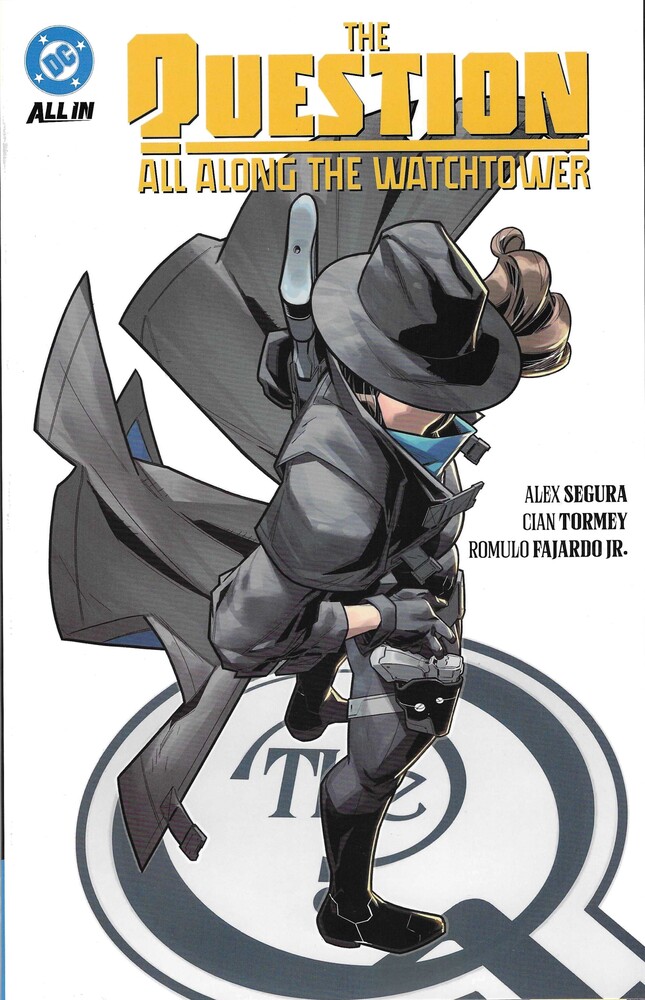 The Question: All Along the Watchtower by Alex Segura (writer), Cian Tormey (artist), Raül Fernandez (artist), Romulo Fajardo Jr. (colorist), Willie Schubert (letterer), Dave Sharpe (letterer), and Paul Kaminski (collection editor). $17.99, 120 pgs, DC.
I’m a bit disappointed with this mini-series, mainly because it becomes too much of a superhero story too quickly. As we saw in issue #1 (which I wrote about here), Batman, Superman, and Wonder Woman bring Renee Montoya on board the Justice League Big-Ass Satellite because they know something is wrong, but they don’t know what, and she can ferret it out. So far, so good. But by the end of issue #2, Eradicator Superman has shown up, and by the end of issue #3, Cyborg Superman has shown up as the Big Bad, and the book just becomes a big ol’ punch-fest. At the end of the first issue, a corpse ended up in Renee’s room, which seemed to imply that this would be some kind of murder mystery with superheroes, which I am down for, but it turns out that there’s no mystery at all, plus the corpse isn’t actually, you know, a corpse (I guess he was just mostly dead). Renee still has to figure a few things out, but not enough, because the Evil Supermans show up so quickly and they like to monologue a bit, so we know their plan pretty quickly, too. It’s just a bit disappointing. It’s not a terrible book, but it feels like it has a lot more potential than what we get here. Renee spends some time mooning over Batwoman, and they figure out how to move forward in their relationship, which is nice, and Segura gets to put Animal Man and Nightshade in the book, which is fun, but it just hints at a weird, kind-of-noir story that might have been weirdly interesting, considering it takes place on a satellite full of superheroes. The art is fine — it’s that inoffensive quasi-house style that DC and Marvel have, and it gets the job done. I just wish this had been what the first issue kind of promised it would be. Too bad.
(I was wondering why another Question showed up and Renee kept calling him “Charlie,” so I looked it up, which I wish I hadn’t. This is actually Vic Sage, the original Question, but now he’s calling himself Charlie, because his name was retconned to “Charles Victor Szasz” in an annual from the 1980s. Really? First of all, DC shouldn’t have two characters with the last name of “Szasz,” because that’s asking for trouble. Did they ever do anything with that? Second, even if that was his given name, he never called himself “Charlie” before, so when did that happen? Yes, I think I might be taking crazy pills. Why does DC (and Marvel, too) pull this shit? Sheesh.)
Rating: ★ ★ ★ ★ ★ ★ ½ ☆ ☆ ☆
One totally Airwolf panel:
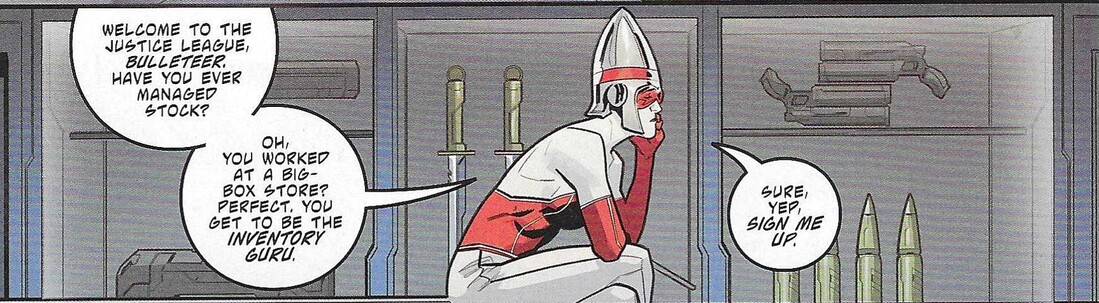
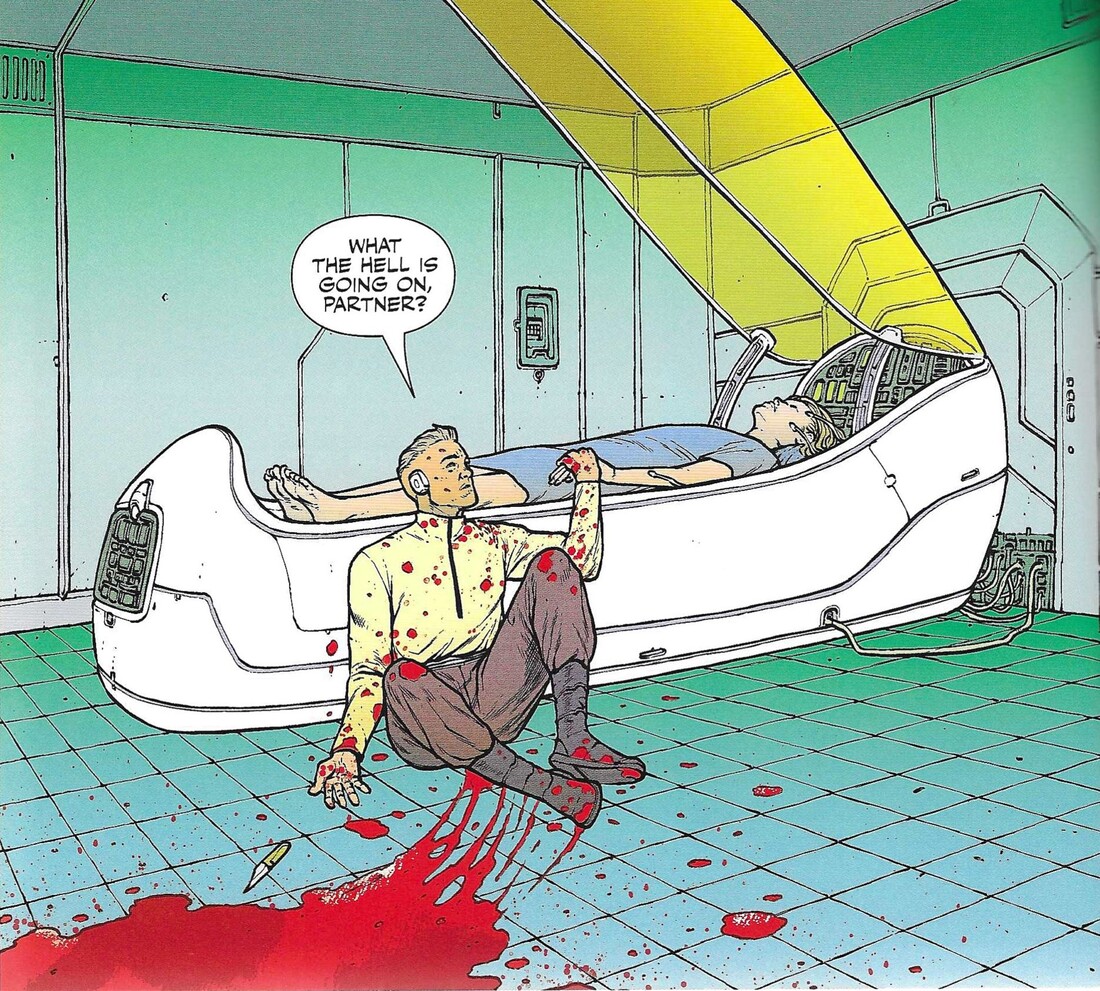
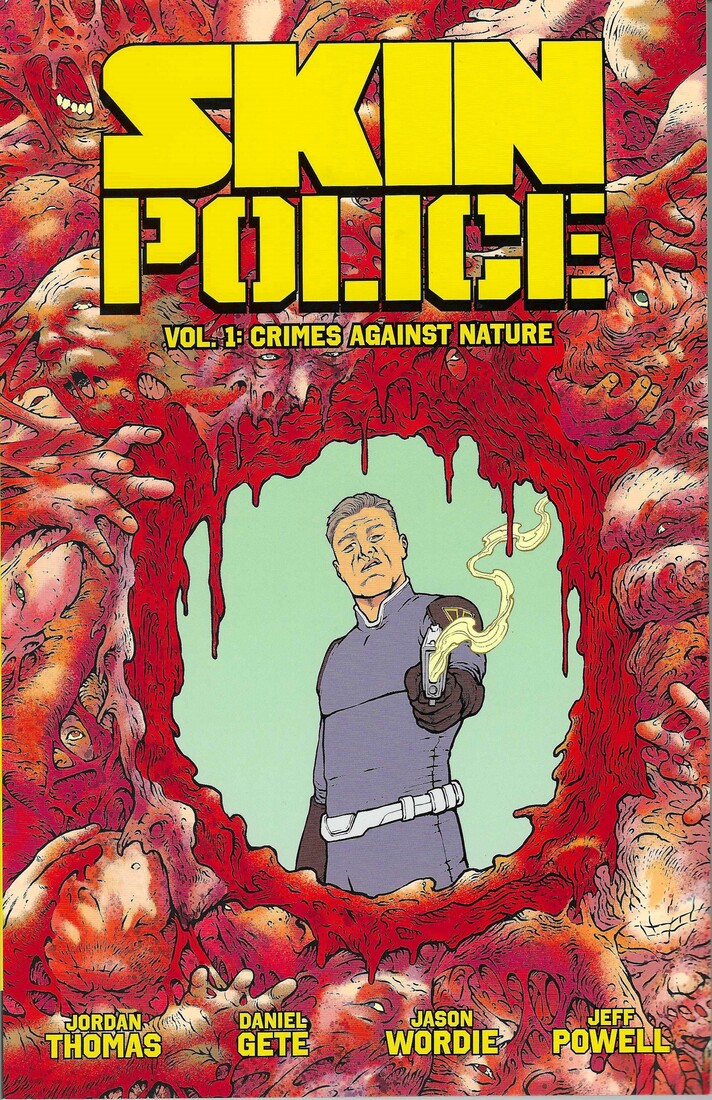 Skin Police volume 1: Crimes Against Nature by Jordan Thomas (writer), Daniel Gete (artist), Jason Wordie (colorist), Jeff Powell (letterer), and Karl Bollers (editor). $17.99, 88 pgs, Oni Press.
This is a nice, pulpy sci-fi thriller, and Thomas doesn’t do anything too shocking with it, just tell a good story. There’s a big twist at the end, but it’s not too crazy, and it sets up future volumes nicely. It’s the future, and birth rates have fallen, and people have begun using their genetic material to create cloned children … but these clones tend to have psychotic breaks after some time, so they’ve been outlawed. Enter the “skin police” a force tasked with hunting these people down and … well, often killing them, but occasionally arresting them, although Thomas leaves it unclear what happens to them. As our protagonist, Brisson Eckis, points out (to his new partner, which is always the way the reader gets information in these kinds of cop stories), the test for clones is very expensive, and there’s no other way to tell if someone is a clone, and most of them don’t know they’re clones, so they have to rely on people calling them to report weird behavior, which might be an indicator that the person is about to have a psychotic break. Yes, you could say that Thomas is making a statement about our current political climate, but it’s generic enough that it could just be the way authoritarian-adjacent organizations work. Anyway, on the opposite of the law is a young woman who manages to escape the Skin Police and falls in with a rebel group, one that proves to her that clones can survive the psychotic break and thrive, as long as they have medication that, of course, isn’t exactly approved by the Powers-That-Be. So it’s a fairly standard story, but Thomas tells it well, and he makes sure that as badass as Eckis is, he’s not a simple thug, so he’s a compelling protagonist who, I’m sure, will eventually discover he might be fighting on the wrong side. We shall see. Gete is a pretty good artist, and his work here looks better than what I’ve seen from him before, and I wonder if it’s because Wordie is using flatter, more old-school colors. Gete’s work doesn’t seem to be as well-suited for the more digital rendering I’ve seen it colored with in the past, so maybe future employers of the artist should consider that. They probably won’t, but they should. He gets to draw a lot of murderdeathkilling, and he has a good time with it. It’s a violent book, for sure, but Gete also does nice work creating this future world so that it’s unusual but not too different from ours. So that’s neat.
I don’t know how long Thomas plans for this comic, but it’s off to a good start!
Rating: ★ ★ ★ ★ ★ ★ ★ ☆ ☆ ☆
One totally Airwolf panel:
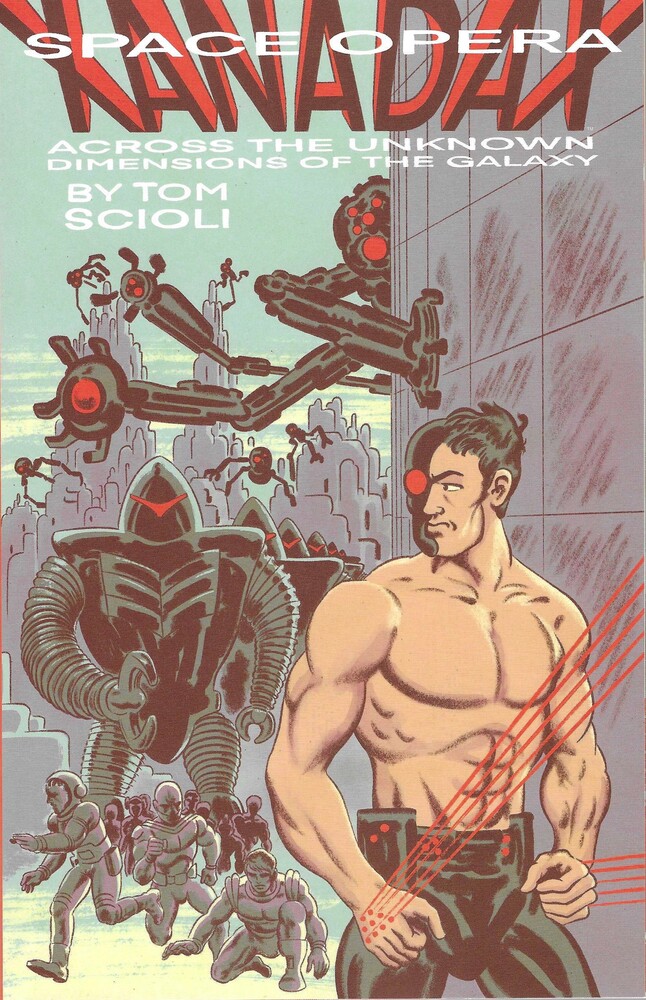 Space Opera Xanadax Across the Unknown Dimensions of the Galaxy by Tom Scioli (writer/artist/colorist/letterer). $19.99, 215 pgs, Image.
I’m a big fan of Scioli and his idiosyncratic comics, so I was keen to read this, his latest graphic novel. Unfortunately, it’s not that good. It looks great — Scioli continues to do his weird, almost child-like Kirby-esque art at a very high level (I say child-like not as an insult, I hope you understand), and we get a lot of cool violence, weird creatures, and intense moments when Scioli becomes more impressionistic, implying that the intensity can’t be contained on the page — but the story isn’t much. Granted, Scioli has never been the greatest writer, but he seems to be phoning it in a bit with this one, as he barely bothers to do any work on the plot, instead simply throwing characters into situations where they need to fight their way out. Xanadax, the cyborg star of the book, is never named in the book itself, and he’s just an extreme Wolverine in many ways — he has laser-light claws and heals pretty fast. His brother is the despot of a planet and he tries to kill our hero, but when a bigger threat shows up, Xanadax has to fight that guy to the death. Meanwhile, two pirates — one a woman who wears a bikini a lot, even in deep space, and her companion, a silent robot-looking dude wearing an old-fashioned military uniform — are captured by a businessman they’ve offended and given a heist job to pay off their debt, and the two stories are marginally related, but not too much. It’s fun looking at the pictures, and Scioli can draw a knock-down drag-out as well as anyone, but it’s just a bit empty. There’s a little about family being family even when the siblings hate each other, but not too much. In the back of the book, Scioli has an unfinished story about a princess who tries to escape her situation but is drawn back in because her brother is being menaced. It’s done in the style that Scioli used in the “SuperFriends” back-up he did for DC a while back, and it’s nifty art. It’s a bit better, story-wise, than the main comic, but it’s also unfinished, so who knows. I’m still a big fan of Scioli, but I do hope his next comic is better than this one.
Rating: ★ ★ ★ ★ ★ ½ ☆ ☆ ☆ ☆
One totally Airwolf panel:

 The Stoneshore Register by G. Willow Wilson (writer), M.K. Perker (artist), Richard Bruning (letterer), and Karen Berger (editor). $24.99, 128 pgs, Dark Horse.
Back in the olden days, Wilson and Perker created Cairo, a terrific graphic novel about the city and its environs. Then they did Air for Vertigo, which wasn’t quite as good but still interesting. Now, they’re back with a new book, and it’s also quite good. I guess they just know what they’re doing!
The book is set in the town of Stoneshore, on the Washington coast, and as you can see from the cover, there’s something unusual about the place — there’s a stone giant leaning against the cliff that rises from the shore, and the town is built around it. A woman, Fadumo, shows up at the offices of the town newspaper, the Register, and asks the editor, Jonathan, for a job. She tells him she was a journalism student, but is mysterious about the rest of her life, only saying that Washington was the farthest place on the map from where she was from. Jonathan hires her even though the newspaper, like the town, is dying, and Fadumo decides to get to the bottom of why there’s a stone giant looming over the town, as Jonathan is unsure where it came from. You would think, from what Fadumo says she’s going to do, that this becomes a puzzle-box comic, as she discovers weird things about the town that become more sinister as she digs. That’s kind of what we’ve been conditioned to expect, but Wilson is too good a writer for that. Fadumo does interview people around town and hear strange stories about what’s going on in the town, and it appears there is indeed something sinister going on, but … that’s not what the book is about. Fadumo’s secrets are revealed, of course, and it turns out Wilson is telling a different story, one in which secrets don’t really matter because belonging to a community that looks out for you is more important. Fadumo is looking for such a community after the trauma that she has endured, and even though the townspeople don’t want her digging into what’s going on in the town, they’re still more than happy to accept her. It’s an odd book, because Fadumo does discover some things that, at least, should freak some people out, but Wilson does a nice job making it ambiguous, so we’re never really sure if what she’s experiencing is real or just a product of her over-active imagination. It’s a nifty way to tell the story, because it adds some weirdness while disguising the fact that the book is not really about the weirdness. We get a lot of people, just living their lives, man, the best they can. Perker does his usual solid job with the art — he doesn’t have to do too much, but he does have to figure out where the giant is in a lot of panels, and it’s well done — and we get a very good graphic novel that isn’t quite what you think it’s going to be. It’s nice to see!
Rating: ★ ★ ★ ★ ★ ★ ★ ★ ½ ☆
One totally Airwolf panel:
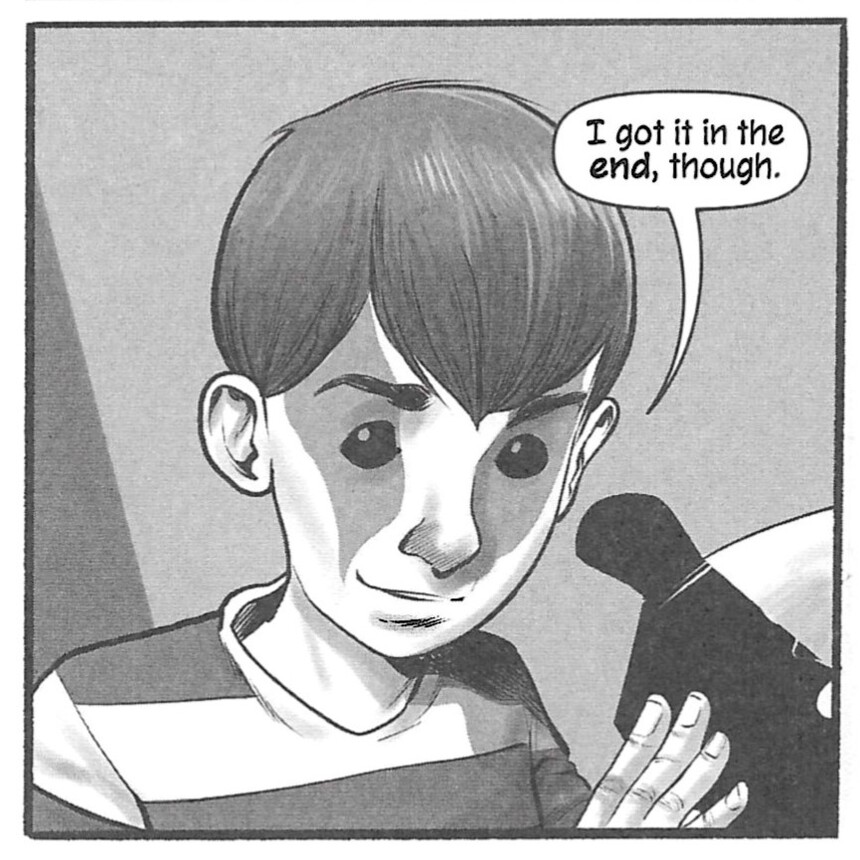
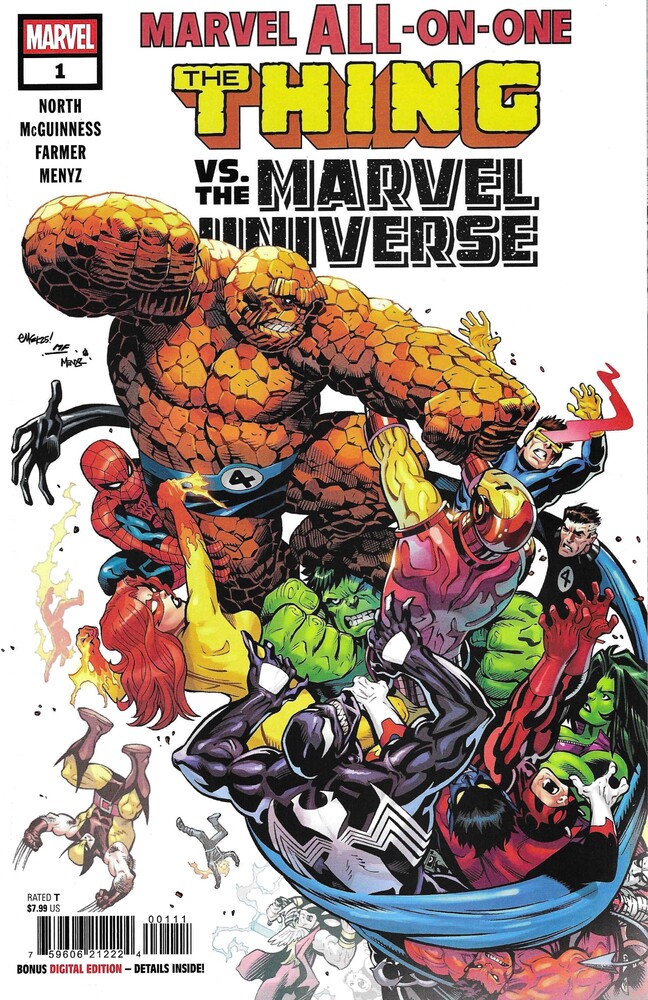 The Thing vs. the Marvel Universe by Ryan North (writer), Ed McGuinness (penciler), Mark Farmer (inker), Marcio Menyz (colorist), Joe Caramagna (letterer), and Tom Brevoort (editor). $7.99, 50 pgs, Marvel.
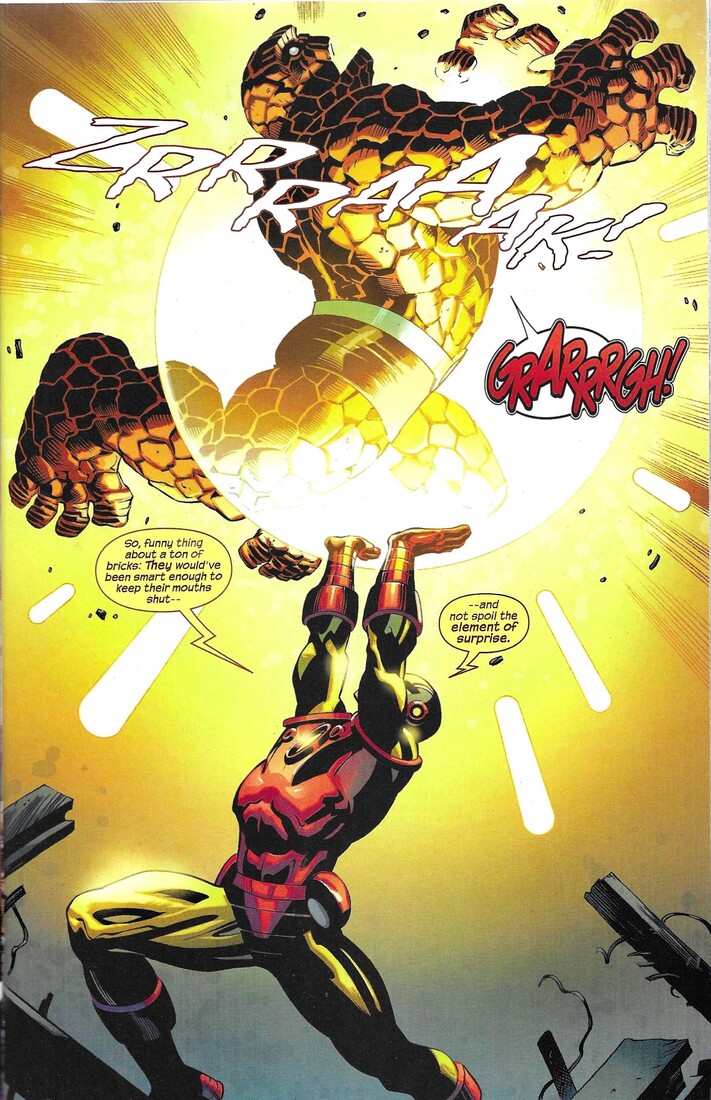
This is a big, dumb comic, almost worth the 8 bucks because it’s the one that McGuinness tells using all splash pages, and the art is just fun as all heck to look at. McGuinness has his flaws, but he’s very, very good at big, dumb action, and that’s what we get here! McGuinness gets to draw a lot of different Marvel heroes (and some villains) and he gets to draw the Thing clobbering them, but it’s in service of a dumb story that’s dumb for a few reasons: North explains one part of it far too early (he kind of has to, or we’d be wondering why Benjy has to clobber all these heroes, but that doesn’t mean it’s not annoying), and the ultimate explanation for what’s going on is kind of, you guessed it, dumb. It doesn’t make this a bad comic, certainly, as superhero comics are often dumb, but it’s definitely a story after Jeph Loeb’s heart, as it’s solely a vehicle for the art. If that’s your thing, check it out!
Rating: ★ ★ ★ ★ ★ ★ ☆ ☆ ☆ ☆
One totally Airwolf panel:
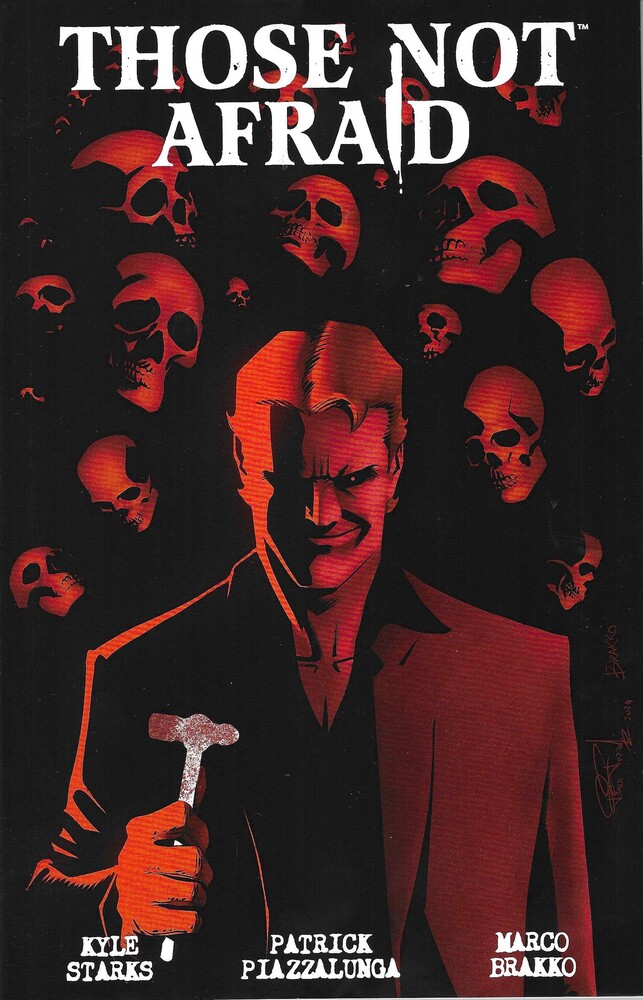 Those Not Afraid volume 1 by Kyle Starks (writer), Patrick Piazzalunga (artist), Marco Brakko (colorist), and Jim Campbell (letterer). $19.99, 96 pgs, Dark Horse.
After his most recent horror story went under, Starks is back with another one, so we’ll see how this one goes! This one is, like Where Monsters Lie, a fairly clever conceit — a couple of serial killers who happen to live in the same town make a bet to see who can break the state record for victims, as they’re both within shouting distance of the body count. A podcaster, CeCe, mentions it on one of her episodes, and she just happens to be friends with a woman, Lucinda, who’s married to one of the killers (but she doesn’t know who he is). The killer, Mark, is a charming and vivacious dude, and he tracks down the other killer, Daniel, who’s a shy, reserved dude, and Mark manages to maneuver Daniel into a date with CeCe. CeCe’s dad is the ex-sheriff of the town, and he’s busy drinking himself to death because he failed to catch the killers. So, you know, there’s a lot going on. Starks plows through plot pretty quickly, as Mark is arrested as the killer and then released for lack of evidence, but that’s enough for Lucinda to figure out he’s up to something hinky. Meanwhile, another disturbed dude decides he wants to set the record, but he’s never killed anyone, so he has to catch up. I wasn’t sure if Starks was going to do more of this or just make it a short series, but when things seem to get wrapped up, he ratchets up the tension a bit more, as he sets up a longer series. Will it sell better than Where Monsters Lie? I think it’s better than that series, but who knows if people will buy it. I can’t predict the market!
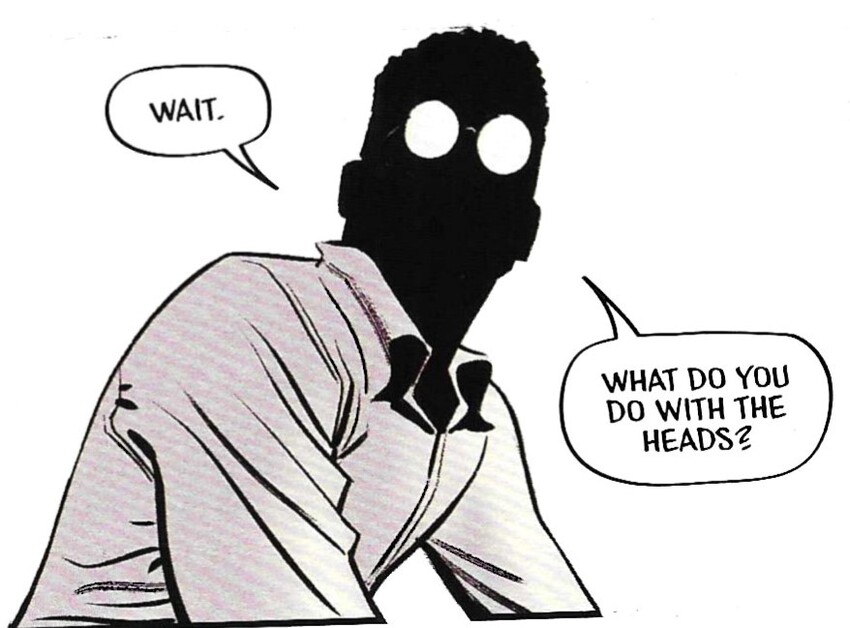
Piazzalunga does nice work on the art — he has a Nick Dragotta vibe going on, which is kind of keen. A lot of the book is dark, but it’s “comic book dark,” not “television dark,” so we can see what’s going on. The characters react very emotionally a lot, and Piazzalunga does well with that, so that’s cool. He also does some nice work with the figures and some wonky perspectives, so sometimes they look much bigger or like they’re coming at us from odd angles, and it makes the book a bit disorienting, which works in its favor. I dig the art, and I hope Piazzalunga can continue doing it on this book.
We shall see. It’s a pretty keen comic.
Rating: ★ ★ ★ ★ ★ ★ ★ ½ ☆ ☆
One totally Airwolf panel:
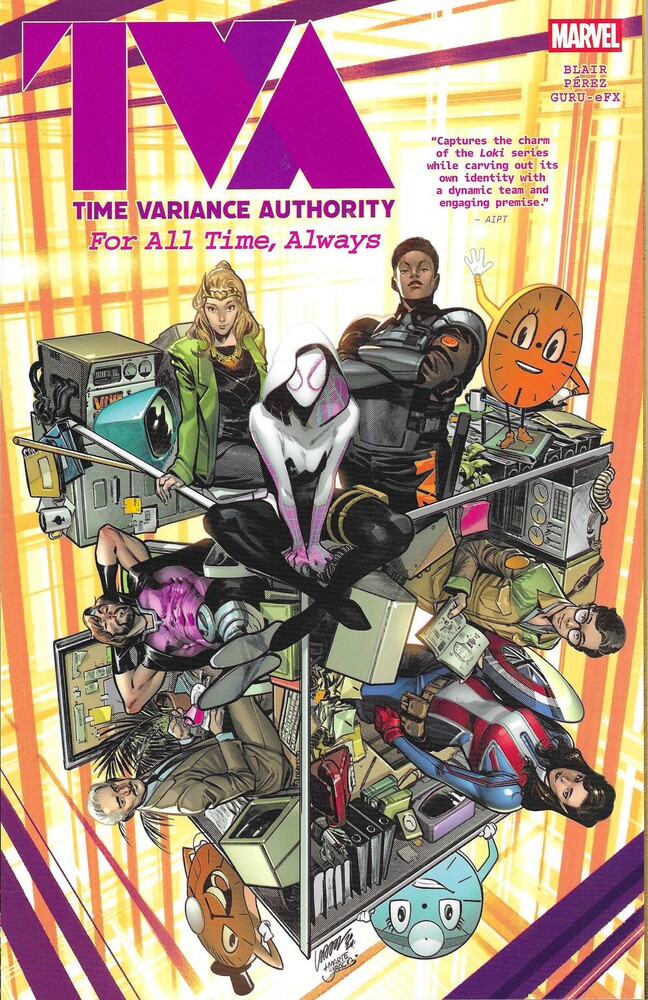 Time Variance Authority: For All Time, Always by Katharyn Blair (writer), Pere Pérez (artist), Guru-eFX (colorist), Joe Sabino (letterer), and Jennifer Grünwald (collection editor). $17.99, 110 pgs, Marvel.
As always, I have to mention that whenever I see “TVA,” like on the cover of this trade, I think of the Tennessee Valley Authority, because my high school American History classes just had that big of an impact on me! This is, of course, not a comic about the struggles of FDR and his Commie buddies to establish a public power company at the height of the Depression, but maybe it should have been!
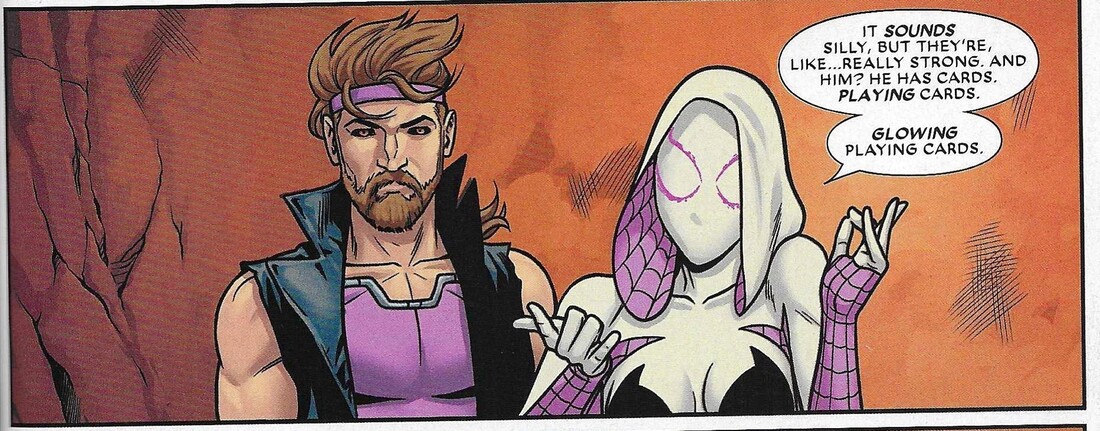
Anyway, this is a perfectly cromulent mini-series, very pretty to look at (Pérez is a good artist, yo) and kind of forgettable. Blair has a bunch of somewhat random characters show up at the TVA — Spider-Gwen (who I guess is called Ghost Spider now), Peggy Carter in her awesome “Captain Carter” incarnation, a dashing Wolverine, a mopey Gambit, Chick Loki — and there’s a threat to all the timelines, and Owen Wilson gets attacked inside the TVA, so they have to worry about a mole, and there’s something in the basement … you know, it’s entertaining, and Blair does a decent job keeping things moving along, but it’s just kind of there. I won’t spoil what’s going on, because when something relies on the plot as much as this does, spoiling it seems churlish. It does its thing, and we all move on with our lives. I don’t love these “different timelines” kind of story, because, I mean, who cares about mopey Gambit, as we’ve never seen him before? I don’t even care about Real Gambit, so I’m certainly not going to care about a mopey variant (although I do like that he’s obnoxiously mopey rather than just obnoxious, which Real Gambit is). At the end of each issue, we get “motivational posters” hung around the TVA by Ryan North and Enid Balam, and those are fun and terrifying. Overall, this is just a mildly entertaining mini-series. If you read it, you’ll probably like it, but it won’t stick with you. That’s not the worst thing, but I do wish it had a bit more heft.
Rating: ★ ★ ★ ★ ★ ★ ½ ☆ ☆ ☆
One totally Airwolf panel:
BOOKS
 The Balkans Since 1453 by L.S. Stavrianos. 970 pgs, 1958, this edition published by New York University Press, 2000.
Years ago I read Fernand Braudel’s The Mediterranean and the Mediterranean World in the Age of Philip II, which is a stunning work of deep, deep scholarship and one of the most classic and famous works of history you can find. After reading this book, I wonder why it doesn’t have the same standing, unless it does and I just missed it, because Stavrianos does for the Balkans what Braudel did for the entire Mediterranean area. I did study the Balkans quite a bit in college, so I’m curious why I hadn’t encountered it before … but it does seem like it was out of print for some time before this new edition, so maybe that’s it. It’s too bad, because while it’s extremely long and took me forever to read it (you might have noticed that I didn’t review any books in my most recent post, which covered June and July, because I was busy reading this), it’s still an impressive achievement. Braudel’s book came out just a decade before this one and is rightly regarded as a classic. I just don’t know why this one isn’t.
Anyway, Stavrianos gets deep into the weeds of the peninsula post-Ottoman conquest (and, naturally, a bit before that, too, to provide context), and he also, like Braudel, discusses the geography and topography of the Balkans much more than a usual history book would. The Balkan peninsula is very inaccessible due to many mountain ranges, and control of the rivers — especially the Danube — is crucial, and Stavrianos doesn’t let us forget the physical world in which these events take place. He goes through the centuries and looks at the rise and fall of the Ottomans and how the empire froze cultural development in the Balkans, both hindering nationalistic feelings until long after they had occurred in Western Europe but also keeping the traditions of the various people alive, because they had nothing else to do except cultivate those traditions. He eventually ends up going country-by-country once the Turks were forced (mostly) out of Europe, and he shows their development prior to World War I, between the wars, during World War II, and the post-war era, which is fairly brief. Stavrianos isn’t the greatest writer in the world — one reason, perhaps, why Braudel, who’s a better writer, is better known — but he’s a thorough historian, and he does a very good job showing all the connections between the people, the land, the different countries, and the greater Europe and why things played out how they did. If he repeats himself occasionally — every Balkan country slid toward authoritarianism in the inter-war period, all for pretty much the same reasons — it’s only to highlight his points and examine how things might have been different. Stavrianos resists bias — it seems clear he’s not a fan of Communist Russia, but he still points out that the Balkan Communists had many legitimate grievances and they were the only ones, in some cases, resisting the Nazis — and sticks to objective analysis, and this makes the book a bit dry. Mostly, though, it’s a clear and compelling history of an extremely tumultuous area of the world, one that continues to be so, largely thanks to events Stavrianos goes over in this book. The memories of the peninsula’s people are long and vivid, and they’re not particularly interested in letting any of it go. Stavrianos does a decent job showing why this is so.
I’m a weirdo, I know, when it comes to some of the things I read. I knew a good deal of this stuff already, especially the pre-Great War history, but it’s still interesting to me. If it’s interesting to you, this might be a book to check out. It’s serious history, though, so beware!
Rating: ★ ★ ★ ★ ★ ★ ★ ½ ☆ ☆
TELEVISION
The Librarians: The Next Chapter season 1 (TNT). I enjoyed the first Librarians series (I watched at least one of the Noah Wyle movies, but I think only one), so I had some hope for this reboot, but it’s not that good. It’s fine, I guess, but as with any show that relies on plot churn (which is most of them), the plots are fine but the real goodness of a show comes from the cast, and the cast in this one just isn’t that great. In the first series, we had Rebecca Romijn, who’s not a bad actor, and she had good chemistry with the three “apprentice” librarians — Christian Kane, Lindy Booth, and John Kim. Kane and Booth had been around for a while, and they’re decent actors, and while Kim was a neophyte, the cast itself worked well together. Plus, John Laroquette was on the show, and Laroquette makes everything better. In this version, Callum McGowan, Olivia Morris, Bluey Robinson, and Jessica Green don’t have as good chemistry, and Caroline Loncq in the Laroquette role isn’t quite as good. The hook isn’t bad — McGowan is a Librarian from the 1840s who gets stuck in a time bubble trying to stop a Serbian general from taking over the world using magic (the show is filmed in the Balkans, which is kind of nifty), and when he’s rescued by Kane (who shows up in a couple of episodes), he releases magic back into the world trying to get back to his time, so Kane has him and the two apprentices — Morris and Robinson — to clean it up, with Green stepping in as McGowan’s Guardian. It’s fine, and the callbacks to the original series are fun, and the show doesn’t take itself too, too seriously (there’s a convention in Belgrade about conspiracies, and it’s fairly goofy), but it’s kind of a pale imitation of the original. Green is not a terribly good actor, and the others give it the old college try, but as I noted, chemistry is paramount for most shows, and it’s lacking here. The second season is either filming right now or already completed, and I’ll probably check it out, but I do hope it gets better. We shall see.
Atlantic Crossing (PBS). At the beginning of World War Deuce, Hitler just up and invaded Scandinavia because, in case you didn’t know, he was kind of a dick. The Danes rolled over like little puppies, and the Norwegians got Quislinged, but not before their royal family managed to flee the country, which is the subject of this pretty good mini-series. Märtha, the crown princess (who was Swedish), managed to get to the States, while her husband, Olav, hung out in London with his father, King Haakon (who was Danish), trying to put together a Norwegian quasi-army. Märtha was friends with FDR, so she tried to get him to help her, which he wanted to but couldn’t because of the U.S.’s neutrality. He managed to finagle some assistance through the Lend-Lease Act, and once the Germans bombed Pearl Harbor, he was free to help, and the series is basically about her commiserating with the prez so that he will help her adopted homeland while pining for her husband, who refuses to leave England. Of course, because it’s a dramatic mini-series, FDR is horny for Märtha and puts the moves on her, which pisses Olav off, and while Märtha has some feelings for FDR, she doesn’t give in. That plot point pissed me off, because it seems like writers simply can’t believe that you can have a piece of fiction without forbidden lust, so they put this in there even though there’s no proof it existed. Roosevelt’s son, who was not around during the time (he was in Hollywood), thought FDR was horny for the princess, but how would he know? Gore Vidal and Roald Dahl, two — mind you — fiction writers, thought there was something hinky going on, but fuck those horny dudes, amirite? It doesn’t really add too much to the narrative — we know they’re not going to consummate the relationship, not only because it probably didn’t exist but because Märtha’s son, Harald, who appears in the series as a cute l’il 3-8-year-old boy, is still the frickin’ king of Norway as of this writing, and I imagine he wouldn’t dig his moms being portrayed this way. Anyway, it’s a pretty gripping series, and the leads — Sofia Helin as Märtha, Tobias Santelmann as Olav, and Kyle McLachlan doing an uncanny FDR — are pretty good, so it’s fun to check out. Oh, and Hitler sucked. I shouldn’t have to write that, but, you know.
Resident Alien season 4 (SyFy). Resident Alien comes to an end, and while it was never a great show, it was entertaining, and it continued to be to the end. This season was a bit messy, as we ended last season with Harry trapped on the alien ship — which turns out to be the moon — and a creature mimicking him back in Colorado, but he escaped ridiculously easily and thwarted the mimic, although it would hang around for a while. I don’t know when the showrunners knew this would be the final season — I assume before it began, maybe, because they really do try to wrap everything up, bringing back some old characters to check in on them and basically letting all the cast members in on Harry’s secret. The final episode is a bit weird, because they really wanted to get Harry and Asta off on new adventures (not together, though — the show never hooked them up like the comics did, and I’m glad about that), and so it did feel a bit rushed. Anyway, the cast remained strong — Steve the Pirate continued to have a blast, Sara Tomko was excellent as the calming influence to Harry’s wackiness, Corey Reynolds and Elizabeth Bowen continued to have excellent chemistry as sheriff and deputy, Alice Wetterlund did very well with D’Arcy’s journey toward sobriety, Levi Feihler and Meredith Garretson had a good arc about their stolen baby, and Judah Prehn and Gracelyn Awad Rinke continue to shine as the kids who are always trying to prove that Harry’s an alien. It never took itself too seriously, but it wasn’t afraid to delve into serious topics, and it worked pretty well. Not a bad show to binge if you’ve never seen it.
**********
Let’s check out what I spent in August!
6 August: $243.80
13 August: $159.60
20 August: $117.91
27 August: $108.39
Total for August: $629.70 (’24: $717.26; ’23: $720.40; ’22: $1000.03; ’21: 871.59)
YTD: $3864.38 (’24: $4333.35; ’23: $4391.18; ’22: $7258.83; ’21: $5341.27)
That’s a bit up from June and July, but still below every other August for the past few years, and my year-to-date is well down, too. I’m just not buying as many comics! Have I outgrown them, or are comics just letting me down? I think it’s more the latter, because I still love reading good ones!
**********
I wanted to write about more music this month, but I never got around to it, and August in the Basin is never fun, so the lassitude was upon me far too often! I’ll try to get back to it this month!
How’s everyone doing? Here in the States we’re just waiting for someone to drop dead, although knowing someone, they’ll probably live to 105 just like Robert Mugabe, because evil keeps itself alive, somehow? (Yes, I know Mugabe was “only” 95 when he finally shuffled off to Hell. Exaggeration for effect!) Anyway, the good-ish news is that someone is going to have to go Full Dictator to enact all their hateful policies, because actual non-evil individuals (or maybe just slightly less evil) are pointing out that, no, you can’t just wipe your ass with the Constitution and call it a day. So we’ll see how it all shakes out. The bad-ish news is that it’s very, very clear that someone and their cronies really want to cancel the 2026 elections, and if someone doesn’t have a massive stroke and fall off the twig, they might do it. If you don’t know who I’m talking about, that’s great — be sure to say that to the FBI agents who show up at your door asking about me.
Anyway, that’s enough of that. We’re doing ok here, I guess. Life, you know. Everyone is still alive and healthy, and hey, it’s football season, so that’s not the worst thing in the world. I hope you’re all doing well! That’s all I got!

Nice to know that Stavrianos’ book is still getting read, particularly by someone who’s not a college student and/or doing some kind of research on the Balkans. It’s still probably the best survey of the region’s history.
…and Resident Alien *is* a great show…
Well, as I pointed out, I AM kind of weird, so that’s probably why I read the book! 🙂
I think my comments are going into the spam folder. Testing, testing.
I’m seeing it just fine, sir! 🙂
Well, this one, yes, but my earlier and much longer comment disappeared into the ether!
Yes, football season is upon us. Luckily the kickoff Eagles vs Cowboys game is showing live on Sky Showcase channel.
Starts at 1.30am but it worth losing sleep over.
Go Birds, baby!
E-A-G-L-E-S EAGLES!
I didn’t get any comics this month, but I have enough comics in my “to read” pile(not mention to my “to re-read” pile) From all of those comics you mentioned, I think I might get eventually that Thing vs Marvel comic. Because one can’t have enough dumb fun comics.
I have been reading some comics and non comics, mainly that Superman Adventures Compendium(sooo good) and a Dashiell Hammett short stories book(sadly, it was also a very short book, like 150 pages or so) and that one was really good too.
For real life stuff: I’ve been more active in the job-hunting department, and man, looking for job when you only had minor jobs and giant gaps in the resume is rough. I’m “too experienced” for jobs that require very little experience, even if my experience is like 5 years or more out of date. But I’m too inexperienced for jobs that pay more but require some experience that I do have but also I’m out of date for lots of tech so that sucks.
Maybe I should just do crimes. I mean, we all know that in the real world crime does pay.
Turn to crime, sir! 🙂
I know what you mean, though. I’ve been trying to get a job for a few months, and even though I’m not looking too hard, the dearth is depressing. Good luck to you!
Holyyyyyy shit, the second Power Fantasy arc was awesome – can’t wait for #12.
Definitely looking forward to your eventual writeup of the Taylor Nightwing – just a warm hug of a book.
It might be a while — the second omnibus has to come out, and I don’t know when that will be! 🙂
Fair! I Hoopla-ed most of it, when I didn’t have library access (speaking of which, Love Everlasting V3 finally dropped!).
Speaking of libraries, I just wrapped my big reading project of the last few months…and Bendis’s OG Ultimate Spider-Man is pretty comfortably the best Spider-Man ongoing of all time.
I read his Miles stuff as it was coming out, but I didn’t appreciate how damn heartbreaking Death of Spider-Man was…and I now deeply appreciate the twist at the end of his Miles run.
I liked Abs Bats more than you, and really dug Dragotta’s art in that. Sherman is also killing it on Absolute WW.
There is a Hero Trade TPB out, but it collects different stuff. I dug it a lot!
Wait, there’s a Hero Trade trade, but it’s not this? Fuck the heck is that all about?
There have apparently been a bunch of Hero Trade stories– mainly dealing with superhero organs being sold on the black market– and the trade collects them. Then this one here is a further continuation.
Stupid Bad Idea with their stupid publicity problems! 🙂