

“It started simply enough: just a pulse in the lowest registers — bassoons and basset horns — like a rusty squeezebox. It would have been comic except for the slowness, which gave it instead a sort of serenity. And then suddenly, high above it, sounded a single note on the oboe. It hung there unwavering — piercing me through — till breath could hold it no longer, and a clarinet withdrew it out of me, and sweetened it into a phrase of such delight it had me trembling. The light flickered in the room. My eyes clouded! The squeezebox groaned louder, and over it the higher instruments wailed and warbled, throwing lines of sound around me — long lines of pain around and through me — Ah, the pain! Pain as I had never known it. I called up to my sharp old God ‘What is this? … What?!’ But the squeezebox went on and on, and the pain cut deeper into my shaking head until suddenly I was running — dashing through the side-door, stumbling downstairs into the street, into the cold night, gasping for life. ‘What?! What is this? Tell me, Signore! What is this pain? What is this need in the sound? Forever unfulfillable, yet fulfilling him who hears it, utterly. Is it Your need? Can it be Yours? …’
“Dimly the music sounded from the salon above. Dimly the stars shone on the empty street. I was suddenly frightened. It seemed to me I had heard a voice of God — and that it issued from a creature whose own voice I had also heard — and it was the voice of an obscene child!” (Peter Shaffer, from Amadeus)
BOOKS
Strange Case of Dr Jekyll and Mr Hyde by Robert Louis Stevenson. Originally published in 1886.
I love the fact that there is, technically, no article in the title. That’s how Stevenson wanted it!!!! Don’t fall for publishers who put it in there!
In yet another case of “knowing the story but not the book,” this is not written in the way you expect from the movies, and I would be fascinated to see someone make a movie hewing more closely to the book, because it might work pretty well. The book is a mystery, and perhaps because everyone knows who Edward Hyde is, it wouldn’t work, but I still think someone should give it a try (unless they have and I missed it). Henry Jekyll isn’t even really the main character of the novella (it’s not long at all — about 25,000 words), as he and Hyde remain shadowy enigmas for most of it as Mr. Utterson tries to sus out what the heck is going on with his friend. Utterson, a humorless lawyer whom Jekyll often employs, is out with his cousin when they see Hyde almost trample a young girl. When they confront Hyde about it, he gives the girl’s family a cheque drawn on Jekyll’s account, which alerts Utterson to the entire situation. He tries to unravel the mystery — he believes Hyde is blackmailing Jekyll — and he pieces together a little bit of what’s going on. Eventually, Hyde is found dead, and Utterson is able to read Jekyll’s journal and understand what has happened. It’s a pretty gripping novella, actually. I do think that audiences would enjoy a more faithful retelling of the book, even if they know what’s coming. The moodiness and weirdness of the early parts of the novella, with Utterson playing detective and both Jekyll and Hyde remaining characters barely glimpsed as he digs into the mystery, would be keen to see, and while Jekyll’s journal is a more straight-forward explanation and might be a bit boring after we’ve already seen some of the things he writes about, a good filmmaker could make it work. Anyway, there are a lot of themes in the book — the good versus evil thing (Jekyll is very much a douchebag, so calling him “good” is a bit of a stretch, but let’s just go with it), the addiction thing, the public versus private contradiction, the homosexual repression thing — but you know them all already. It’s just a neat Gothic horror book, and it’s a good read.
Rating: ★ ★ ★ ★ ★ ★ ★ ★ ☆ ☆
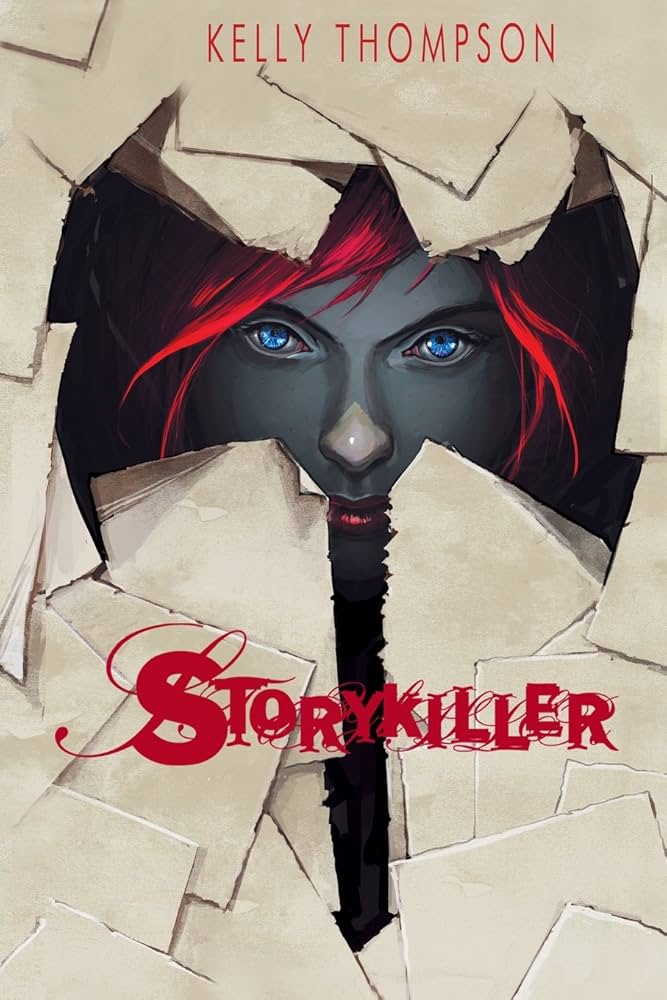 Storykiller by Kelly Thompson. 297 pgs, 2014.
Here’s yet another book that I’ve owned for over a decade yet never read, as I must stick to my alphabetical order of reading, people! It’s just science!!!!!
I didn’t love Thompson’s first novel, The Girl Who Would Be King, although it was perfectly fine, and back then, of course I was going to get her second novel, which she also Kickstarted back in the day (and did very well with it). It came out just about the time her comics career was starting, and she hasn’t written a novel since (which is annoying, as this definitely sets up a sequel hard), which is too bad. Still, Storykiller is better than The Girl Who Would Be King, but it’s still a bit flawed. The set-up is that everything fictional is actually real, and every fictional character lives in a world called, appropriately, Story. The protagonist, Tessa Battle, is a teen who turns 17 at the beginning of the book and discovers that she’s something called the “Last Scion,” the ancestor of a union between a Real person and a Fictional person. She’s able to bridge the gap between the worlds, and more importantly, she’s able to actually kill Stories, which means they’re erased from history completely and no one “Real” will remember them (she kills Bluebeard early on, and her “Real” friends immediately don’t know who Bluebeard is). She’s the “Last” because she’s the first Scion to be female, and there’s — of course — a prophecy about that. Oh dear. Because she kills Bluebeard, she gets caught up in the politics of Story and how the Fictional characters interact with the Real world, and she needs to figure out what to do about it. Someone — or something — is moving around her town of Lore, Oregon, which is kind of a nexus of Fictional characters coming over into the Real, and she has to deal with it. She makes a couple of friends — Brand and Micah — and she gains some reluctant Fictional allies, including the Snow Queen and the Big Bad Wolf (who is also Fenris), and she gets a love interest, Robin Hood. There are bad things coming for them, and they need to work it out, while Tessa is trying to learn about her abilities and keep her identity a bit secret and try to figure out why the people in charge of Story don’t seem to be on her side. There’s a lot going on!
As usual, Thompson creates interesting characters, because she’s very good at that. Tessa annoys me quite a bit, but that’s not a bad thing, because she’s a 17-year-old with a lot of emotional problems and she doesn’t always make smart choices, and that annoys me (in a good way). Come on, Tessa, be smarter! She flies off the handle quickly and rushes into trouble a bit too quickly, but it makes sense because of the way Thompson constructs her, so she feels like a real character even though she does some dumb things sometimes. The Snow Queen is fascinating, as she’s a complete bitch, because she likes living in the Real world so she wants to help but she’s also very selfish, so she doesn’t want to help all that much. Micah and Brand are very neat, too, as they seem that they’re going to be “minions,” as the Snow Queen calls them, but Thompson is too smart for that, and they become really interesting characters in their own right. She does a nice job taking Tessa through the story, and she always plots things well, so the story tends to click together fairly well.
I do have some issues with it, though. As decent as the plot is, ultimately, we don’t really know what Tessa is supposed to do. The plot, such as it is, is kind of forced on her, and she’s reacting the entire time. Early on, the leaders of Story tell her vaguely what her job is, but when the plot kicks in, it’s that she trying to stop something that doesn’t seem to have much to do with her job. So it’s kind of frustrating, because it feels like she’s doing a lot of stuff that doesn’t really move her story along. It’s kind of hard to explain, but it feels like this story is … a bit incidental to what’s really going on? Furthermore, there’s Robin Hood. Robin is Tessa’a love interest, but it doesn’t really work for me. Robin is a Story, and his Story features Maid Marian, and they make a deal about it, which is nice, but Robin talks a lot about breaking free from his own Story, and it doesn’t feel … right? Plus, it doesn’t feel like Thompson makes it work very well — the romance isn’t as well developed as some of the other parts of it, and so it feels a bit artificial. Plus, Tessa is 17 and Robin is obviously an adult, and it’s a bit odd to me, especially as Tessa has never been in a romance before, so she doesn’t quite know what to do with it and it feels a bit like Robin is taking advantage of her? I don’t know, it just seems off. Perhaps if it had been written a bit better, I might have liked it more, but it doesn’t feel like Thompson knows what to do with them, and even that she’s not that interested in it? I don’t know — it just doesn’t hit with me. I like the story when Tessa and her “minions” and her reluctant allies are fighting the bad guys and trying to figure out what’s going on and less when she’s getting all hot and bothered over Robin Hood. Her relationships with almost every other character works quite well, but the one with Robin just doesn’t do it for me.
Anyway, the book is available on Amazon, if you’re interested in checking it out. I imagine Kelly has some copies, if you want to contact her directly — she’s nice, she’ll get you hooked up!
Rating: ★ ★ ★ ★ ★ ★ ★ ☆ ☆ ☆
 Hadji Murád by Leo Tolstoy. Originally published in 1912/1917, translated by Aylmer Maude.
I’ve only read one Tolstoy book prior to this (the big one), but I heard of this a few years ago and decided to get it because it’s a novella, so it wouldn’t take a month to read like some of his giant books. Tolstoy wrote this between 1896 and 1904, and it’s set in 1851/1852 and is based on a true story. Tolstoy had served in the Russian military around the time the story is set, and he met Hadji Murád in December 1851, when he surrendered to the Russians, so it’s clear that the Avar chieftain, who was in his mid-30s, about ten years older than Tolstoy, made quite the impression. This book tells the story of his surrender and subsequent death, and it’s not terribly long (my copy is 145 pages; I can’t find a word count). It’s both an interesting read, given that Tolstoy is, naturally, a very good writer, and also a bit frustrating, because so little happens. Hadji Murád is a tribesman in the Caucasus, a flashpoint of war for Russia for a long time as they always tried to expand their empire and the people living there did not think that was a great idea. Murád fought against the Russians for several years until he got in a feud with one of the local leaders, which prompted him to go over to the Russians. The Russians took him in, but they never quite trusted him, of course. Murád’s former boss had taken his entire family hostage, and Murád wanted the Russians to negotiate for their release before he helped them, but they dragged their feet. After some months of frustration, Murád decided to take matters into his own hands and rode away on a rescue mission, but the Russians chased him down and killed him. Game over, man.
There’s not a lot going on here, and it’s a bit frustrating. Unlike in his other work I read (you know, the big one), Tolstoy doesn’t seem terribly interested in the inner workings of the characters, so we don’t get too much about what’s actually going through, say, Hadji Murád’s head. We get a tiny bit, but not, it feels, enough, and it makes his actions occasionally inscrutable. The other characters are ciphers, too, and it’s a bit frustrating. Like a fellow 19th-century writer (the one who wrote about that dude with the curved back who lives in that Parisian cathedral), Tolstoy goes off on weird tangents — there’s a good bit in the middle of the book about a Russian soldier who is wounded and later dies, and later on, there’s a good deal about one of the Russian soldiers who sort-of befriends Murád (nobody really befriends him, but some are more accommodating toward him than others). Murád does tell his life story to one Russian, so we get that, but when he decides to betray his hosts and go back into the wilderness, it feels almost perfunctory, as if Tolstoy needed to kill him off and so made him do something foolish. Now, in real life, Murád did exactly what Tolstoy has him do, but it’s odd that someone who writes pages and pages about Prince Andrew contemplating his own mortality and even begins the book with the narrator (presumably Tolstoy himself) thinking about a crushed thistle (it works, believe me!) doesn’t do a little bit of that with Murád. Tolstoy is obviously comparing the decadence of the Russians with the rough-hewn Caucasians (Jason Aaron, he of the “urban = bad / rural = good” mode of storytelling, certainly didn’t invent it!), as the Russians go to fancy dinners and flirt (or more) with others’ wives and make sure their tsar (Nicholas I) can find a nice place to bang his latest mistress and think about the glory they’ll receive in battle while Murád and his ilk are fighting for their very survival, and that’s not a bad theme to hit, but it still feels a bit empty. The book can be beautiful because Tolstoy is an excellent writer, and his descriptions of the Caucasus and the small villages where the tribespeople live and the opulence of the Russian lifestyle even so far away from the center of power are very well done, but it still feels a bit too much like a newspaper account, especially when it comes to his nominal hero. We dive more into the Russians’ states of mind, which seems odd. Still, it’s a nice, short adventure story that has some good insights into the way Russia worked in the middle of the 1800s, and Tolstoy can’t help but make the writing beautiful. There’s nothing wrong with that!
Rating: ★ ★ ★ ★ ★ ★ ★ ☆ ☆ ☆
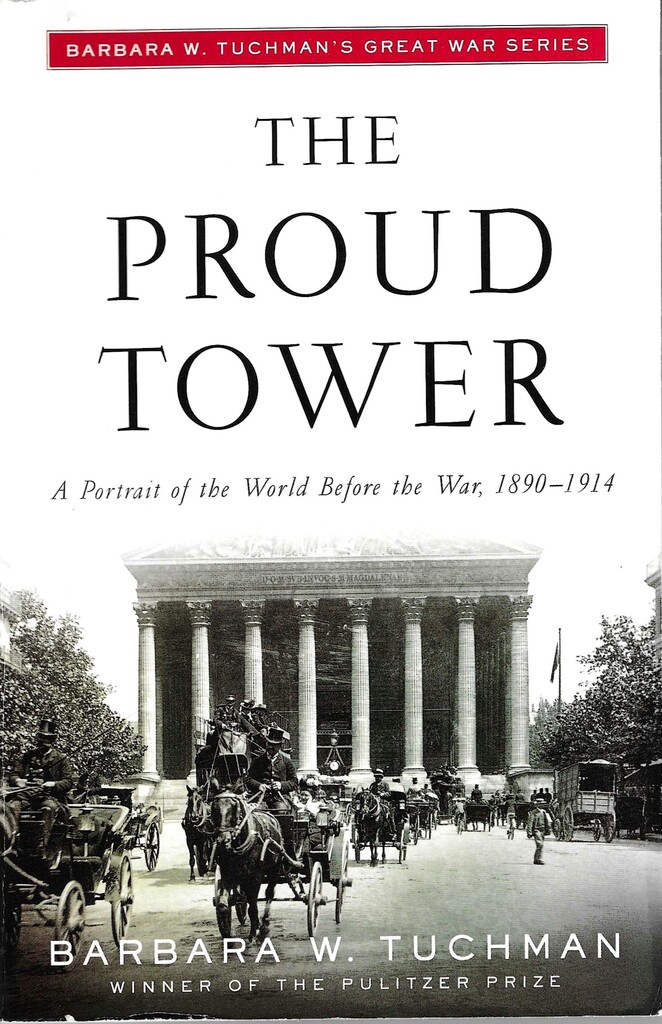 The Proud Tower: A Portrait of the World Before the War, 1890-1914 by Barbara Tuchman. 588 pgs, 1966, The Macmillan Company.
I’ve been a fan of Tuchman’s for years; my dad had a few of her books, so I read them when I was a teenager and enjoyed them. She’s writing histories for God these days, so maybe one day I’ll have actually read all of her books, as there’s nothing new coming out! I have read The Guns of August, one of her World War I books, but not The Zimmermann Telegram, her other World War I book. Maybe some day! This book, another World War I book (not really, of course, as it ends just as the war begins, but still), is a fairly exhaustive look at the state of Europe and the United States in the quarter-century leading up to the war (not “the world,” as the subtitle announces, as Tuchman stays strictly in Europe and the States), and it’s pretty fascinating. She divides the book into large sections focusing on either certain countries or certain movements, and yes, they overlap, but it’s a pretty good way of doing things. She begins in England in the 1890s, with the structure of the country, its place atop the pyramid of nations, and the attitudes of the patricians who thought it would last forever. She moves to the anarchist movement, which was a fairly powerful strain of anti-establishment thought during the years leading up to the war. She checks in on the United States and the empire-building fever that gripped it around the turn of the century. Obviously, she has to take a look at the Dreyfus Affair and what it did to France. She devotes a chapter to the peace movement, which was spearheaded by Russia for cynical reasons but became something that the other countries tried to take seriously and grapple with. The next chapter is about Germany and how it dealt with being the rising star in Europe. She returns to England to examine the first decade of the 20th century, when liberal and socialist politics became more in vogue, and she finishes with a broader view of Socialist parties throughout Europe, which made large gains during this time (even in the U.S., where Eugene Debs actually got millions of votes in presidential elections). As with all of Tuchman’s work, it’s well-written and deeply researched, and she manages to tie all the threads together quite well, from the attitudes of the upper classes who thought everything was great at this time to the travails of the lower classes, who thought things probably needed to change a bit. One thing she avoids, which is interesting, is the sense of inevitability about the war — in hindsight, we can see how things led to the war, but at the time, there was very little warning about it, and Tuchman notes some of the alliances that would make it possible, but doesn’t push it, which feels like the right way to go, as everyone living at the time did seem to be taken off-guard by the outbreak of hostilities. Despite the build-up of militaries, the delegates to the peace conferences really did try to hammer out plans to stop or at least restrict war. The upper crust in England and France might have been disdainful of Germany, but they really did believe men — or at least white men — had become too civilized for an apocalyptic conflict. Her chapter on Germany is fascinating, as it’s the only one that delves into the culture of a society, and Richard Strauss is the star of the section. It’s fascinating because as their culture became recognized for its triumphs, Tuchman implies the rise of a superior attitude about said culture, which leads to uglier notions down the road. There’s a lot going on the book, as you can probably tell. Tuchman is a fine historian, so there’s not a lot of 1960s bias about certain things — I’ve read histories from this time period that retroactively damn the Russian Communists because of what they had become, but Tuchman avoids that. Her writing is always pretty good, and she keeps things clear even though she’s dealing with a lot of characters across several years. This isn’t my favorite book of hers — I think that’s A Distant Mirror — but it’s a good history of a time period that gets a lot of focus, naturally, but not in the way Tuchman focuses on it, so that’s nice.
Rasting: ★ ★ ★ ★ ★ ★ ★ ★ ☆ ☆
TELEVISION
How to Get to Heaven from Belfast (Netflix). Lisa McGee’s follow-up to Derry Girls is not as funny as that one, but that’s because it’s not a comedy (and it is funny, just not as funny as Derry Girls). Three high school friends — Saoirse (Roisin Gallagher), Robyn (Sinéad Keenan), and Dara (Caoilfhionn Dunne) — get mysterious emails telling them their fourth friend, Greta (Natasha O’Keeffe), has died and they should come to the wake. They meet Greta’s odd family — her husband, Owen (Emmett J. Scanlan), her daughter, Maria (Matilda Freeman), and her mother-in-law, Margo (Michelle Fairly) — and Saoirse, who writes a popular crime series, begins to think the corpse in the coffin is not actually Greta. We find out she’s right fairly quickly, but the other characters don’t know it for a while. Greta is on the run for some reason, and a network of women is helping her establish a new identity and get out of the country. Meanwhile, the three friends think her “death” has something to do with a Bad Thing™ they all did in high school, especially when the son of one of the characters from back then shows up and begins asking questions. It sounds dire, but there’s a lot of humor in it, even as things do get bleak occasionally, and there are several murders in the show, so there’s that. The three leads work very well together, and we can believe they’re long-time friends, and O’Keeffe does a nice job playing off the rather strange women who are helping her but also kind of keeping her prisoner (they have a good reason — she’s not allowed to contact anyone from her former life — but it still feels a bit mean). There are also a lot of red herrings, but they don’t feel forced into the narrative just to confuse us — we’re experiencing the investigation kind of how the three friends do, so they chase leads and we’re not sure if they’re chasing a good one or not, so it doesn’t feel too odd when they don’t pan out. Plus, every lead they chase adds more backstory to them and their friendship, so it’s a nice way to get some character development in. The cast is very good — not only the main cast, but the rest of it, too, with people like Darragh Hand, Bronagh Gallagher, Saoirse-Monica Jackson, and the actors who play the teen versions of the main cast — and the locations are, of course, very cool to see (it’s filmed in Ireland, of course, and some of it is in Malta, which stands in for Portugal). At one point, Jackson sits in Derry in front of a Derry Girls mural, of which she was a member, so it’s Jackson’s character sitting in front of a different Jackson character, which is fun. Anyway, this is only 8 episodes (very stuffed episodes, though — McGee keeps things moving!), so you should invest some time in it!
Dark Winds season 4 (AMC). Zahn McClarnon is back in everyone’s favorite Navajo crime drama based on the books of Tony Hillerman and set in 1970s Arizona, and this time he’s contemplating retirement because his wife, quite correctly, ditched him and moved to Los Angeles because he was being a dick in earlier seasons (not to her, just in general). So he’s working on himself, hoping to prove to her that he’s changed (which, in the course of the season, he does, but it’s not enough to lure her back), and thinking about letting Jessica Matten, who’s back working for the tribal police after her disillusioning turn with Border Patrol in season 3, take over as lieutenant. Matten, meanwhile, is boinking Kiowa Green, her fellow cop, which, of course, is complicated. They come across a small massacre at a diner on the rez, and from that they figure out that a 16-year-old girl is missing and she was hanging out with her cousin at the diner and someone is looking for the cousin for some reason. Eventually, they have to head off to Los Angeles to find the girl, and they’re caught up in a bigger case than they realize. As usual, it’s a tense drama, but man, I’m getting less and less tolerant of characters being written stupidly. Jim Chee, Gordon’s character, has always been kind of a progressive dude, especially for the early 1970s, but when he finds out that McClarnon wants to promote Bernadette (Matten’s character) instead of him, he spends several episodes being a complete baby about it. He acts petulantly, refuses to talk about it, and puts himself in dangerous situations to “prove” himself. McClarnon has a perfectly reasonable reason for wanting Bernadette, but Chee never asks what it is, nor does McClarnon ever tell him. Nobody at any point tells Chee, “Dude, grow the fuck up,” although Bernadette does come close. I knew it was put in so that Chee can have a “grow up” moment later, but it still feels stupid. Then, of course, McClarnon figures some things out about the case and goes to “solve” it all on his own and gets into danger. The main villain is played with very oddball evil by Franka Potente, who’s taking care of her dementia-ridden Nazi grandfather (played by Udo Kier) and becoming obsessed with McClarnon. McClarnon knows she’s obsessed with him, but he doesn’t take back-up to a place where she might be, and so gets captured. Again, this is just so we can have a tense confrontation between them in the final episode, but he’s still acting very stupidly. Overall, though, it’s still a good show, and getting the principals off the reservation works pretty well, as they get into the culture of Indians who don’t live with the support system a reservation offers, which is something we haven’t seen on the show before. And Joe Leaphorn might want to retire, but the season ends with the beginning of a new case that’s very important to him, so he ain’t going anywhere quite yet!
Seven Dials (Netflix). Mia McKenna-Bruce is adorable in this odd Agatha Christie adaptation as Eileen “Bundle” Brent (no reason is ever given for the nickname) whose prospective fiancé dies the night after attending a party at her family’s sprawling estate (which they are renting out to a nouveau riche steel magnate, because it’s 1925 and the aristocracy just doesn’t have cash anymore) and who suspects foul play even though no one else does. She starts investigating, and more bodies start dropping, of course. She believes there’s a secret society (the Seven Dials) behind it all, but she can’t figure out what they’re doing or how it’s connected to her family. Her father (played by Iain Glen) was killed in Spain a few years earlier, gored by a bull, and her mother, Helena Bonham-Carter, has no use for these new businessmen but can’t escape the fact that they need money. Bundle meets with Superintendent Battle of Scotland Yard (played with very great Britishness by Martin Freeman), who dismisses her at first but can’t deny that she has good instincts. There’s political intrigue, there’s personal intrigue, there’s the secret society, and it’s unclear which way the story is going, which is nice. McKenna-Bruce holds it all together, tearing through the show like a house on fire, ignoring the advice of all to forge her own path. All the men love her, of course, and she uses that a little bit to get her way, but nobody holds that against her. Freeman is able to match her, for the most part, but even he can’t rein her in completely. The show looks great, and it’s only 3 episodes, so we zip through it, and there are all sorts of fun twists and turns. I have never read the original novel (I’ve read a lot of Christie novels, but almost exclusively the Poirot ones), but it seems they didn’t change too much except a few crucial things, so if you have read it, there are some surprises. It’s a fun show.
The Suspicions of Mr Whicher (Disney+). After I read this book, the algorithm in my television started reading my mind and spit up this series as “recommended,” so we eventually watched it. It’s not bad. Paddy Considine stars as Jack Whicher, and the first episode (it’s British television, so each “episode” is basically movie) is about the real-life Road Hill case, while the three subsequent episodes are entirely fictional. This means the first episode, given that it’s based on an actual case, is a bit messier than the others, but the writers of the three other cases do a nice job making them a bit messy, too, as they want to hew a bit closely to the ambiguity of the real-life case, and the show is a bit better because of it. In the second movie, Olivia Colman hires Whicher (after the Road Hill case, he left — or was fired from — the police force and became a private investigator) to find her teenage niece, but the girl turns up dead, so Colman wants Considine to find the baby the girl had recently given birth to. In the third case, Whicher is hired by an MP who was instrumental in getting him kicked off the force who wants him to help his son, a businessman who has recently returned from India and is being followed by an Indian for reasons unknown. Finally, Whicher is gathering evidence for a divorce case, but when the man with whom the woman is being unfaithful is killed, he has a whole different kettle of fish on his hands. The stories take a lot of twists and turns, and Considine is often either completely wrong about what’s going on or being told to mind his own business because he’s uncovering too many secrets (which is hilarious, because he’s an investigator — of course he’s going to dig up secrets, and you might not like what he finds!), and it lends some nice verisimilitude to the proceedings, because of course he’s not going to be perfect. Plus, the show, like the book on which the first case is based, gets a bit into the society of Victorian England — they liked their secrets, naturally, and they don’t want Whicher going places where they can’t control him, but such is life. It makes his job more difficult, naturally, but it also gives us nice insight into how these people lived and how hypocritical they could be. Considine, who’s usually played supporting roles, is quite good as the put-upon Whicher — he doesn’t want to step on anyone’s toes, but he can’t really let go of something once he starts digging into it, especially if he hasn’t figured everything out yet. As this is a time when forensic science didn’t exist (or was so rudimentary as to make no difference), he needs to get people to confess or at least discover so much circumstantial evidence that they have no recourse, so he becomes annoying to the other characters, badgering them so they finally lose their cool, which is what a lot of television detectives do, of course, but Considine does a nice job with it — he’s like Columbo in that he just keeps calmly asking questions until the suspects break. The show is gorgeous, too, as it feels darker than a lot of shows set during this time, as the filmmakers seem to use a lot more natural light. It seems like they do this simply to show how dark the indoors of Victorian England could be, and it lends a nice atmospheric vibe to the whole thing. The settings are very nice, too, as we get both the squalor of London and the beauty of the English countryside. It’s a decent enough detective show, if that’s what you like, and it’s streaming on Disney, so you can take a look there!
The Puzzle Lady season 1 (PBS). This is called Murder Most Puzzling in the UK. Why did they change it?!?!?!? Stupid ‘Muricans!
Anyway, it’s yet another “cozy mystery” series, of which there are dozens — hundreds? — but which are usually fun as all heck. In this case, a very famous crossword puzzle … writer? (yes, you read that correctly — a famous cruciverbalist) moves to a small-ish town in Yorkshire with her niece and sets up shop. They’re obviously running away from something, which we find out quickly is the niece’s abusive ex-husband. When a corpse is found stretched out on top of a grave in the local cemetery with a piece of paper on her chest bearing what appears to be a crossword clue, the cops head over to the Puzzle Lady’s house to ask for help. And just like that, Cora Felton, the Puzzle Lady, is involved with solving crimes!
There are three mysteries in this season, and they’re all pretty interesting. The first case draws Cora (played by Phyllis Logan) in, but she finds that she has a taste for it and is good at it, so she wants to keep helping the police even though the DCI, Hooper (Adam Best), thinks she’s a nuisance. Meanwhile, not only does her niece, Sherry (Charlotte Hope), want to lay low to keep out of her ex-husband’s orbit (he’s famous and has some resources to find her), but Cora herself has some secrets. Of course, everything comes out in the course of the series, but it just sets up more seasons of the show, so that’s all right. The cases are fine, but, as with all of these kinds of shows, the cast makes it work. Logan is very good as a woman who has some serious self-esteem issues and hides them well by being a blustery older woman who thinks nobody will hurt her because she’s an older woman (Logan was 69 when the show was filmed, but it seems like she’s playing someone at least a decade younger), while Hope always has nice, twitchy energy (she was in Game of Thrones for a bit, but I remember her most as Catherine of Aragon in The Spanish Princess) that works well in a role like this, where she’s not sure if an abuser is going to find her and she’s not sure whom she can trust. Best does a nice job as the cop who might be slightly in over his head, and the rest of the cast is pretty good, too — they’re not quite as “quirky” as a lot of these British cozy mysteries, which is a good thing. I don’t know — you know I dig these kinds of shows, so I’m inclined to like them. If you’re not, I don’t know if this will convince you, but I think it’s pretty good!
Peacemaker season 2 (HBO). This is both a better and worse season of Peacemaker than the first, which is hard to do. It’s worse because it feels a bit more unfocused — there’s no big bad that our boy Jon Cena has to fight against, and it feels just a bit messy. Peacemaker has a door to another dimension, and one day he discovers one very much like his own … except his dad and, especially, his brother are still alive. He accidentally kills his doppelgänger, but then he decides to replace him, because his world is just too painful for him and in the other dimension, he has a chance to be happy with his family and Harcourt (Jennifer Holland), who’s a bit nicer in the new dimension. Of course, his friends want to bring him back, and the new dimension isn’t quite as nice as Jon Cena thinks it is (my wife figured it out pretty early, and Gunn does a hilarious job making it obvious once Peacemaker’s friends show up, but it’s still a pretty good swerve), and the shit starts hitting the fan a lot. The problem that while the plot kicks off in the first episode, it takes a while before Peacemaker goes to the other dimension, and it feels a bit draggy. Meanwhile, the A.R.G.U.S. part of the plot is a bit silly — Rick Flag, Sr. (Frank Grillo) takes over, and it’s clear he has it out for Our Boy because Peacemaker, you know, killed his son. He claims it’s not about that, but, come on, Crossbones! He also wants access to the dimensional portal, and that’s the other big plot, because he wants … well, if you’re up on recent-ish Suicide Squad history, you can figure out what Flag is looking for. Apparently, Gunn has said there are no plans for a third season, but … I mean, there has to be some resolution to Peacemaker’s dilemma at the end of the season, right?
Anyway, the good parts of the season are, naturally, the core group of “11th Street Kids” — Peacemaker, Adebayo, Harcourt, Economos, and fucking Adrian Chase. They have their issues, sure, but the writing for these characters is usually crisp and the cast sells it. Chase actively seeks out his double in the other dimension, and the results are pretty hilarious. Nhut Le, Sol Rodríguez, and Tim Meadows as Judomaster, Sasha Bordeaux, and Langston Fleury, respectively, are quite good (Meadows is just creepy and hilarious and scary all at once), and Michael Rooker has fun in basically an extended cameo. Sure, it’s wildly vulgar, but the cast is quite good, and it’s nice to see them work with each other. Peacemaker’s difficult romance with Harcourt is nicely done, too, as Holland does a good job showing just how damaged Harcourt is. And the violence is fun as hell, too. I wish it had been a bit more focused, but it’s still a pretty good show. I just don’t know what Gunn is going to do with Poor L’il Jon Cena if there’s not another season!
The Count of Monte Cristo (PBS). Sam Claflin of Hunger Games fame (yes, I know he’s been in other stuff!) wanted to make this series, it seems, because he’s a producer as well as the star, and by gum, he did it! It’s been years since I read the book, but revenge stories are always fun, aren’t they? I do wish this had been a bit more like Inigo Montoya’s revenge, but I guess drama demands some soul-searching, so as Claflin gets closer to finishing his grand project, he has some doubts about its morality, but, I mean, those three dudes are douchebags, so fuck ’em, right? Anyway, Edmond Dantès is falsely accused of a crime, sent to prison for 15 years, weird old dude tells him where to find treasure so he can fund his revenge, he escapes and screws with everyone who put him there. Easy-peasy, right? There are some alterations to the text in the transition to television — most notably, perhaps, is how the series ends, which changes Edmond’s fate fairly significantly (for the better, I think, but you may disagree). For the most part, however, this is a fairly faithful adaptation, and it looks amazing. It was filmed in Malta, Italy, and Paris, and the scenery is always gorgeous. Claflin does a decent job as Dantès, underplaying him a bit so that his rage doesn’t boil over, which is an interesting choice. Jeremy Irons shows up as the abbé who teaches him and gifts him the treasure map, and Irons is always fun. A few character act very, very stupidly at key moments, but such is life. Plus, I cannot believe that only Mercédès recognizes Dantès when he shows up. I mean, I get that Villefort barely ever saw him, but Mondego and Danglars knew him fairly well, and all Claflin does to disguise himself is grow a beard. Come on, people! Anyway, there’s not much to say — it’s beautiful, gripping, tense, and they actually allow Eugénie to be a lesbian, so good for her!
Outlander season 8 (Starz). Outlander ended about as well as it could, given that it’s firmly rooted in history and therefore can’t really lead to any apocalyptic showdown — we know the Americans are going to win the Revolution, so why bother with that? I guess some people are annoyed, mainly because a character everyone loved (and who does not die in the books) died, but, you know, such is life. The biggest problem is that the showrunners kind of sidelined one of their best performers, and she’s the main character, so why would they do that? Caitríona Balfe was the heart of the series, and while her romance with Sam Heughan could be overwrought at times (and still is in this final season!), the two actors sold it hard, and it worked very well for the most part. Claire’s story, however, seems to have been over for a few years now, and so they kept trying to make her relevant, and in this season, they gave her a granddaughter, the offspring of her long-thought-dead daughter. Fanny was introduced in season 7, but it wasn’t until the end of that season that Claire suspected that she was her granddaughter, and far too much of this season is spent trying to figure it out. Fanny just doesn’t have much to do, and unless Starz is planning a spin-off with her character (she can, it seems, time travel), it was too much time, but maybe they needed Claire to do something (Florrie Wilkinson, who plays Fanny, isn’t terrible, but she doesn’t have much to do except look sad). This is Jamie’s season, as he gets lured back into the Revolution even though he has a book (brought back in time by his and Claire’s daughter, Brianna) written by Claire’s first husband, Frank, which claims he dies at Kings Mountain. Oh dear. Heughan is quite good this season, as he grapples with being the patriarch of his little slice of North Carolina and all the responsibilities that entails all while trying to stay out of the larger war, which keeps drawing him back in (you guessed it — he’s Old Pacino). The problem is that the cast has expanded so much, so we get his son, William, whom he left with his friend the English lord and who found out that Jamie is his real dad and isn’t handling it too well; we get Brianna and Roger, who aren’t bad characters, certainly, but they also seem to have finished their stories yet they’re still hanging around; we get Ian trying to find his Native wife because her community may have been wiped out and he’s worried about her and his son, which is kind of a useless storyline; we check in with Fergus and Marsali, who are printing subversive literature in Savannah; and why not throw in a random time traveler who’s causing mischief? It’s a lot, and while Sophie Skelton (as Brianna) and Richard Rankin (as Roger) have gotten better at acting over the years and John Bell (as Ian) and César Domboy (as Fergus) have always been fun, William is a drippy character and Charles Vandervaart doesn’t do a whole lot with him, and the fact that he’s a fairly major character this season isn’t great. Balfe and Heughan have always been the center of the show, and while Heughan gets to do a lot this season (and, of course, ends up at Kings Mountain, where he didn’t really want to go), Balfe (who did direct an episode, so maybe she just wants to get more behind the camera) seems to stand around looking into the middle distance and using her modern medical skills to save lives. I mean, good for her and all, but is that it? They’ve given Balfe some dumb stories in this show — she married William’s adoptive father, who’s, you know, gay, when she thought Jamie was dead, which was a phenomenally stupid idea on the part of the writers — but in this season, she doesn’t even have a dumb story, she just has nothing. Oh well. It does end really well, though, I’ll give it that — the last half of the last episode is really powerful stuff. I just think they lost some focus over the past few years — the best seasons are, unfortunately, the first two — and when you’re not using a radiant presence like Balfe well, you’re doing something wrong. It was a pretty good series, though, and I’m glad they didn’t try to make it too world-shattering at the end. The spin-off series is gearing up for its second season, so we’ll see what’s what with that!
Daredevil: Born Again season 2 (Disney+). Daredevil: Born Again is a well-made, often beautiful show with a compelling if somewhat simplistic storyline — what if a demagogue became a dictator (I mean, how unrealistic!) — that suffers from the fact that its leads are mismatched. Charlie Cox is fine as Matt Murdock, but he’s not as good as an actor as Vincent D’Onofrio, who takes this role of a lifetime and just inhabits it, no matter where he turns up (in Hawkeye and Echo, for instance). D’Onofrio makes you believe that Fisk could charm those he needs to charm and kill those he needs to kill, and he simply dominates every scene he’s in, including the ones with Cox (and Deborah Ann Woll, who, like Cox, is fine, but not in D’Onofrio’s league). It doesn’t make Fisk sympathetic, certainly, but it’s almost like we can’t believe he will fail, and when he does, it almost feels like the writers forced it, because there’s no way this Wilson Fisk is losing to this Daredevil (and, to be fair, it takes the entire city of New York, practically, to defeat him). As usual, the real-world parallels hit a bit too close to home and also don’t make much sense, as Fisk is able to do a lot of things in a city that recently elected a godless Muslim socialist as their mayor, so it seems like it would be harder to do what Fisk does there, but I get that it’s a metaphor. I also don’t quite buy Heather Glenn’s arc in this series, as she goes from Murdock’s lover to batshit insane fairly quickly. Margarita Levieva does what she can with the role, but it’s not a very good one, and it’s going to make less sense going forward, if the teaser to next season comes about. I know this is linked to Miller’s story, even though they have to expand it, and that’s fine, but they make some odd narrative choices, and it’s one time I wish they had a bigger Marvel Universe to draw from. In D.G. Chichester’s quasi-sequel to “Born Again,” he brings in Hydra, and we get this magnificent moment:
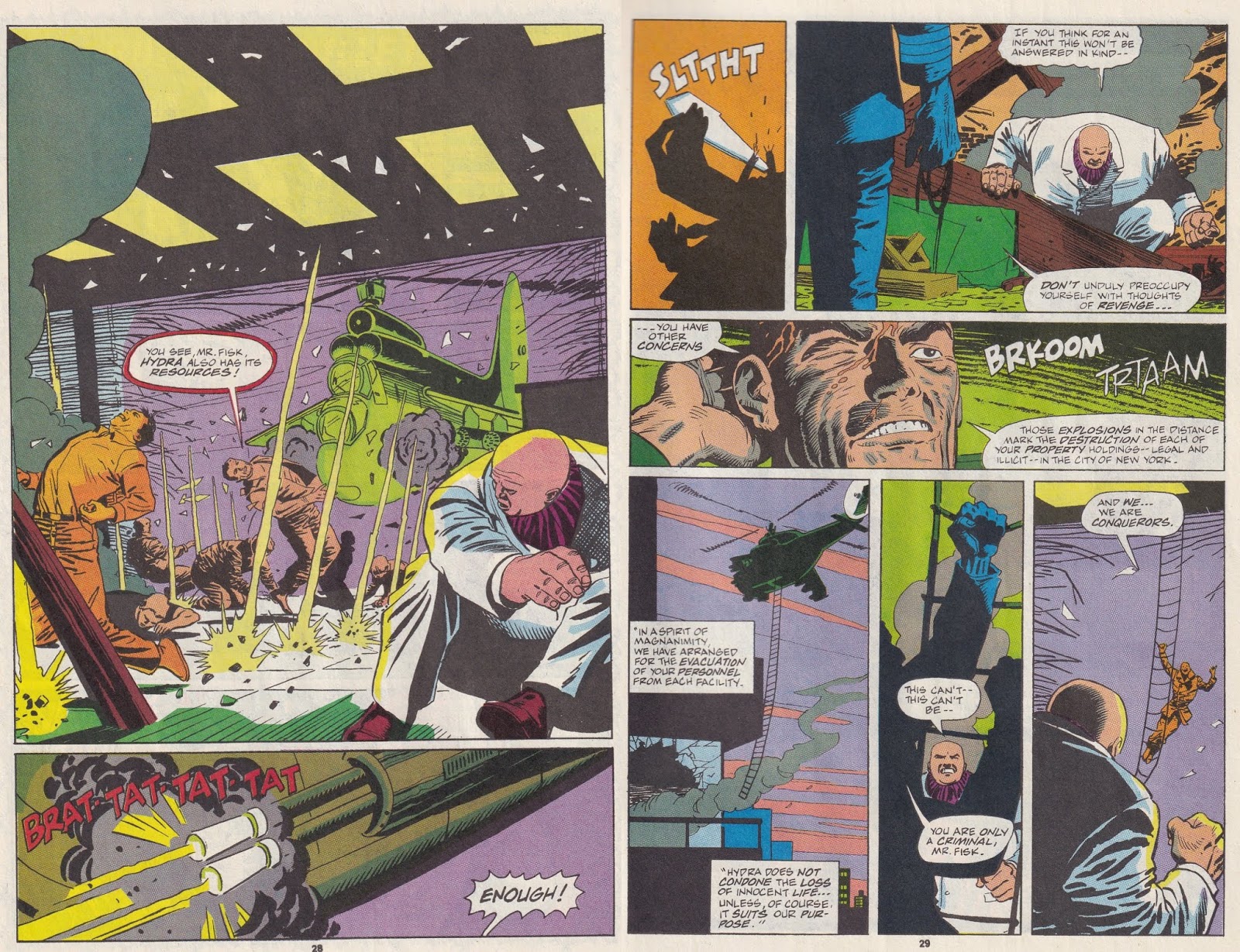
There’s nothing like that in Born Again, which is fine, but I was hoping that Matthew Lillard’s CIA agent would be something like the Hydra soldier here, but the showrunners went a different way with him. It’s fine. I do like that Lili Taylor, as New York’s governor, is not cowed by Fisk, because why would she be? And they do a good job with Bullseye and his arc, and Krysten Ritter shows up at the end of the season, and it’s all fine. It just feels a bit by-the-numbers, and when Cox and D’Onofrio face down, it feels a bit unfair to ol’ Hornhead. But that’s just me. I do hope they stay away from Fisk in the third season, but I fear they will not!
Spider-Noir season 1 (Prime). I mean, Nicolas Cage as a harried 1930s P.I. who happens to have Spider-Manny powers is just perfect, isn’t it? This show got a lot of love on yonder interwebs, and it’s deserved, for the most part. It drags just a bit — you have to fill those 8 episodes! — but not too badly, and Cage has the time of his life being, well, Nic Cage. The cast is quite good: Brendan Gleeson is doing Brendan Gleeson things as Silvermane; Lamorne Morris is Robbie Robertson, a friend of Ben Reilly’s who can’t help being a skeevy journalist occasionally; Karen Rodriguez gets the “secretary” role, which in a noir detective story is usually the stealth MVP, and she kind of is here; Li Jun Li does an excellent job channeling Anna May Wong as Cat Hardy, Gleeson’s kept singer who falls in love with Sandman, played by Jack Huston; and Andrew Lewis Caldwell has a blast playing Megawatt. It’s tied in nicely to World War I and the Depression, and while all the characters do some stupid things that prolongs the plot unnecessarily, generally it works quite well. We watched it in black-and-white, but I am curious to watch it in color, because the coloring is weird and saturated and I’m kind of keen to check it out. The effects are pretty good, and it jsut has a cool vibe. I don’t know what else to say about it: it’s neat.
Amadeus (Starz). Peter Shaffer’s play, on which this is based and which gets referenced at the end (I’ll get back to that), is marvelous, and the movie and this series didn’t quite capture it, because it relied so much on the words, and when you have a great actor alone on a stage, you can get away with the magnificent speeches Salieri gives in the play but you can’t quite get away with it on screen, when people want more spectacle. And so we get a slightly lesser version in both the movie and this series, and because it’s five episodes and not two hours, we need inventions, which are generally not up to par. Whenever writers these days need to fill in some places, they fall back on sex, and so we get a bit more sex than is probably necessary (there’s some in the original play, but not as much as here). Joseph II is a slightly bigger presence in this series, and the politics of the Holy Roman Empire come into play a bit more (they mention the Russo-Turkish War of 1787, for instance, and what it meant to the Empire). Still, it’s a compelling story, told pretty well, and it looks absolutely stunning (it was filmed in Budapest, because of course it was!). Paul Bettany is quite good as Salieri — he feels more elegant and urbane than F. Murray Abraham, so his presence at court feels more realistic. Will Sharpe is fine as Mozart, as he does the vulgar things the story demands quite well, but he’s overmatched a bit by Bettany (Sharpe is 16 years younger than Bettany, when in reality, Mozart was 6 years younger than his “rival” … plus, Salieri was 41 when Mozart dies, and Bettany is 55). The series does rehabilitate Constanze, Mozart’s wife, quite a bit from the play and movie, as Gabrielle Creevy does a good job imbuing her with deep humanity. As we know, the rivalry between Salieri and Mozart is overblown by Shaffer and Mozart wasn’t quite the venal fop of the play, nor did he simply write down his works without any work because he was such a genius, but it makes for good drama. One thing that always bugs me about stories about art is that we don’t really get enough about why the art is such genius. Classical music scholars can understand that Mozart was genius, and we know his music, certainly, but we don’t really get why. It’s the same for any art endeavor, I guess — I can probably recognize why comics art or writing is genius where some non-comics reader can’t, but it still would be nice to know why Mozart was such a brilliant composer and Salieri, in contrast, was not. But that’s just me. Anyway, this is a decent series, and in the end, it’s kind of clever: Alexander Pushkin visits Constanze in the 1820s, who gives him Salieri’s confession, and he writes a short play, Mozart and Salieri, which was later turned into an opera by Nikolai Rimsky-Korsakov* in 1897. The show gives us Pushkin (and ignores the opera), and then we see a man typing up the play (it’s Shaffer, but he’s, you know, dead, so we don’t see his face), and then Bettany on stage giving the final monologue to an audience (it’s pretty much lifted from the play, which is nice, because it’s a neat monologue). It’s a neat way to end. I don’t know how essential this mini-series is, but it’s still pretty decent.
* If you’re ever in Portland, be sure to visit the Rimsky-Korsakoffee House!
**********
Hey, let’s look at the money I spent on comics in April, May, and June!
1 April: $129.22
8 April: $184.76
15 April: $197.77
22 April: $223.78
29 April: $158.75
Total for April: $894.28 (2025: $632.31; 2024: $602.78; 2023: $438.86; 2022: $1090.51; 2021: $651.46)
6 May: $175.60
13 May: $12.99 (!!!) (Yes, it’s true — that’s how little I spent. I would like to point out, though, that it was three (3) single issues, and it still cost thirteen dollars. Man, everything is expensive these days!)
20 May: $309.72 (!!!) (It all comes back around eventually — stupid Conan Omnibus!!!!)
27 May: $126.63
Total for May: $624.94 (2025: $351.05; 2024: $564.75; 2023: $691.27; 2022: $825.15; 2021: $880.63)
3 June: $70.22
10 June: $82.38
17 June: $93.68
24 June: $136.94
Total for June: $383.22 (2025: $344.21; 2024: $758.34; 2023: $550.91; 2022: $839.57; 2021: $598.36)
Year to Date: $3383.48 (2025: $2826.20; 2024: $3181.96; 2023: $3100.83; 2022: $5518.10; 2021: $3769.89)
I’m $500 up on last year at this time, which I don’t love. Prices of comics keep going up, and I’m trying to limit what I get, but I guess I still can’t keep my spending down too much. I keep trying, though! I know I’m trying to skip giant omnibuses, but occasionally, someone brings one out that I just really want! We shall see what happens in the second half of the year, if I can bring down my totals!
**********
So, how’s everyone doing? It’s full-bore summer here in the Basin, with temperatures hovering in the low 100s for a bit before it gets really hot, but such is life on our rapidly warming planet. I’ve been enjoying the World Cup, and I’m hoping the U.S. does well in the next stage, although I’m not sure how far they can really go. I love the fact that some non-soccer powers have gotten through — I know it’s a function of more teams making it, but I don’t care — and I’m not enjoying the “hydration breaks,” just like all good fútbol fans do not. I hadn’t thought that it probably helps the smaller countries’ teams, because they can recalibrate what they’re doing and counter what the other teams are doing, and that ought to benefit teams that don’t have the talent or depth of, say, Spain, and that’s a good thing, but it still annoys me, because it’s so very fucking clear that it was done to cram more advertisements into the show. Fox looked at 45+ minutes of no commercials and said, “Uh, no fucking way,” and FIFA caved like an old gold mine. If it helped Cape Verde or Ivory Coast make it through, I guess I’m ok with it, but let’s not pretend for one solitary second that it’s about player safety. FIFA, like any other sports organization, cares not a whit about player safety.
I was hoping this World Cup would be a disaster because you just know the Cheeto-In-Charge is going to take all the credit for its success, and he should never have even the hint of nice things. I guess things are working pretty well, even if we tried to fuck it up before it began by doing the stupid things we’ve been doing for a while now. I do like reading about all the reactions of Europeans to the States, as many of them can’t believe how big everything is (products, architecture, geography) and how nice ‘Muricans actually are. I did read something from some right-wing nutjob who was talking about how foreigners love the States even though left-wingers don’t, which completely misses the point (which isn’t surprising). Generally, I really like the United States and, if Donny the Dingbat weren’t in charge, I would love living here. Just because you like living here doesn’t mean you can’t criticize things, and just because you criticize things doesn’t mean you don’t like living here. Conservatives seem to think in Manichean terms: you love the States so you never criticize anything the government does, or you hate the States so you criticize everything the government does. That’s not the way life works! I think it’s great that foreigners are coming here and realizing that ‘Murica can be pretty cool. That doesn’t mean I’m going to stop saying that the Giant Orange Taint is horrible for the country.
Speaking of which, I’m increasingly worried about the mid-terms, because it’s becoming clear that the Republicans will do anything they can to rig the elections and that the Democrats remain clueless. In some primaries, seriously lefty politicians have won, and Democrats have turned the dogs on them. Mainstream politicians of both parties are in the pockets of the rich, of course, but it’s still depressing to be reminded of it. If you claim to want to help the vast middle- and lower-classes but do nothing to actually help them, why are you surprised when the people become more radicalized? We saw this with the Tea Party and then MAGA — a lot of Republicans were surprised when people who voted for them actually, you know, wanted them to follow through on things. I agree more with leftist policies, of course, so the fact that Chuck Schumer and his ilk are stunned that people who want lower gas prices and better health care and controlled rents and cheaper groceries are not voting for them after years of them claiming they would get right on that but didn’t. I have no idea if the Muslim socialist in charge of New York will make things better — he seems to be doing well right now, but we’ll see after a year or two — but why high-up Democrats are surprised at his success (and people like him, who won some primaries recently) makes me chuckle. This is exactly what happened to the Republican Party. Why did they think it couldn’t happen to them? Anyway, that’s depressing to think about. The country needs to stop Diseased Donald, yet the people who could are ranting about politicians in their own party who are saying, “Hey, maybe we should listen to the people who vote for us.” We’ll see what happens in the next few months. I’m not confident.
I hope everyone is doing well. My younger daughter turned 21 recently, so that’s fun — she and her mother went to Las Vegas to celebrate, and they had a decent time. She is still working a dead-end job, but she’s at least putting together a plan to go back to school, but we’ll see if she follows through with it. Her mental state is still not as solid as I’d like it to be, and she thinks the stress of school might not be good for it, so she wants to get some stability in her life before she takes it on. She always has a problem with being seen — either in a bad or good light — so she does not like to do things that draw attention to herself, which is, unfortunately, most things in life that will make you even a little bit successful. She’s been working on that, but it’s a long road. As for my other daughter, we’re still trying to get her covered by the state so she has access to day programs and respite care (for us) — it’s a long process, so we’ll see where we are the next time I write one of these.
I hope you’re digging this format, in which I try to give single reviews to everything I read and then do the other stuff in this post. I haven’t reviewed everything — I’ve skipped very few comics, but I have skipped some — and I’m behind (I almost managed to get through all the comics I got in May), but I still plan to review everything, as long as I can keep up. Sometimes I don’t have a lot to write about a comic when I’m doing these long review posts every month, and I thought this would force me to write a bit more about each one. Of course, that puts me behind a bit more, but we’ll see. Anyway, if you’re digging the way I’m doing these, let me know, and if you don’t, let me know, too. I also know we’re not doing the best job getting the word out on social media about the blog, but we haven’t had a chance to address that yet. Sorry about that! I know we don’t have the biggest readership in the world, but we do want to attract more readers, and we’re just not very good at it. We’ll work on it!
Thanks for reading, everyone. We do appreciate it! Have a great day!

I really enjoy Dark Winds, one of only a handful of current tv shows that I actually bother to watch.
We are so far behind in the UK though, season 3 only finished a couple of months ago, it will probably be the end of the year or early 2027 before we get season 4.
Yeah, we experience the same phenomenon with European shows. I’ll finish a season and go on-line and realize there are already two more!
I admit I got bored with Dark Winds in season 3 and bailed. The late great Udo Kier shows up? That’s neat.
Seven Dials was fun. Really liked McKenna-Bruce. I don’t think Christie wrote a sequel, so I guess we’ll never see the secret society of clock-faced folks again.
Peacemaker s2 felt weirdly paced/structured. I would’ve liked to see Chris spending more time with his doppelganger family, since that should be the emotional crux of the whole thing.
I am in a constant state of agita over what’s happening in our country. I think I’ll leave it at that.
I’ve only recently gotten into soccer/football in recent years thanks to Ted Lasso and the Wrexham documentary, so I’ve been catching World Cup stuff and mostly enjoying it.
I’ll mention some comics here I didn’t see you review, but that I enjoyed over the last few months:
Batman v1 by Fraction and Jimenez: I think the old-school Batman fans on this blog would appreciate this more than other recent runs.
Escape v1 by Remender and Acuña: Anthropomorphic animal WWII book, with a Joe Kubert style story and very nice art.
Bad Idea has me buying single issues again, and The Hab by Dysart, Lapaham, Siekiewicz, et al, Hank Howard by Venditti and Lapham, Ordained by Venditti and Hairsine, and Tony Millionaire’s Oddball’s Odyssey are among my favorite reads of the year. The Tankers TPB was also fun.
Other stuff I enjoyed: Good as Dead by the Laphams; Sleep by Zander Cannon; Terrorbytes v1 from Mad Cave, by Marks Russell and London and a bunch of artists; the deliciously mean Star Trek: Red Shirts by Cantwell and Levens; and I’m going to mention Lavender Jack by Dan Schkade again, because it rules.
I did get the Fraction Batman trade, and I’ll review it eventually!
I’m kind of out on Remender, so I probably won’t read Escape.
The Bad Idea books are pretty good, but I’m still waiting for the trades!
I also got Sleep, so I’ll review it down the road! Plus, I did get the first trade of Lavender Jack, so we’ll see what’s what with that!
The new format works fine with me.
Do you even come outside? ); All those comics, books and tv shows you follow. Respect!
It’s very hard to find these shows in Holland.
Holland out of the world cup, that’s a bummer but npot completely a surprise. Morocco was better. Germany out is not a bad thing. I think USA will certainly have a chance.
I got 3 omnibuses last month : Web of Spider-Man 2, Amazing Spider-Man 7 and Hulk by Bruce Jones.
When it comes to actual reading I finished Revival. I liked this a lot.
I got 3 nice HC of european strip Bernard Prince. I don’t know if you are familiar with the works of Hermann and Greg. Comanche is another fantastic works by them.
Nicoline will be working 3 days in a week starting this week. Her doctor is very surprised about it because most of the time people try to get back to work a year after the last chemo. It has to do with rules. If you don’t work 2 years after your first workday your boss gets a large fine, and she don’t want that to happen to him because he was nice to her during this shitty period.
Next week we will be in Valencia to see Jean-Michel Jarre. Yeah, the old geezer is still alive and kicking. It’s our first small holiday since Curacoa in april ’25.
Mr. “I see everything through pink glasses” is still prime minister in Holland. Not a lot of people like what he does and I’m curious how long it will take before we have to vote again.
Trump is becoming a talented Tell Sell guy, Bible’s, watches, bit coins you name it. LOL. But no end to the war he started. I fell you Greg. I really hope the Democrats are getting there act together because otherwise november will not make you (and a lot of other people) happy.
Hang on with this man child.
I wish all of you the best of luck.
I mean, it is really hot here in AZ, so none of us go outside too often! I do play tennis three times a week, so there’s that! My wife and I have been doing some stuff outside the house recently, so maybe we won’t be watching as much television in the months to come!
Germany got hosed in extra time (that wasn’t a foul, come on!), but, I mean, you can’t go to penalty kicks against Paraguay if you’re Germany.
I like Hermann, actually. I think I reviewed one of his comics way back when, but I have a few others that I haven’t reviewed!
That’s very excellent news about Nicoline. I’m happy to hear it!
What’s wrong with your PM? I don’t know anything about him, but he can’t be too bad, can he? And yeah –I love that the prez’s fans don’t even care a bit how much money he’s made scamming the country while he’s in office. It’s a cult!
Thanks, sir. I hope you have fun in Spain!
For what it’s worth, I much prefer the new format. I spend much more time reading your reviews of comics, and I usually skim through the rest to see if anything interests me, so having each comic review separate is easier for me to navigate. Plus it increases how often I check the blog since the comic reviews when split up come more often.
Thanks, sir. That’s good to know. I was going to keep doing it for a while, but it’s good to get feedback.
Enjoyed Spider-Noir. Astonished they have people smoking in it, as even period pieces don’t do that very often these days.
Amicus Films’ I, Monster (1971)stars Christopher Lee as Jekyll and Hyde (though they changed the names of the leads). It follows the book more closely than most (though not completely) and despite Lee and Cushing in the cast, it’s dull.
Seeing that years ago convinced me that no, the book was too slow to work onscreen. Then I encountered The Testament of Dr. Cordelier by the great French director Renoir and it is very faithful and very good. Partly because the guy playing Opale (the hyde figure) gives such a weirdly twitchy performance I can buy that as in the book, people would take an instant dislike to him.
This is a hard one to find. I was lucky enough to find a version on YouTube; when I went back there was only a version with no subtitles.