

(Another repost from my own blog from years back).
A couple of weeks back, I was browsing a blog post suffused with nostalgia for blacksploitation movies—which I admit to being quite fond of myself—and laughing at the idea some black groups had actually criticized the movies as not representing black life in America. Yeah, right—like Schwarzenegger and Stallone action films represent reality? You don’t see white guys protesting then, do you?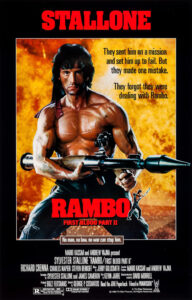
The problem with this, as I pointed out (I never went back to see the response) is that us white guys don’t depend on Rambo or Terminator to capture us on screen. During the eighties, when Stallone and Ah-nuld embodied the action film, we could also see Michael Douglas as a power broker in Wall Street, Tom Cruise as an angry Vietnam veteran (Born on the Fourth of July), Steve Martin as a lawyer possessed by Lily Tomlin (All of Me) and Jeff Bridges as a saintly ET (Starman).
The blacksploitation era of the 1970s offered the same diverse range of white roles. Blacksploitation, on the other hand, was pretty much the whole ball of wax for African Americans: mean streets, crime, cops, PIs such as Shaft and freelancer troubleshooters such as Pam Grier in Coffy (which is a terrific film). There had been black millionaires since before I was born but they showed up in supporting blacksploitation roles at best. African-Americans got very few family dramas, very few rom-coms. The problem wasn’t blacksploitation, it was all the other movies that didn’t exist.
As the late comics writer Dwayne McDuffie said once, when you have only a couple of black or minority characters in any medium, it’s 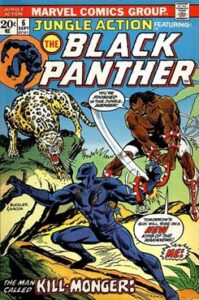 not possible to represent blacks/gays/Jews/Latinos well. One or two characters can’t possibly embody the whole experience. One of the things McDuffie loved about the Bronze Age Black Panther (cover by Rich Buckler) was that it was set in Wakanda and everyone but one of Killmonger’s henchmen, Venomm, was black. McDuffie could suddenly see himself in all kinds of characters.
Contrary to the post I responded to, it’s completely reasonable that people wanted a wider range of African American roles back then, or now. It’s easy not to grasp this. I’ve never had the problem of looking at a movie or TV screen — or a comic book — and thinking there’s nobody who represents me or my race in it or in any of the alternatives out there. I’ve heard enough people talk about the experience, or the thrill of finding a doll with the “right” skin color, to know it matters.
