
Justice League of America was my favorite comics series for most of its original run. Not always. Denny O’Neil’s run was the first of many bad stretches, and even Gardner Fox wrote some off issues. And there were periods when other series, such as Dial H for Hero, won my 12 cents.

 By and large, though, the League ruled. It’s no surprise therefore that when I got back into comics in the early 1970s, it was the Justice League that served as the gateway. I mean jeepers! — quite aside from the cool cover image, this had the origin of my favorite super-team, a story I’d never read! How could I resist?
This was part two of the Mike Friedrich/Dick Dillin story pitting the JLA against Starbreaker — Galactus but without any of that “beyond good and evil” bilge. Starbreaker relishes destroying planets, then selling off some of his cosmic energy to tyrants to power their military weaponry (we never learn what he gets from this — it’s not like he needs the money). Then came a done-in-one pitting the JLA against alien anti-pollution activists doing more harm than good. I read them all. They seemed okay. They were the League.
Then came Justice League of America #100. And my perceptions changed.
Len Wein’s debut on the book was more than okay. It was a terrific adventure involving  the JLA, the JSA and some group I’d only vaguely heard of called the Seven Soldiers of Victory. Could the Earth-One and Earth-Two heroes find the time-lost Law’s Legionnaires? Could they bring them back to the present fast enough to avert Earth-Two’s destruction? Well of course, but as with all comics, the fun is watching them do it.
There’s a bit of writing advice from Mark Twain, that finding the exact right word to use is the difference between “the lightning and the lightning bug.” This was sort of like that. Friedrich, to his credit, understood how to write a JLA story better than Denny O’Neil or Robert Kanigher, but as I’ll be blogging about eventually, he couldn’t quite pull it off. His stories were the lightning bug.
Wein by contrast, was able to pull it off. His run renewed my enthusiasm for the World’s Greatest Super-Heroes, enough that I kept buying them through the long, processed-cheese era between his departure and Steve Englehart becoming the writer. I’m not sure I’d count Wein’s stories as the lightning but they definitely crackled with more than enough energy to satisfy me.
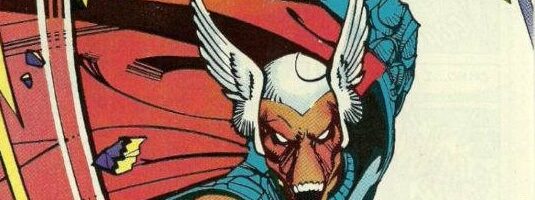
 Over the coming decades, other creative teams or individuals hit me the same way. The David Michelenie/Bob Layton team on Iron Man got me to buy Shellhead’s book for the first time ever. Walt Simonson’s Thor — well, sorry for the pun but that run was 100 percent the lightning.
Question of the week: what runs have affected you the same way, showing how good comics or a specific comic book could be?
Covers top to bottom by Jim Mooney, Neal Adams, Nick Cardy and Walt Simonson.

Stand outs for me have got to be Gene Colan’s unbroken 70 issue run on Tomb of Dracula with Marv Wolfman & Tom Palmer.
Also Master of Kung Fu, probably one of the more underrated 70’s Marvel comics.
Paul Gulacy kicked things off, followed by Mike Zeck and the brilliant Gene Day.
Other mentions would be John Buscema’s Savage Sword run and of course Walt Simonson’s Thor.
The one that stands out for me is Steve Gerber on Defenders. When he (and Sal Buscema) left I stayed only a few issues. The first time I dropped a book over change in creators.
I’d also say Englehart leaving the Avengers, but I stayed much longer because I liked Perez and Byrne’s artwork.
And Miller on Daredevil, like your experience with Iron Man, it was the first (and really only) time I picked up the book regularly.
The Claremont/Byrne/Austin run on X-men. And yes, Michelinie & Layton on Iron Man. I sometimes half-joke that 1979 is the best year in comics, because that’s when I discovered and became an avid reader of both series early in that year (my first issue of X-men was #120, and my first of IM was #121). Just a little after that, I pulled Daredevil #158 off the spinner rack, and subsequently never missed an issue of the fabled McKenzie (yes! he scripted the initial issues!)/Miller/Janson run.
A little later, it was Wolfman/Perez on New Teen Titans and Levitz/Giffen/Mahlstedt on the Legion.
Yes, that was a great Legion run. Shows the advantage of having a long-term creative team rather than constant rotation.
I’ve never been able to get into Miller’s Daredevil — it’s pitched at a frequency I don’t pick up — though I know the impact it had on most readers.
I had the same reaction to Simonson’s THOR that you did. Previously, I bought just the occasional issue. After #337, I bought the title monthly.
I had a similar response to Miller’s DAREDEVIL, although it came later in the run, specifically with the Death of Elektra issue, 181. Then, the book was on my radar (pun intended) monthly.
I’m now having similar reactions to Absolute Wonder Woman. Easily the best anyone’s done since the New 52 started.
It’s the ASM team of Conway/Andru for me.
I was able to follow a big part of this run. It came out in black and white and was translated in Dutch, and had 1,5 issues without adds.
This planted the seed for years later.
I still have those comics and I am getting closer to those issues in my ASM re-read.
some already mentioned
also Mike Grell’s run on Green Arrow