

Just as it’s easy to inject Superman into a story by having Clark Kent assigned to cover something (“A scientist has been digging up graves to get raw material for an experiment defying all the laws of god and man — get the Planet the scoop, Clark!”), it’s easy to drag Tony Stark or Bruce Wayne into a plot by having their business interests threatened. It’s even easier with Bruce because he has a broader range of interests than Tony.
I do not, therefore, find it implausible that in two different books coming out in August 1970, Bruce Wayne gets into trouble while visiting a European movie production he’s invested in. A bit of a coincidence, but he could definitely visit London in Brave and the Bold, then Spain in Detective Comics, or vice versa. Though these days, when Batman is 100 times more obsessive about fighting crime in Gotham City, I’m not sure Bruce would ever leave that long.
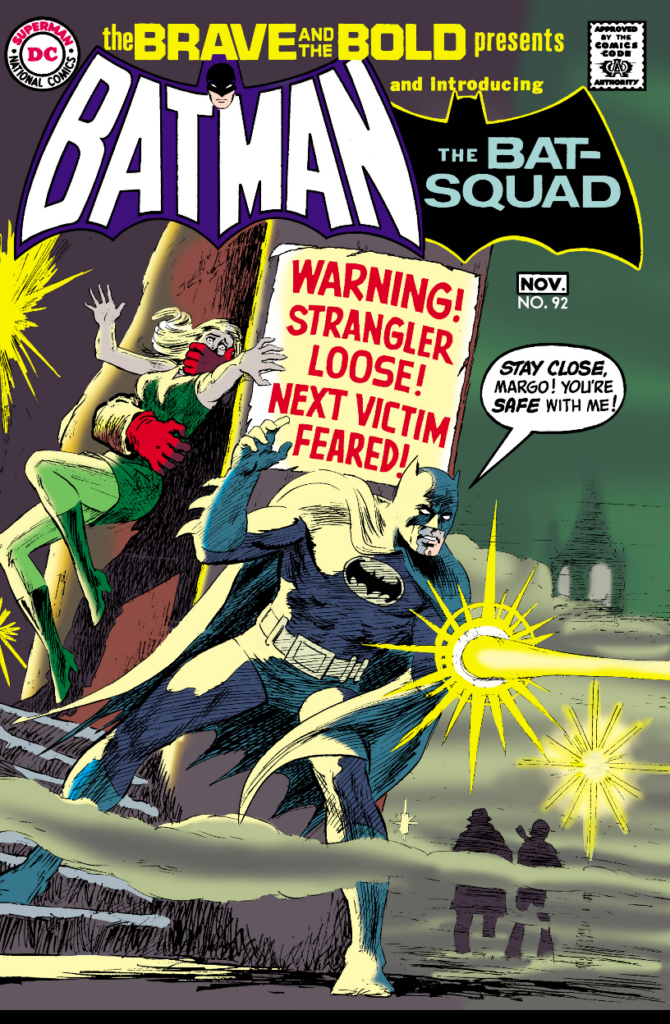
Brave and the Bold #92 (Bob Haney and Nick Cardy, who drew the cover) is an odd issue. By 1970 B&B had become a team-up book that typically co-starred Batman-with another DC headliner such as Sgt. Rock, Metamorpho, the Teen Titans, Green Arrow … Bats working with three random people because they’re on hand isn’t a team-up in the conventional sense, even if they do dub themselves the Bat-Squad.
The movie in “Night Wears a Scarlet Shroud” deals with the infamous Scarlet Strangler murders of the previous century. When someone posing as the Strangler starts committing fresh murders, Batman recruits actor Margo, guitar-player Mick and movie consultant Major Dabney to investigate alongside him. It’s a weird little story — at one point Batman’s wondering if they’ve gone back to the 19th century, and we never get a clear answer —and weirder for being such a strange team-up concept.
While the Bat-Squad express themselves eager to work on another case, they never return, joining Cliff Battles in the Land Of Characters Nobody Cares Enough to Revive. Online research couldn’t find any explanation why Bob Haney created them for this story — did he think they had spinoff potential? Was it because he blanked on anything better to write? Were they a last-minute substitute for something that feel through? No clue.
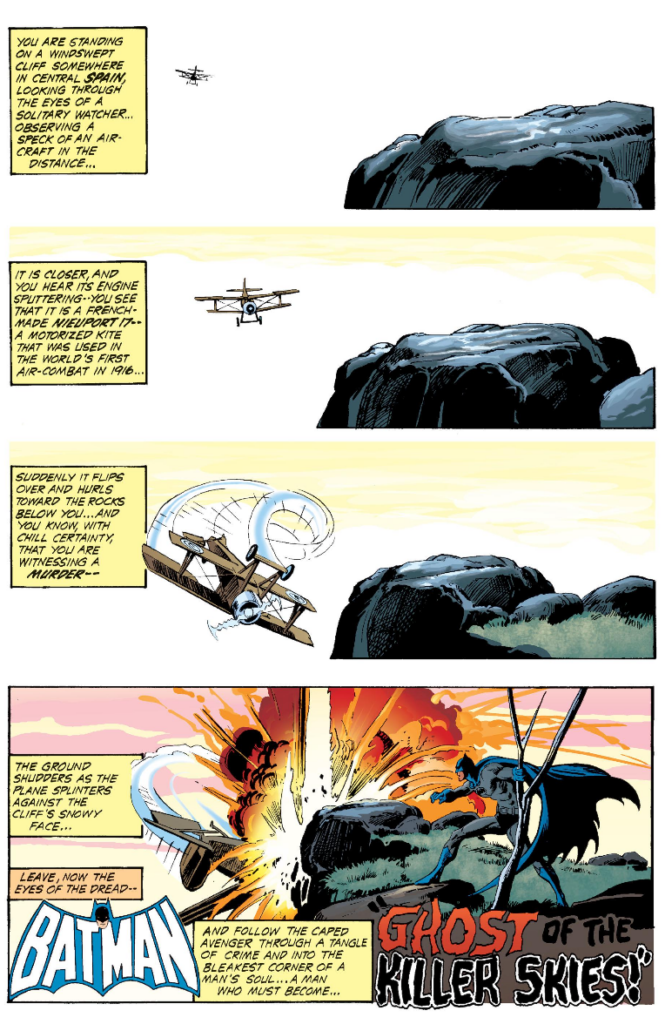
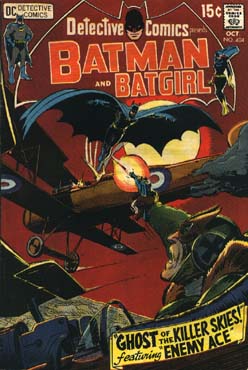 Detective Comics #404 is more memorable, if only for having Neal Adams draw Hans von Hammer in “Ghost of the Killer Skies” (written by Denny O’Neil). This time Bruce is checking up on a movie about von Hammer AKA Enemy Ace. Unlike the Scarlet Strangler film, it’s clear someone is trying to sabotage the production.
It turns out one of Von Hammer’s descendants thinks the movie is a travesty for showing his ancestor as a human being conflicted over his legend as “the Hammer of Hell” — conflicted feelings are for wimps and Von Hammer was a strong, proud German! We end up with Batman and the killer settling things Von Hammer’s way.
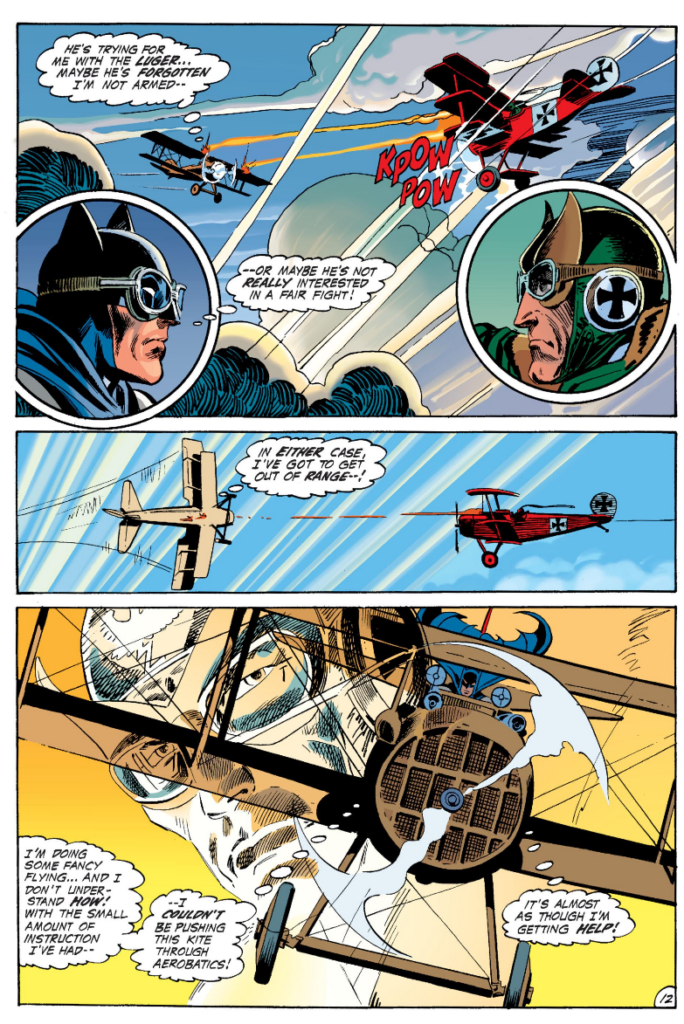

As the ending text box says, this is a love letter to a remarkable war comic. It also establishes Von Hammer, like Sgt. Rock is a part of the DC Universe. And Neal Adams makes WWI dogfights look as cool as he does everything else.

I’ve been a big fan of “Ghost of the Killer Skies” since it was first published, and not just because I was an obsessive Neal Adams fan at the time. (I spent an inordinate amount of time seeking out his work, going so far as to buy titles that I wasn’t necessarily interested in, like Weird Western Tales or War of the Worlds, just for his artwork.) I loved the way Denny O’Neil treated the Enemy Ace character with such affection and respect and how Adams did the same with Joe Kubert’s artwork for that series. The panels you reproduce here include Adams’ homage to Kubert’s classic cover for Star Spangled War Stories 138 and show the care he took to imitate Kubert’s line work in drawing Enemy Ace. I had just enough experience with the character to get what O’Neil and Adams were trying to say about both the character and the artist (and, I suppose that means Robert Kanigher, too). It was affecting.
I also have a weakness for the kind of ghost stories where a haunting turns out to be phony but in the end the villain is brought down in a way that suggests a supernatural presence might have been involved. Jim Shooter’s “The Ghost of Ferro Lad” is one of my all-time favorite Silver Age stories, and it works in this way. In both that story and “Ghost of the Killer Skies,” the ghosts aren’t scary and menacing; being dead heroes, they project a kind of nobility and lonesomeness. Something in that touches me.
Thanks for the flashback on this particular story. It holds a special place for me in the entire O’Neil/Adams Batman run.
As for the Bat-Squad story, I remember really liking it at the time. I felt much the same way about the Batman/Black Canary team-up in, I think, the previous issue. I haven’t revisited them lately, so it’s possible Bob Haney’s writing doesn’t hold up (13 year old me wasn’t nearly as critical of Haney’s scripts; I loved almost everything he wrote in Brave & the Bold and Teen Titans), but I feel confident Nick Cardy’s artwork looks just as good all these years later. His work here just swept me off my feet. He seemed to really take advantage of the mystery and atmosphere of those stories to immerse the reader in mood: fog, shadows, night skies. Plus, it may be the most luscious Black Canary has ever looked.
Cardy is great. His covers for the mystery anthologies are terrific too.
As a timid kid, the ending with the Ghost of Ferro Lad being real freaked me out. As an adult, I find it extremely moving.