
You knew I’d be back at some point, and here we go!
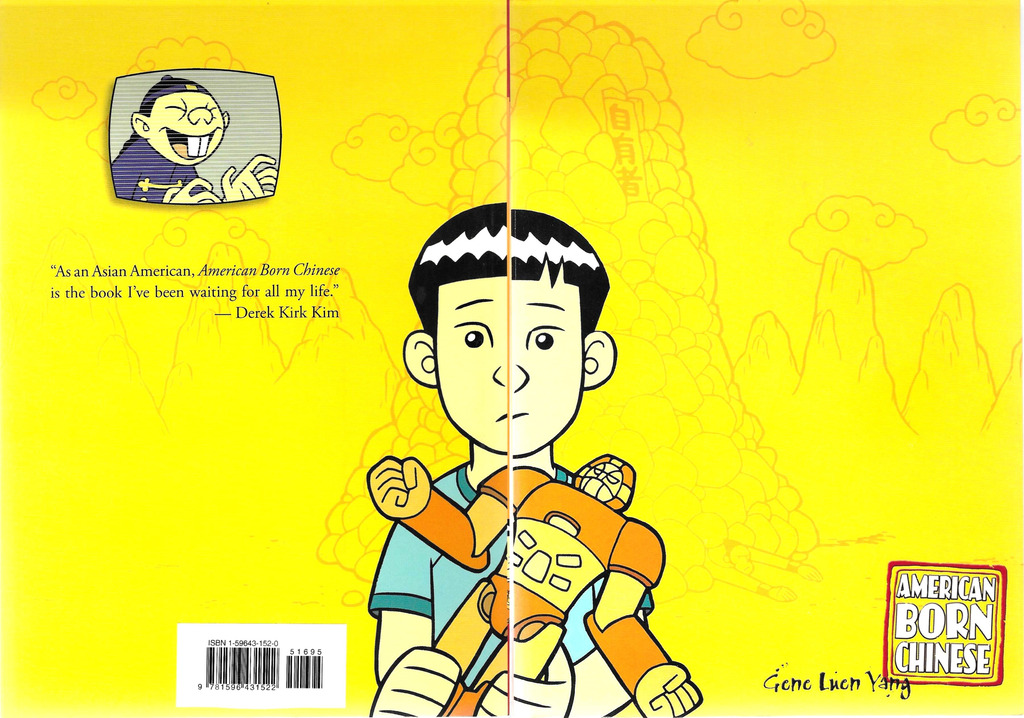
American Born Chinese by Gene Luen Yang (writer/artist) and Lark Pien (colorist).
Published by First Second Books, cover dated September 2006.
As always, be aware for SPOILERS, but I don’t think I really have any in this post!
American Born Chinese isn’t Gene Luen Yang’s first comic, but it is his break-out book, and it remains, 20 years later, a marvelous commentary on racism and assimilation and teenage angst. It made people pay attention to Yang, and he’s been a major force in the arts ever since. 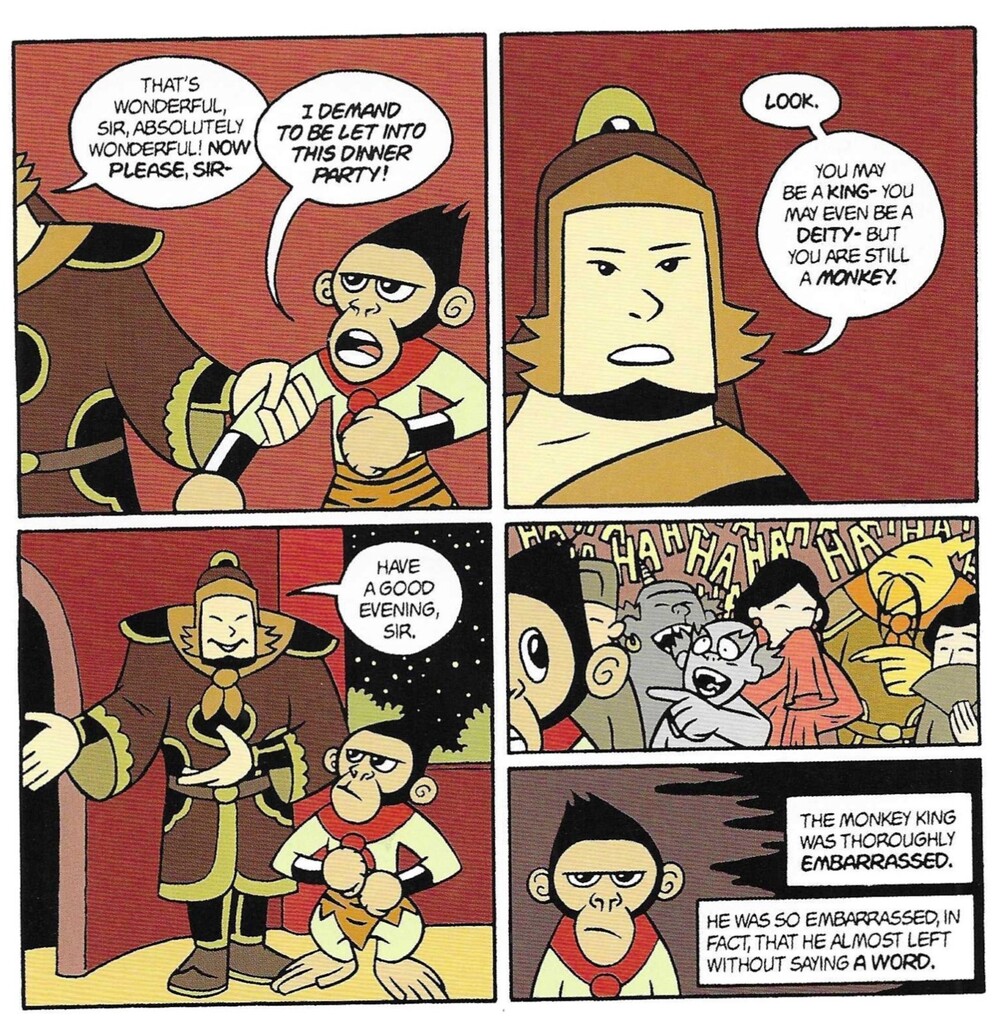 And it’s all thanks to … monkeys?
Yang, obviously, wants to write a comic about racism, but writing a story simply about racism can be deadly dull, and he wants to do other things, too, so he gives us three separate stories about, well, being Chinese. We begin with the Monkey King, a key figure in Chinese mythology, as he tries to prove that he’s as good as all the other gods and demons in Heaven even though they don’t respect him because he’s, you know, a monkey. In the second story, we get the most grounded tale, as Jin Wang moves to a new school and is confronted by the casual (and not-so-casual) racism of the white Americans there. He wants to be friends with them, but they ignore him (when they’re not mocking him), and eventually, he becomes friends with a newer arrival, Wei-Chen Sun, who’s the only person who will talk to him. Finally, in the third story, a white teenager named Danny is trying to live his life, but his Chinese cousin, Chin-Kee, visits him and messes his life up. Chin-Kee is a ridiculous Chinese stereotype, and that story is presented as a sitcom, complete with laugh track (which is a nice commentary on the depictions of minorities in American entertainment, but Yang doesn’t get into that more than that, but it’s still there).
Yang illuminates both traditional Chinese folklore and the Chinese experience in America, and does so in often funny but also clever ways. The Monkey King story, obviously, is most concerned with folklore. The King feels that the more august gods and demons do not respect him, so he continually masters disciplines to make himself more attractive as a deity. He wears shoes (and forces his monkey subjects to do so) because he’s denied entry to the dinner party of the gods because he doesn’t wear them. His monkeyness gets under his skin, as he realizes he will never be accepted by the gods because of who he is (despite many of them not being exactly humanoid, either). He trains himself in many fighting techniques and defeats many gods, until he meets Tze-Yo-Tzuh, the ultimate creator. 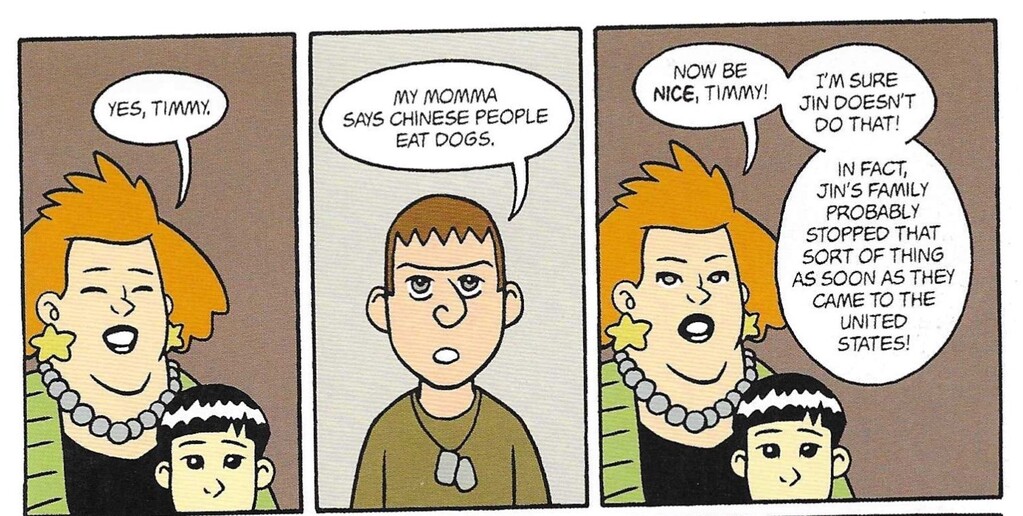 Despite Tze-Yo-Tzuh’s power, the Monkey King still tries to defy him, whereupon Tze-Yo-Tzuh buries him under a giant pile of rocks and keeps him from using kung fu, so he remains trapped there for five hundred years. He only escapes when he accepts who he is and humbles himself in front of a wandering monk who wants him to accompany him on a journey. The Monkey King scoffs at the idea that he could be anyone’s disciple, but circumstances force him to re-evaluate who he is and what his purpose is, and he’s able to move past his pettiness and embrace a more spiritual path. Yang was raised Catholic, and there’s a very Christian strain running through the Monkey King’s story, culminating with the fact that he and the monk end up at the manger in Bethlehem. The idea of submitting to a will greater than your own is, of course, a very Christian thought, but it’s not exclusive to Christianity, and Yang doesn’t make it too explicit, but it’s still there. Even without it, the Monkey King has to realize that accepting who you are is not necessarily a bad thing.
In Jin Wang’s story, the theme of changing who you are is even more prevalent. Jin is American, but of course his classmates treat him as an exotic foreigner. Early on, he has a freighted exchange with an old woman, the wife of an herbalist:
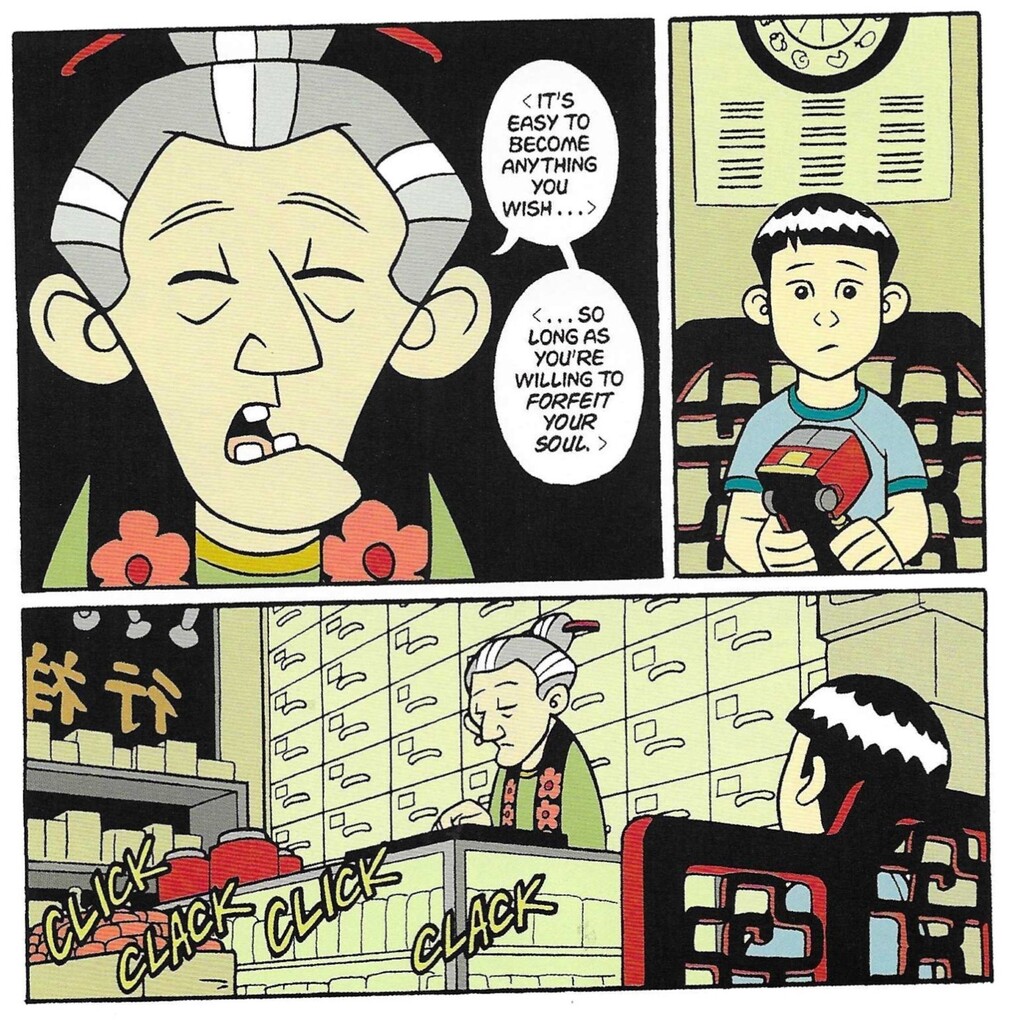
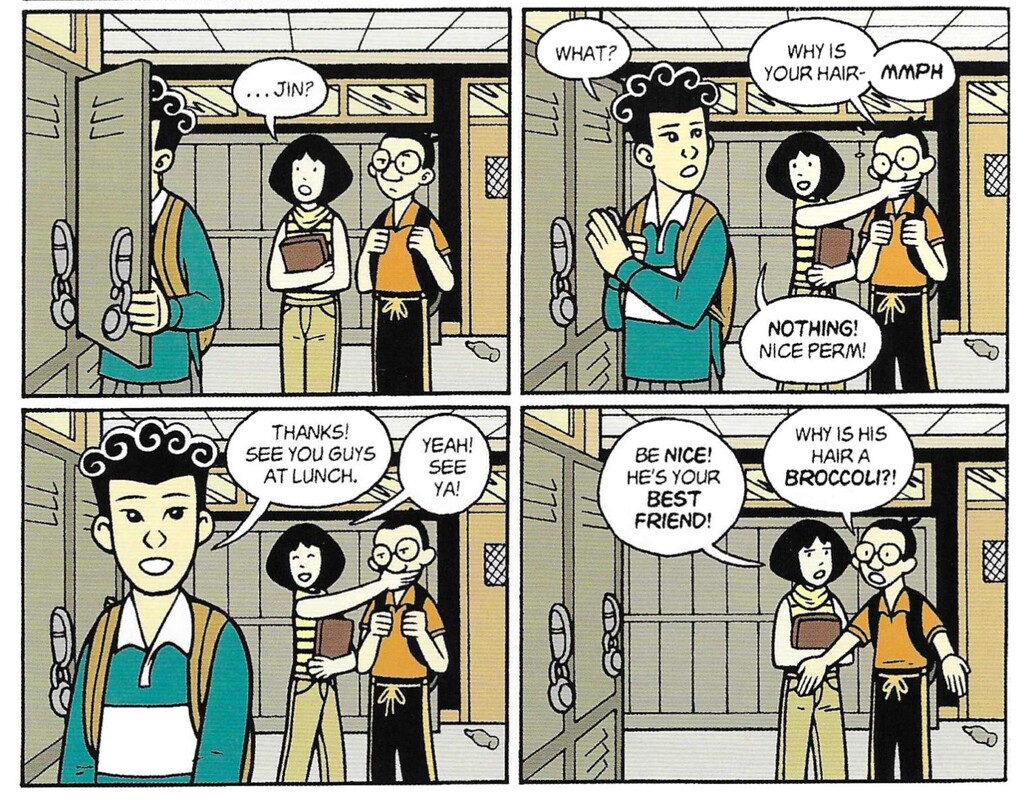
This comes back to haunt him a bit, as he definitely wants to change who he is, thanks to what’s happening in his life. Jin experiences the casual racism of the students and the teacher, who is trying to be nice but can’t overcome her own prejudices, and he avoids the only other Asian person in his class, a girl who later ends up dating Wei-Chen Sun. He tries to ignore Wei-Chen when he shows up, but Wei-Chen has an action figure robot that “transforms” into a robot monkey, which Jin finds very cool, and he and Wei-Chen become friends. A few years later, Jin gets a crush on a white girl, but he doesn’t know how to approach her. 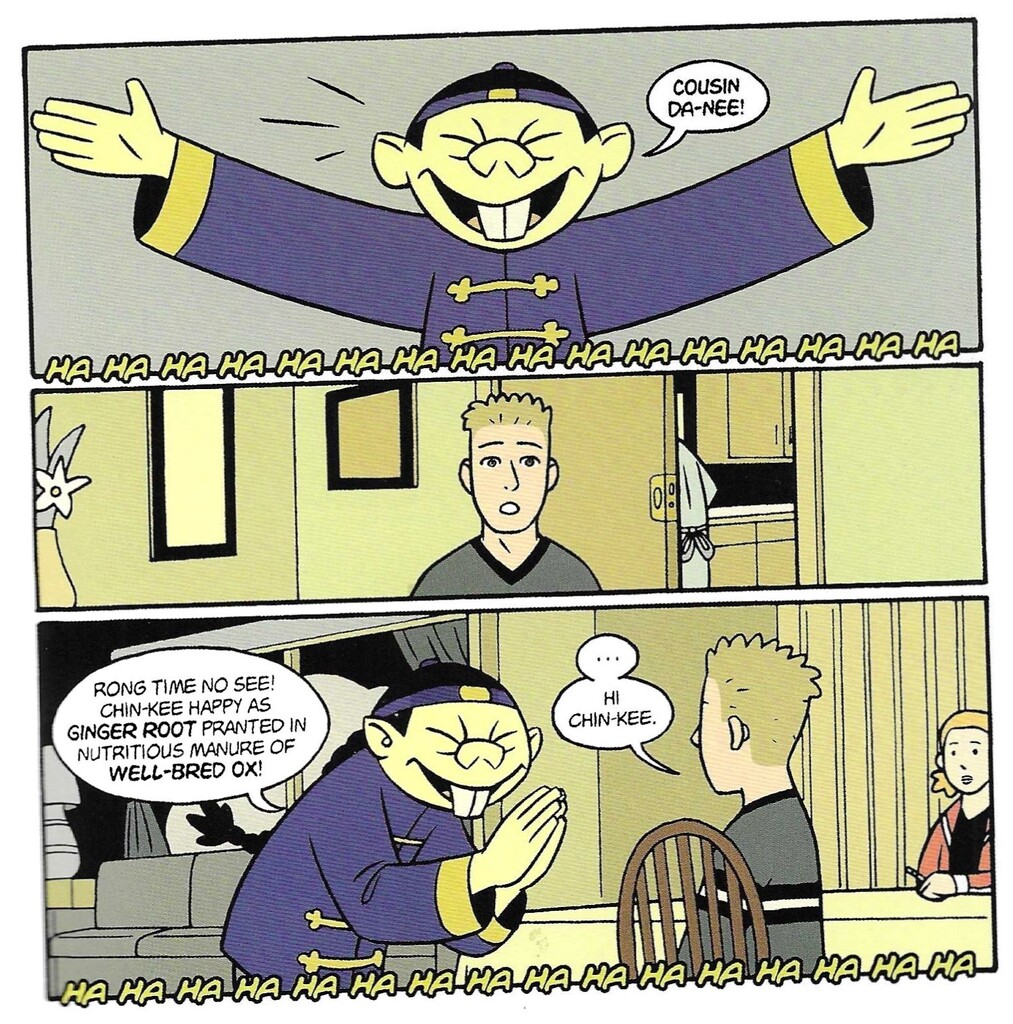 He styles his hair like a white dude in his class who seems like an all right guy and whom the object of his crush seems to dig, and Wei-Chen acts as his wingman to let the girl know that Jin kind of digs her. As he and the girl become a bit closer, the presumably cool dude tells him that he should back off because the girl has to “start paying attention to who she hangs out with.” This crushes Jin, and he makes a move on Wei-Chen’s girlfriend, which wrecks his friendship with him. Things are not going well for Jin Wang.
Danny, the Anglo teen, is wildly embarrassed whenever Chin-Kee comes to visit. Chin-Kee is the ultimate Chinese Stereotype — the way he looks, the way he dresses, the way he acts, and the way Yang writes his dialogue, with the “r”s replacing “l”s and vice versa everywhere (his first words are “Harro Amellica!”). Chin-Kee is extremely gregarious, so when he’s at school, he’s always begging to answer the teacher’s questions (and he’s always right, which also embarrasses Danny) and he’s always smooth-talking the girls (especially the one Danny likes) and playing pranks on the guys. Danny wants nothing to do with him, but just his association with Chin-Kee makes people begin to treat him differently, as the girl he likes claims that he’s beginning to look a little “Chinese,” which upsets him. There’s a reason Chin-Kee is like this, and eventually, Yang pulls all the stories together, showing us how they’re all connected. It’s fairly nifty.
The big theme of the book is being true to yourself, which isn’t surprising, given the subject matter. Yang wants to write about racism, of course, but he doesn’t want to bash us over the head with it. The racism is overt in some places but casual in others, and it gives us a good idea of what minorities go through even when they’re not surrounded by people who actively want to hurt them. 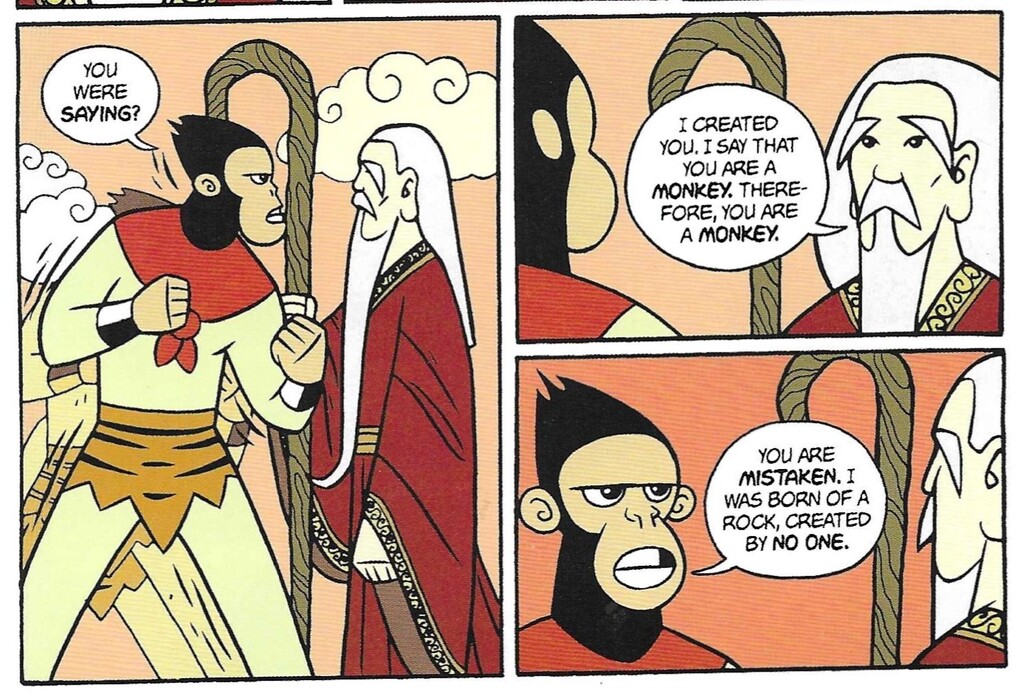 The teacher’s introduction of Jin Wang, the way his friend suggests that he stop dating the white girl, the way Danny’s crush mentions that he’s taking on Chinese characteristics, the classism of the gods when the Monkey King comes to Heaven — all of these are things that aren’t ridiculously, overtly racist, but they chip away at the self-esteem of the characters every time. It leads them to act foolishly. The Monkey King becomes proficient at everything those in his world seem to appreciate — many various forms of kung fu — yet it’s not enough. Jin Wang tries to fit into American culture, yet it seems to only make him more of an outsider. Danny tries to ignore Chin-Kee, but Chin-Kee’s presence is too indomitable, and Danny finds that the racism directed against his Chinese cousin can be mutated into something else that can be used to exclude him, even though he’s a bland white guy. As these characters go through their stories, they need to learn how to accept themselves, which is Yang’s point. He’s too good a writer to make it that simple, though. I’m not sure how deliberate it is on Yang’s part, but there’s a dark underbelly to remaining true to yourself, because it also becomes remaining true to your roots, which can be as stifling as breaking free from them. The Monkey King has to learn to be humble, true, and that helps him, but he also sublimates his personality to something greater than himself, which is the essence of Christianity, certainly, but is also changing yourself for something exterior to you. Whether you think the trade-off is worth it is the ultimate question.
  Jin Wang flees his own heritage and needs to find his way back to it, but does that force him to abandon parts of himself? Jin Wang is American as well as Chinese, after all, so what is he supposed to become? Danny has to figure out what to do about Chin-Kee, which leads him to discover things about his past that continue to affect his present. In the end, Wei-Chen, who seems to reject his heritage while also incorporating it into his larger personality, might be the most complete person in the book. Yang doesn’t condemn those who leave their heritage behind, and he doesn’t laud those who embrace it. Part of the thoughtfulness of the book is that Yang recognizes that everyone has to make a choice. What is important to them might not be important to someone else, and what is important to them at one point in their lives might not be important to them at other points. This is not the most radical idea, of course, but Yang does a nice job getting his characters to it, and it makes the journey they take fascinating.
Yang’s art, while nothing spectacular, tells the story in such a way that highlights his themes very well. The Monkey King story, the most fantastical of them, features many wonderfully bizarre gods and demons, all emphasizing, early on, the Monkey King’s lowly status. He dresses very simply and is, after all, a monkey. The first page of the comic shows what kind of beings he has to contend with:
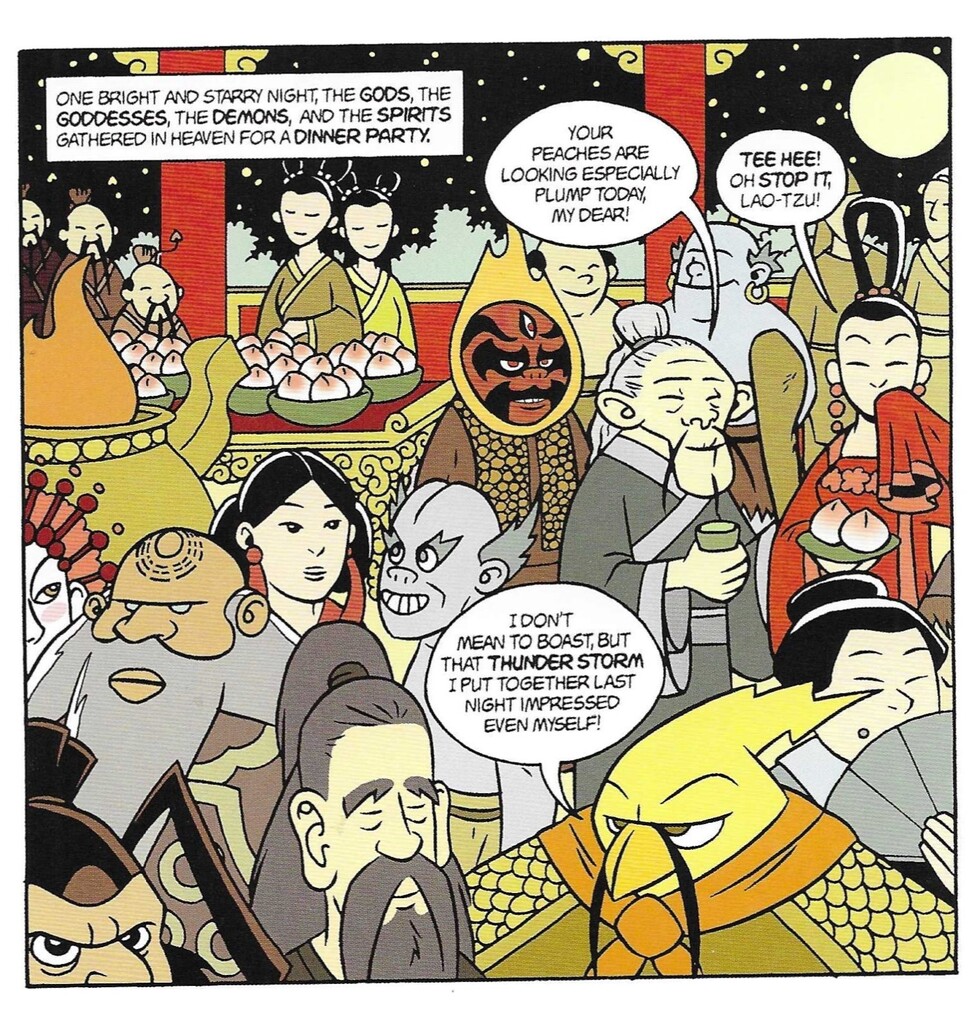
This is a marvelous evocation of Chinese folklore, and we see the gentility and grace of the supernatural entities gathered for their party. The women are refined and demure, the men are masculine yet polished, and the clothing is beautiful finery. When the Monkey King comes among them, he is singled out by his rough dress, unkempt hair, and his uncouth manner. 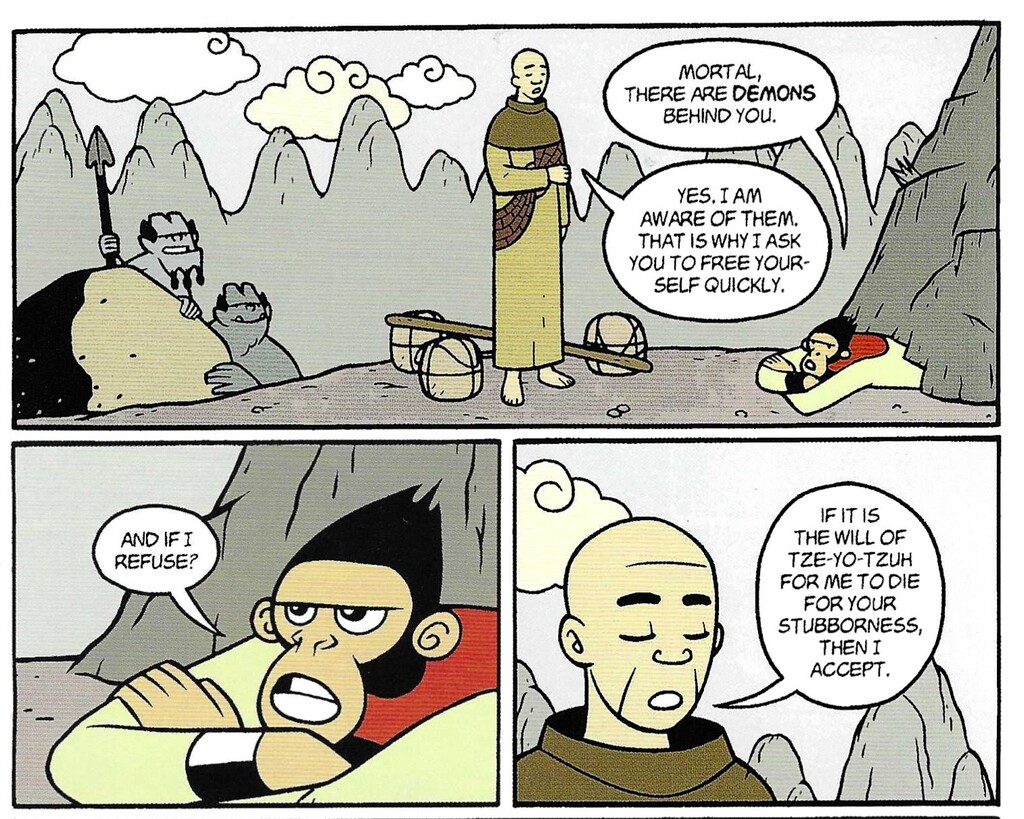 As he learns kung fu and becomes more powerful, he grows even more uncouth, as he not only wants to prove that he’s better than all the others, but better than them on his terms. It’s only when he meets the monk, who is unkempt in his own right but rises above it due to his inner grace, that the King understands who he needs to be. Yang does this nicely through the art. In the other two stories, he uses the art to show how forlorn Jin Wang becomes when he realizes that he can’t be friends with the white people, and how happy he is when he finally gets to go on a date with the girl he likes. Yang also does a nice job showing how awkward the date is, as Jin tries to get closer to the girl but can’t figure out a suave was of doing it. His best use of the art is with Chin-Kee, who’s designed to be a stereotype. His head is large, his teeth jut out from his upper lip, he wears his hair in a long queue, and Yang gives him a traditional Chinese outfit with a hat, buttoned tunic, and slippers. He’s always smiling and his eyes are always just lines on his face. Pien colors him pale yellow, and Yang occasionally makes him the obsequious Chinese servant figure, which heightens the stereotype even more. Chin-Kee is a ridiculous caricature, and he doesn’t fit into Danny’s strictly white world, which is, of course, the point. Yang makes it largely through his artwork.
Yang has done other comics since this one, of course, and many of them have been excellent. American Born Chinese was the first time, I think, when he showed what a talent he was and what he could do with comics, and it remains one of the better comics of this millennium. 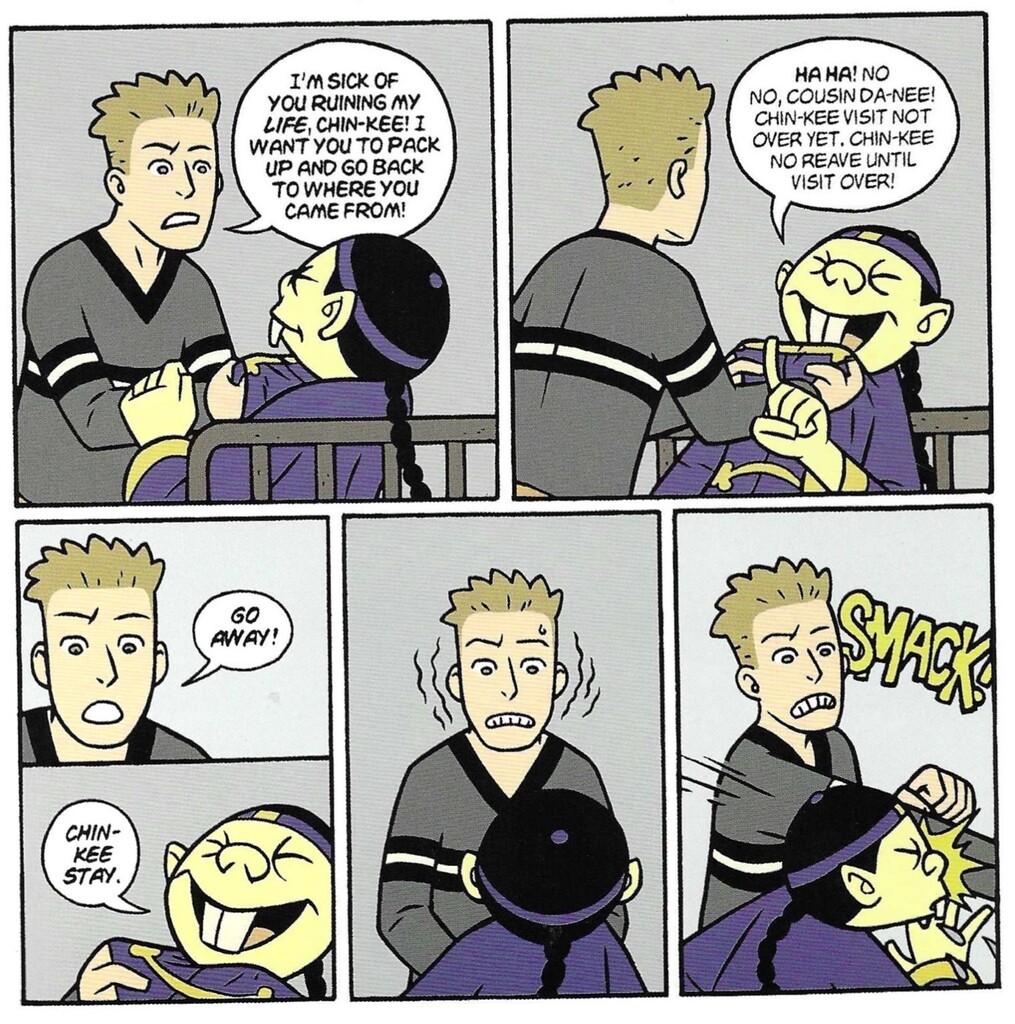 You can find it on Amazon, not surprisingly, but I’m sure you can find it many other places if you don’t want to feed that beast (although, of course, we do get a tiny piece of money if you use that link). I have not watched the television show from a few years ago that was based on this, but it sounds like it got good reviews even though it appears they changed it to make it more action-oriented. Even if a show exists, you can still read the book, you know! And if you want to see more Comics You Should Own, you can take a look at the archives!
[If you notice these sorts of things, you might notice that this comes alphabetically before the previous entry on American Vampire. It was not where it was supposed to be on the shelf, so I didn’t get to it back then, but now I have. In the meantime, I read two other comics that I think you should own, but I didn’t want to post those before I posted this, so I have this and two others ready to go over the next few weeks. I know I have a haphazard schedule for these, so I just thought I’d mention that there would three of them over the next three Wednesdays. I didn’t want to alarm anyone! Thanks for reading, as always!]

I must have picked this book up over a dozen times over the last few years, only for it to be tucked back away onto my pile of shame.
It remains unread.
Well, get on it, sir! 🙂
Even though I like Yang’s work, I wasn’t able to get into this one. I may try again as our library has it.
He revisited the legend in DC’s Monkey Prince, which was a lot of fun.
Boooo!!! 🙂
Give it another try. Maybe it will work for you this time!