

Hammer Studios’ Dracula and Frankenstein series are justifiably famous. Their three Jekyll and Hyde films? Not so much.
This is partly because rather than a series, they’re three separate movies riffing on the same horror story. It’s also because only one of the three is any good, a point driven home when I (re)watched them this year for my book on Jekyll and Hyde films.
The Ugly Duckling (1959) is a reminder that Hammer, one of the great horror studios, never came close to being a great comedy studio. It made several attempts, mostly based on TV Britcoms. The series The Army Game, for example, was the basis for Hammer’s I Only Arsked (1957) which included Bernard Bresslaw as the gormless Private Popplewhite. He was popular enough with audiences Hammer commissioned a new comedy built around his dimwit screen personality. I have no idea why they thought a modern Jekyll and Hyde story (the first feature film to set it in the present day) would be Bresslaw’s ticket to stardom.
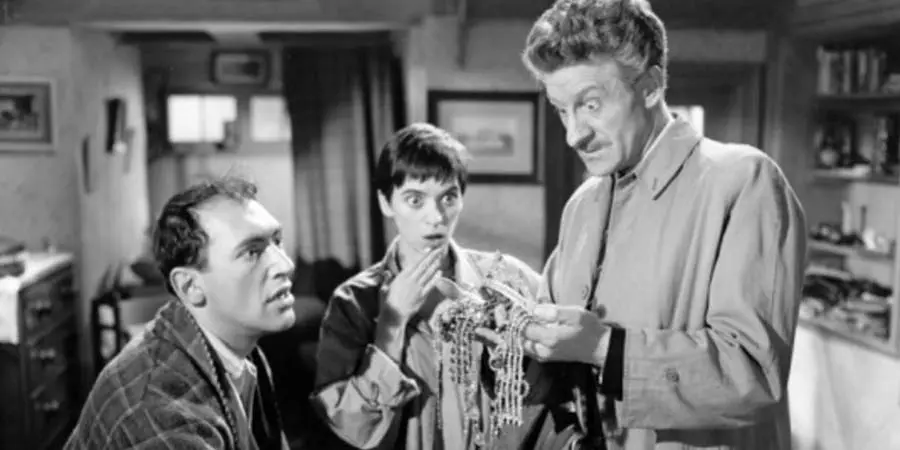
As clueless dork Edward Jeckle (their spelling), Bresslaw is a complete embarrassment to his siblings Henrietta (Maudie Edwards) and Victor (Jon Pertwee, a popular light comedian in this era, the Third Doctor a decade later). Bad enough the family’s respectability is tarnished by those stories about their ancestor, but to Eddie’s klutzy bumbling as an added embarrassment? How is that fair? Edward feels ashamed of what a burden he is, but hopes that by experimenting in his ancestor’s lab he can come up with a useful product and finally impress people.
Instead, Edward discovers a copy of Dr. Jekyll’s formula for turning a timid man into a confident tiger (where Stevenson’s Jekyll erased his conscience, this version seems to erase insecurity and self-doubt). Taking it turns Edward into “Teddy” Hyde (a reference to the Teddy Boys, flashily dressed punks of the era), a coolly confident but completely amoral man. So amoral that when he discovers the manager of the local Palais (dance halls that were a major center of British entertainment in that era) is plotting a jewelry heist, he deals himself in.
Edward has no memory of how he’s spending his nights. Neither do Victor and tomboyish Snout (Jean Muir) who’s sweet on Edward. Then they stumble across the jewels Teddy stashed in his other self’s bedroom. Victor is horrified (“You couldn’t just go out and strangle a blonde like our great-great-grandfather, could you?”) and the trio realize the only solution is to restore the gems before the truth comes out. That proves difficult until Snout reminds Edward that anything Teddy could do is within Edward’s grasp. Inspired, he returns the gems, busts the hoods and ends up with the girl and management of the Palais.
The results rely heavily on Bresslaw’s breakout potential as a comedy star; while he’s competent in his two roles, he’s not good enough to make the picture fun or funny. As Edward doesn’t remember his experiences as Teddy, we don’t get to see how he feels about going from zero to (anti)hero, which might have been interesting. This was a lost film for several decades and the cinema world would not have suffered if it had stayed lost.
 The Two Faces of Dr. Jekyll (1960), AKA House of Fright, isn’t a good movie but you can see the potential for one hiding inside it. Paul Massie plays Jekyll, married to Kitty (Dawn Addams), but by the time the movie opens, it’s a miserable marriage. Jekyll’s neglecting her for his research, leaving Kitty to console herself with her husband’s BFF Paul (Christopher Lee). Lee, who’d originally hoped to play Jekyll and Hyde (he’d get a shot a decade later in Amicus’ I, Monster), is the best thing in the movie with the most interesting role. Paul is an immoral cad who has no qualms making love to Kitty, then asking her wealthy husband to pay off the IOUs from Paul’s latest round of gambling.
When Jekyll transforms into Hyde and explores London in his new identity, he discovers Paul/Kitty is a thing. In his new identity he befriends Paul and buys up his IOUs. Then he can simply offer to erase the debt in return for Paul giving up Kitty to his new buddy. Alas, Hyde is every bit as clueless about people as Jekyll was …
The movie has potential. I like the idea of Jekyll and Hyde both pursuing the same woman. Massie’s Hyde fits Stevenson’s description of a man who looks normal but unsettles everyone around him. Massie has an odd, stiff quality like he’s only posing as a human being and can’t quite pull it off. Critics mocked Jekyll’s beard disappearing and reappearing with the transformation but I don’t object: it’s a valid point but lots of previous Hydes had similar issues with their hair (like Fredric March shown below in both his personas from the 1932 film).

Screenwriter Wolf Mankowitz conceived the film as a slashing attack on Victorian hypocrisy, which is true to the original novel’s themes. The movie does a great job touring the seedy side of Victorian life — dance halls, mistresses, bare-knuckles brawling, high-stakes gambling — but as we don’t see anyone pretending to be moral while indulging in vice, it doesn’t really scream “Hypocrite!” Paul, Kitty and Jekyll are all rotten in different ways but none of them pretend to be otherwise. That was what director Terence Fisher hated about the script: no likable characters, nobody to root for.
Fisher’s distaste is often cited as the reason the film doesn’t work but I think it lies in the script. The relationship between Paul, Kitty, Jekyll and Hyde needs a lot more characterization than we get. Did Jekyll and Kitty once love each other? We don’t know (though it is clear Hyde doesn’t understand Kitty any better than Jekyll does). The acting doesn’t help: Kitty is supposed to be in love with Paul but Addams can’t convey it.
Fast-forward to 1971 and we finally get a good, though thoroughly unfaithful Hammer take. Director Roy Ward Baker says he and some of his colleagues who’d worked for Hammer were at dinner, coming up with absurd titles for new films; Baker’s suggestion of Dr. Jekyll and Sister Hyde was the winner. A couple of days later, someone called from Hammer — Roy, we understand you have a new idea for a Jekyll and Hyde film? How soon can you get us a synopsis?
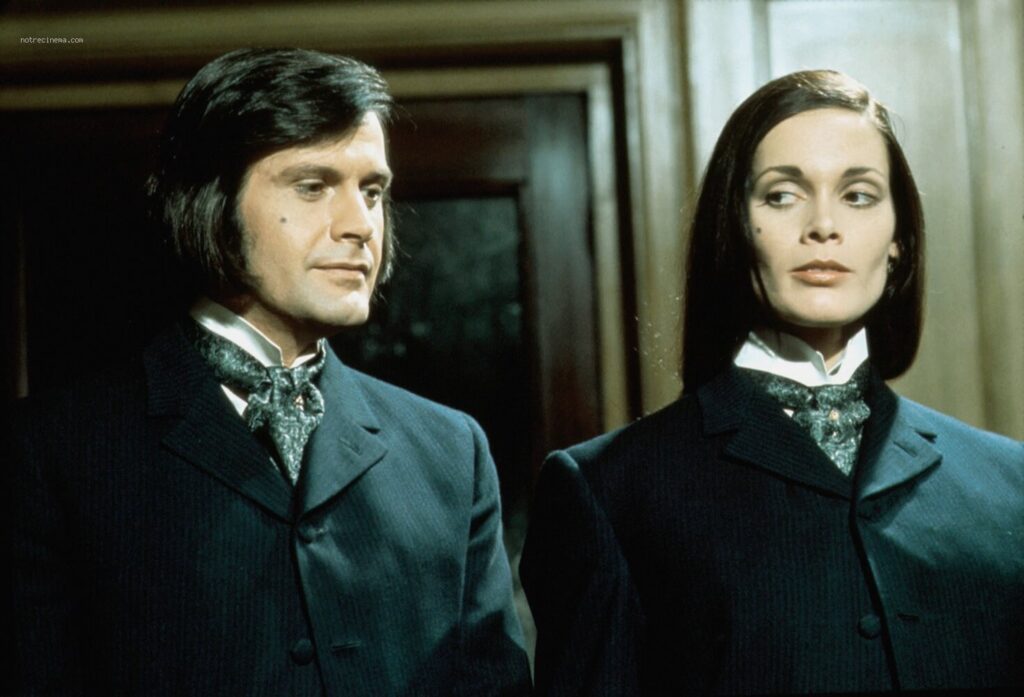
Ralph Bates plays Jekyll, here a London scientist dedicated to finding a cure for all diseases. His womanizing friend Robertson (Gerald Sim), who thinks Jekyll should work less, party more, points out that if he took, say, three years to cure cholera, then another three years to cure diphtheria — well, curing all diseases before he dies would be impossible, wouldn’t it? Neither man considers that curing cholera and diphtheria would save millions of lives, a worthy goal even if Jekyll accomplished nothing else. Instead Jekyll decides that to master disease, he’ll have to master age, finding a scientific fountain of youth to keep him going.
After his early experiments indicate female hormones are the key, Jekyll pays the local morgue attendant to provide him with newly dead women. When that source dries up, he turns to legendary body-snatchers Burke and Hare to provide him with fresh corpses (their characters here are clearly modeled on the 1959 film about them, The Flesh and the Fiends). Finally his formula is ready — and when he tries it out, it transforms him into Martine Beswick, one of the great Evil Woman actors. Jekyll’s shaken by the transformation but continues his research. As he can’t get corpses he makes them by slicing up prostitutes in Whitechapel — yep, in this film he’s Jack the Ripper too! Police pressure soon gets too hot for him to keep killing. Fortunately no woman would suspect his “sister,” widowed Mrs. Hyde, of being Jack the Ripper — hell, they’ll ask her to walk them home so they can look out for each other.
The movie plays fast and loose with facts — Burke and Hare operated in Edinburgh — and with Victorian attitudes; Susan (Susan Brodrick), a neighbor who flirts with Jekyll, is way too forward for a respectable Victorian miss. It works anyway — hell, a mix of Jekyll and Hyde, Burke and Hare and Jack the Ripper would have to actively work at being bad for me to hate it. Bates is good as a rather impoverished Jekyll (lives by himself, doesn’t even have a manservant), Beswick is mesmerizing as Mrs. Hyde and the supporting cast, particularly Sim, is solid. It’s memorable in a way neither of its predecessors was — by being fun to watch.

I keep thinking it’s been way too long since I watched Hammer horror. I hope to see more soon.
Aside: Jon Pertwee is my favourite Doctor for some reason.
I like him a lot (my fave remains Tom Baker) and his era stands out for UNIT, the best Master and a lot of Earth-based adventures.
Oh, Tom Baker is easily the leader of the pack – at least as far as classic Who goes. I don’t even know why I like Pertwee.
There’s none of the original seven I dislike other than Colin Baker.