

(Title is from the lyrics to Crystal Gayle’s “Our Love Is on the Faultine,” in case you were wondering). I’m pleased with DC’s new DC Finest reprint line. So far I’ve replaced one of my B&W Green Lantern showcase volumes and one Hawkman with the same stories in living color.
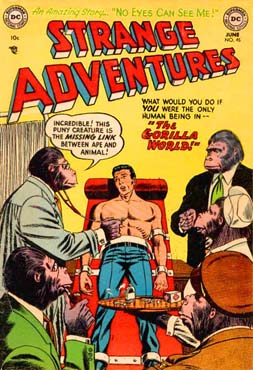 I’ve had the most fun though with the Gorilla World collection, reprinting a string of1953 and 1954 Mystery in Space and Strange Adventures issues. It seems to start randomly — there’s nothing significant I can see about the issues they pick to open with — and the stories aren’t as strong as they’d become a few years later. But as I wrote a few years back, these series are typically better than they needed to be, and head and shoulders above DC’s other SF anthologies (e.g., Tales of the Unexpected) or Marvel’s SF/monster books. They’re way better than the Tommy Tomorrow stories from the same era, which are also included in the book.
That’s not the point of this post, though. The point is that reading this during my ongoing Silver Age reread makes me see how much these books foreshadow the birth of the Silver Age. Showcase #4 is a couple of years off, but Julius Schwartz and his crew are clearly heading in that direction.
First off, there’s all the recurring characters. Jack Schiff’s DC science fiction anthologies didn’t have series characters in this era, neither did Marvel’s. Schwartz — who’d launched DC’s last attempt at a superhero book, The Phantom Stranger — gives us several, though only one of them appeared regularly. Mystery in Space has the largely forgotten Bert Brandon, investigator for Interplanetary Insurance (inspired, I suspect by radio’s insurance investigator Johnny Dollar — much like Johnny, Bert begins each case by narrating a letter to his boss) and the one and only Space Cabbie. Strange Adventures brought back scientific investigator Darwin Jones, who’d first appeared in #1. They might as well not have bothered; Jones is so generic, replacing him in every story with a string of unconnected scientists wouldn’t have hurt.

And then, of course, we have Captain Comet. Unlike Phantom Stranger he was a full-on superhero with a costume and powers, powers born of being a mutant a thousand centuries evolved from modern-day humans. Despite the great superhero die-off at the end of the Golden Age, Schwartz clearly hasn’t given up on the concept. And Comet is very much in the mode of the upcoming revivals of Flash and Green Lantern, a mix of costumed crime-fighter with science-fiction ideas.
Unfortunately he’s not very good. John Broome clearly hasn’t got the knack for superhero stories he’d show a couple of years later. No matter what the alien invader or other menace of the month comes up with, Comet’s evolved abilities invariably kick their butts without working up a sweat. Nor does he have as good a supporting cast as Hal Jordan and Barry Allen would acquire. Despite a couple of good stories, he’s overall a guide to how not to launch a superhero revival.
“The Guilty Gorilla” (John Broome, Murphy Anderson) is an exception. In an earlier story, not included here, Captain 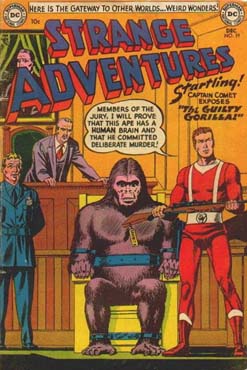 Comet encountered an intelligent, evil gorilla, part of an African tribe of super-apes. Now he’s brought him to trial for a murder committed in that story. The gorilla breaks out and launches a crime spree before Captain Comet takes him down.
It’s one of the few stories where Comet meets a foe who can hold their own with him, psionically as well as physically. The never-named ape feels so much like a dry run for Gorilla Grodd, I’m astonished nobody ever tried to connect them up. Perhaps there weren’t enough people who remembered or cared about old Captain Comet stories.
Then there’s #48’s tale of “The Human Phantom” by Otto Binder and Gil Kane. A man discovers too late his drinking well has been contaminated by negative matter that turns him into a Phantom Girl/Shadow Thief type, able to pass through solid matter. Initially he uses his power to become the “Prince of Escapes” pulling off impossible feats that make Houdini look like a klutz. As you can see from the image below, it doesn’t stop there.
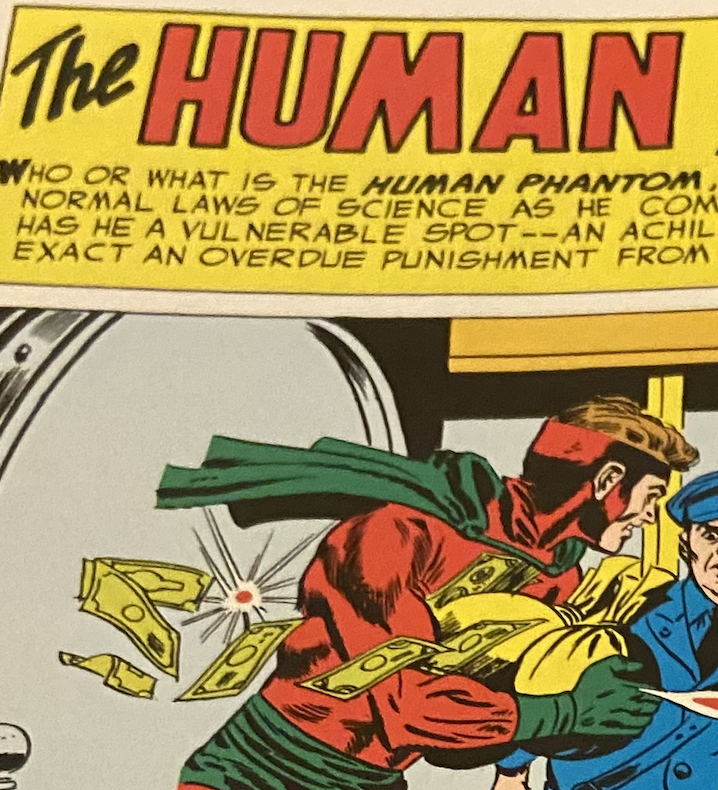
Yep, he’s soon using his great power for evil, making him a pre-Silver Age supervillain, right down to having a costume. Unfortunately he overlooked that only his boots keep his intangible body from sinking through the Earth. A landmine blows them off his feet, which doesn’t injure his immaterial body. However his protection is gone and he sinks helplessly into the ground, the end.
Too bad the story makes zero sense. We’re told the man’s negative-energy aura allows his clothes to pass through solid objects with him; how then, can his boots stop him sinking? How does he even put his clothes on when he can’t touch solid objects? It feels like the script missed a panel explaining this (“When the power wears off, I don my costume, then drink the water to become immaterial again.”). When the Shadow Thief appeared to battle Hawkman, Gardner Fox managed to work around such problems but that’s not the case here.
In fairness, lots of later stories would have me wondering how the villain’s powers/plans/tech makes sense. I suppose “The Human Phantom” is a forerunner in that sense too.
Covers by Murphy Anderson.

What all is in that Science Fiction Finest? Just the Tommy Tomorrow stories from Action, and then all the material from that run of Strange Adventures and Mystery in Space? Or anything left out? Definitely curious about that one.
Strange Adventures 35 from mid-1953 through 48 from roughly a year later. MIS from 18 to 22, covering the same period. Tommy Tomorrow stories from the same period. As far as I can tell, nothing from the Schwartz books got omitted — series and one-shot stories, they’re all in it together.