

Movies don’t always start with a brilliant idea. AIP, the legendary maker of low-budget drive-in movies, would often come up with a publicity campaign, then make the movie if theater owners showed interest. Similarly, Don Miller’s excellent B-Movies says lots of those low-budget films started with a promising title (Boston Blackie Meets a Lady, Two Señoritas From Chicago), then came up with a script. It’s the equivalent of the old “cover-first” approach to writing comic books.
Sometimes this approach can give us a fun film, such as Dr. Jekyll and Sister Hyde. However it also gave us films like 1951’s Son of Dr. Jekyll, a Jekyll and Hyde movie that can’t make up its mind whether Mr. Hyde exists. Did Dr. Jekyll transform himself into a brutal monster or was he the innocent victim of mob hysteria? The movie wants both of these things to be true.
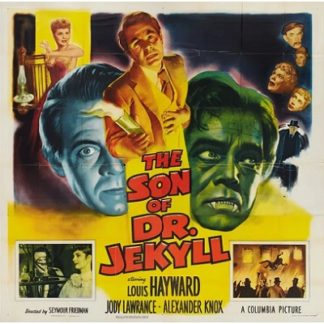
Screenwriters Jack Pollexfen and Mortimer Braus were kicking around titles they thought would sell when they came up with Son of Dr. Jekyll. They liked it and pitched they idea to Columbia, which gave them the go-ahead to write it Edward Huebsch also contributed to the script; as he was on the Hollywood blacklist, he’s uncredited.
The film opens shortly after Mr. Hyde (Louis Hayward in third-rate monster makeup) has murdered his wife Jane, the crowning act of his reign of terror. Fleeing his home on Soho for Jekyll’s upscale Mayfair digs, Hyde takes his transformation drug but too late to disappear into Jekyll’s respectable facade — the torch-wielding mob has tracked him across town. Hyde tries to escape out the window and onto the roof, falls and dies (a surprising number of Hydes buy it that way), reverting to Henry Jekyll (Hayward without makeup).
In the aftermath, Jekyll’s friends Utterson (Lester Matthews) and Lanyon (Alexander Knox) stare down at the corpse. Utterson marvels that a few minutes earlier he wouldn’t have recognized his friend. While that’s true — the brief glimpse we got of Hyde’s face makes that clear — Lanyon puts a different spin on the words. He tells Utterson they wouldn’t have recognized him because Jekyll is a man where Hyde was a legend given form by the ignorant masses in the mob — “they’ll never stop creating monsters, will they?” This becomes the theme of the movie: the horror isn’t that Jekyll turned himself into a murderous monster, it’s that Londoners freaked out about it so much.
With Jekyll dead, Lanyon and Utterson must decide what to do about his son, Edward. Although Lanyon is Jekyll’s executor, he convinces Utterson that the latter, being married, is better qualified to raise the boy. That settled, we fast forward to see a grown up Edward (Louis Hayward again), who’s unaware of his parentage yet seems to be a chip off the old block. Having won membership in the Royal Society, England’s premiere scientific body, he’s been drummed out for “experiments bordering on witchcraft.”
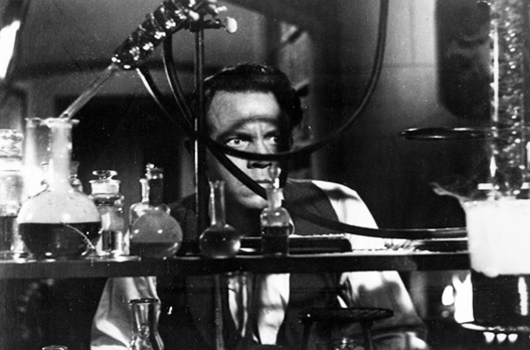
What were those experiments? We never learn. I suspect the writers threw that in as a red herring to raise the possibility Edward’s following in his dad’s footsteps. His disgrace doesn’t stop him from proposing to Utterson’s daughter Lynn (Jody Lawrence) at which point Utterson and Lanyon reveal the truth about his ancestry. While this means Edward will soon inherit the Jekyll fortune, he doesn’t find his genealogy welcome news. Has he inherited his father’s madness? Will the mob react with the same hysteria that turned them against his father?
The film proceeds on these parallel tracks, never considering they can’t fit in the same film. On the one hand, Jekyll was a mad scientist who became a brutal fiend. On the other, he’s a “lonely, tortured” man who only murdered Jane after J. Jonah Jameson-style attacks in the popular press turned her against him. Which the movie seems to think makes a good tragic excuse. Lanyon in one scene compares Jekyll’s death to the way Galileo was driven to his death for claiming the Earth moved around the sun. Galileo, of course, was not driven to his death and spent the last years of his life under house arrest.
The dangers of lynch mobs and fearful, frightened people have been the subject of some excellent films such as 1936’s Fury and 1943’s The Ox-Bow Incident). A story about a Jekyll whose transformations were nothing but a myth could be interesting — probably not at the hands of these scriptwriters though. They can’t stop piling nonsensical ideas atop the nonsensical foundation.
After the truth about Edward’s parentage comes out in the papers, he sets out to redeem his father’s name. In Jekyll’s now abandoned home he discovers his father’s old notebooks including the transformation formula. If Edward can duplicate it, that will prove his father wasn’t a delusional crackpot. Which nobody in the film has claimed: people hated Dr. Jekyll because they believed his formula worked, not because he was a loonie. Jekyll’s man-servant (Rhys Williams) says Jekyll’s real goal was to develop a universal cure for all disease. This idea is just tossed off and then forgotten; Edward’s clearly trying to duplicate the Hyde formula. He apparently succeeds, giving us the only clear look at Hyde in the film. As Edward turns back a moment later, it wouldn’t affect the story if it had been a hallucination.

We see what Edward didn’t, that a mystery figure tampered with the formula to make it work. When he concocts the formula in front of an audience and drinks it, it doesn’t work (don’t ask me how success would clear his father’s name). OMG, he’s as delusional as Dr. Jekyll! As the evidence accumulates that Edward’s losing his marbles, maybe even murdering people like dear old dad, the press once again whips the mob up about this new menace to society. Edward begins to worry he’s cracking up, telling Lynn “What’s real to me isn’t real to others — you know the name for that, of course.” Lanyon suggests maybe a rest cure in his mental hospital would be a good thing.
At the climax, Edward finally puts it together: there’s a crooked real-estate developer behind it all! No, wait, that’s Scooby-Doo — this time it’s a crooked executor! Lanyon, as he admits in their final showdown, was ruined by his association with Henry Jekyll. As payback, he’s been embezzling from the estate. If Lanyon gets Edward locked away, the boy will never learn about the fraud. Instead Lanyon winds up trying to escape one of the angry mobs he’s whipped up and falls to his death just as Hyde did.
It’s a completely incoherent mishmash of a plot, which didn’t stop Pollexfen from recycling it a couple of years later into Daughter of Dr. Jekyll. That one had a halfway coherent story, and a spooky isolated setting which made it more watchable, though still not good.
Son of Dr. Jekyll is not the worst movie I watched for my book. Among the bad ones, it is one of the more memorable.
