

I was talking to my friend Ken over the weekend (he claims he’s going to check out the blog, so if you’re reading, Hi Ken!) and he said he likes talking to the guys at his comic book shop because they have some interesting conversations. Apparently, this topic came up at some point, so I’m going to steal it as this Week’s Question! It’s easy — we’ve all read comics that we think are brilliant, and then when we revisit them later in life, they don’t do it for us. My Question is: Which one(s) are yours?
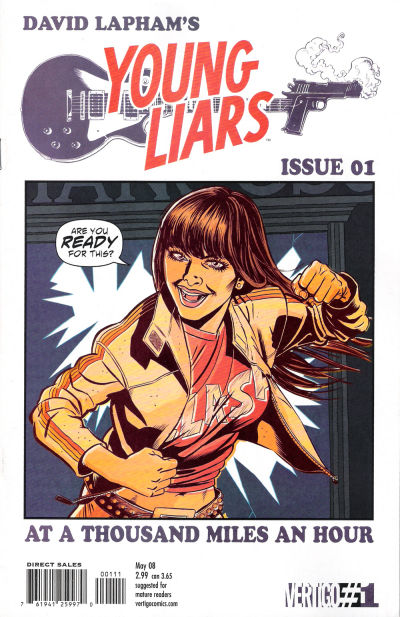
When Ken asked me this, I immediately thought of Young Liars. When it came out, in 2008-2009, I thought it was excellent. There were a few missteps, sure, but overall, I thought it was superb. I loved issue the first issue and enjoyed the series, although occasionally it was a bit too much for me. Even so, I loved the fact that Lapham just chucked everything at the wall and hoped some of it stuck, and there were moments and issues that were dazzling in their brilliance. A few years ago, when I reached the back end of my single issues that I was re-reading, I was really looking forward to reading the entire thing in one(-ish) sitting, and it was … kind of meh. Not terrible, but not as good as I recalled (of course, I knew I had been ambivalent about some of it, but overall, I thought it was good) and definitely not as weird as I thought it was. Well, that’s not true — it was weird, but whereas back in ’08 I thought it was batshit insane in a good way, when I re-read it 15 years later I just thought it was Lapham being batshit insane for no good reason. It just feels like he’s definitely chucking everything at the wall, but less of it seemed to stick, and I hoped he had some kind of plan, but it felt far too unfocused. It kind of bummed me out, but such is life.
I could probably think of more, but I’m not going to. I’ve only just started into my trade paperbacks and graphic novels, and I’m sure there are some that I once thought were very groovy, but I just haven’t re-read them yet. As for my single issues … well, there are probably some, but none come to mind right now. I imagine if I checked out the Michelinie/McFarlane Spider-Mans, I’d see all the cracks, but it’s been a while since I read them, so I can’t say. I know my choice is a bit odd, because usually, if you think about this, it’s something you liked when you were a kid and your critical faculties weren’t as well developed, and as an adult, you see all the flaws (this is the main reason I don’t want to watch Manimal again, because it would ruin the wonderful memory I have of watching what I’m sure was a garbage show). Mine is from when I was an adult, and not even too, too long ago. But it’s my choice, and now I’d like to hear yours! Don’t be shy — we’re all friends here!

Warning: potential heresy:
When I reread Watchmen about ten years ago (original floppies bought new) I was very, very nonplussed.
I mean, intellectually I could appreciate all the effort, coding, singaling, foreshadowing, symbolism, etc. It was just boring.
Then again, even at the time shortly after the original publication when various commentaries appeared analyzing the sheer brilliance of it all, I remember thinking people were getting a tad excited.
Question of the Week is a safe space, sir, no matter how wrong you are! 😉
Not wrong, maybe ahead of my time?
Which is to say, I am absolutely correct about this, I did find it boring.
Heh, I had Young Liars too. Sold them years ago.
When the first few issues of Age Of Apocalypse and The Boys came out I liked them and got the rest with the idea to read them in a short period of time. When I did I didn’t get any further. Luckely I could sell them for a nice price.
If I like stuff I try to upgrade. So recently I got the 2 Secret Six omnibuses. As a bonus the 14 issues of the New 52 Secret Six.
Most of mine are things where I was, as Tom Brevoort puts it, “underwriting mediocrity” — comics I kept buying long after they turned to crap. Case in point, Ed Hannigan’s run on Defenders which was one of the first times crappy quality beat my completist impulse.
I liked Infinite Crisis as it was coming out because I assumed Power Girl learning the history of the DCU was leading somewhere. Instead when I reread it, it was six issues of pre-crisis history, COIE history, post-crisis history, for no point at all, then one issue of action. It’s almost like a satire on the kind of continuity porn COIE was supposed to kill off — but I know it wasn’t satire.
I’m really trying to think of a good answer for this, but I haven’t reread much lately. There are probably some of those extra-weird comics I raved about 20 years ago that won’t hold up for me as an older, crankier human being. And part of me dreads revisiting work by certain cancelled creators.
Oh man— the question should have come with its own follow-up. . . “And why is it KAMANDI?”.
And I only mention it because earlier this year I picked up the 10 or so issues I was missing from the early part of the run, and plonked myself down to revisit ol’ Earth-After-the-Great-Disaster for the first time in, like, 45 years. And ohhhhhhhmigod, I mmmmaybe got through issue #4 before I surrendered entirely. There’s only so much lifespan left, y’know-? And it’s too valuable to waste reading once-favorite comics that are objectively NOT GOOD AT ALL. (Sorry, fans– but, jeepers!). The biggest offense is Kirby’s complete lack of ability to write dialog that somehow manages to be both cliche’ and yet completely unlike how any human (or anthropomorphized animal) would ever, ever speak. Characterizations across the board are non-existent– in an era where Character was All— Oooooof.
Ohhh it did make me melancholy.
HB
Strong disagreement. Kamandi and Eternals are the only really outstanding post-New Gods series by Kirby (and yes I have read it recently). Though I agree dialog isn’t his strong point, but it picks up steam as it goes along (https://atomicjunkshop.com/hes-not-the-chosen-one-kamandi-the-last-boy-on-earth/)
I have to go back and sort of agree with HB, in that – when I sat down and read the entire Kirby run of it about 15 years ago – I found it quite a grind and, in fact, the earlier issues were better. For me, it did not get better as the series progressed.
Easy for me: Preacher and 100 Bullets
At the time I could afford only the equivalent of one trade a month. If I penny pinched to the extreme, I got two. I started my comic collection with Preacher and 100 Bullets. Loved them.
Got them all, read them all several times. Then let a few years pass by, read them again, found them bad and sold them both. No regrets, don’t care about them anymore
It’s been a while since I read Preacher, but I never thought it was as good as Hitman. We shall see once I re-read it. I thought 100 Bullets ran out of steam in its second half, but it’s another one I haven’t read in a while, so I’ll have to find out when I get around to it. In short, I don’t think either of your choices are too surprising!
Re 100 Bullets, I did too. The more I learned what was going on, the more it felt like a more routine crime thriller.
Pretty much Frank Miller’s main output. It was more interesting, at the time, in contrast to other work of the period; but, a lot really doesn’t hold up and I don’t like his worldview. Also, I can see from where he is swiping, in a lot of it. Daredevil holds up better, though more early than later and I never thought that much of Born Again, other than Mazzuchelli’s art. The Martha Washington stuff and Big Guy and Rusty The Boy Robot are different stories, due to the collaborators. I soured on Sin City pretty quickly, especially when it became apparent that it was a one trick pony that was being ridden again and again. Also, Miller has a real problem with women.
I also disagree about Kamandi and Kirby’s ability to write dialogue. He doesn’t write snappy dialogue, but he writes interesting dialogue, if you examine it closely. It took age and experience to get me in a similar headspace as Kirby and understand where he was coming from, on his 1970s and 80s projects. Kirby is a storyteller, not a scriptwriter. He handled things in broad strokes and often riffed on things, in a sort of visual jazz and his dialogue had similar elements of jazz and Beat Poetry.