

“People feed me with their lives I have a hungry soul and they all worship me and pay their homage day and night”
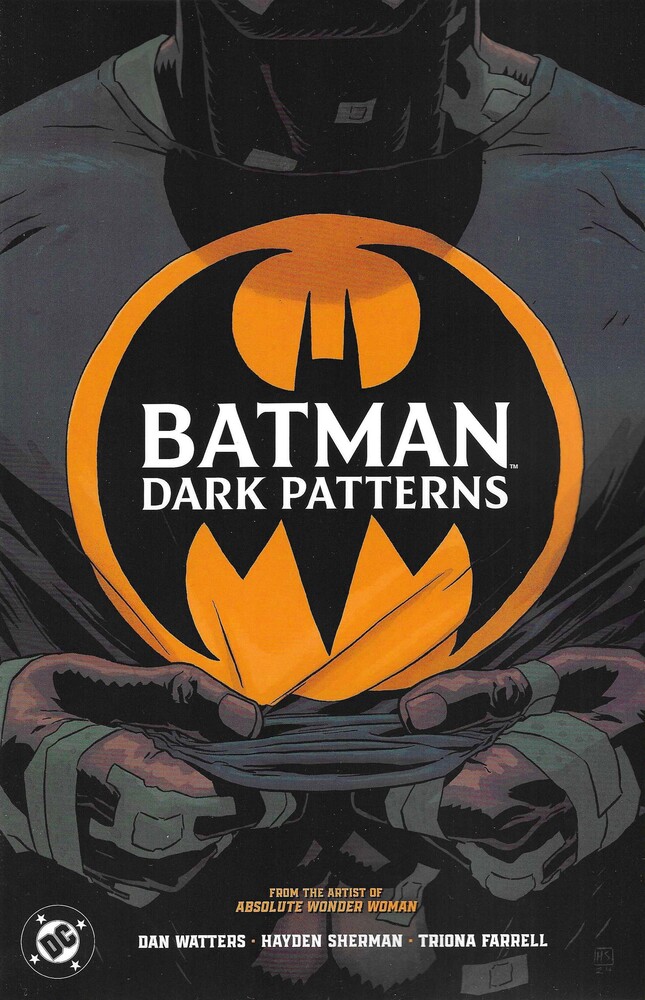
Just what the world needs: another Batman book! This one is by Dan Watters, Hayden Sherman, Tríona Farrell, Frank Cvetkovic, and Arianna Turturro as the all-mighty editor, and it’s $29.99 for the nice softcover, but it is a hefty 266 pages longs, so there’s that. So let’s take a look at this monster!
It’s a Batman book, so if you read comics at all, you’ve probably heard a bit about this: it’s 12 issues, but each “case” is three issues long, and they’re related but not completely connected until the “dark pattern” becomes clear in the final case. 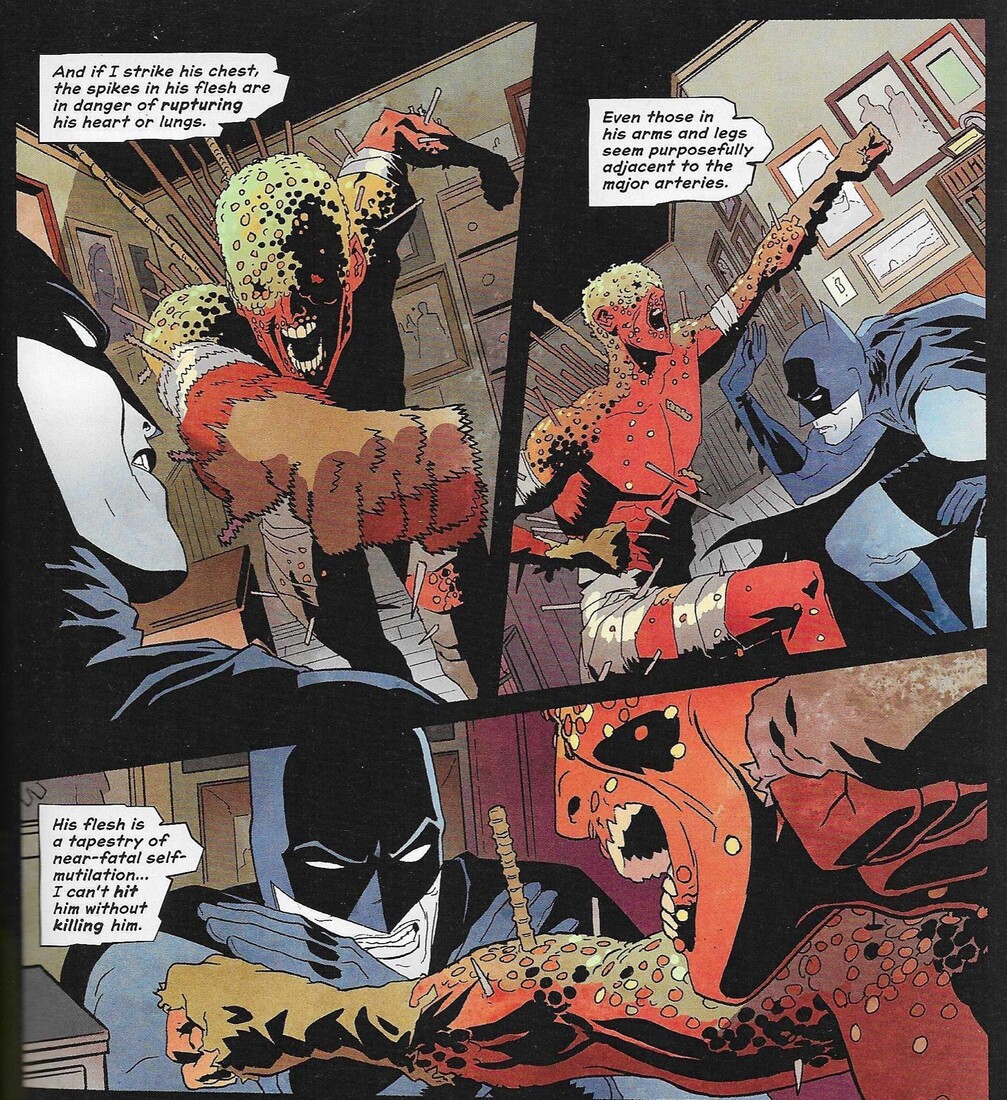 Watters sets it (sigh) a bit earlier in Batman’s career, so Gordon is a bit younger and Alfred is still alive (Alfred has been dead for 7 years, and while I appreciate DC sticking with the bit, it seems like writers can’t resist using him, so maybe they should bring him back?). This means that he can make it feel older — the fashion and the cars feels like it’s the 1940s, even though it’s not, but writers can’t resist that, either, so we get that weird, out-of-the-right-time Gotham that writers (and artists, probably) love instead of a more modern Gotham. I don’t love it, but I don’t hate it, either (the Batmobile is super-mod, for instance, and Bats has his cool-ass computers, so it’s clearly a modern-ish story, which makes it weird to see all these ’40s-style cars on the street). In the first case, Batman fights, frankly, one of the best new Bat-villains of the past, what, 30 years? in the “Wound Man,” who has all sorts of sharp implements embedded in his body and is somehow (comic-book science!) still alive. The Wound Man is killing people by sticking sharp things in them slowly, making them feel a buttload of pain before they die, and when Bats figures out his scheme and who he is, we begin to see what kind of pattern Watters is going for (which I’m not going to discuss, because it’s more fun to read it for yourself!). In the second case, Scarface is back, and he seemingly has possessed … an entire apartment building? There’s a cop being held hostage inside, so Batman has to Judge-Dredd his way through the maze of the building so he can find out exactly what’s going on. He thinks he’s beginning to see a pattern to these events, but then, in the third case, he goes into an extremely poor neighborhood in Gotham, where he finds a corpse, and he has to keep reminding himself that not everything is a pattern … or is it? Finally, in the fourth case, he finds out what’s going on. Again, I’m not going to tell you what’s going on, because you’ll need to read the book for that!
Watters does a lot in this book, because he’s a thoughtful writer and he has a lot of room for it, so he’s going to take it, dang it! The cases are certainly interesting, and Watters wants to emphasize the “detective” part of Batman’s identity, which is certainly something I appreciate, so there’s that. 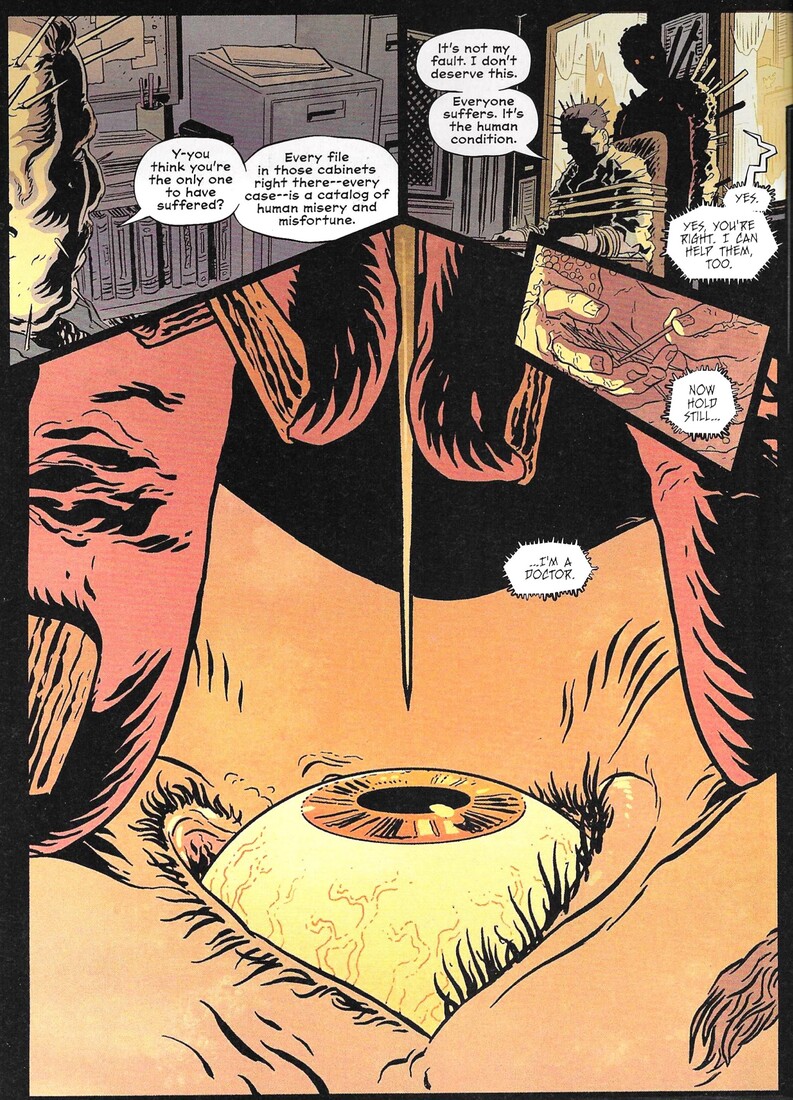 More than that, however, this book is about legends and myths and how cities grow these myths and what part Batman has to play in all of that. Watters uses a familiar trope — fire — to make his points, as fire and what it destroys is a big part of the book. Fire-as-metaphor isn’t new, even in the Batman books (we all remember how parts of the city were bombed to reveal that Anton Furst had secretly designed buildings around town, right?), but Watters does some interesting things with it, leading to a climactic moment with Batman and the fire itself. If “Gotham City” is supposed to be the poorest parts of New York around midnight, then it’s not surprising Watters turns to the history of New York to inform his history of Gotham’s fires (although, according to the Atlas of the DC Universe, Gotham is on the south coast of New Jersey, so it would have been fun if Watters had had the Swedes settling it rather than the Dutch, but such is life). He and Sherman ground the story deeply in Gotham, which is pretty keen, and it’s nice to see that Watters thinks about Gotham as a city and where things would be in relation to other things and how the city would work (I still contend that Gotham should not work as a city because it’s such a mess, but Watters, at least, makes the effort!). Do I think there would be a neighborhood like “the Rookery” in Gotham? It is, as Watters describes it:
… half rebuilt with temporary materials decades ago after a minor quake. The city never bothered to go back and fix it properly. The streets here have no names or numbers. Half the buildings have no clean running water or proper electrical wiring. Some are simply constructed by the residents, wherever they feel like. Rooms balanced precariously over alleyways. Overlapping. Tunneling through. It cannot be navigated by intuition. Only by those who know it.
This is ridiculous on the face of it — the worst cities in the States do not have neighborhoods like that, and only the poorest cities around the world might have something analogous to it. 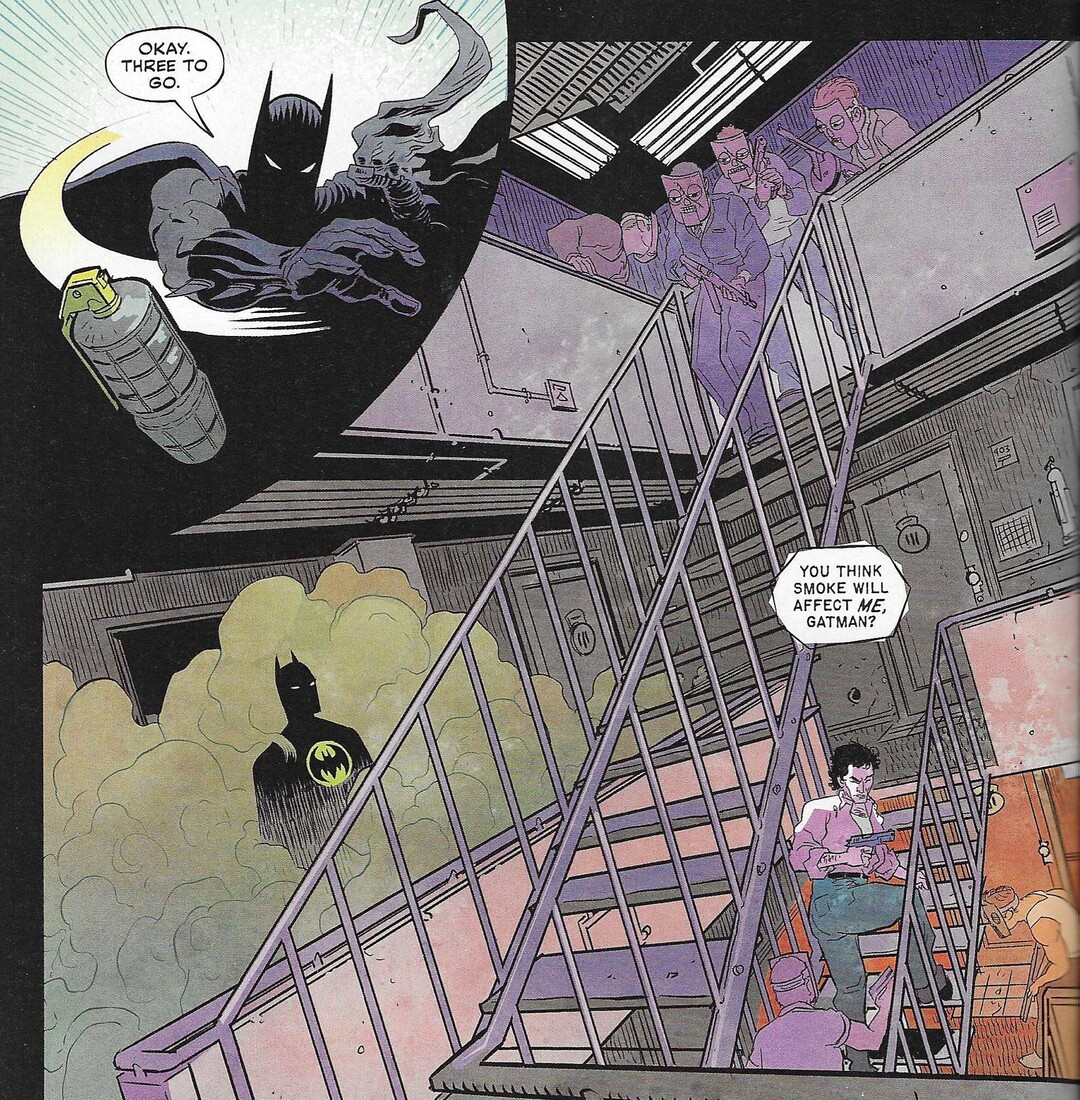 Certainly, this real estate in a port city on the eastern coast of the United States would be far too valuable, even in a shithole like Gotham, to allow to be turned into a medieval town, but Watters is, of course, trying to make a point in this story about Batman looking for patterns where there might not be any (but, also, might be!), so this idea of a neighborhood that defies any kind of order or even cartography is perfect, and Watters brings it to life beautifully. It’s not meant to be realistic, of course, and so pedants like me just have to accept it. My point is that Watters creates these very interesting places in Gotham and works within them very well, and he puts a lot of fascinating characters into these places and does a nice job with them. We get the odd pathologist with the secret in his past (I mean, he’s a fictional character, so of course he has secrets in his past!); we get the Menckenian journalist who digs into places that Batman doesn’t, mainly because they’re not connected to crime right in front of him; we get a Sionis (I didn’t love that he’s named Sionis, but such is life) who’s a slick businessman, so of course he’s creepy and villainous; we get Rickson, who may have replaced Arnold Wesker as the Ventriloquist … or did he???; we get the old Red Hood gangster who’s trying to prove he’s still a tough guy; we get a Donald-Sutherland-in-Backdraft-which-is-just-a-riff-on-Anthony-Hopkins-in-The-Silence-of-the-Lambs Garfield Lynns. Of course, we get Gordon, who’s basically always the same, and we get Alfred, who’s very tired of all of Master Bruce’s shit. The cases are fascinating, sure, but Watters does a lot of work with the characters, which makes the cases work. Plot is fine, but if the characters aren’t engaging, who cares that much?
Sherman is, of course, superb on the art. Watters wanted a fully-realized Gotham, and Sherman gives us that, with broken-down neighborhoods and creepy, mind-bending apartment buildings, and glitz juxtaposed fiercely against grime. It feels like a place that could exist — again, I’m not buying the Rookery, but Sherman makes it a place feels like it had been built haphazardly, and they make it feel lived-in, which is what you want from a comic. Similarly, the “Scarface” building seems to be haunted, and part of that is its geography, which Batman has to navigate and which holds clues to what’s happening in the story. 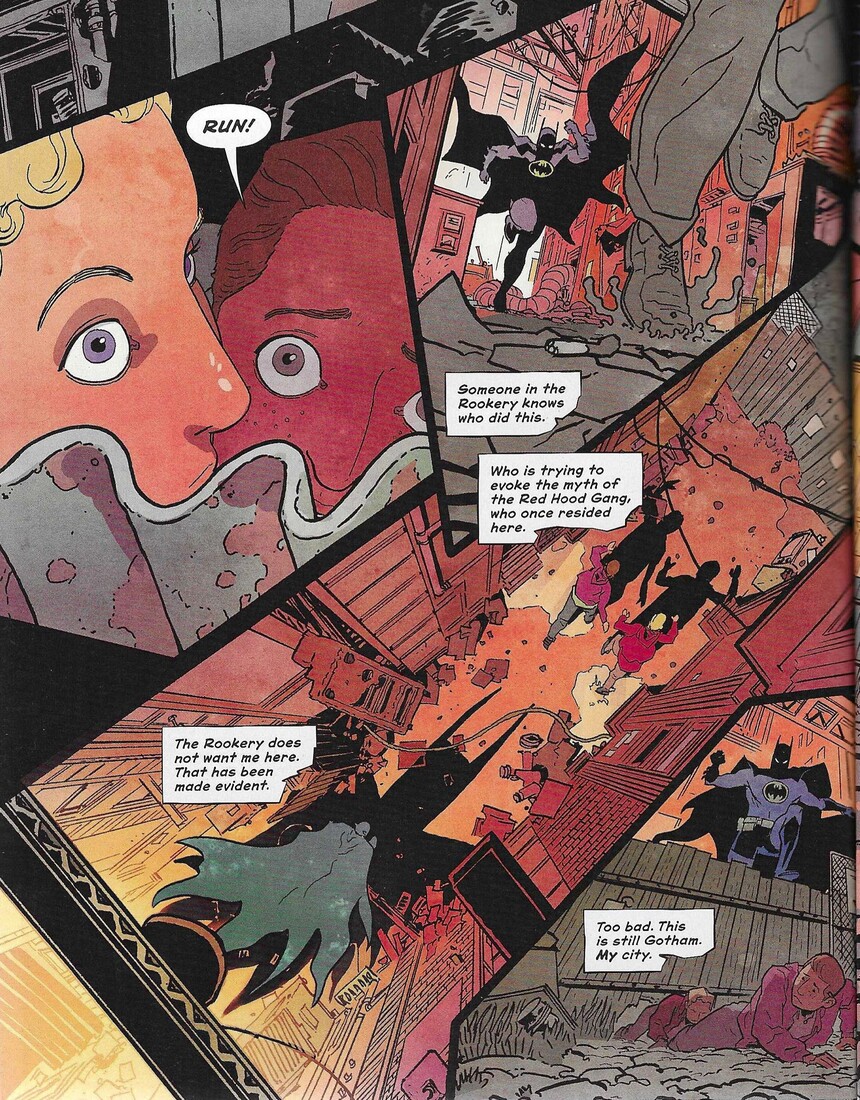 Even when Sherman shows us the less bad parts of town, they add small Gothic touches around the edges to give it a slightly decrepit feel. It seems like the editorial directive for Gotham City in the 21st century has been “1940s futurism,” sort of, with a lot of modern stuff but 1940s clothing and culture aesthetic. I, it must be stressed, do not agree with this vibe at all, but it seems like the editors want it (for the most part; both Bat-books recently have leaned a bit more into the contemporary), and Sherman is one of the better ones at toeing this line. The two “big spaces” in the book — the “Scarface Towers” and the Rookery — are wonderfully designed, and because they’re both kind of labyrinthine, Sherman’s unusual way of designing a page and the panel placements make them a very good artist for these kinds of stories. Meanwhile, their design for the Wound Man is truly amazing and terrifying, and I very much hope that DC doesn’t use him again, because his story is unique to this case and also I’m not quite sure how well other artists can bring him to life. Sherman’s work is so detailed and marvelous that I just can’t write about all of it here, but this comic is yet another reason why Sherman is getting so much work on high-profile titles. If you look at it, you’ll know!
This comic is a bit reminiscent of David Lapham and Ramon Bachs’s “City of Crime,” in that Lapham also dug deep into the city itself and while that was more clearly one big story, there were some small parts that formed smaller stories within the whole. It’s just something that struck me, and when it did, I thought that it’s odd that 20 years ago, DC published “City of Crime” in Detective Comics, yet they separated Dark Patterns out into a mini-series, and they were both 12 issues. DC even interrupted “City of Crime” to do their “War Games” crossover, which is wild to think about. I actually thought it would have been kind of cool if DC actually did these kinds of stories in the pages of the regular titles, but that ship has sailed a bit. Oh well. It’s just something I thought of.
Anyway, this is a very keen comic. Watters and Sherman are good on their own, and putting them together is an extremely shrewd move by DC, and this is a very good comic. It has weird stuff in it, Batman gets to be a detective quite often, and it looks really keen. They can do more comics together if DC and they want to!
Rating: ★ ★ ★ ★ ★ ★ ★ ★ ½ ☆

I’ve heard great things about this, glad to see it got another “thumbs up” vote here as well. With Watters’ Arkham City: Order of the World book and now this, it seems like he’s the one to do good, dark self contained Bat-universe titles (haven’t read a Bat monthly since Morrison, and none have really seemed interesting from what I can tell)
Although I enjoyed Morrisons run on Batman, he kind of ruined the character with the whole Bat-God angle.
Other writers just can’t seem to let it go and the plots and action just seem to get overblown and ridiculous.
I prefer my Batman more down to earth and Dark Patterns brought that in spades.
It’s so, SO good – best Batman book I’ve read in ages.
Maybe since Black Mirror?
Black Mirror was pretty good, the first and last decent thing that Snyder wrote.
Really enjoyed this, definitely the best Bat-comic in a long time. The art is phenomenal, of course. Also feels like Watters is influenced by my beloved early ’90s Bat-comics. This could slot right into Legends of the Dark Knight or Shadow of the Bat.