
[Today I’m combining two of Greg’s columns — this one from 12 September 2015 and this one from 28 November 2015, as the second one is a sequel to the first, so why not? This is pretty cool of Amendola, who found Greg’s columns about “Night of the Stalker” and contacted him about it. Amendola is still alive as of this moment, which is nice. Greg and I and lots of others have often pointed out how cool it is that the comics community is still small enough that conversation between fans and pros is very common, and it was neat that Amendola was willing to share all of this with Greg. Enjoy!]
It’s probably my favorite Batman story of all time … well, okay, tied for first with “The Laughing Fish” and “Half an Evil.”
I’m talking about “Night of the Stalker,” in Detective #439.
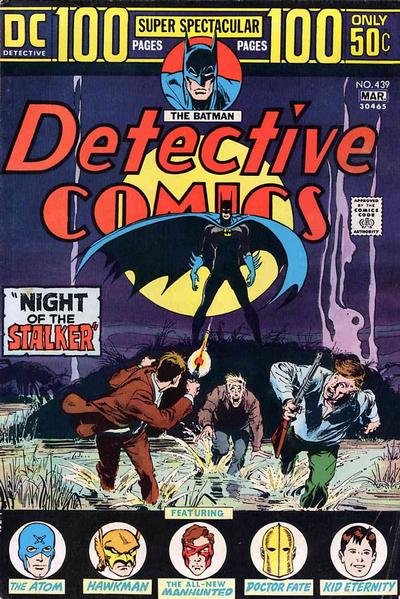
I’ve written about it in this space more than once, most recently here.
I’ve been doing this weekly column thing for almost a decade, and writing for Jonah at CBR even longer than that. Nevertheless, it always comes as a surprise when it turns out anyone actually reads the stuff beyond my wife and the core group of regulars (you know who you are, folks.) I’m especially shocked when it’s someone I admire.
All of which is preamble to telling you that I about fell out of my chair when an email from Sal Amendola arrived last week asking me if I wanted to know the story behind “Night of the Stalker.” It transpired that in the course of looking up something on the internet about his time working at Archie Comics, he’d run across some old columns of mine and liked them enough to get in touch. Of course I lunged at it — the guy that plotted and drew my favorite Bat story ever? Come on!
So he sent me the following — it’s from a textbook he wrote as part of the classes he’s teaching these days, and when I told him my readers would love to see this menmoir as well, he graciously agreed to let me reprint it here. So here is Mr. Amendola.
***
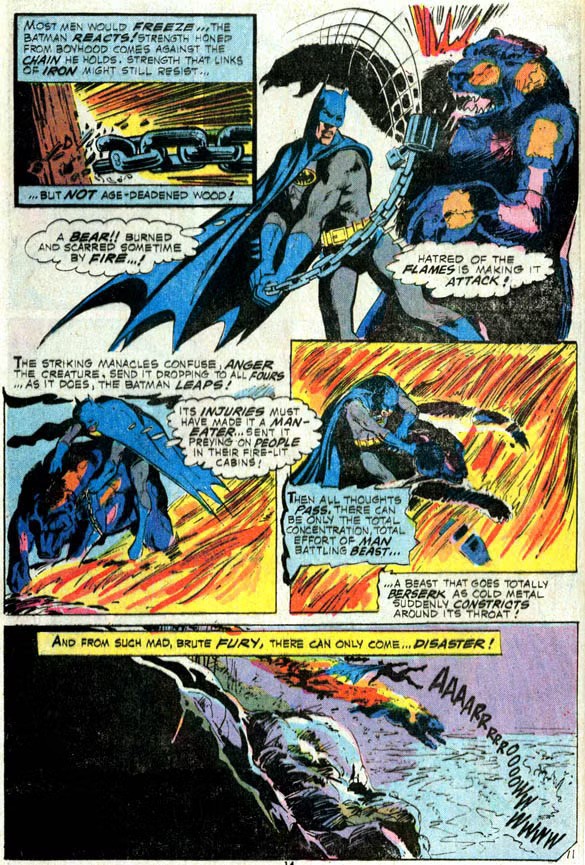
Around 1970, Neal Adams described an incident that he thought would be exciting to incorporate within a Batman story. [A scene with a fight in the water.] He told the “incident” (story pages 11 & 12 of Detective Comics # 439) over and over again, to anybody who’d come into “The Artists’ Room” at DC.
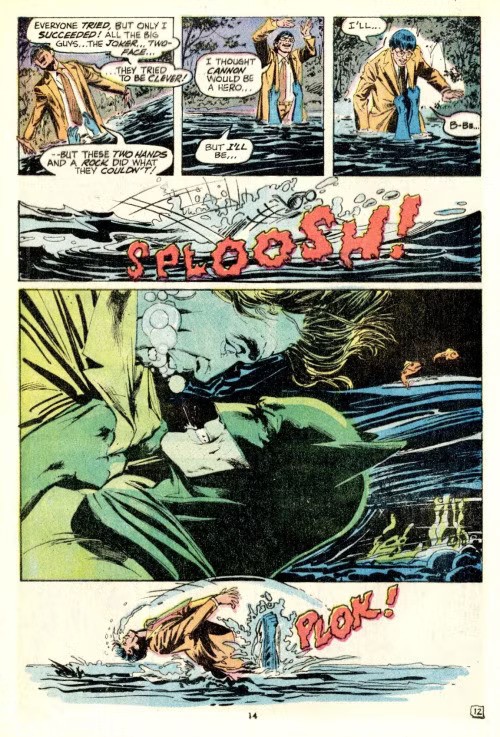
He told it each time as if it were the first. He was appropriately and effectively histrionic. I fought off goose pimples each time I heard him tell it. Some of the reactions I recall from others to whom he told his “Batman incident”:
Carmine Infantino walked out of the artist’s room chuckling, “You’re an animal, Neal. An animal.” All the way down the hall to his office, we could hear Carmine chuckling and saying, “He’s an animal. An animal.”
Denny O’Neil laughed his shy, breathy, almost inaudible laugh as he shifted from one foot to the other.
Joe Kubert laughed his loud, booming, infectious laugh.
Julius (Julie) Schwartz jingled the coins in his pocket and walked from the artists’ room without comment (his way of telling Neal that “Time was money,” and that he still had deadlines to meet).
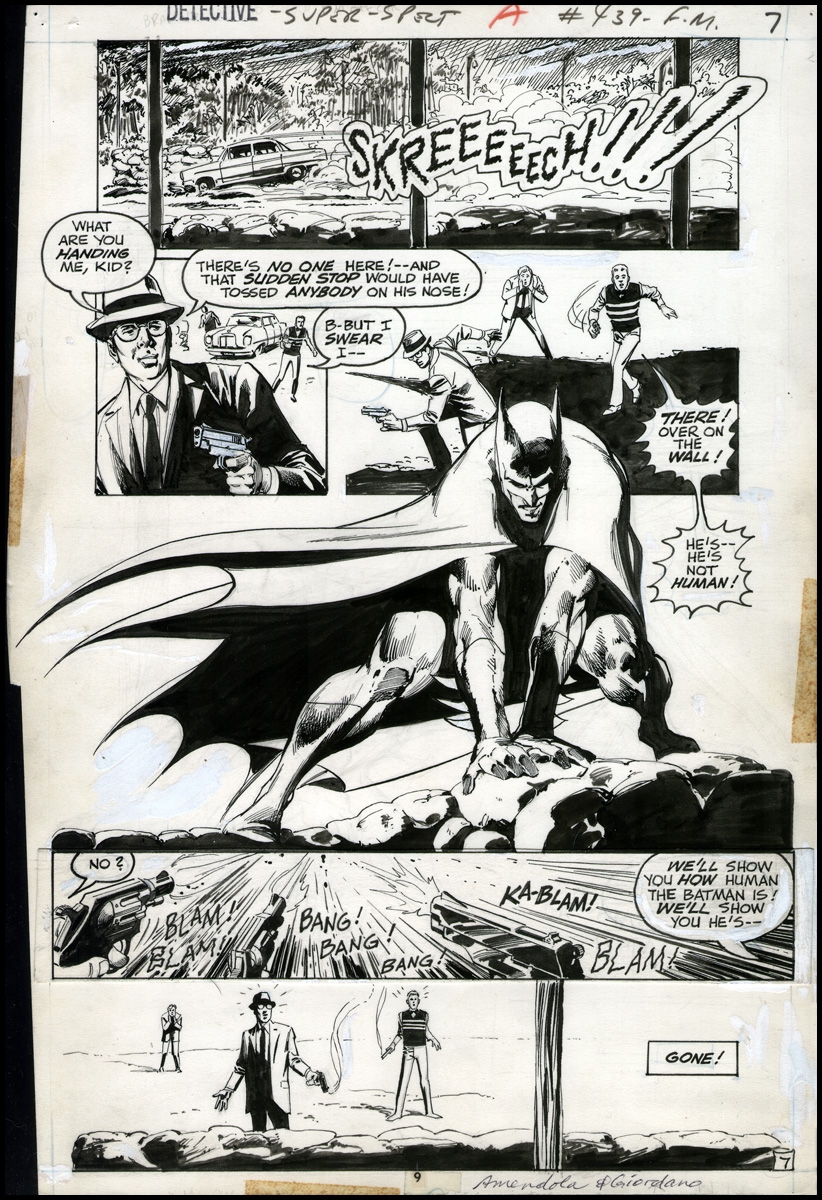
Nobody took up Neal’s “Batman incident.” I told Neal’s “incident” to my brother, Vincent. He encouraged me to “Do it. Do it.” I wrote an outline. Talked it over with Vinny. He told me what he liked and what he didn’t. Example: The scene on page 9 of the story, where one of the killers (whom I drew to look like Neal) charges toward The Batman, and they both go over the cliff.
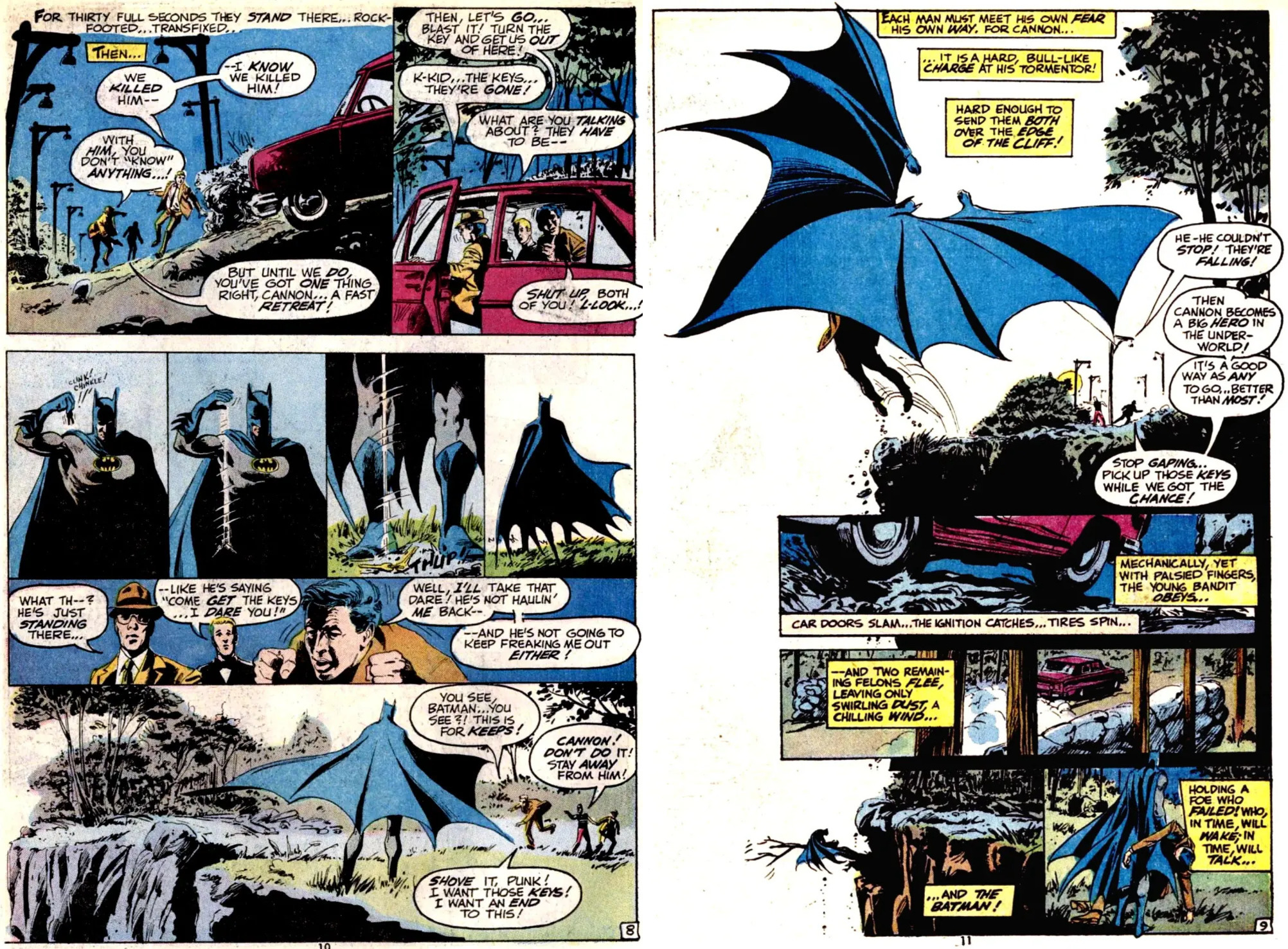
My outline had The Batman saved on a branch that he already knew was sticking out of the side of the cliff, and the villain fallen to his death. My brother thought that The Batman should “T’row da guy off da cliff” (my brother spoke “Brooklyn”). I told him that The Batman “don’t t’row nobody offa no cliffs.”
Julie and I were at odds on that point, as well. Julie, in looking over the pencil- artwork, asked, “Where’s the villain” who charged toward The Batman, sending both over the cliff. I said that he’d fallen to his death.
“Batman killed him?” Julie asked.
“No,” I responded, “The Batman let him die.”
He insisted that I indicate that The Batman had saved the criminal, and to add a panel that would confirm that fact. “Batman doesn’t ‘let’ anybody die!”
At first, I was angry about that change. I’d wanted to show The Batman so blinded by outrage that he would be driven to the edge of murder; to become almost as unprincipled as the sociopaths he hunted down. I later was glad for this particular change.
Steve did a great job on the dialogue, but it was also in this scene that one of three of Steve’s dialogue choices went contrary to my intent. I wanted the character to be in a frightened, horrified panic. To this day I feel that it would have added to a sense of horror over the merciless outrage that churned within The Batman for him to have so coldly “allowed” the death of somebody so “whipped.” Steve apparently thought that the guy should be a “mad dog” for The Batman to have risked his death.
Dick Giordano inked the villain’s expression as “angry,” appropriate with Steve’s dialogue. Since I also inked the backgrounds, when the pages passed back to me from Dick, I tried to change the expression back to “whimpering desperation.” A small part of the story, but not a wise thing to have done. It risks confusing the storytelling. It should have been one emotion or the other, not a confusing mix of the words saying one thing, the drawing suggesting another.
Steve gave names to the villains. Not only had I wanted them nameless, in order to keep the Reader from feeling personal / emotional attachment to these thieves and killers, I was especially saddened that Steve chose “stereotype nick-names,” like “Cannon,” “Kid,” “Punk” — or a simply “K-sound” name, “Rick.” I’d always cringed at character names that “defined” who / what they were, ever since, when as an adolescent, I’d created a super-hero character whose civilian name was “Arthur Istowistowsky — which he shortened to “Art Ist.” So “coincidentally appropriate,” since, in his civilian identity, he was an artist.
After I’d written the outline, I presented it to Neal. He agreed to write the dialogue and do the penciling. Then I learned that he’d given my outline to Mike Friedrich to dialogue. I was “hurt.” Neal was angered. He returned my outline. My brother said, “Do it. Do it” (pencil it). I did. Showed it to everybody I could. Everybody had some shot against it:
Marvel (Marie Severin, Johnny Romita, Sr., specifically) said, “Super-heroes don’t cry.” I said that it wasn’t The Batman who cried. He took off his mask — it was Bruce Wayne who cried.
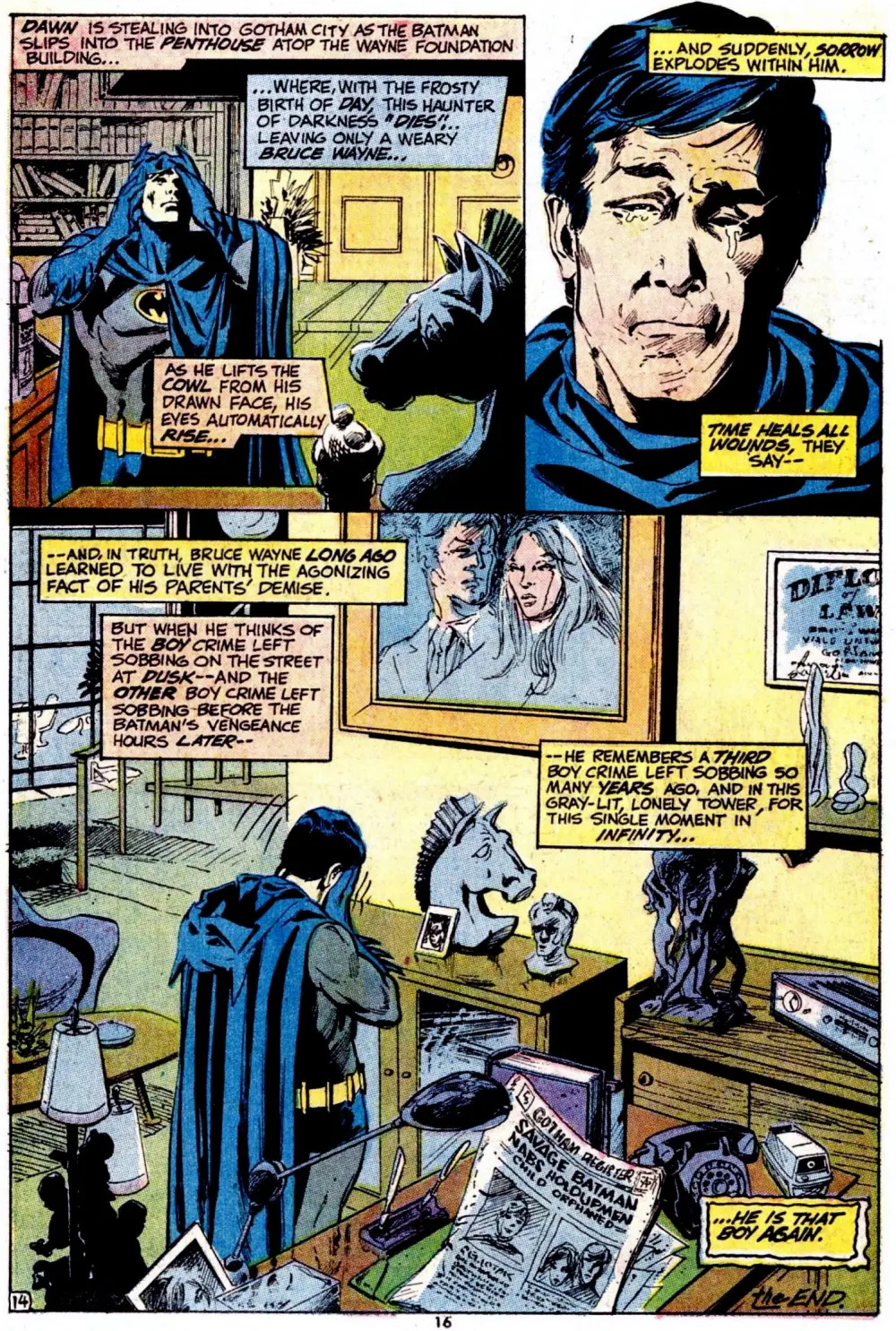
That it was symbolic of The Batman’s “dual nature”: Self-righteous conservative vigilante as The Batman, bleeding-heart liberal do-gooder as Bruce Wayne.
“It doesn’t matter,” they said. Marie was more adamant, saying that she would reject the story.
Dick didn’t like that I’d made The Batman’s “trunks” looser, indicating his manhood within (“Super heroes don’t got balls!”). He didn’t like that I showed The Batman’s eyes in the close-up on page 3 …
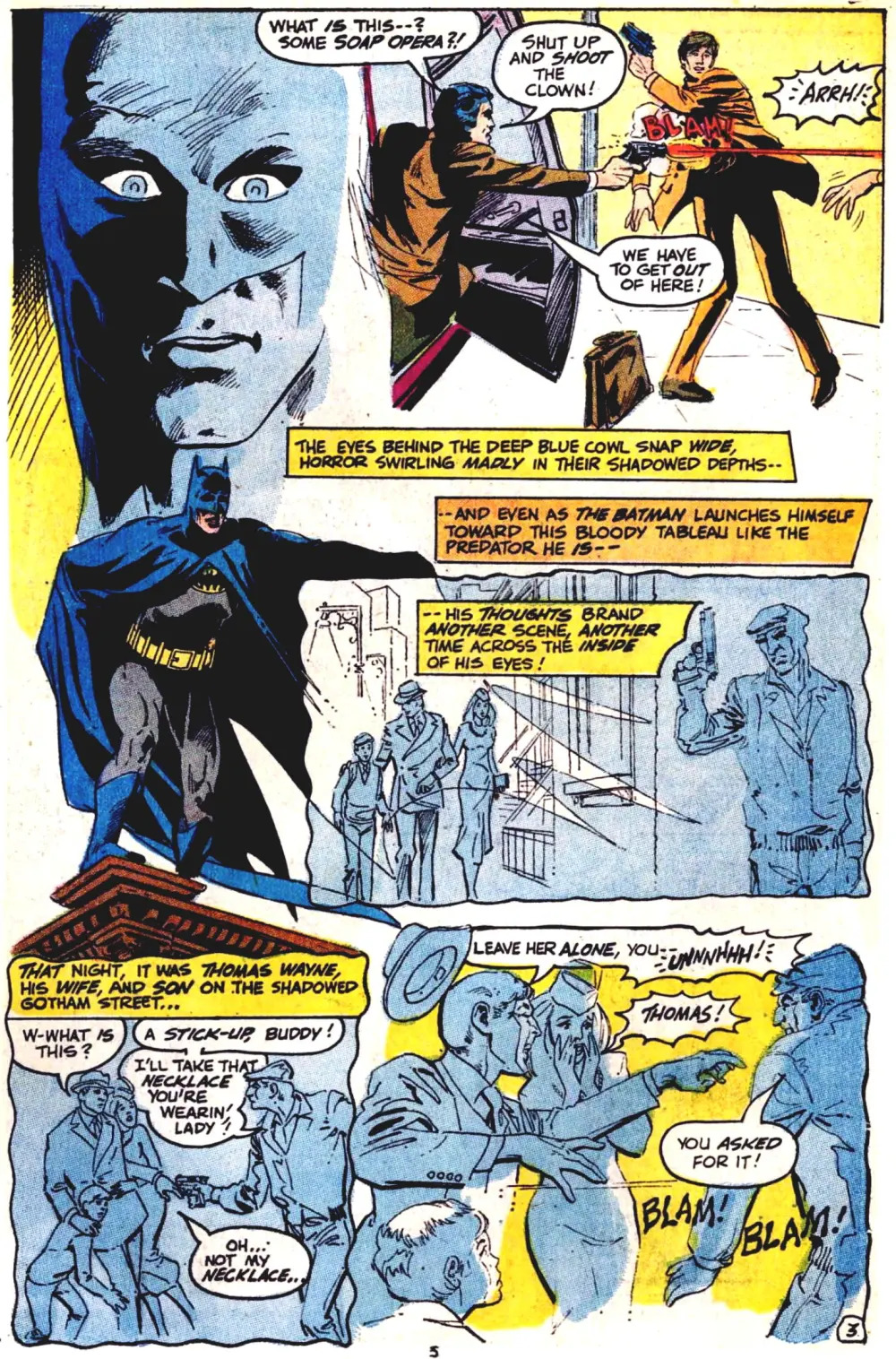
… and he refused to ink the eyes black in all the other panels, but since I did the backgrounds, when the pages passed back to me from Dick, I blacked in all the eyes. (Damn! How could you take seriously a crazed vigilante who has Little Orphan Annie eyes!?)
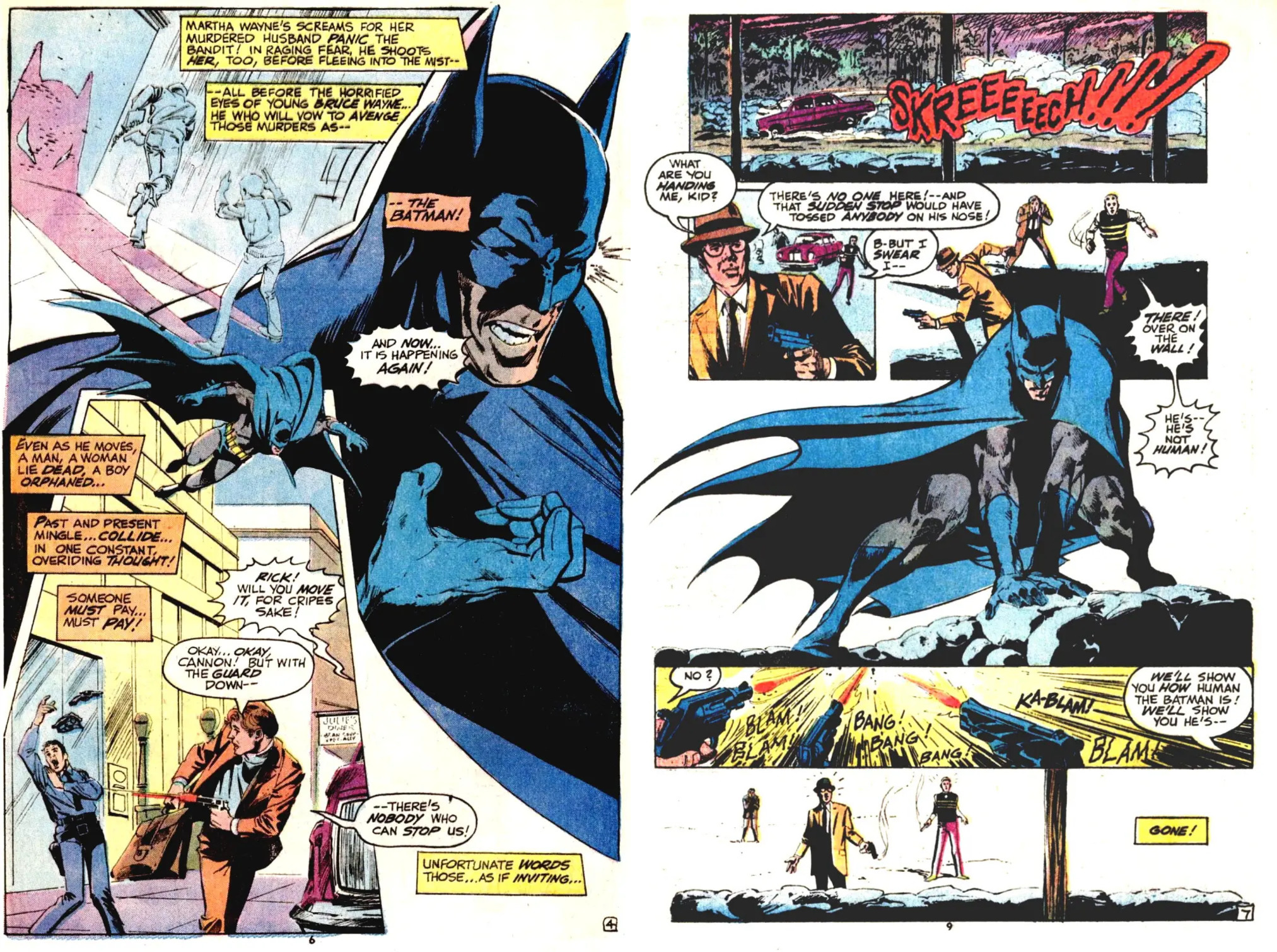
Nobody liked the drawing I did of The Batman crashing through the door on page 10 of the story. (Sergio Aragonès’ remark was that I’d made The Batman “Luke like a seesy [look like a sissy]!” Neal “presumed” to completely redraw it.)
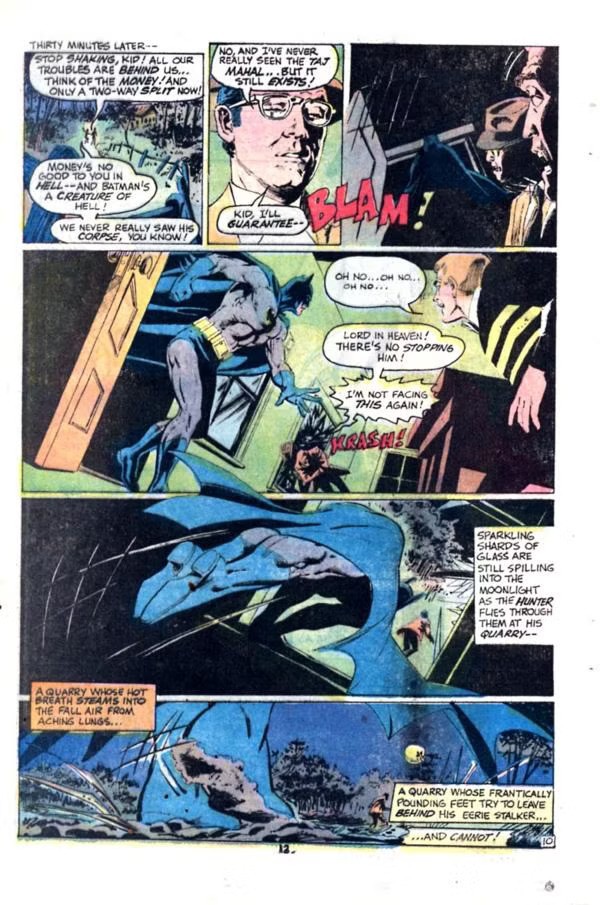
Nobody noticed the “Bill Finger BILLBOARD” that framed The Batman in panel 1, page 2. Unlike my depiction in his honor, writer Bill Finger did 3-Dimensional billboards in his Batman stories: ads with giant 3-D typewriters that really worked, the keys upon which Batman and Robin would jump, to catapult criminals cowering within; or, giant 3-D toothpaste tubes on which the two would jump, to squirt real toothpaste upon hapless fleeing criminals.
At one point, Dick spilled coffee on several of the pages. I’d intended to “light- box” them onto new bristol. He talked me out of it, saying that the stain would not interfere with reproduction, and that I’ve got to avoid any unnecessary work, thus avoid wasting precious time and money.
I showed the pages to Joe Kubert. He looked favorably on the work, overall, but the coffee stains inspired a particularly ironic compliment: “Hmm, nice ‘special effect’!” He then let loose his familiar, loud, booming, infectious laugh. I redid the pages.
I presented the finished pencils to Julie. We argued about changes that he wanted me to make (almost all were silly, hypocritical, censorship issues). He won some. I won some. With one exception, the compromises weren’t too painful for either of us: Julie said that the title, Déjà Vu, would not be understood by the readers (I recall a déjà vu experience as far back as five years of age); that it would have to be changed. I lost that one. I still believe I was right!
We talked about getting someone to do the dialogue. He wanted Len Wein. I was afraid that Len’s approach would be “Holy Adam West, Bats” (fully negating my central raison d’être), so I insisted, “NO!” I liked Gerry Conway (personally and as a writer). I don’t recall why Julie dismissed consideration of Gerry, but then he suggested Roy Thomas. I was ecstatic. Carmine rejected Roy, Julie said, because he worked for Marvel. Ultimately, we agreed on Steve. But then Julie rejected the story, anyway. “What can I tell you, my boy,” he said (every single time I offered him a story): “There’s no plot!” [How ironic that now, at best, I’m given credit only for the story’s “plot.”]
About 1973, Archie Goodwin came back to DC as editor. He asked to see my Batman story. Accepted it. Steve dialogued it. Archie proudly showed me the job lettered and asked me what I thought of it. I misunderstood. I thought Archie wanted to know what I thought.
I told him:
I didn’t like the “Marvel-style” title.
The lettering was poorly done.
Steve got “top billing” as writer.
Neal was given no credit at all (but since I also did the background inking, when the story passed back to me from Dick, I lettered-in Neal’s credit, myself).
The Batman talks.
The next-to-last page was dropped (to make room for an ad, I was told — never got that page back … was never paid for it.)
Archie got mad and said, “What the fuck, Sal!” I apologized for my “attack.” After all, he was the only one who had accepted my work without wounding negative judgment. He removed all the Batman-dialogue that Steve had written and Morris Waldinger lettered-in. Years later Archie personally conceded to me that he should have reworked the credits, too.
The colorist, Jerry Serpe, did not understand the “foreshadowing” (first panel, page 4 of the story) and colored the shadow too light in value.
I sorely miss the page that was dropped in favor of an ad. It was meant to serve as a “wind-down / transition” page between the non-stop action, and the final page, which showed Bruce emotionally breaking down in his penthouse office. This deleted page explained that The Batman had, essentially, walked all the way back to Gotham from the edge of the Long Island countryside. It makes logical his having a copy of the newspaper on Bruce’s desk in the last panel.
The dropped page also showed The Batman in an elevator to the Wayne Foundation penthouse, with some awed and dumbstruck young people, returning with replenishments for an all-night party. The narration was to have told of their having excitedly told the other party-goers that they’d just shared their elevator ride with The Batman. Of course, no one would believe them. The narration was also to have mentioned the muffled sounds of the party, audible in the elevator. — Life and death intensity for The Batman … while Obliviously Care-Free Life continues.
The story was nominated for the Academy of Comic Book Arts’ “Best Story of the Year” award. Archie asked me to his office, to read the stacks of letters that had come in on the story. Only one letter was negative (“The only good thing about the entire book was the cover!” [By Neal]).
One letter writer said he cried at the end of the story. That one letter alone made worthwhile everything I’d gone through to that point.
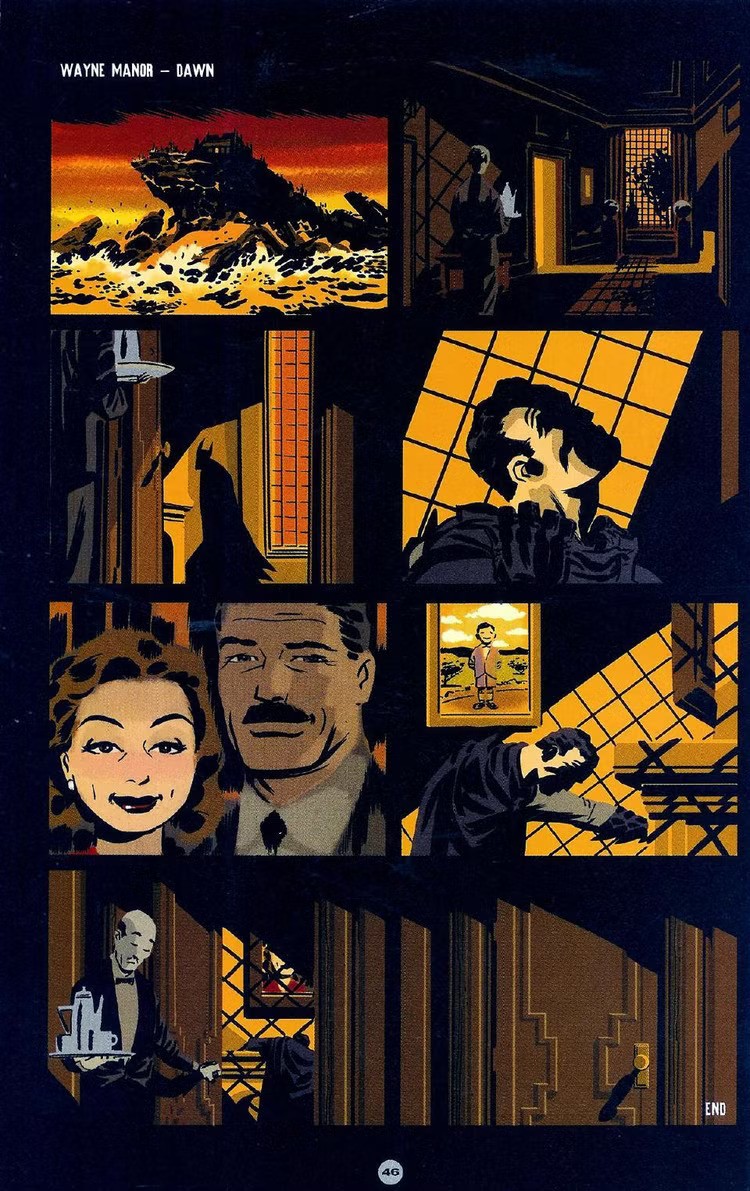
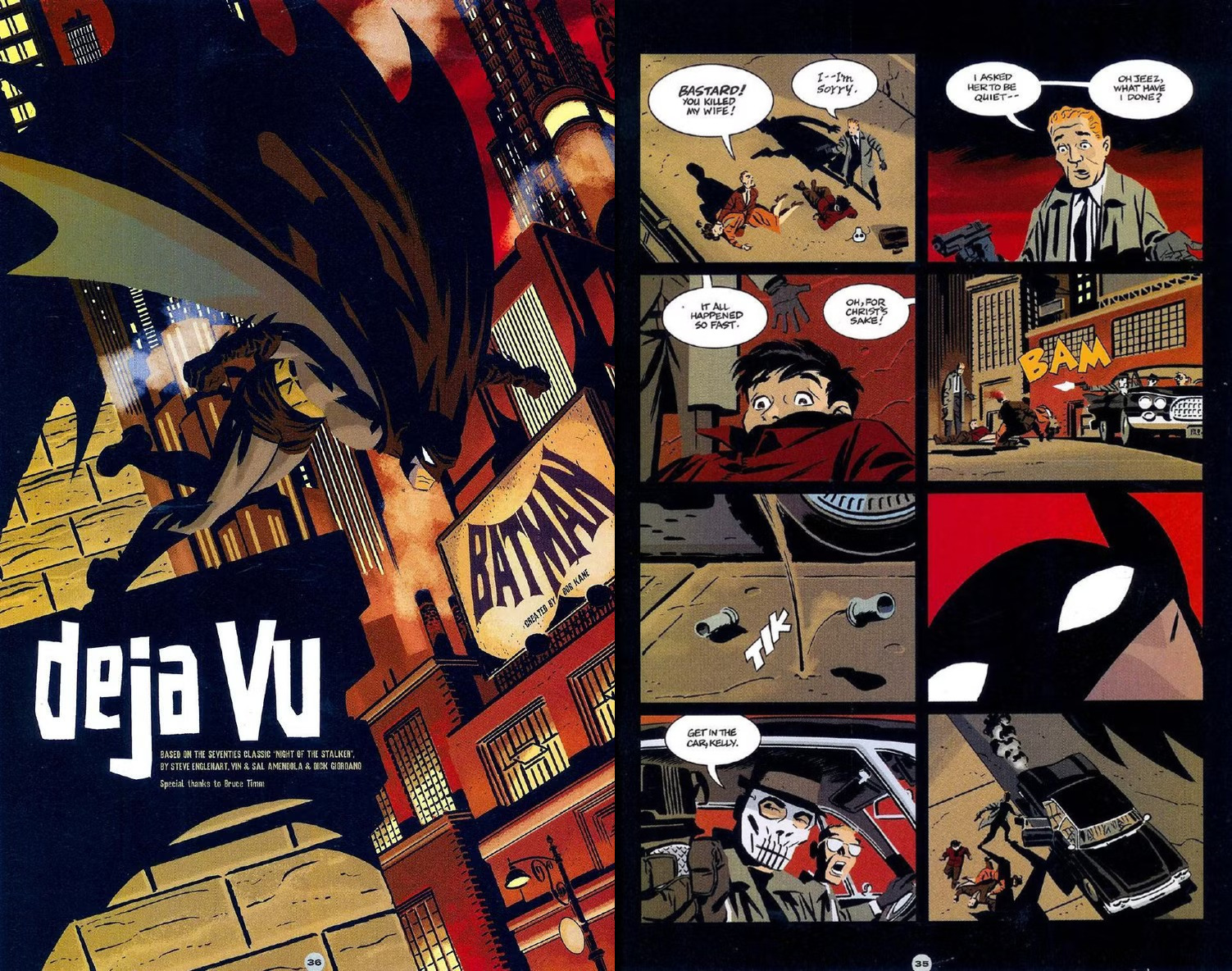
Writer-Artist Darwyn Cooke did a “remake” of my story, giving it the title I’d originally wanted, Déjà Vu.
Yale University owns two pages of this story’s originals. In the story’s last panel, I had placed a “diploma” on the wall of Bruce Wayne’s “Foundation” penthouse office, showing that he had graduated from Yale’s School of Law.
****
So there you have it. Many thanks, again, to Mr. Amendola for letting me use his memoirs here. He has also graciously agreed to answer any questions anyone may have if you want to put them in the comments below.
As for me, I’m still grinning about the fact that I got to express my appreciation to one of my favorite Bat-artists for one of my favorite Bat-stories. It may amuse Mr. Amendola to know that the blacked-in eyes on the Batman mask was how I always could tell it was one of his, even when I was eleven. I loved it here and also on “Ghost Mountain Midnight,” and I wish more guys drew the mask that way.
Though without the lighter blue cowl I suppose it’d be harder to see. The current costume design’s probably too dark.
Anyway. Hope you all enjoyed that. I sure did. It’s this sort of thing that reminds me how cool this column gig really is.
See you next week.
**********
I’ve made no secret of the fact that “Night of the Stalker,” from Detective #439, is one of my favorite Batman stories of all time. A couple of months ago, my various columns about it came to the attention of the primary architect of that story, Sal Amendola, and he was kind enough to share his memories of it with me and even let me share them with you all, here. But there’s more.
It turns out that Mr. Amendola was enjoying the reminiscing — especially, getting to set the record straight at last — as much as I was. We struck up a little bit of a correspondence after the original column went up and not too long ago he sent scans of the original notes he’d made for “Night of the Stalker” to accompany the art sent to Steve Englehart, who was doing the actual dialogue and captions. I was completely nerding out over this find, naturally, and he very graciously granted permission for me to reproduce the scans here for you.
So here’s the original plot for “Night of the Stalker,” along with some additional notes at the end for Steve Englehart. Below these scans you’ll find a few more footnotes and afterthoughts from Mr. Amendola, from the email that accompanied the scans.
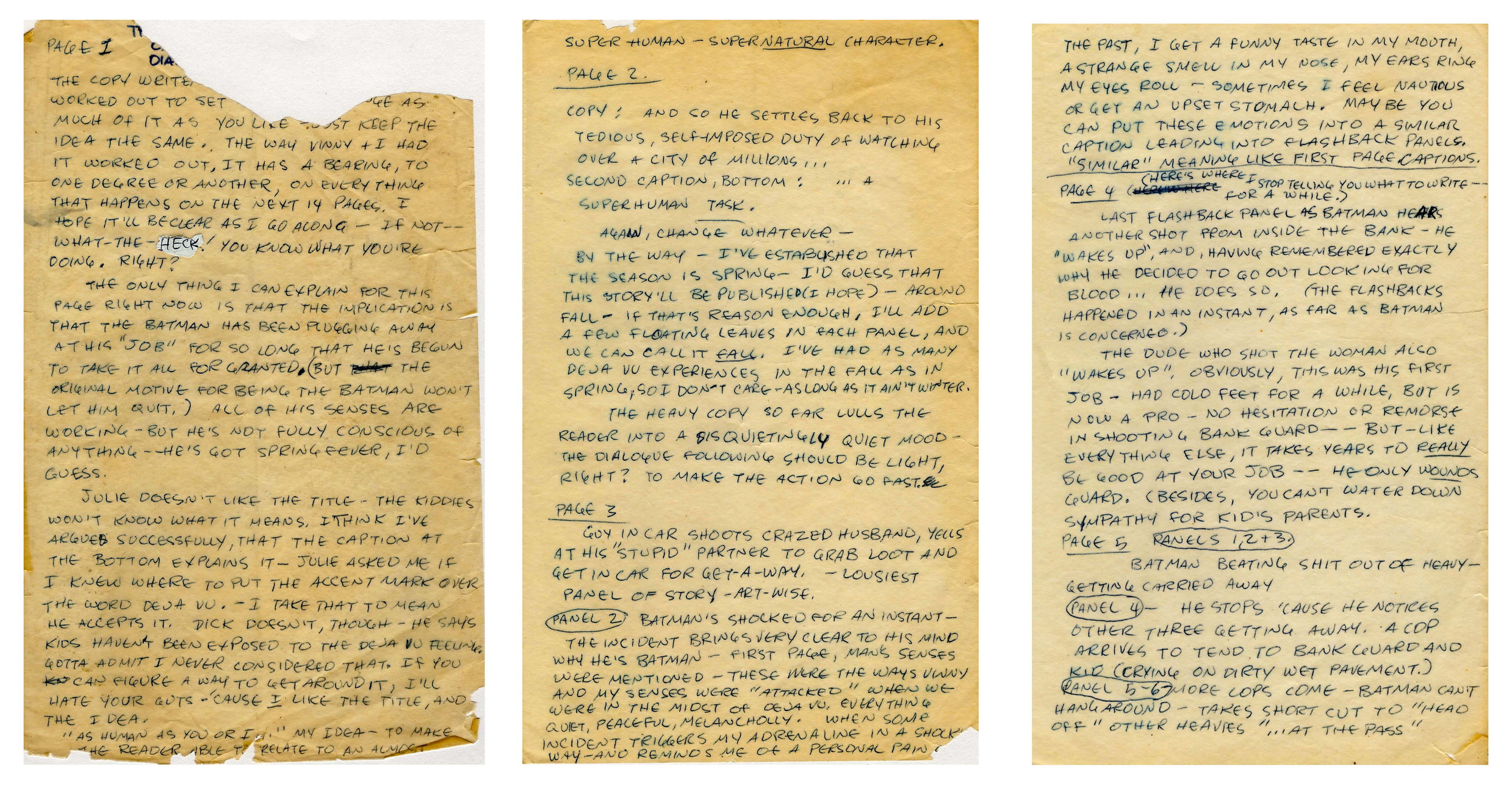
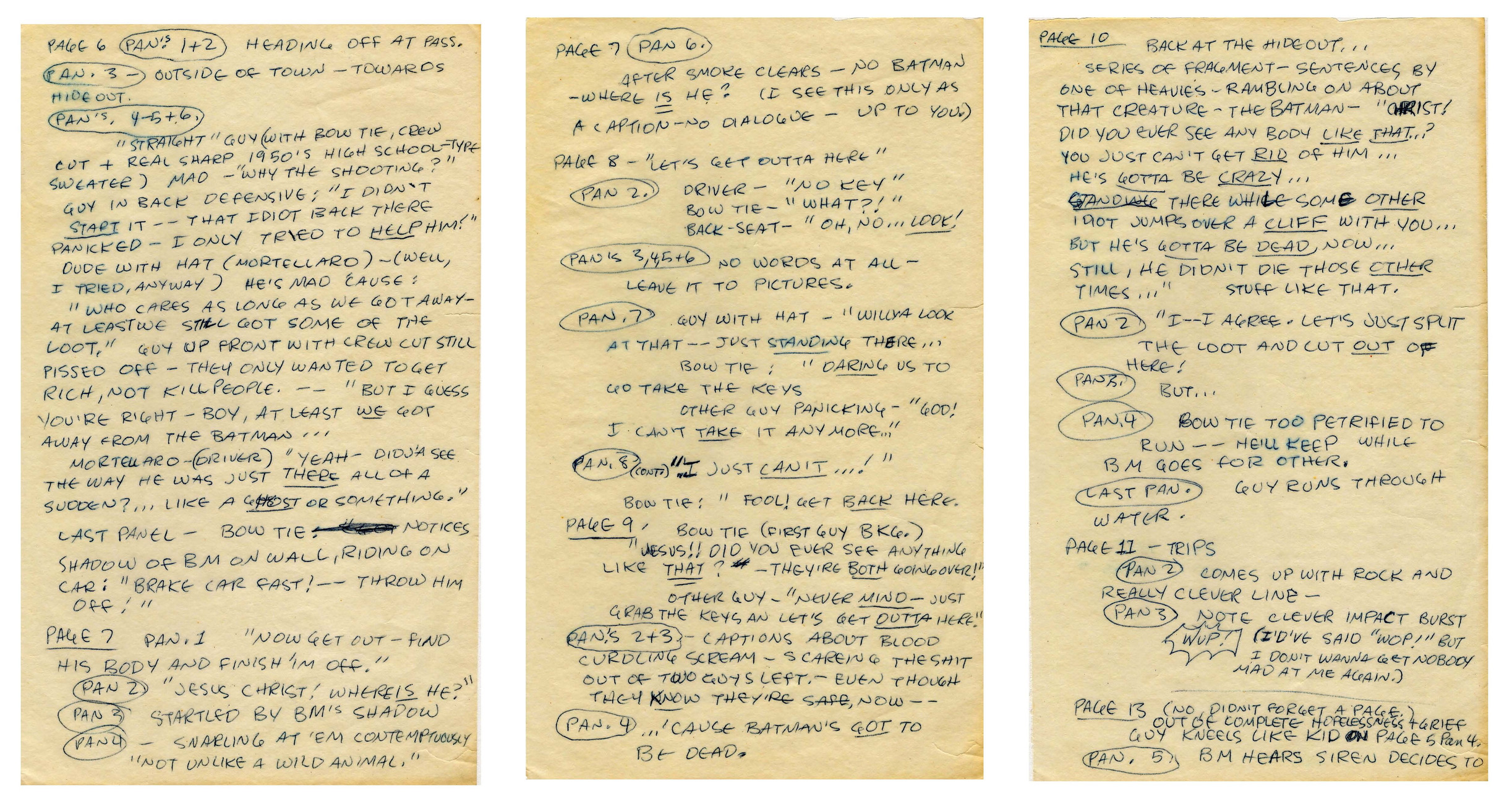
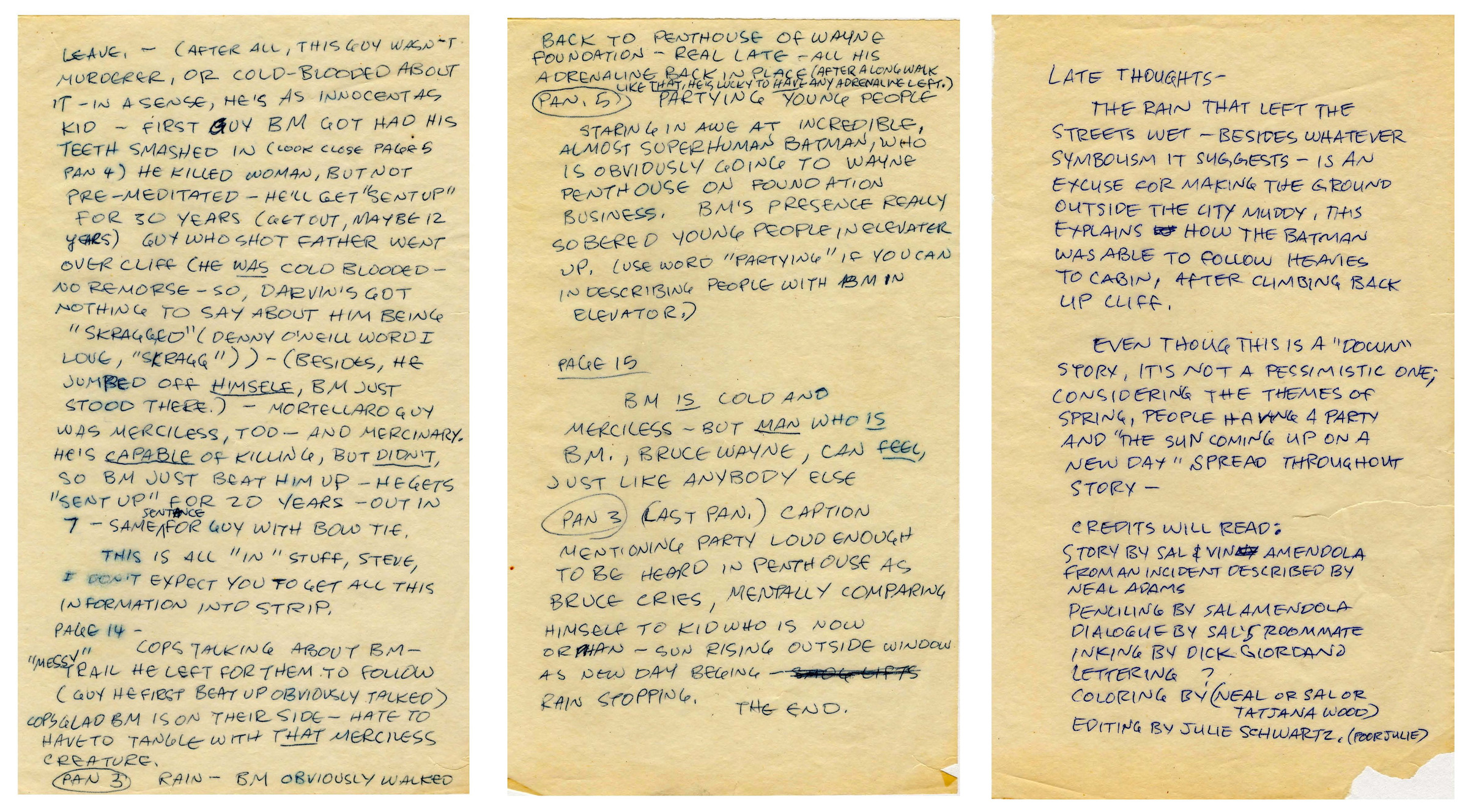
Sal Amendola has this to add:
I kept the notes I wrote to Steve when it looked like Julie was going to accept the story (but then didn’t). They were in a plastic envelope … but still oxidized, and there was some crumbling away of a bit of the first page. I wrote them on tracing paper; especially susceptible to drying out and turning brown.
In these notes, I defined one of the bad guys as “Mortellaro” or “the Mortellaro guy.” Steve knew who I meant. He was someone who worked up at Marvel. Did production work, and inked a lot of backgrounds (you could tell his backgrounds. He always took it upon himself to insert a lot of newspapers swirling in the wind). I tried to draw him from memory (the words in my notes: “Well, I tried, anyway.” The drawings did not look like him).
I mentioned “Darvin.” Leonard Darvin. He was the guy in charge of the Comics Code. Hated by a lot of artists and writers, but he was a good guy, who had a job to do and honored the responsibility; and worked as hard as Carmine, Julie, Neal and Denny to “modify” The Code (in advance of the Green Lantern/Green Arrow anti-illicit drugs issues).
The note about the “WUP” sound effect burst in the shape of a bat: I did that a lot in Batman stories. You could tell what Batman stories I did the backgrounds for by that bat symbol burst. The reference to people getting mad at me: I wrote a Batman story about organized crime. I put “WOP” in the sound effects. I figured, being Italian, I could do that. They actually noticed, and were not amused. Julie rejected THAT story, too (same reason, “No plot”).
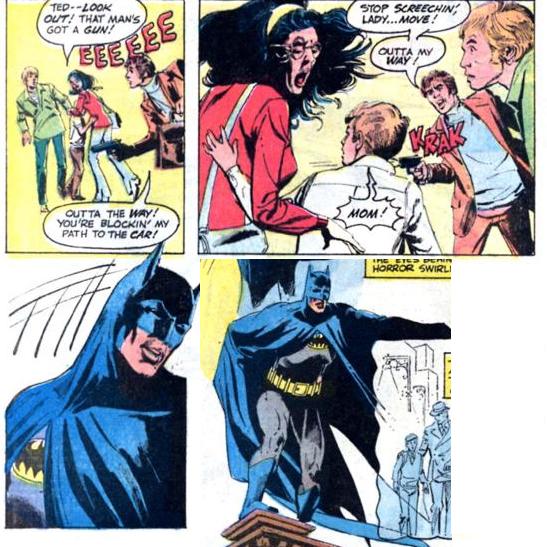
There’s a mention in the notes about Batman beating some teeth out of the first killer. They had Dick give the guy instant “implants.” – Another censorship: I had to redraw the little boy between his mother and the guy shooting her. We could not have an uninterrupted path between a gun being shot and the person being hit. That’s what I meant in my account by “… silly, hypocritical censorship …”.
I had hoped Johnny Costanza would letter the story, and either Neal, Tatjana Wood, or I would color it (I sucked as a letterer, but was a good colorist).
At one point, in the original thumbnails (long gone, along with the original typed outline) I changed the boy in the story to a girl. Dick asked why? I said, “Too much coincidence with the Waynes.” I thought something should be different. Dick said no, better to keep it a boy. I decided he was right.
I came across your posts on Bob Kane/Bill Finger. To my relief, your (and the majority) opinions were right and logical, just as I came to understand them. The insights I remember in the posts comparing/contrasting Stan Lee with Kane were pretty accurate, too (Stan did do things like write his name on artwork done by someone else, but he didn’t deny the artist’s part in the story if asked). I had glimmers of the true history as I got into the business, but it was Nelson Bridwell who first gave me much of the details. Your quotes of Dick [Edit: I haven’t gotten to that yet, so here’s the Wayback Machine link!] were the same as what he’d told me (the legal constraints against DC telling the truth). Carmine taught at the School of Visual Arts, as I did. In the school cafeteria, one day, he told me just how deep-down stupid he thought Kane was, but that Kane had (I believe Carmine said) an uncle who was an aggressive lawyer. I met Kane once. He came into my Talent Coordinator office once to admire a giant poster of The Batman, done by Neal.
Anyway, you’re the first person to see these attached notes, since Steve and Archie, all those decades ago.
*
And now you’ve seen them too, because all this is too cool not to share. My heartfelt thanks to Sal Amendola for letting us all see this stuff. I hope you all get as big a kick out of learning this history as I do.
See you next week.

DC has yet to do a facsimile of any of the 100-pagers. I’d love to have this one. But if they do another Finest volume after the upcoming one featuring the first appearance of R’as al Ghul, I think it should be in there.
I must go reread that one now. Not that I question Greg’s esteem for it, it’s marvelous. Reading the backstory, part of which I’d heard before, it’s remarkable how such a good story can result from so much conflicting creative/supervisory input.