
“Digging deep, I’d found buttons in my pockets; naked now my skin begins to crawl”
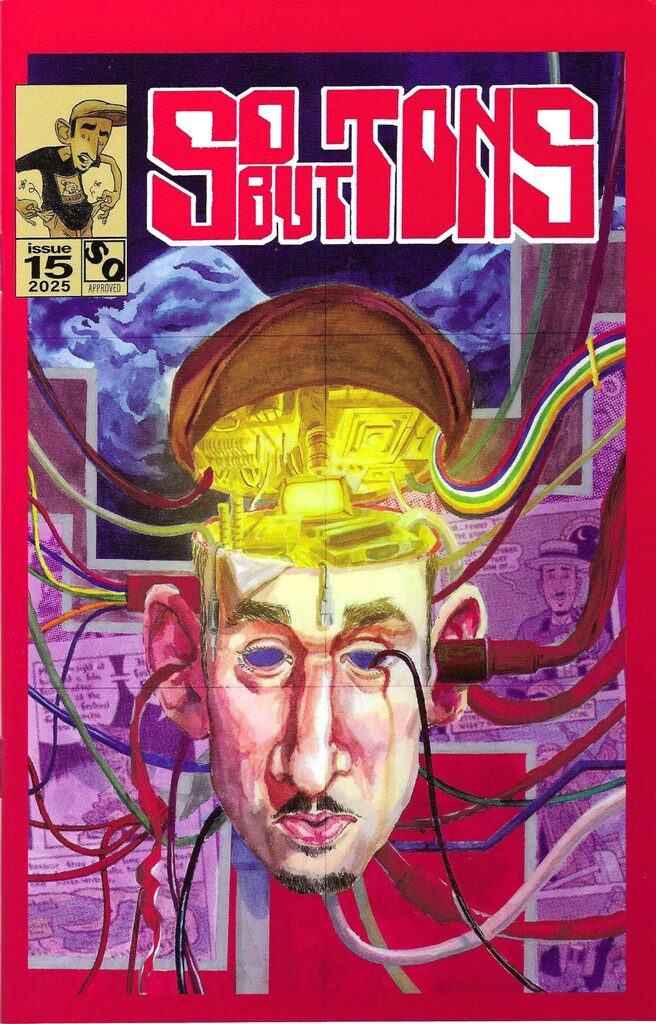
I’ve been Facebook friends with Jonathan Baylis for a while, and I’m a bit embarrassed that I still haven’t gotten around to reading the first collection of his comic, So Buttons — I got it when it came out, but as you know, sometimes time just gets away from me, and I never read it. 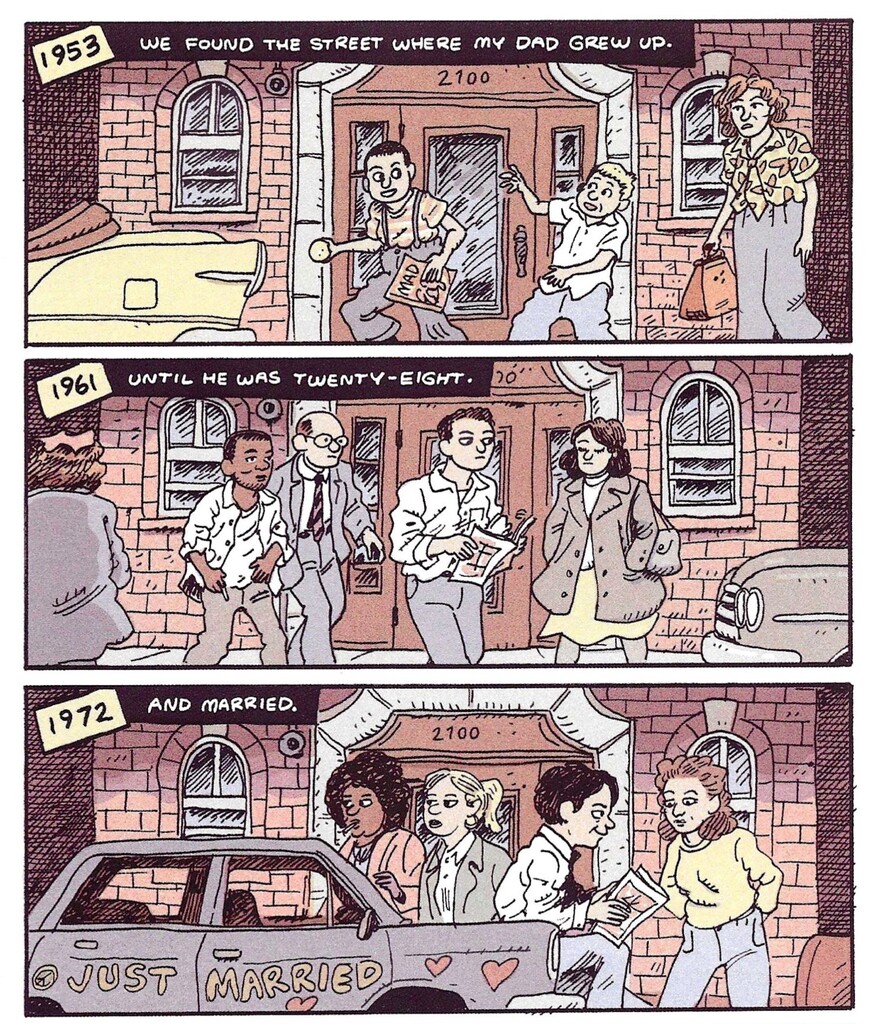 I will eventually! This means that I still hadn’t read any of Baylis’s comics, but he contacted me recently and asked me if I’d like to read the latest issue, and of course I said yes. I knew that the book basically consists of short vignettes, so the fact that this is issue #15 didn’t really mean I would be missing a big backstory. Baylis publishes this himself, and you can get issues of the series on his web site and, according to the indicia, “finer comic shops.” So if yours doesn’t have it, that means they suck! (On the web site, he lists several stores across the country that carry his comics — I’ve been to all three in Manhattan, and while I never went to Cosmic Monkey in Portland because it didn’t exist when I lived there, I would have gone there if it did, and the one in State College is the one I patronized regularly when I went to Penn State, so I guess I’ve hung out at some very fine shops!) This comic, by the way, is $10, which, sure, is a bit much, but it’s a very nice book, very professionally done, with 32 packed pages of interesting stuff, plus it’s basically a one-man operation, so there you go!
Baylis knows a lot of artists, so he gets them to draw short autobiographical narratives that he writes, and there’s your comic. As you might recall, I famously am not a fan of autobiographical comics, but I’m not opposed to them, either, and I will certainly give them a chance. What I like about this comic in particular is that Baylis isn’t writing a long, autobiographical story, just short moments from his life that have a clever punch to them. 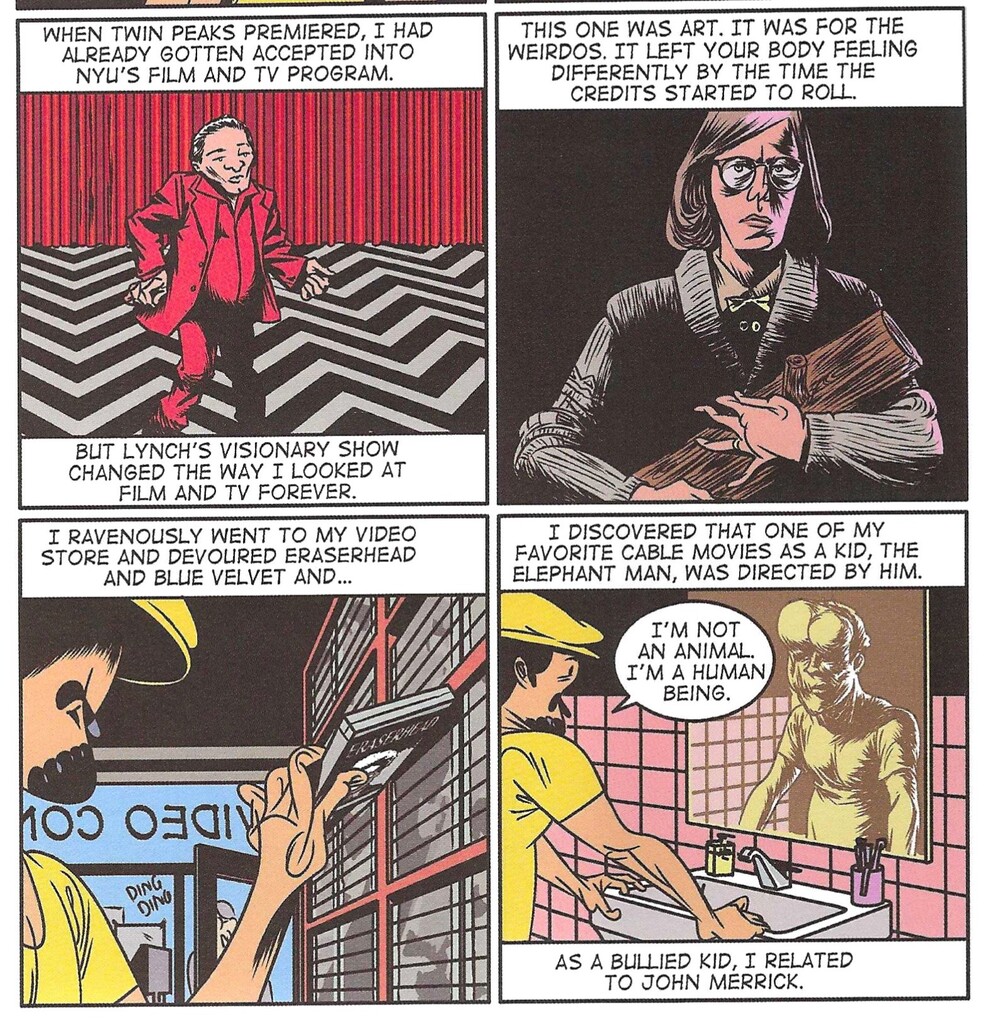 In this issue, as he points out in a short essay in the back, he wanders into a theme about fathers, something he didn’t plan to do but which just happened. In the first story, Baylis notes that when he was a kid, he was bullied, so he tried to make himself into a person who would be acceptable to those around him. He became, in his words, a chameleon, reflecting the tastes of others so they would find him likable. His dad took him back to his old neighborhood in Brooklyn one time, and Baylis saw that the area had changed — it was largely black at the time, and he wasn’t sure if two white guys would be welcome. His dad, however, connected with the people living there through their shared history of the area, and Baylis learned that he just needed to be himself. It’s a charming vignette, deftly illustrated by Noah van Sciver, who brings his nice cartoonish realism to a story that demands it. There’s a really nicely drawn story by Bhanu Pratap about Baylis’s relationship with David Lynch. It’s about his early professional career and how it brushed up against Lynch’s 1990s work, and while Baylis doesn’t note that Lynch was a father figure, he’s clearly important in the development of his tastes and what he feels about art, which makes him an unintentional mentor. Pratap’s beautiful, heavily-inked art combines a cartoonish goofiness and gorgeous renderings of movie scenes from Lynch’s work (plus Robert Duvall in a river, because, well, you’ll see!).
There’s a fun, two-page story about Leonardo DiCaprio’s connection to comics, which is also a father-son theme, and there’s another two-page story about Baylis hunting down a Mike Leigh short film from 1992. 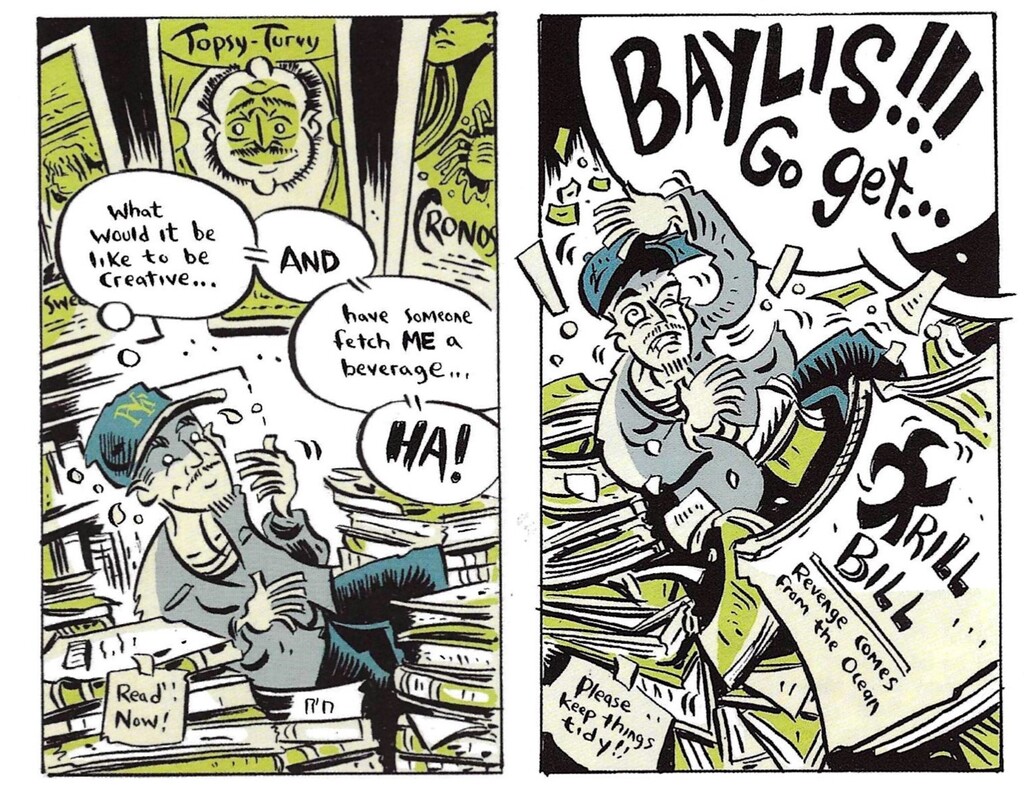 Obviously, the first one plays into the theme of the comic, but the second one is simply about Baylis and his professional career … although I suppose you could look at his nostalgia for physical media (something I certainly share) as keeping the connection to the past, which might mean his dad. Either way, it’s a story I appreciated, because I didn’t know about the short film and I love Mike Leigh, so I’ll have to check it out. Karl Christian Krumpholz draws a story about COVID and the impact on film festivals, and he has a quirky style that works nicely. Baylis then switches things up with a story about his mom (whom, he points out in the essay, died a few years back) and her love of musicals in general and West Side Story in particular. What’s kind of neat about the story is that Baylis points out that his mom never talked about her past, so he’s still mystified about why West Side Story connected with her so much. It’s neat because that’s the way life works — some questions just won’t get answers, and Baylis accepts that and just thinks about the nice times he had with his mother watching the musical. He uses Bernstein as a bridge to his next story, which is about the fact that he was going to see Bernstein conduct when he was a freshman, but Bernstein retired and then died. Leonard Slatkin stepped in, and Baylis notes that 35 years later (in 2025) he saw Slatkin conduct again. It’s a nice, circular story linking the present, once again, to the past. B. Mure’s scratchy yet lush art seems to fit the orchestral motif quite nicely.
The book works because Baylis isn’t really trying to give us a blow-by-blow of his entire life, so it’s “autobiographical” in the sense that he’s writing about himself, but he’s not writing a grand narrative of his life. 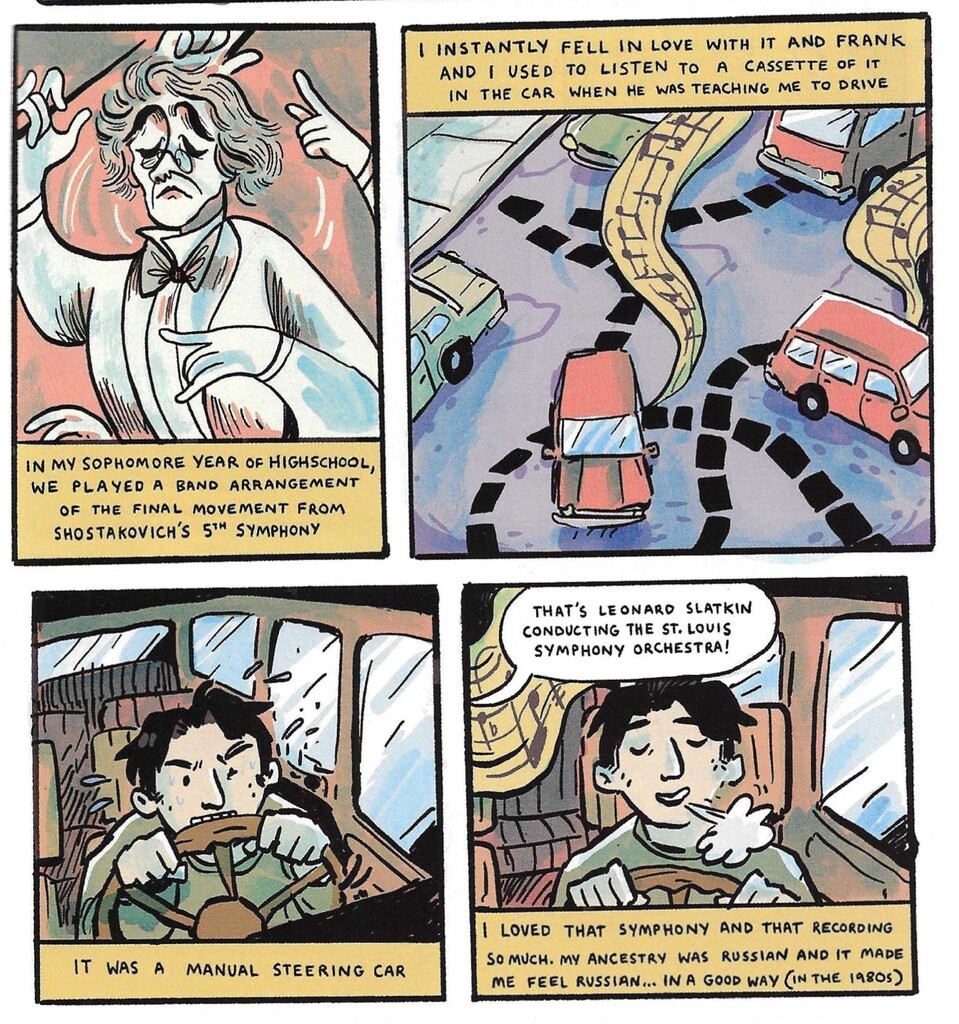 Everyone has fun little moments in their lives that could work as short vignettes, and if they tell us something about the character, so much the better, but they don’t really have to. Does the fact that Baylis wanted to see Bernstein conduct and then he died and he saw the replacement conductor, of whom he was a fan, twice 35 years apart, mean anything? Not really, but then you recall Baylis writing about West Side Story and his mother and his father and it becomes a bit more meaningful, but Baylis doesn’t have to highlight it. Did Baylis really need his dad to connect to Brooklynites to realize that you should just be yourself? Maybe, but he doesn’t bash us over the head with it — he just mentions it and moves on. For me, what makes the book work is the light touch Baylis employs. He never beats us over the head with revelations, and except for the first story, he doesn’t really come to meaningful conclusions — he just presents these things and hopes we’ll enjoy them and maybe reflect on our own lives a little bit. Obviously, he gets some nice artists to do the stories and some pin-ups along the way, and the result is a charming comic that doesn’t take itself too seriously but still manages to examine some serious things.
As I noted, you can find So Buttons — both this issue and the others — at Baylis’s web site. Grab this one or one of the others and give it a look. I don’t think you’ll be disappointed!
Rating: ★ ★ ★ ★ ★ ★ ★ ½ ☆ ☆

Noah Van Sciver! Did you ever read his Joseph Smith and the Mormons? It is a monumental feat in cartooning and the history of the Mormons beggars belief!
I did not, but Mormon history is certainly interesting. I don’t keep up with van Sciver as much as I should because he does so many DIY comics that I just forget about them because they’re not offered in Previews or whatever we’re calling it these days. I do like him, though. I’ll have to track down that book!