

“You say you don’t feel safe alone tonight, ’cause you feel the pressure building in your head”
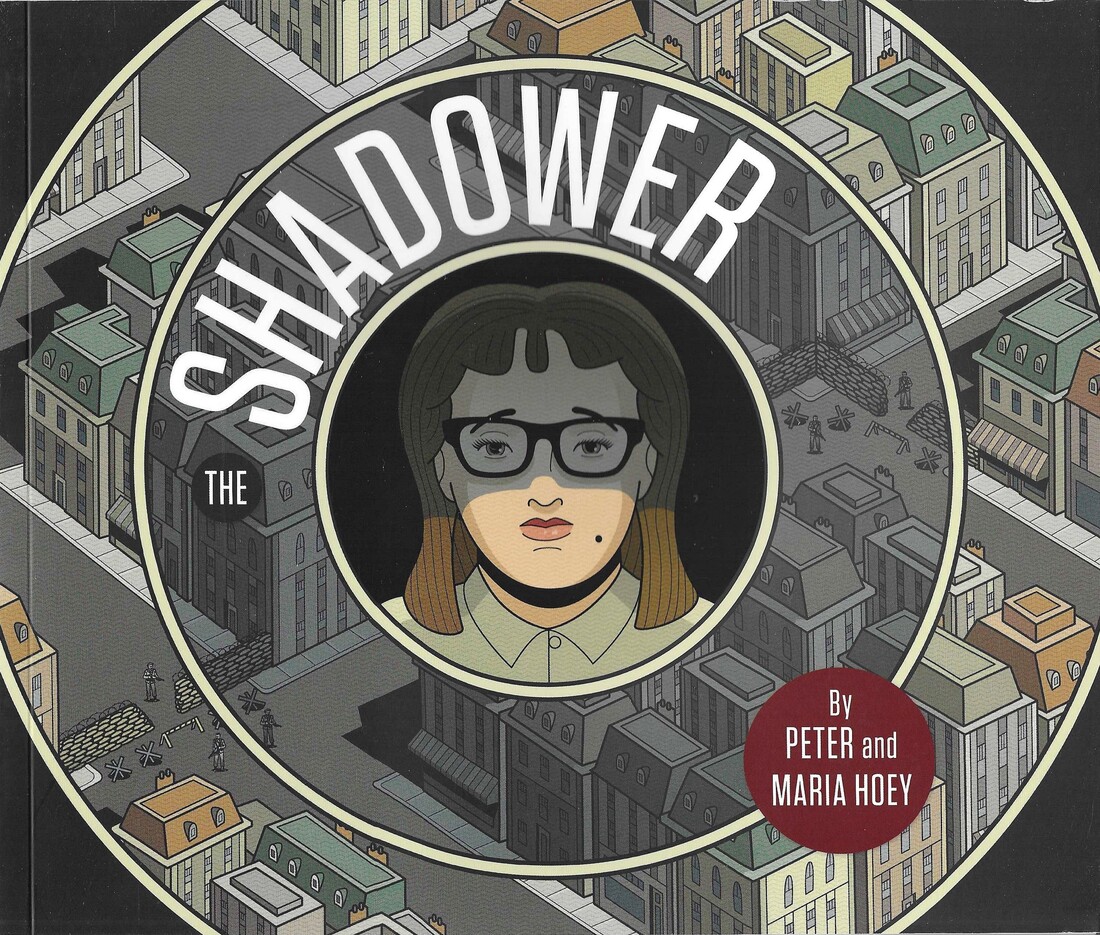
I’ve been a fan of Maria and Peter Hoey’s work for a little bit now, even though I don’t quite love their comics. They’re very odd, and they make me think a bit, but they’re also a bit cold, so I can’t embrace them completely. But they have a new one, The Shadower, out from Top Shelf, and of course I gave it a look! It’s by the Hoeys, of course, with an additional story credit for C.P. Freund, it’s $19.99, and it’s a solid 182 pages.
The Hoeys’ comics tend to be very dry and chilly, as they create characters, put them in strange situations, and then use an omniscient narrator to describe what happens in the most clinical way possible. 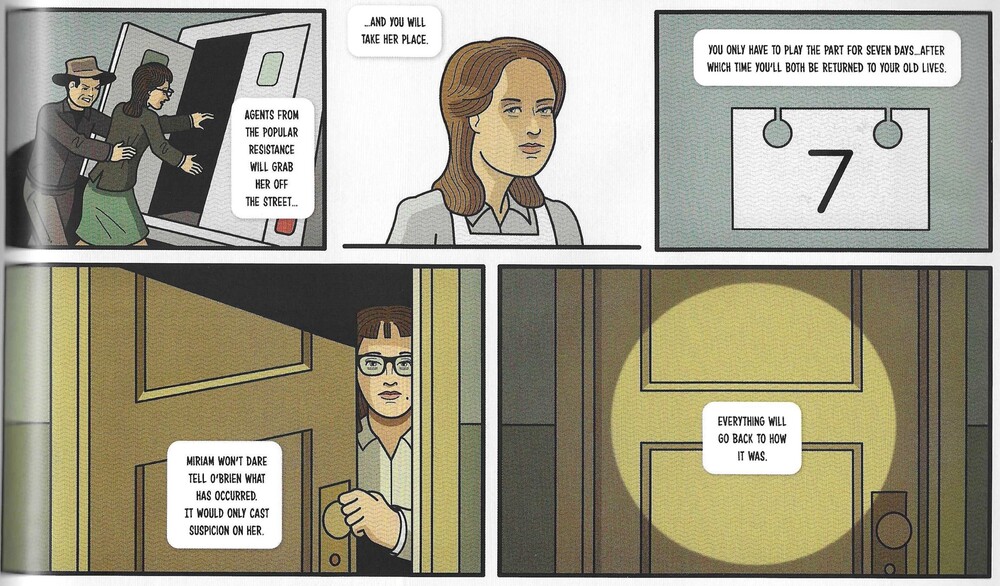 It’s a weird, off-putting way of telling stories, which is why I don’t love their comics completely, but I do find it fascinating. They come up with very interesting and complex stories, which helps, and the tone is so strange that it compels you even if you don’t fully get immersed in the world they’ve created. It also, oddly, builds tension, because the tone is so dispassionate that you can’t help but wonder when it’s all going to explode, which leads to tension as you’re reading it. Sure, you don’t want to be tense when you’re reading something — shouldn’t reading relax or at least delight you? — but it’s a pretty effective device, as they can lead you on and keep slowly turning the screws. Whether or not they pay it off sufficiently is, I guess, up to each individual reader and depends on the comic. But the odd, almost flat narration is an unusual device, as we don’t get a lot of it in comics (or prose in general) too much, and the Hoeys use it pretty well.
The Hoeys’ previous comic, In Perpetuity, was their noir comic, and The Shadower is their spy comic. There’s a capital city that has experienced a civil war and it’s still divided into sectors, each controlled by a different faction. People are allowed to pass between the sectors, but they need to have passes and their cars are searched, so our main character, Nadia, doesn’t tend to go anywhere. She lives in an apartment with her mother, and her father was an important member of the ruling faction and was killed in a bomb attack some years earlier. Her father was a playwright, her mother was an actor, and Nadia has followed in her mother’s footsteps. 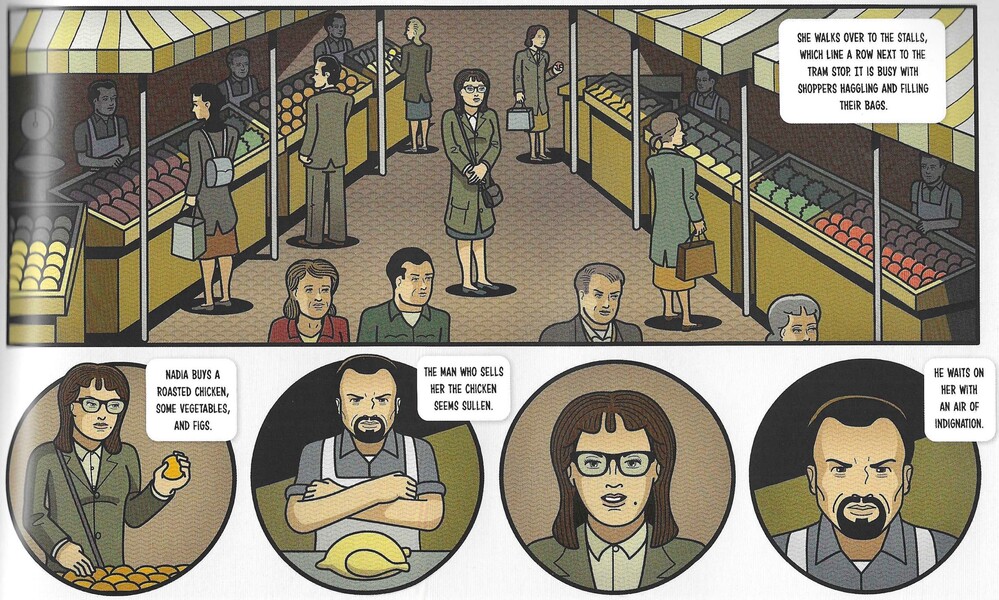 After an impressive performance in Ibsen’s A Doll’s House, she is approached by Nikola, a security officer for the ruling faction, who tells her he has a job for her. The head of security for a different faction always spends a lot of time in a café in a different sector, and the waitress who always serves him resembles Nadia. They’re going to snatch the waitress — Miriam — off the street and Nadia will step into her life for a week and bug the conversations the dude has by attaching a bug to the samovar he uses throughout the day. Of course, the job doesn’t turn out to be that easy!
Nadia’s father wrote an acting book called, significantly, The Methodology of Disappearing, and Nadia uses this to get into Miriam’s character, while Nikola works on disguising her, with a wig and a beauty mark on her cheek. She manages to get into Miriam’s sector with little trouble, and she moves into Miriam’s life. She has some moments when she slips up slightly, but nobody notices that she’s not Miriam, and her mission goes smoothly for several days. Interestingly enough, people around the neighborhood do not seem to like Miriam very much, and Nadia doesn’t quite know why. She visits her mother at some point because she discovers something about Miriam, and we learn some things about her father, Miriam, Nikola, and what happened to her dad, but other than that, she stays in her role and keeps up with the mission. Of course, her target begins to suspect that something is going on, and Nadia finds herself in a bit of a pickle, as you knew she would. 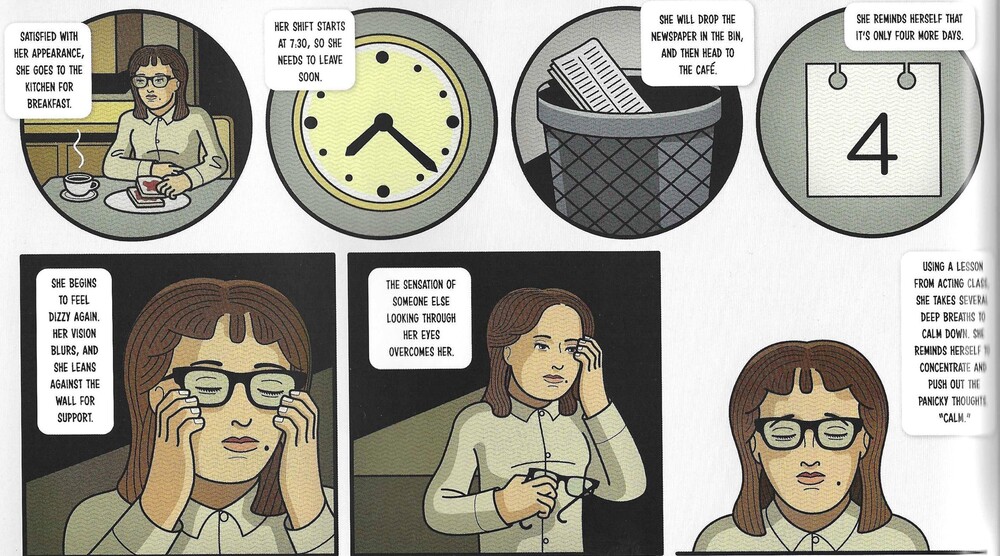 You don’t have to be the sharpest tool in the shed to know that Nadia will begin to lose her identity in Miriam’s, but this is where the Hoeys’ odd narration helps, because as the actual events get a bit more surreal, the narration stays cool and detached, which makes the situations even weirder and more effective. Nadia is interrogated by the security officer, and while the narration tells us that she’s in trouble, it doesn’t come across in the tone of the words. The Hoeys aren’t interested in spelling everything out for their readers, so we’re left wondering how far into Miriam goes Nadia, but that’s part of the unsettling nature of the book. The Hoeys are keener on exploring the idea of identity, and they use a spy thriller to do it. They’re certainly not the first to do it, but they do it in a tonally odd way, which helps the story quite a lot.
I also still haven’t warmed up to their art, although I don’t hate it. Like their writing, it’s odd — they use crisp, thick lines, which makes their drawings have a solidity that belies the strangeness of the narrative. They don’t do a great job with perspective or movement — their characters are always stiff — and they don’t use shading entirely effectively. That makes it sound like the art is awful, but it’s really not, because they do other nifty things with it. 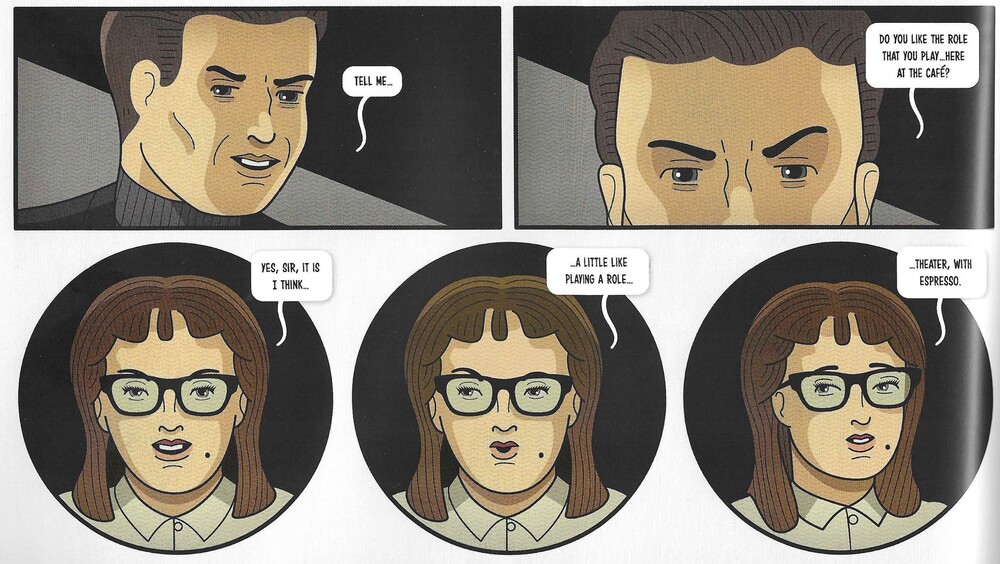 They do a nice job creating worlds for their comics, as Nadia’s city is a depressing, rainy place that fits the dour and seemingly ultimately futile games these men are playing, and their characters are interesting to look at. As Nadia transforms into Miriam, they do a nice job showing all the small things that go into it, which is neat. The Hoeys also make a lot of their characters blank slates, as if their faces don’t quite work, which adds to the weirdness of the narrative but also jars us when they shift just slightly, either by looking somewhere else in a panel or smiling or scowling a bit. It works really well, especially in a story like this, which is all about artifice. When the façade cracks, even just for a moment, it’s very effective because of what we expect of the art. It’s difficult art to love, sure, but it’s still done well and with an interesting purpose.
I’m going to keep buying the Hoeys’ comics, because I do find them fascinating and entertaining. Sure, I have issues with them, but nobody’s perfect, right? The Shadower is another neat example of their bizarre sensibility, and we need more bizarre sensibilities in comics and the world in general, so there!
Rating: ★ ★ ★ ★ ★ ★ ★ ☆ ☆ ☆
