

For what, you ask? Well, to post this Marshall Rogers cover as part of my Silver Age Reread.


I’m sorry I couldn’t get it in as one photo but it’s still fricking awesome. [Edit: Here it is, all nice and merged!]
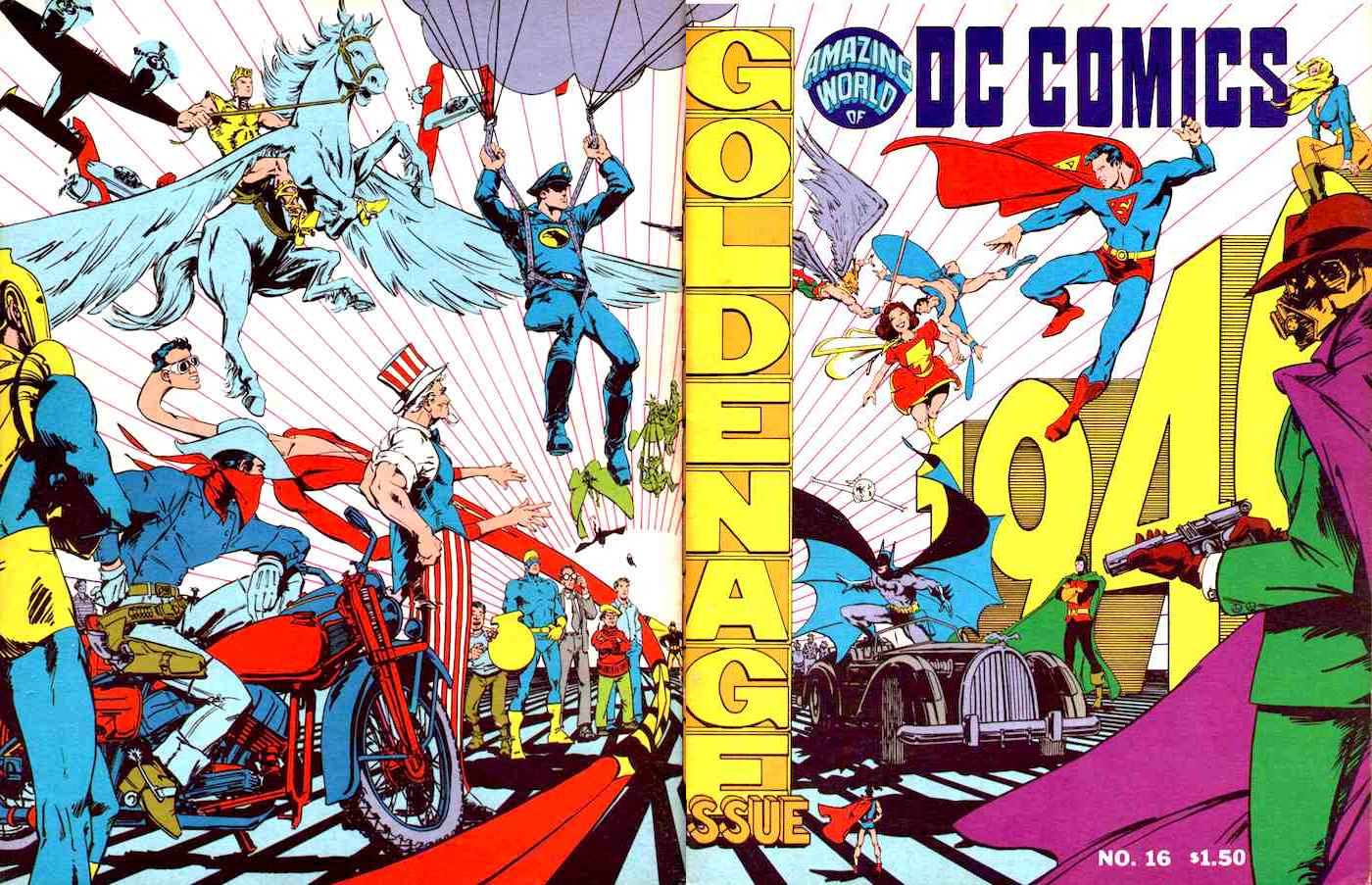
While this came out in 1977, it also tackles a continuity issue from 1970, the Spectre’s role in Justice League of America #82 (Denny O’Neil, Dick Dillin, cover by Neal Adams) —
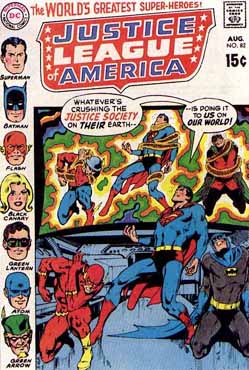
and #83 (cover by Murphy Anderson)

This story ended O’Neil’s original run on the series, though he wrote a one-off JLA story a few years later. While I’m not, as y’all know, a big O’Neil fan, this one’s fairly decent, though not so much I wish he’d stayed on the book. In Part One, the alien Creator 2 contrives to smash Earth-One and Earth-Two into each other, thereby creating a mass of raw materials he can use to build a new planet for his client. The JSA (he’s based in their universe) tries to stop him and goes down; because the dimensional barriers are lower, their JLA counterparts go down too, but the League has no idea why.
At the end of Part One, the JSA doesn’t know who they’re fighting or what they want; the JLA has even less of an idea; and when the League realizes something is pulling the Earths together, Black Canary worries she, an Earth-Two native living on Earth-One, is the nexus. Maybe to save the worlds, she has to die (for the record Creator 2 is using Red Tornado’s android body to bring both Earths together).
In part two more heroes go down so Dr. Fate brings out the big guns, summoning the Spectre from a tomb in which he’s been imprisoned.

I think the main reason the story behind his imprisonment “may not be related now” is that O’Neil couldn’t think of one. In any case, Dr. Fate and the Thunderbolt take on Creator 2 while the Spectre sacrifices himself to protect the two Earths until Dr. Fate blows up the alien’s machines (if you’re curious you can check out Alan Stewart’s more detailed take on the story).
The thing is, the Spectre’s imprisonment apparently happened right between the two issues because he’s free in Part One.
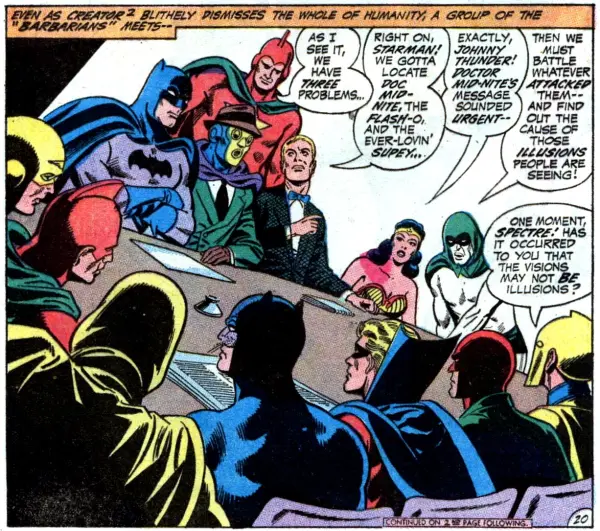
Despite which, nothing in Part Two suggests that Spectre being in that crypt is a new thing — it seems much more like a long-standing situation. As Alan says, it’s possible Dillin threw in the JSA meeting scene, not knowing how Part Two would develop. It’s also possible O’Neil hadn’t figured out Part Two’s plot yet and when he did, decided not to let that one panel hold him back (I think that’s a reasonable call). Either way, we can write it off as one of those continuity errors that aren’t worth worrying about.
But of course, comic-book fans, like fans of Sherlock Holmes, have an uncontrollable urge to explain things that aren’t worth worrying about (I’m as prone to it as anyone). Which leads us to Amazing World of DC Comics #16. Amazing World was a DC in-house prozine that combined coming attractions, behind the scenes stories, interviews and occasional articles devoted to continuity fixes. For example, J’Onn J’Onzz told us when he first appeared that Mars was a utopian planet with no war or crime; how does that fit with the genocidal war between white and green Martians we learn about in JLA #71?
In Amazing World #16, future comics writer Cary Burkett [edited: I originally misremembered it as Paul Levitz] sat down and tried to figure out the Spectre’s continuity. How was he in the JSA meeting room when God had sentenced him to sit around reading the book of judgment (as dramatized below by Nick Cardy)?

What happened to the Spectre between the two parts of the JLA/JSA story?
And how did his supposed death lead into his next life, as the ruthless avenging spirit of Adventure Comics?

Levitz does his best with the continuity he has to work with, which shows why it was a hopeless task. First, God freed the Spectre from sitting around reading because duuuh, the world might end without him. Second, the Spectre has a proven power to bend time so obviously he used it to squeeze in a lot of adventures between the two JLA issues. Since he has an encounter with the cult of Kali in Brave and Bold #116 —

— (cover, like Adventure, by Jim Aparo), maybe it was the cult that imprisoned him. And when his spectral body was apparently destroyed, he was actually reincarnated on Earth Prime for his Adventure Comics run. That explains why he could crack jokes about “Clark Kent is just a mild-mannered reporter” and why he’s a complete ghost rather than a spirit dwelling in Jim Corrigan’s physical body — that body is still back on Earth-Two.
While the explanation holds together, the amount of guesswork and speculation makes it hard for me to like it. Still, I think Levitz did a decent job given what he had to work with. And hey, it did justify me posting that cover — though even without an excuse, I’m sure I’d have done it anyway.

I haven’t seen that particular issue of Amazing World. I’ll have to look it up, because I love stuff like this.
To wit: I don’t think that “Clark Kent” joke from Adventure Comics is really a problem. Clark has been suspected/accused of being Superman countless times (mostly by Lois Lane). And of course, every time it comes up, Clark finds a way to disprove it. So it’s practically a meme by this point — a conspiracy theory that everyone has heard, but no one takes seriously, sort of like Jimmy Hoffa being buried under Giants Stadium. So it’s perfectly reasonable for someone on Earth-2 or Earth-1 to crack a joke about a Kent-like reporter secretly being Superman.
(See also Action Comics #457, where Superman tries to reveal his identity to Jon Ross, but the kid doesn’t believe him, precisely because it’s been debunked so many times.)
No argument, it could play out that way. Or it could be the person he’s joking with just stares at him blankly and wonders what the hell Corrigan’s talking about.