
[It’s the first mini-series to finish, and you can check out the original post right here, and dig the debate over what to call her and why she’s there. David Brothers checks in! Enjoy!]
Hey — the first of the mini-series to finish! I’m sure there won’t be any surprises in this one, right? Well, if there are, I’m here to SPOIL them for you! So watch out, because there are lots of SPOILERS below! That’s if, you know, there’s anything surprising in this issue.
Man, check out Gloriana Tenebrae on that cover. It’s a good thing she’s in Los Angeles, because she probably found an excellent plastic surgeon. I mean, look at those things!

The issue begins with our favorite Queen of Terror sitting on her throne, flanked by some minions and I, Spyder. She is commenting on both Justin and our pitiful world — both are “trembling, uncertain, doomed to perish.” Then she picks on Justin’s fashion sense, which she really shouldn’t be doing — I mean, look at what she’s wearing! She says that he was not the only one to survive the fall of Camelot — the “perfect knight” spent some time at Summer’s End and was spoiled. She re-introduces Justin to Galahad, who once “served virtue” but now has “a different creed.”  The idea of the Seven Virtues contrasted with the Seven Sins has come up before, and here is the living embodiment of the corruption that can occur. Incidentally, back in the good old days (when Rome ruled the civilized world!), virtus meant “goodness,” but its primary meaning was “manliness.” Only later did it acquire the more simpering definition of today. Vir, in fact, is the Latin word for “man.” Galahad has lost his manhood as well as his goodness. So Justin has to fight Galahad — considering what’s coming, it’s the “unmanned” knight versus the “never-a-man” knight. Galahad has some keen characteristics. He has a pentagram etched on his chest. A pentagram has many meanings, but, interestingly enough, it appears on Sir Gawain’s shield in Sir Gawain and the Green Knight. Galahad is gray, which evokes both the golem and Solomon Grundy — an effect heightened by the fact that he’s obviously not all there in the head. On page 2, Bianchi draws him with six arms (four are after-effects of moving, but they’re still there) and, of course, two legs — eight limbs (like a spider). I’m not the only one who sees freaky crap like this, I know!!!! The Queen is overconfident — she says that the last time they came, humanity was strong and vigorous, and even then they could barely resist the Sheeda. Galahad shatters Justin’s sword (which can’t be Caliburn, can it? it looks like it, but what exactly happened to Arthur’s sword?) and rips that ugly, shapeless tunic he has worn since he met Ali Ka-Zoom. The Queen, self-aware as ever, asks Tom Dalt if he appreciates the metaphor of heroes fighting each other while the Sheeda swoop in. Dalt enigmatically answers, “A great day, milady. For some.” Oh, that Tom Dalt! Always conniving!
We return to Vincenzo’s mansion, where he is immersed in the cauldron (following the attack on him during which he was shot with a poison-tipped arrow). As we know, this was a bad idea, because now the Sheeda know where the cauldron is, and as we also know, this will avail Vincenzo naught, as he’s soon going to be riding the ghost bus along with his old friend. But it’s nice that he’s defiant now. We quickly switch back to the combat between Galahad and Justin, as the perfect knight asks Justin if he’d like to be a eunuch. Ha! 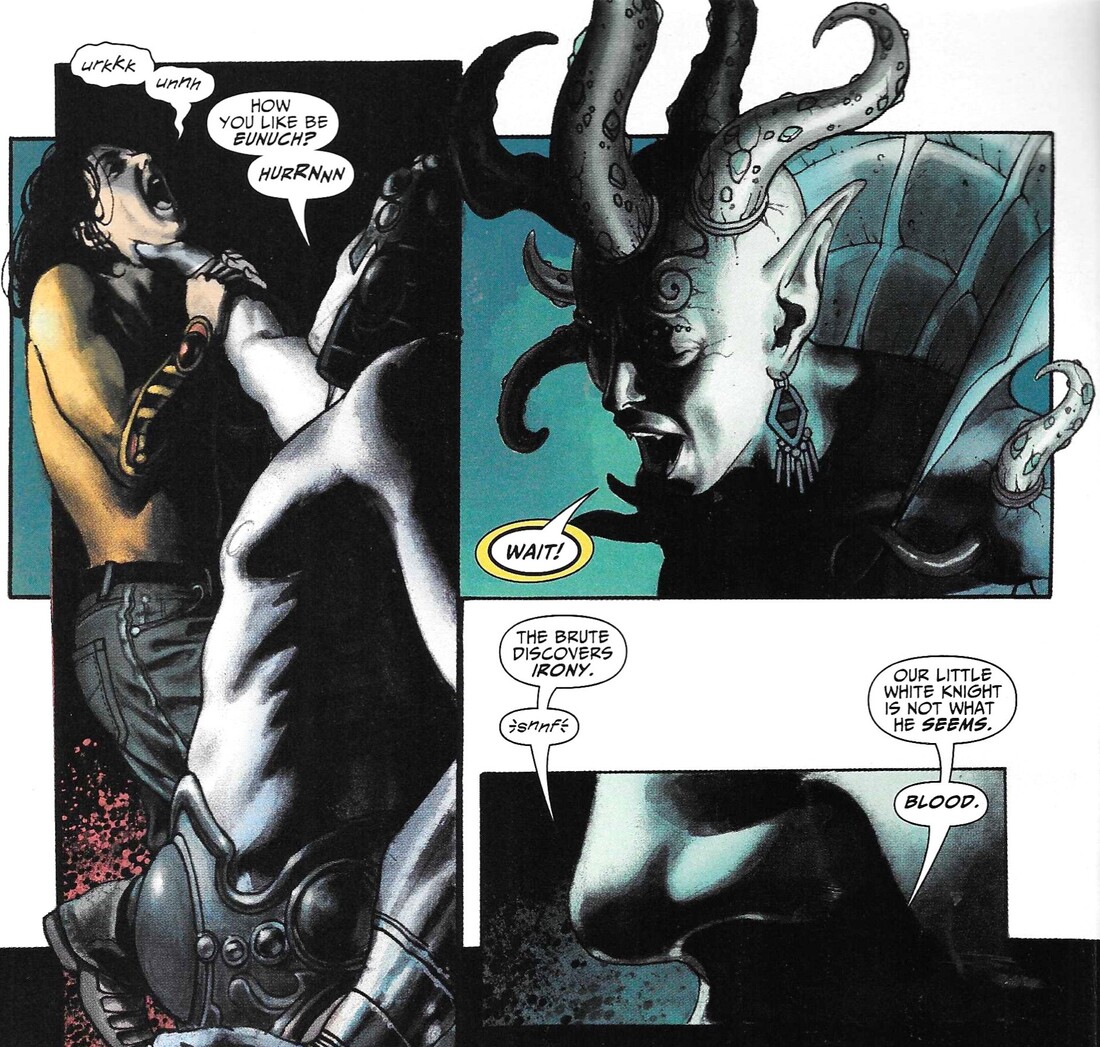 The Queen suddenly smells “the blood of a womb,” and realizes that Galahad is employing unintentional irony, because Justin is actually Justine [Edit: Justina?]! What? How could that be? We’ll get back to this revelation, obviously. Galahad bashes Justine while a tiny messenger “from the east” arrives riding a lizard. He tells the Queen that her husband, “dark Melmoth,” still lives, which causes her to retire to her chambers to ponder this new development. Melmoth, of course, is stirring up some trouble in New York with Klarion. Who knew he was Gloriana’s husband? Isn’t that cute? The Sheeda language, by the way, resembles (is?) Ogham, an old alphabet, and thanks to our own Dread Lord and Master, you can read what the Sheeda are saying. Except for this first time, it’s nothing important, although it is funny. As she leaves, the Queen tells Galahad to break Justine to slavery, and make her beg to love the Queen. We’re back to this fairy tale motif, as well as the idea of control. The easiest way to control someone is to make them love you. That’s what the Queen wants. Interestingly enough, in order to salute the Queen when she leaves, Galahad puts down his swords. Who’s that reaching for them? Why, it’s Justine! Stupid, stupid Galahad.
We head back to Vincenzo’s, where Crazyface tells him he’s been in the cauldron for five hours, and most of their guys are dead (remember, Neh-buh-loh is out there wreaking havoc). He thinks it’s a hit by the East Coast mob, but Vincenzo tells him this has nothing to do with Silencio. You’ll recall Silencio from the beginning of Klarion, issue #3. Vincenzo asks Vanguard if he’s willing to make up for his part in this Apocalypse (what part, exactly, has Vanguard played?) by helping the don fulfill a violent childhood fantasy. He understands his place in things — he’s at the “end times” and tells Crazyface and Strato, “This is where we make our peace with who we are and go down fighting.” Crazyface tries to convince him otherwise, but Vincenzo is having none of it. We’re back to the idea of legends and myth — Vincenzo tells Vanguard, “This is fucking mythology calling,” and he decides to become a myth, like Butch and Sundance, with a “violent childhood fantasy.” Outside, the Sheeda carry green lanterns (again with the green lanterns?) and survey the carnage, and then Neh-buh-loh hears the door opening, and out comes our heroes! Vincenzo blasts Neh-buh-loh’s mount, which he sees is a robot. What the hell? When Misty sees it in Zatanna #3, it looks like an actual living being.  So which the hell is it? As his spider falls, Neh-buh-loh throws his spear through Vincenzo, who is down, but not out. Vanguard kicks Neh-buh-loh from behind, and Vincenzo blasts him with “special bullets” (we never find out what they are — silver, perhaps?), shouting, “This is for Mo Colley, you bastard!” Um, who? We haven’t actually heard of Mo Colley yet, although we have seen the Sheeda that possessed him in Cassandra Craft’s store in Zatanna #2. What’s neat about this epic is that Morrison planned it to read this way, so that he introduces the name in this issue, and in the “next” issue we learn about Mo, even though the “next” issue is in a different mini-series. In the same way, he subverts our expectations for this issue, because we already know that Vincenzo is dead and Neh-buh-loh has the cauldron. It’s a neat way to structure the saga. Vincenzo, strangely enough, knows that Neh-buh-loh is an actual universe, as when his bullets stagger him, he tells Strato to cut his globular clusters out. Neh-buh-loh, however, recovers in time to destroy Strato. Poor golem dude!
Justine, meanwhile, is begging Galahad, which is nice. She’s asking him to find one spark of honor in his heart, but he has none, which makes the fact that she then chops his face in twain a bit easier. She does ask him to forgive her, indicating that she, too, will be dealing with guilt over this act. Now that we know she’s a girl, it isn’t that big of a leap to conclude she once had the hots for Galahad (she could have even if she was a boy, I know, but — let’s face it — most of us are more comfortable making those kinds of logic leaps with heterosexual relationships). As she carries half of Galahad’s head out, she speaks of red ravens following at her heels and says that she is Gloriana’s death. We see the imagery of carrion birds again here.
Outside, Vincenzo repeats “mythology” a few times, then dies. Let’s all notice Vanguard behind him in the first panel, looking quite bloody and dead. Chronologically, the next time we see him the Sheeda are trying to tie him down, so what’s going on there? Anyway, let’s notice something else. Between panels 2 and 3, the entire second half of Zatanna #3 takes place. In panel 2, Vincenzo sees Castle Revolving above him as he dies.  In panel 3, Neh-buh-loh already has the cauldron. So Zatanna and Misty found Vincenzo’s body, Ali Ka-Zoom took his soul away, Misty confronted Neh-buh-loh, and escaped on Vanguard. But this makes no sense, because Neh-buh-loh, in panel 3, is referring directly to what Vincenzo says in panel 2. So he went inside to get the cauldron, railed at Misty, then thought, “Oh, wait, I have a witty rejoinder to that dead guy outside.” Talk about l’esprit de l’escalier! I’m not sure if this is a mistake on Morrison’s part. Anyone want a No-Prize and explain this?
But that’s in the present. We end the mini-series where we began, 10,000 years ago, as the Sheeda overrun Camelot. Galahad girds for battle, and his page, “Justin,” helps him. Justin asks for news from Castle Revolving, and Galahad tells him that 140 horses (”seven score”) have been killed, and 140 warriors were slain by “weapons without names.” He cradles the dead Tristan in his arms, but tells Justin he can’t stay, because Lancelot calls them to glory. Justin asks Galahad to make him a knight, and Galahad tells him that the Sheeda have faced their finest warriors and “sent them to the ravens” — another carrion bird reference. Justin is persuasive, however, and Galahad knights him, saying that in these times, “the lowest shall be called to the highest service.” Camelot was a Golden Age, but they still had class distinctions! And so we’re back where we started — the knights fall, Justin rides Vanguard to Castle Revolving, where further adventures await him. The narration repeats the quote from “The Spoils of Annwn” that we saw in Seven Soldiers #0 (and will see again). It’s all about circular motion, people!
The major theme of this issue is, of course, transformation. We have seen how these heroes are on a path to transformation, into full-fledged heroes or, you know, grown-ups. Justine doesn’t really need to become a hero, because she is the most fully-realized hero of the bunch, despite Zatanna’s Justice League credentials. But transformation is still at the heart of this issue, because of Justine’s “shocking” revelation. How does this retroactively color our viewing of the series? Does it? It makes Justine’s concern for Olwen much more interesting, for one. It also makes her relationship with Gloriana Tenebrae much more akin to Misty’s.  Misty is the stepdaughter, while Justine is the spiritual heir to the Queen — they are both warriors, after all. It also recalls Eowyn’s triumph over the Witch King of Angmar — no man can defeat him, but she’s not a man, baby! Justine’s “transformation” into a man shows us the cracks in the glorious Avalon — men and women have their place, and a woman’s place is NOT in battle. Is this why she is able to survive, because Gloriana is faced with a foe she doesn’t understand? Interestingly, this series barely dealt with gender issues, like Bulleteer does. Perhaps the most intriguing thing about Justine’s revelation is, ultimately, how meaningless it is. It changes very little. So why does Morrison do it? Perhaps to set up the possibility of either Misty or Justine succeeding the Sheeda Queen — neither of which happens. I’m not sure why the ”change” of gender was necessary. Theories are welcome. [Edit: Given Morrison’s gender fluidity, perhaps it does mean nothing, except that they wanted to put a non-binary character into a DC mini-series in 2005 and wasn’t sure the DC higher-ups would dig it, so this was a way around it?]
As we have seen throughout the series, Shining Knight is very concerned with mythology and legend. Obviously this pertains to Justine and the knights of Camelot, and at the end, Justine certainly thinks she is going off to die gloriously in Castle Revolving, and thus become part of legend. This “successful” “Charge of the Light Brigade” is contrasted with Vincenzo’s from earlier in the issue, which ends, predictably, in disaster for all concerned. Vincenzo is also concerned about becoming part of mythology. We still don’t know for sure that he was a member of the Newsboy Army, but once we get confirmation of this, we understand that he, like Ed Stargard, knows what it takes to be a hero, and therefore doesn’t shirk his duty when the time comes. Vincenzo has drifted far from his heroic roots, but when it is time for him to return to those roots, he steps up and does what is necessary. We saw his “ascension,” so to speak, in Zatanna #3, where the bus (and Ali Ka-Zoom) can be seen as a Valkyrie, taking Vincenzo’s soul to his eternal reward. Vincenzo’s behavior can be contrasted with Klarion’s, as Klarion needs to be shamed into doing the right thing, whereas Vincenzo is eager to do it. Similarly, we have seen Jake ready to quit his job, and Zatanna run around the countryside shirking her responsibilities. Ali Ka-Zoom, meanwhile, refuses to die because he has responsibilities. These older heroes are trying to show the younger generation what it takes. They understand the power of myths. Despite Vincenzo’s failure to keep the cauldron from Gloriana, he remains an inspiration, much like the knights of Camelot inspire Justine.
It seems that a lot of people were unhappy with Bianchi’s artwork in the latter half of the series. It’s certainly sloppier than it was in the first issue, but I wonder how much of that is by design.  I want to give Bianchi the benefit of the doubt, even though I think the art is still good in issue #4. I do admit it’s rougher. But let’s consider — the first issue takes place as Camelot falls — certainly a place for rough art, but it’s still a place of magic and power. As Justine moves through Los Angeles, the art gets darker and rougher, mirroring the city in which our heroine finds herself. In this issue, the art matches the two bloodbaths that are occurring — one in Gloriana’s arena, the other at Vincenzo’s mansion. It is, I would argue, supposed to look sloppy, because the notion of heroism is slipping away. Even Justine does something unheroic — chops Galahad’s head in two. Yes, she needed to do it, but it’s still something horrific. The art is not helped by Dave Stewart’s colors, which are far murkier than they have been during the rest of the series. Again, this is, I would argue, a conscientious choice. There is little to uplift us in the issue, despite the fact that two people act like heroes. They are heroes because they do what they have to do, not because what they do is necessarily heroic. And remember — Vincenzo fails in his task. So too, we could argue, does Justine — she fails to reach anything noble in Galahad, and so is forced to kill him. Our heroes do the right thing, and it’s still not enough. Hence the art reflecting this rather downcast ending.
So the first of the seven mini-series comes to an end. Will Justine die? Who knows. Will she get her revenge on the Queen of Terror? Luckily for her, she knows that Gloriana Tenebrae is heading east, to New York, and that’s where she is bound. What part will she play in the grand finale? Oh, that’s a fine question. Maybe she and Zatanna and Alix Harrower can go shoe shopping. That’s what chicks in New York do, right????
The annotations are brief, but pretty good. Jog makes some excellent points about why it’s NOT a very good issue. And commenter Douglas points out Ragnell’s very excellent analysis of the entire series. That’s why most people on the Internets are smarter than I am! Of course, I’ll appreciate any other reviews that you point out.
Next: The Secret History of the Newsboy Army! How can you not love it????
