
[Only one comment of any interest on the original post, but it’s a pretty interesting one. Enjoy!]
Ooh, Zatanna goes all meta on us! How groovy! And things, you know, get weird. Of course!
This issue actually came out AFTER Klarion #4 and Bulleteer #1. But it should be read before them. Don’t blame me – that’s how The Great Bald One wants it!
Standard SPOILER warnings apply, in case you didn’t already know. Read the issues!

Zatanna and Misty get all girly in Z’s closet (not like that, you pervert sickos! sheesh). Misty thinks Zatanna’s fashion sense is cool, and asks if she can borrow a coat, even though her die will protect her from the cold. Really? How does she know? Zatanna says that’s fine, because Misty is, after all, going to Tibet. Wha …? When did that happen? What the hell is going on?
Well, they fly Vanguard to Slaughter Swamp, where the horse tells them that they are going to the city of Gorias, which is “high in the mountains of the East,” and there they can make a stand, because it was unknown to all but Arthur’s inner circle. 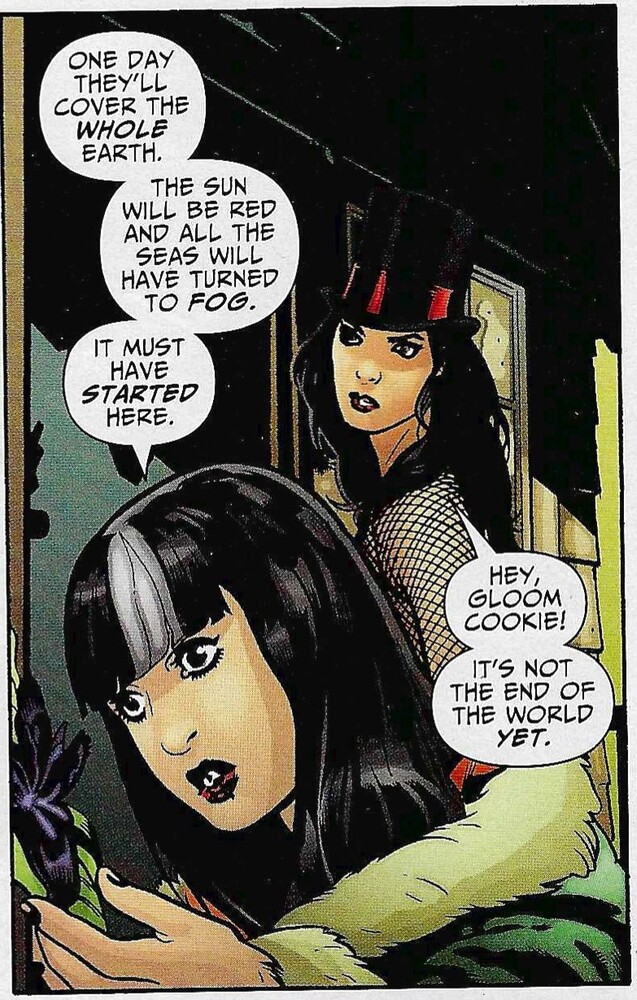 Gorias is one of the four magical cities in the “Land of Youth” in Irish mythology. Significantly, each city is home to a timeless treasure, and in Gorias is the Spear of Lugh, who is a sun god (which is probably also significant). Zatanna tells Vanguard to take Misty to Gorias while she finds the Seven Unknown Men. Misty follows her to Cyrus Gold’s cabin, telling her that Gorias won’t offer any protection from the Sheeda, and she should know. She also repeats what the Terrible Time Tailor said in The Manhattan Guardian #4 about black flowers covering the earth. Spooky! Zatanna calls her ”gloom cookie,” which I found humorous, considering she looks like someone from a goth comic, and then they enter the cabin, where instead of the Cosmic Sewing Machine, they find a spinning wheel covered in spider webs, not unlike the one Misty was spinning on in her flashback in issue #3. Misty claims the loom looks familiar, which isn’t surprising, and wonders when “she” will show up. Vanguard warns them to get a move on, because there are footsteps on the ceiling. These are Zor’s footsteps, presumably, because he shows up on the next page. Zatanna tells Misty that she doesn’t think she really lost her powers, just her faith in herself, but Misty has helped her remember who she is. One of the themes of the saga is, of course, discovering what it means to be a hero. After her big mistake at Baron Winter’s house (and, I’m convinced, the events of Identity Crisis, which Zatanna sort of references on this page), she felt completely unheroic, as she probably should have. Being a hero is not about being the strongest or the smartest, it’s about taking responsiblity for your actions. Misty allowed Zatanna to focus on making things better instead of wallowing in self-pity, and even though she got involved in adventure as a way to externalize her feelings, it still allowed her to move past the guilt she felt over getting her friends killed. By becoming a mother figure to Misty, Zatanna realized that there were more important things in life than saying spells backward. Morrison allows Zatanna to have it both ways, too — she grows up and becomes more of a hero, but she also rediscovers that childlike innocence that allows her to believe in making things better. Morrison is doing a nice job with that sort of thing – superheroes are essentially childish, but they bridge the gap between childhood and adulthood by allowing us to fantasize about having powers and experiencing wild things, but at the same time learning about heroism and what it means to be an adult.
 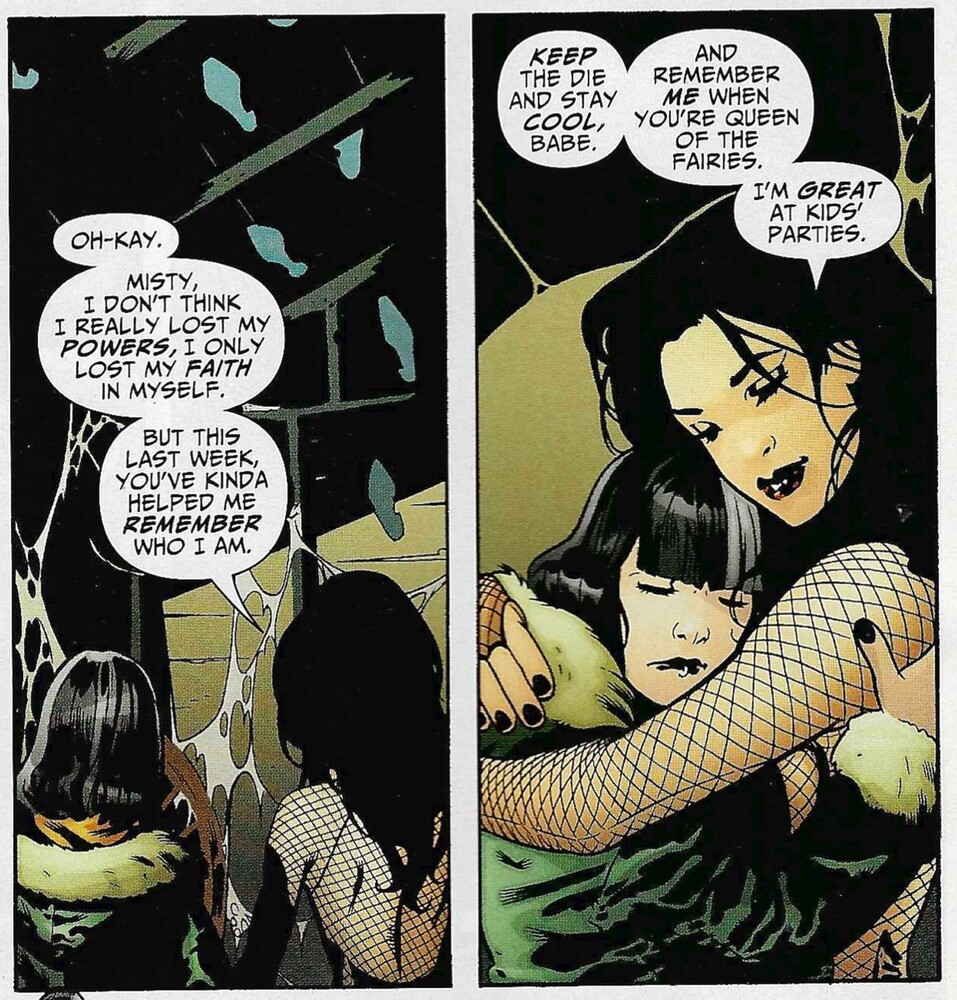 Zatanna sums this up on the next page, when she explains that being a superhero is about finding yourself as the only one who can save the world, and whether you run or whether you do it, not matter how hard it is. Zatanna has been able to decide, and that’s why she doesn’t need Misty anymore. She needs Misty to be safe instead of helping her, so she makes sure Misty gets out with Vanguard.
And then Zor shows up. Zor is not a nice guy. He bit the head off of a dove, for crying out loud! He shoots bullets out of his eyes! He tells Zatanna that he was the one who showed up in Cassandra Craft’s store, all in order to make Zatanna think it was her father back from the dead. He also says that in this world, he can do anything. This is interesting, because we wonder which world Zor comes from. Considering the metafictional nature of this entire issue, it’s certainly worth wondering about. He changes Zatanna into his own wicked daughter, Zorina, but that doesn’t work, and Zor gets tougher. According to the annotations, he refers to one of his battles with the Spectre from More Fun Comics #55, and the battle between he and Zatanna plays out like that one. Zatanna releases Gwydion and tells him to battle Zor. Gwydion says he is one of the seven treasures — so far it’s been four treasures, but now it’s seven — and that he is made of living language, born in the workshops of the gods. This is interesting, because the language Justine speaks is some kind of proto-language, a language that all men could understand before they lost touch with the gods. Gwydion is a manifestation of that. Morrison, of course, is very concerned with language and how we can play with it and manipulate it, so Gwydion becomes a crucial component of the way Morrison’s fiction plays out. Gwydion can change the world simply through language. Zor takes for himself the role of “new architect of the universe,” which Gwydion claimed to serve back in issue #2. Zatanna narrates about magical battles, saying that “belief becomes a weapon more deadly than bombs.” This ties back into Zatanna’s renewal as a hero — she believes again, and can therefore fight someone like Zor. Zor attempts to make her feel guilty, but she is past that, and it doesn’t work. Then things get weird.
This entire series has, in one way or another, been concerned with texts. We saw the Liber Zatarae as the catalyst in the first couple of issues, and Misty’s “origin” in issue #3 is taken right out of fairy tales.  In this issue Morrison concerns himself with the idea of texts as a gateway to a different reality, which isn’t that original an idea — we experience it whenever we pick up a text, after all. Zatanna goes “outside” the text, which is just another way of growing up — she seizes the opportunity to make her own reality and not just follow the script. By not doing what is expected of her, she is able to defeat Zor, of course, but she is also able to comprehend the machinery behind the Sheeda threat. Only when we step outside the proscribed arc of our lives are we able to reach understanding. How does Zatanna achieve this? Zor “breaks” the Merlin, Gwydion, who is born of living language. He doesn’t destroy Gwydion, but by shattering him, if only for a moment, he allows Zatanna to escape the bonds of reality (her reality is defined by language, after all) and become something different. Zor claims that he has become the universe — not unlike Neh-buh-loh, mind you. However, what Zatanna has finally understood is that there are many universes, and Zor is just a small one that she can easily defeat. His universe is the text of a comic book (note that Gwydion seems to be making reference to that while Zor crushes him – “I, the many thousand hands that hold it … I, the multi-colored eyes that gaze upon you …”), while Zatanna is no longer confined by that. She struggles with Zor in the swamp, but is able to shift him outside that reality, where he has become the universe, to someplace different. Remember, Slaughter Swamp is a “soft place,” and Zatanna has taken Zor outside of where he is powerful to a place where he is impotent. This momentary switch is all she needs to stun him. She hears “voices coming from somewhere east of nowhere” — the Newsboy Army, remember, lived on Nowhere Street – and realizes that if she can break through the “weird machinery, this scaffolding stuff that was holding all our lives together” then she could contact “them.” She reaches toward the reader, as she comes to understand that the reality of the writer (Morrison, in this case) is the one that dictates what happens in her reality. If only she can get through to that reality, maybe she can change everything. On the next page we see the Seven Unknown Men of Slaughter Swamp, staring down at her as she reaches toward them. They are impressed that she has made it that far. She understands why she couldn’t reach them before — they were there all along, meaning that the writer is ever-present in the text. You’ll notice she’s reaching up through the inner workings of a typewriter.
  She is no longer “being written” like a comic book character. She has broken beyond that.
She enters the world of the Seven Unknown Men, where she feels “eyes, tens of thousands of eyes, in different times and places, all converging on me.” Again, this is a reference to the readers, who are watching her go through this turmoil. The men tell her that they are called “time tailors,” who “patch and sew” to “make sure the fabric of your universe is kept in good repair.” Zor took it too far and tried to change the pattern. Notice in this panel that the time tailors are removing Zor from a panel of a comic book. Zor appears to be the eighth time tailor — or has he been replaced by a new one? We saw in Seven Soldiers #0 that there were only six time tailors — Zor is obviously not there, because he has thrown in his lot with the Sheeda. So they have found a new one in the interim, right? Anyway, they explain that he introduced a deadly plague into the world — the Sheeda, remember, ride mosquitos, which spread disease. They also tell Zatanna that they set seven “hidden” warriors in motion, but if they fail, the Sheeda strain will do irreparable damage. This backs up Ed’s statement about the Seven Soldiers not knowing each other — they must remain hidden from the Sheeda if they have any chance. Finally, they offer Zatanna access to anything in their records, and she, of course, asks about her father’s four books. Giovanni appears (along with the others who died in issue #1) and tells her that he wrote the books in her, and she was his gift to the world. Each book represents a primary element, and they also correspond to the four golems Ed Stargard created back in the day. As the time tailors cut up Zor and try to determine what went wrong with him (which, if we accept that to be a true hero you must overcome your limitations, means that perhaps nothing was ”wrong” with Zor and he just became fully actualized, which makes him a “renegade”), Giovanni hugs Zatanna and sends her back to save the world. Just like Shining Knight, we’re back where we started, as Zatanna meets privately with Etta Candy and finishes telling her the whole thing. 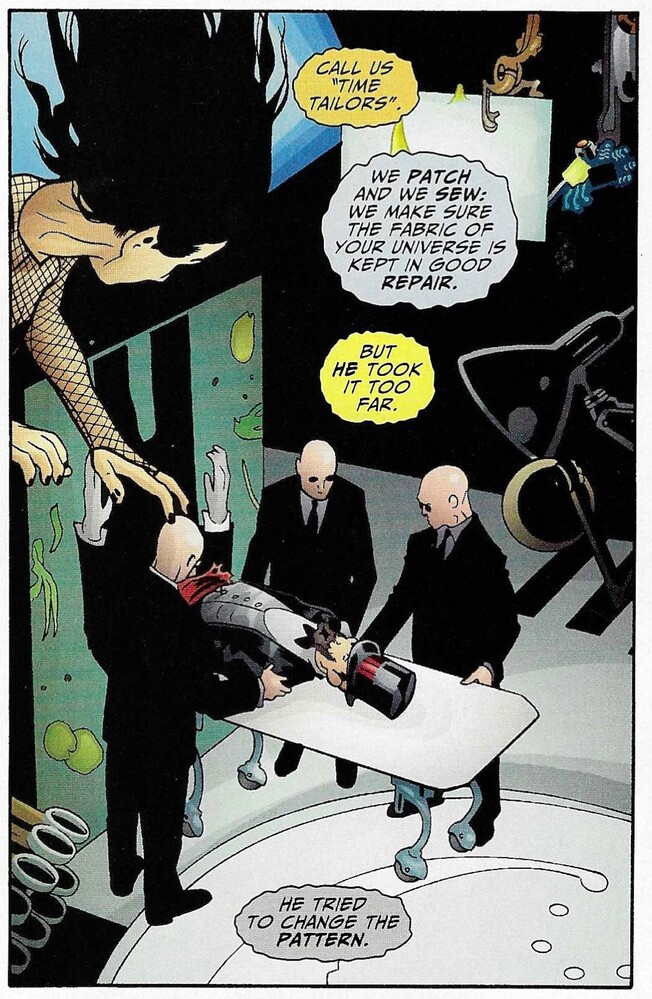 Etta, who did nothing to help her, still says she did nothing wrong, and even if she did, all the right things she did make up for it. Which is what Morrison has been pointing out all along.
Zatanna does get to keep Gwydion, still in his jar, but, amazingly, she’s still an action junkie, as she says (backwards) that she needs a new adventure, and suddenly Misty shows up riding Vanguard and leading a pack of flying horses, telling her that Gloriana Tenebrae is about to invade the earth. Of course that’s where we end. Luckily for Misty, Zatanna is back at full strength!
There’s not much else to say about this issue that I haven’t already covered. Through all of these comics, issue #3 has been the issue in which the hero discovers something about themselves that makes them face their fears, and issue #4 is when they get a chance to prove it. Zatanna has possibly come further than the others, because her magical nature has allowed her to accept the fundamental differences between realities. Justine and Klarion have personal experience with the Sheeda, so they aren’t thrown too much by what’s happening. Jake is a meat-and-potatoes kind of guy, so he gets freaked out by it before coming to grips with it. Zatanna, however, is able to accept the existence of the Sheeda, but she needs to go further, because of the nature of her guilt. Her guilt might be greater than any of the others’, because she got people killed through her own actions. So she needs to reach beyond our reality and understand that nobody ever really dies. In much the same way that Morrison’s ultimate tale of metafiction, Animal Man, showed us how silly comic book clichés can be, this comic allows Zatanna to realize that her father and the others may be gone, but that doesn’t mean they are “dead.” Hell, Terry Thirteen is already back! This allows her to truly become a hero, because she is no longer riddled with guilt.
Phew. 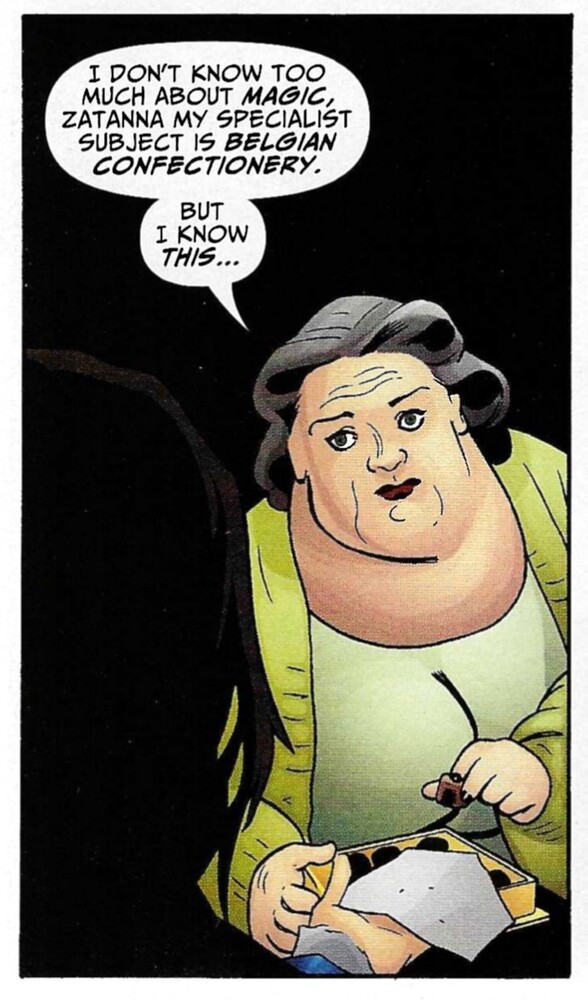 That’s a tough book to read, even though it’s very fun. Sook’s art certainly helps, as it remains the best overall of the mini-series (and second only to Williams’ art in the bookends). And although people complained about the whole “reaching out to the audience” thing that Morrison likes to do, it does seem to be necessary and not just a gimmick. That doesn’t mean you have to like it, but you can’t just dismiss it cavalierly. Well, maybe you can, but you shouldn’t.
For this issue, the annotations are very good. Jog has good thoughts about the issue, too, even though they’re kind of in line with mine, which either makes me smarter than I actually am or Jog dumber than he actually is. Marc Singer also thinks deep thoughts about this issue. So many smart people out there!!!!
Where to next? How about Klarion tied to a stake? Sure, why not?
