
[My original post is here, in which RAB comments about something cleverly (or not-so-cleverly) hidden from your more common readers, like me. Enjoy!]
Another mini-series comes to an end! A soldier must die — will it be Klarion?
Lots of SPOILERS here, by the way. As if you didn’t know by now!

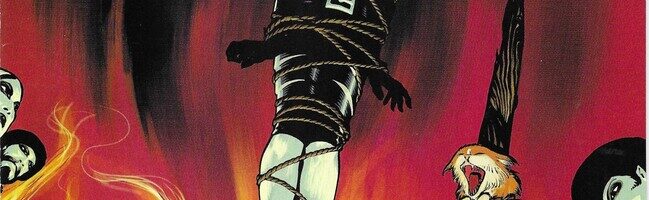
Not a good place for Klarion to begin this issue. When last we saw him, he was heading back to Limbo Town to warn them about Melmoth’s impending attack. Well, the inhabitants obviously didn’t take too kindly to that, because they tied him to a stake and are about to burn him as he warns them, over and over, that there is no witch-god and that men are coming to burn Limbo Town. His mother and his sister lead the charge! Before they can put the torch to the pyre, however, the earth starts to shudder (which they attribute to his blasphemy) and a moment later, Melmoth’s sapper drill bursts through the ground, scattering the fearful Puritans. 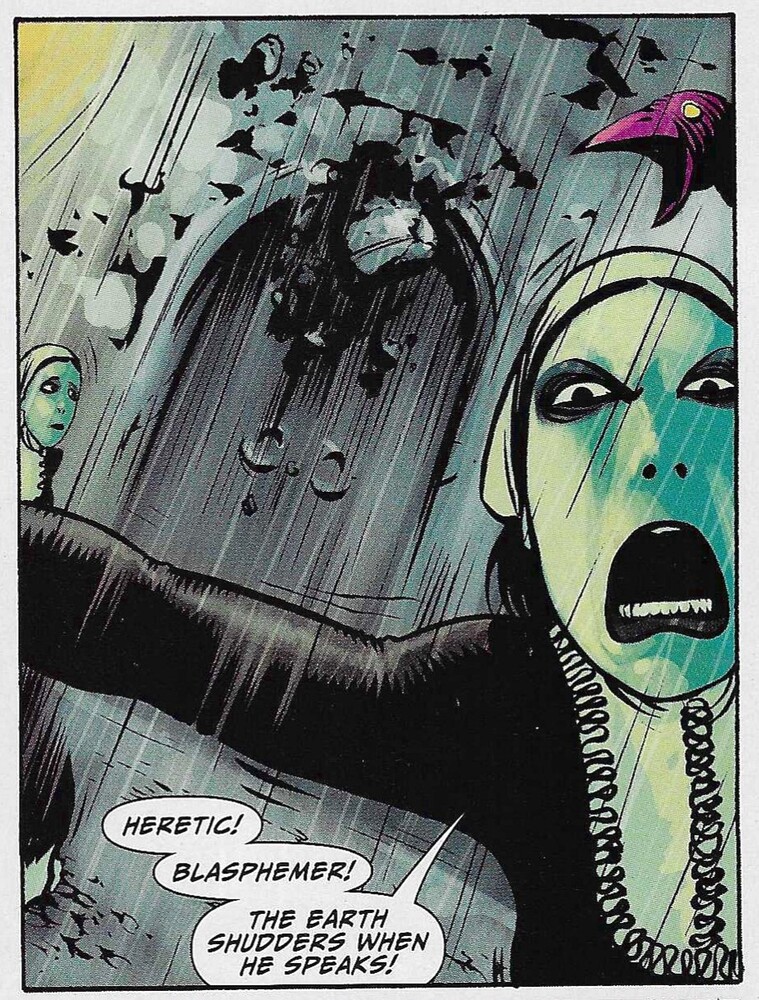 Melmoth and his men get out, and in the confusion, Beulah frees Klarion and tells him to ring the Sabbat bell nine times. Melmoth stands in front of the stunned Puritans and tells them he had “spider-sex” with their ancestors, and they all crawled underground to have his babies. One wonders what “spider-sex” is and how Melmoth accomplished it, but I suppose it’s too icky to think about. As usual with these series, the fourth issue gives us a big reveal — Justine is a girl, the secrets of the Newsboy Army, the identity of Zor — and this one simply confirms what we kind of already know. He tells them that even though he’s going to turn Limbo Town into a breeding pen, they’ll survive, because Sheeda “were born to cling fiercely to life in the most hostile of environments.” This is a bit of foreshadowing to the issue of Frankenstein when we finally see the Sheeda Earth of the future — it’s not pleasant. Klarion rings the bells, which summons the Grundys from the ground, and those zombies are ready to fight! In the bell tower, Submissionary Judah appears, having dragged himself back from the subway tracks where he was smashed in issue #2. He doesn’t look good, but he’s still full of hatred for Klarion. As the Grundys attack Melmoth’s men, Judah asks Klarion the same question he asked him in issue #1: “Would ye be Submissionary? Would ye bear burdens of knowledge heavier than the rock of mountains?” Judah is dying, so he wants to pass on his knowledge to the younger generation, and Klarion is all that’s left. Presumably, he also wants to kill Klarion, so he hopes the youngster will not be able to handle the secret knowledge. Considering Klarion already knows that Croatoan doesn’t exist, Judah’s hope is a futile one. Klarion heads into the map room, where the Submissionaries became the Horigal, and tells Teekl that it’s only a map. However, we see strange light emanating from the map, and we know it turns people into the Horigal. It’s not a lost treasure of Camelot, but what is the map? Anybody know? [Edit: It’s a world map from Puritan times, clearly, but what is its significance?]
Outside, Melmoth’s men have finally gotten the upper hand against the Grundys, and Melmoth tells them that “Croatoan is a sophisticated artificial intelligence system and it comes in the form of a pair of dice.” We know where both die are — Klarion has one, and Misty has the other. 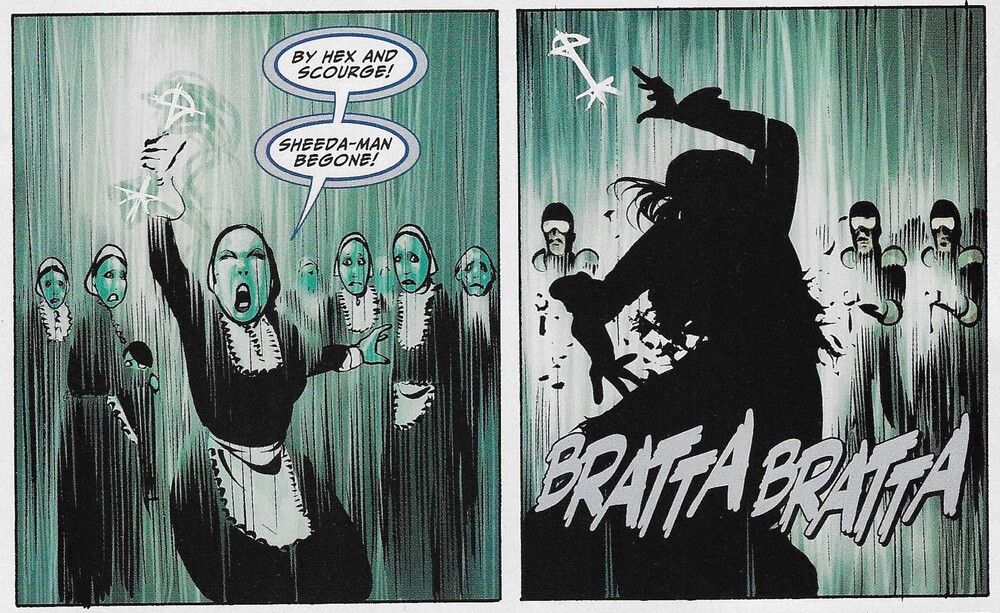 What exactly is Croatoan supposed to do? We won’t find out for a while. If they’re so important, one wonders why Melmoth left them lying around in the first place. Stupid Melmoth! He goes into the bell tower and says he’s very pleased with his eugenics experiment. He then sees Judah and tells him that he remembers him from his toyshop (and he forgets the name of the third one, who will remain forever unnamed — is it important?) and then he reaches into his mouth and switches him off. This is weird. Judah is like the spiders the Sheeda use — a very sophisticated machine. Is he immortal? Did no one notice that he lived for 400 years? The other Puritans aren’t like him, but they don’t seem to know about Judah. Ebeneezer knew that the train hitting the Horigal wouldn’t kill it — did he know that Judah wasn’t alive? So many questions!!!!
We get no answers, however, because Klarion shows up, having been transformed (with Teekl) into the Horigal. He wreaks some bloody havoc, to be sure, and chews Melmoth’s arm off at one point when he drives the Sheeda into the pyre that was meant for him originally. Melmoth, however, steps out of the fire (looking very much like Gwydion from the first issue of Zatanna, in that they’re both on fire) and tells Klarion that blood no longer runs through him — instead, the waters of the cauldron do, and he’s pretty much immortal. He casts a spell on Klarion that is supposed to kill him, and leaves Limbo Town, confident that after the Sheeda are done with the world, he’ll have plenty of time for his depravity. Klarion is in agony, but his mother is able to separate him from Teekl, using “secrets the men never learn.” This is a standard theme in fantasy fiction, it seems, that women learn different kinds of magic than the men. She heals him, and all is well. When next we see Klarion, the Puritans are asking him to stay and take Judah’s place. He tells his mother that he’s going to send Leviathan to their aid, but they should close the Wicket Gate because the war is coming, and he has to join in. He has to go, because he wants to be many things before he dies, and today, he’s a soldier. 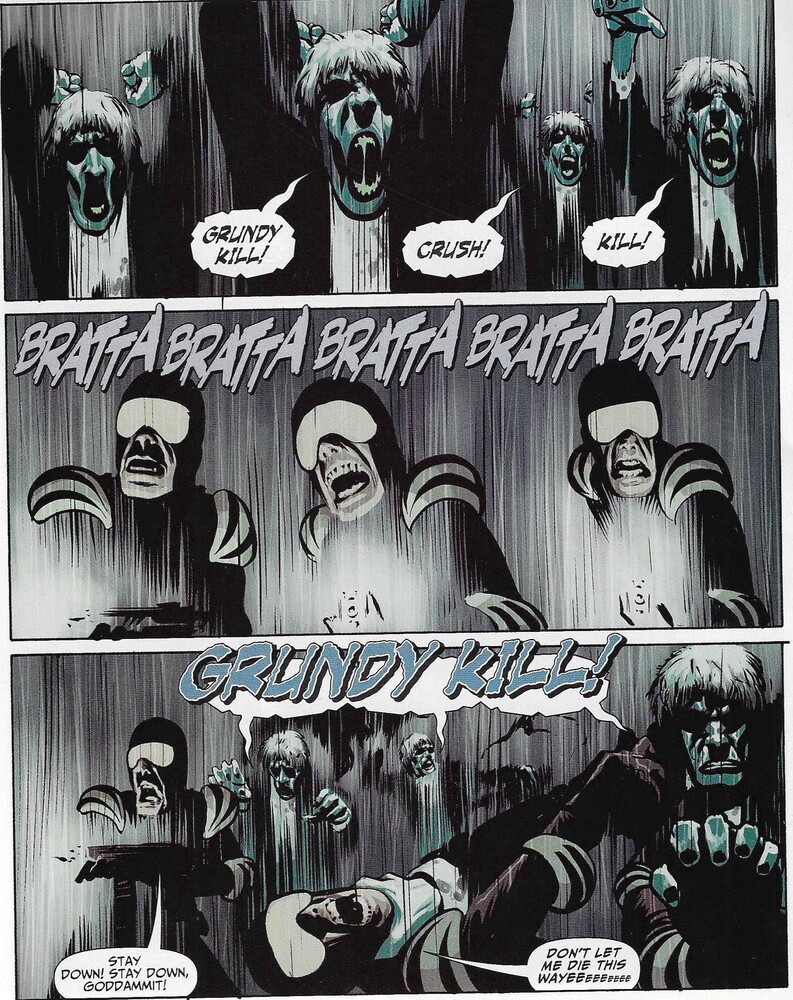 The last image we get of Limbo Town is one of the Puritan women (Beulah, possibly), ready to set Melmoth’s men on fire, gleefully saying, “Smell how they burn!” Oh, those wacky Puritans! Always ready to burn somebody!
This is one of the few issues that doesn’t have a lot of “meat” on it, in other words, weird hidden things that we can delve into. That doesn’t mean it’s not a good issue — Irving’s art is as stellar as ever, and Morrison gives us good action, but because a lot of the issue is fighting, it’s not as “deep” as most of the other issues of the epic have been. Some interesting things come up, but they are what we’ve already suspected: Melmoth is the progenitor of the Puritans, which is why they’re blue in the first place; Judah is a machine (we might not have suspected this, but he did get hit by a train and survive) like the Sheeda spiders; the power of the Submissionaries in Limbo Town itself, like the power of Croatoan, is based largely on illusion (although I’m still wondering about that weird light in the map). Does it get into anything else of interest?
Well, we’re still tracking this idea of growing up, something Klarion had to deal with last issue. In this issue, Melmoth takes on the role of the father figure once again, and tries to destroy his progeny, especially his rebellious offspring, Klarion himself. Klarion is still a rebel, but his rebellion is channeled into a positive outcome, as he helps save Limbo Town from the Sheeda. Of course, we see that the Puritans are still clinging to their superstitions at the beginning of the issue, and spiritually, they are much closer to Melmoth than Klarion. They want to punish Klarion for his transgressions, because he dared rebel against their law. Again, it’s a case of the younger generation — the children — being punished for daring to say the emperor has no clothes. Klarion seeks knowledge, while the Puritans seek conformity. Only when they are confronted with a threat do they realize that the rebel is actually the one who can save them, because he dared to step outside their reality and find out the truth. In the same way that Zatanna stepped outside her world, so too did Klarion step outside his, and gain insight that helped him when he returned to his world. Thematically, then, this issue is similar to the final issue of Zatanna. There is a father figure — Zor and Melmoth — who wants to “claim” his offspring, but those children stand up and become grown-ups when they resist. When Klarion makes the difficult choices, he becomes a hero.  Interestingly, both he and Zatanna yearn for new adventures at the end of their trials. Justine is motivated by revenge, and Jake is motivated by a need to rescue the woman he loves. Both Klarion and Zatanna are motivated by a need for adventure. We will see how their motivations lead them to fight the Sheeda later.
I have mentioned throughout that Klarion is kind of a jerk. Does he remain one? Well, for the most part, yes he does. He’s not as much of one, to be sure, but he’s still the most emotionally stunted of the Seven Soldiers so far. But this is partly because of the lessons he’s learning. He has been lied to about his religion his entire life. He has been betrayed, probably by his own father (a debate for another day). He has been betrayed again by a substitute father, and he learns from Melmoth that it’s best not to grow up at all. He is betrayed yet again by his mother and sister, who are first in line to burn him when he returns to Limbo Town. Yes, he forgives his mother, but what are the lessons he is learning during this series? Trust no one. Stab them in the back before they stab you in the back. Remain a child. Through all his growing up, he eventually shirks any responsibility he feels toward his home (sending Leviathan to help is a nice touch, though) and leaves for more adventure. Can we blame him? Probably not, because who’s to say that his family won’t betray him once more? But it remains an issue, because Klarion should be learning better lessons than this. He doesn’t, though, and this sets up his actions in the finale.
Finally, the idea of group-think enters into this issue, as it has been an undercurrent during the epic so far. The Puritans are caught up the “witch-fever,” as Beulah puts it, and don’t stop to consider what Klarion has to say until it’s almost too late. The Sheeda, it appears, are a collective, not necessarily a hive-mind, but definitely alike in their thinking to the point that they are almost non-entities. What they want to do is stamp out individual thinking, which will make resistance to their onslaught less likely. We can see this even back in the JLA: Classified arc, during which they took mental control of several Ultramarines. Any villain in this epic so far has exhibited this kind of group-think mentality, and even some of the more benign groups show it. What is Zatanna’s self-esteem workshop but a less insidious form of group-think? Morrison is implying, as most writers would, that this kind of thinking leads to disaster, and true heroes overcome it. At its worse, it can destroy a civilization. Look at the knights of the Round Table, who split the atom in order to defeat the Sheeda. Galahad comes up with the idea but can’t do it himself. Bors cheerfully steps in, because nobody is thinking independently — the overriding concern, to defeat Mordredd, has taken over. 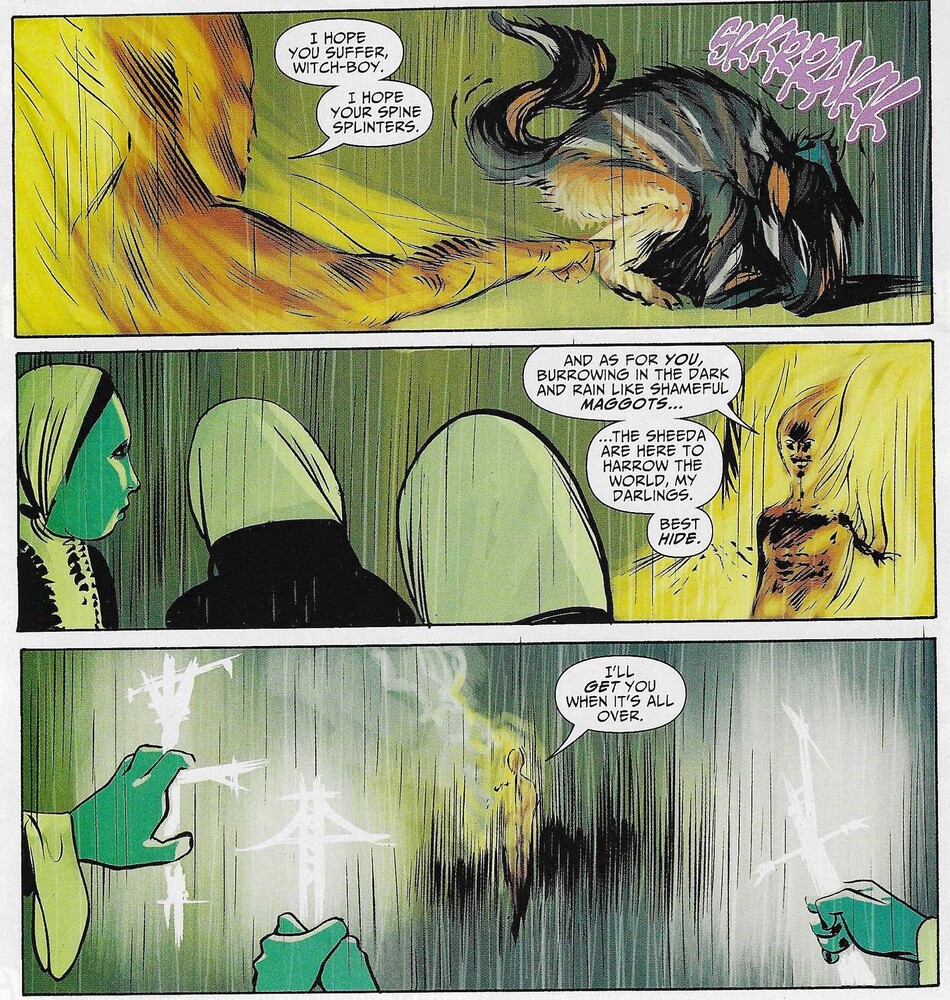 The Puritans, who are trapped in amber with regard to their civilization, cannot break out of that mentality, and therefore anyone who suggests that there might be something different is obviously a “blasphemer” and “heretic.” The Terrible Time Tailor (Zor), by attempting to “fit” everyone into his “special clothes,” is assigning roles to them, roles that will dictate how they live their lives. Ali Ka-Zoom mentions how stupid they were to send Cap into his cabinet, because he did something they thought was wrong. He regrets the decision, because it was a decision, we understand, that was made for them by the structures of society. The Newsboy Army had become just another group enforcing conformity, which is why they failed. Klarion, by remaining non-conformist and immature, might not be a true hero, but he might also be a wild card that the Sheeda can’t anticipate. Melmoth certainly didn’t anticipate the Horigal.
So while Klarion #4 doesn’t show the depth of some of the other books in the saga, it does offer some interesting connections to the other heroes and what they have experienced on their journeys. Of the four mini-series so far, Klarion is the most consistently interesting, even though certain single issues in other series surpass it. In the other series, the characters’ arcs don’t really take us by surprise all that much. Klarion, however, remains an enigma as he hops in the sapper drill and prepares to return to Blue Rafters. That’s why his mini-series is neat. And that’s why we need to keep an eye on him.
What kind of person would I be if I didn’t link to the annotations? A not very thorough person, I’ll tell you that much. Of course, Jog has his usual good thoughts. So there’s that!
Next: Exploitation is groovy!
