

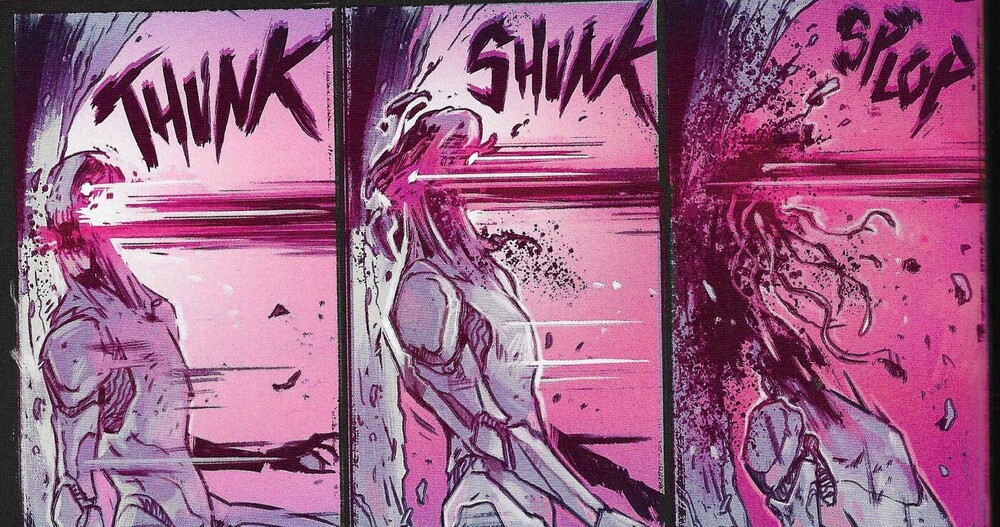
Let’s check out another keen horror-ish comic!

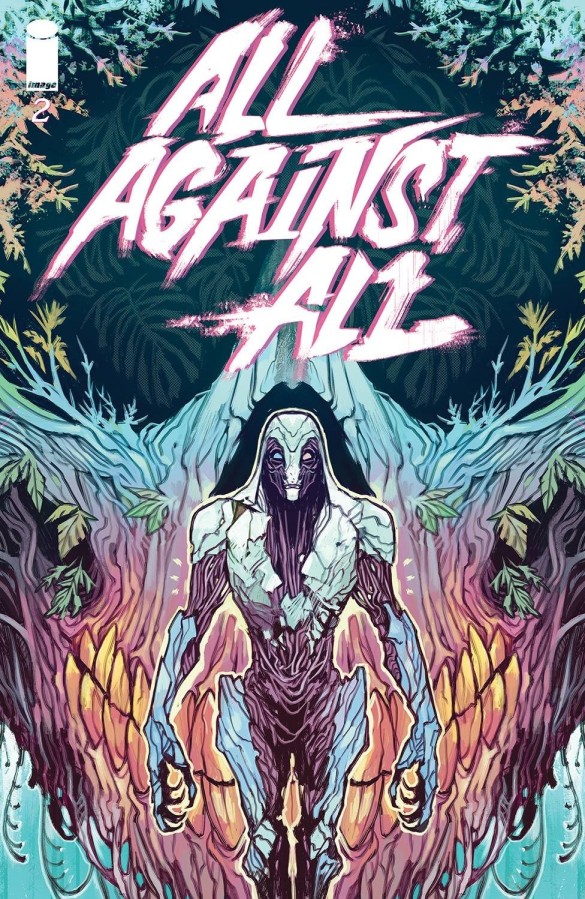
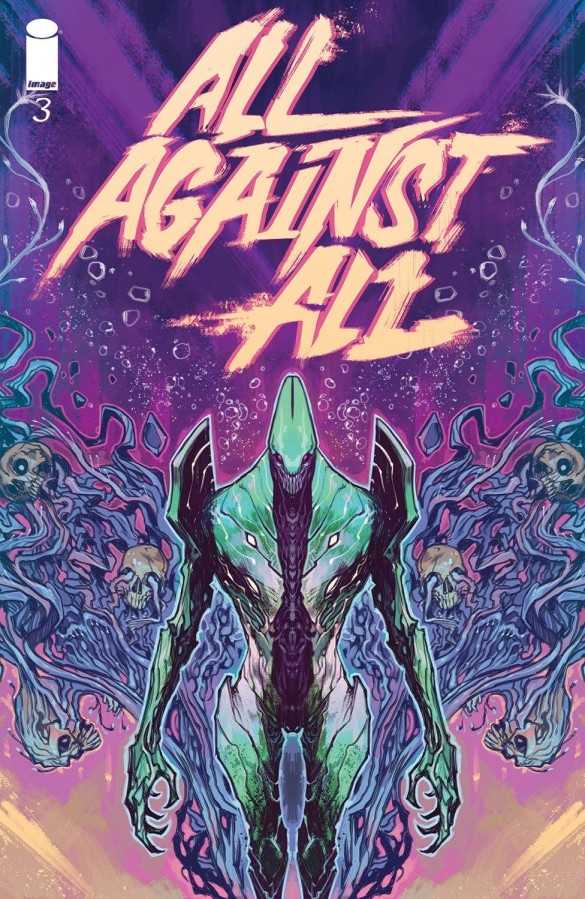


All Against All by Alex Paknadel (writer), Caspar Wijngaard (artist), and Hassan Otsmane-Elhaou (letterer).
Published by Image, 5 issues (#1-5), cover dated December 2022 – April 2023.
SPOILERS? Possibly, so be aware! And you can click on the images to see them better, as well!
It’s a coincidence that I’ve recently written about different “Alien” stories, because next in the alphabet is Paknadel’s own “Alien” story … with a classic twist, of course! In “Alien” stories, humans encounter the xenomorph and don’t know what they’re dealing with, tending to underestimate it (even the Marines in the second movie, who should have known better, are a bit overconfident) until it tears them apart.  In All Against All, the protagonists encounter a xenomorph and don’t know what they’re up against, and they tend to underestimate it. The big shock, of course, is that in this story, the “xenomorph” is a human being, while the hapless protagonists are aliens. Oh, the wackiness!
Paknadel has to do a bit more with the nice hook, though, or this wouldn’t be such a good comic. This is a book about civilization and what happens when that civilization begins to decay. It’s about fathers and their children, the loss of family, the struggle of people who want to retain what power they have, and a story about war and what people will do to win one. And yet, the only human being in the comic is a fierce animal, almost gleefully killing the people whom Paknadel spends the most time making sympathetic. It’s a fascinating way to tell the story, because while we don’t often cheer for the monster, in this case we do because he’s the only human in the book, yet B’tay, the main character, is a tragic figure himself, so we can’t help rooting for him, either.
B’tay is the head scientist of a research station that orbits a long-dead planet (no points if you figure out which one). He and his team have built biomes in the station where they’re breeding animals. He narrates the first several pages, on which we see what appears to be a diseased bear about to attack a small, naked child. Oh dear! Luckily, a gorilla comes to the boy’s rescue, and they fight the bear together (well, the gorilla does most of the fighting). Suddenly the gorilla is rendered unconscious by some sort of weapon, wielded by very strange-looking aliens. They think the bear is dead, but it rises up and mauls one of them, ripping its body in two. 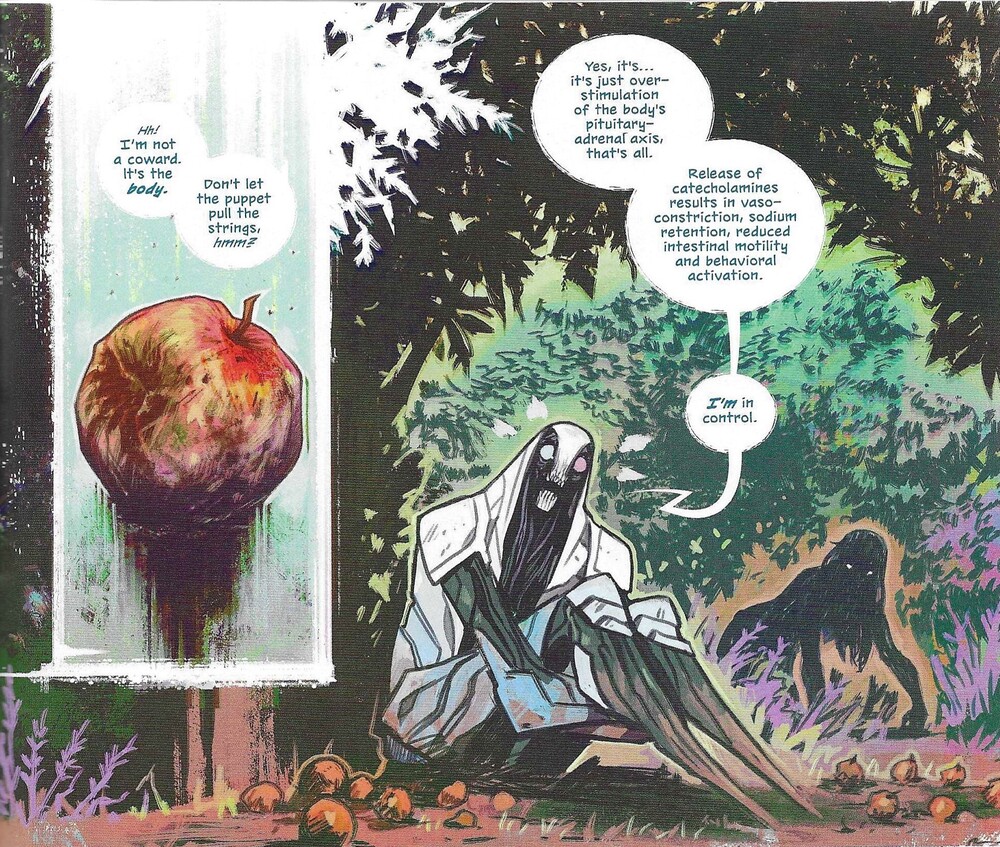 That’s when we learn that the aliens appear to be simply heads trailing tentacles, and killing their bodies does not kill them. We also learn that B’tay is a coward, as he runs away while the remaining alien kills the bear. While he’s hiding, the human boy sneaks up to him holding a sharp rock. He feels a kinship to B’tay, it’s clear, as they’re both heterochromatic. He gives the rock to B’tay and leaves. Then we jump ahead several years.
It’s a tense beginning, and it gives us a lot of information, even though Paknadel doesn’t overwrite it. B’tay’s wife is dead, we learn, and since then, he’s been more drawn to the habitats because, as he puts it, “every organism in this place … improves itself through a process of continuous violent negation.” He finds this pure, and he continues, “In my dreams, I imagine myself as one of them — a moil of instinct and stiffening fur. I see my enemy across an interval of time and dirt and my hormones surge, making me invincible.” Of course, we learn quickly that B’tay is a coward, making this dramatic entry into his diary all the more ironic. When they stun the gorilla, one of his colleagues wonders if the human — they’ve named him “Helpless” because, as we learn later, they released some human babies into the habitat, and B’tay could not believe they’d survive: “The other primates’ young were vital, alert … capable of fending for themselves. These things were mewling tubes — heads like baubles. Helpless.” — can survive without the gorilla’s protection. This is more irony from Paknadel, as “Helpless” is, naturally, anything but, and thrives without the gorilla, although not completely on his own, as we’ll see.
In the present, B’tay is trying to keep the habitat together, as it’s decaying rapidly. His workers are still experimenting on the animals (without anesthesia, because, as one of them notes, “the pain is the point”), but B’tay’s heart clearly isn’t in it. His daughter, V’lmann, is also on the station, and she is still hopeful about the utility of the habitat. We learn that they’re fighting a war, which is brought home to them when a general, Cov’n, comes to visit. We learn that B’tay and the research station are supposed to be figuring out which bodies the aliens can use to fight their war. 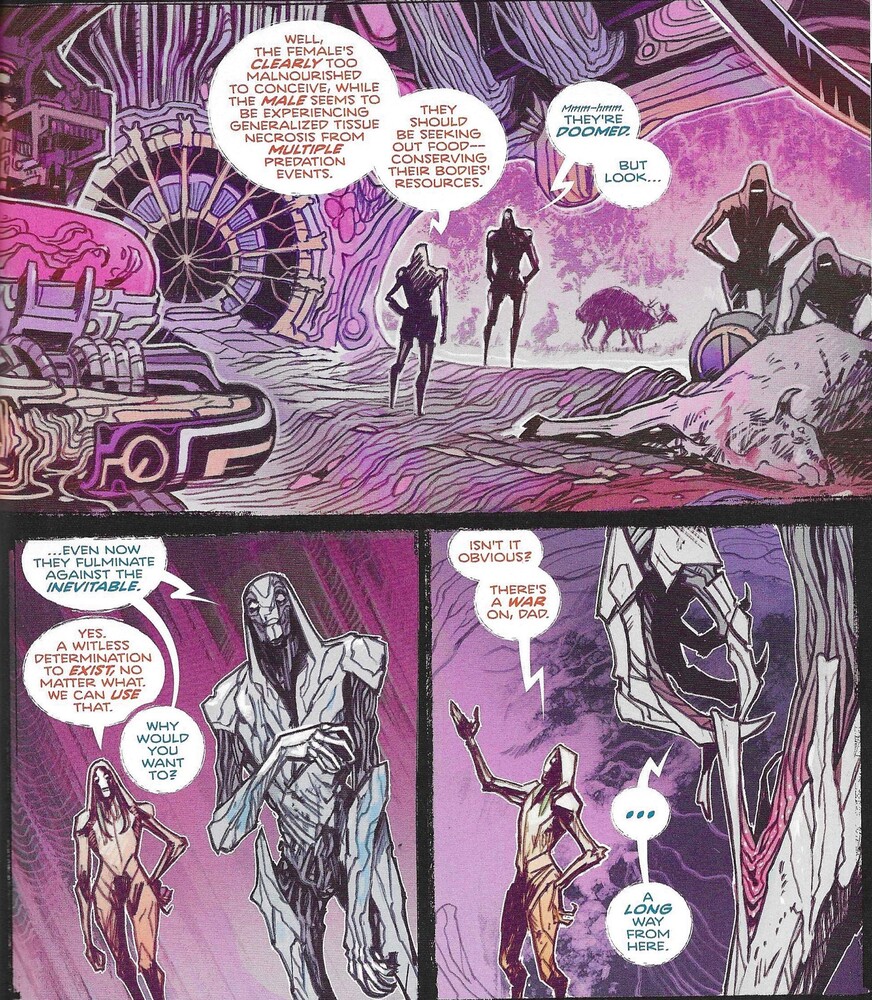 They can transfer their own, jellyfish-like bodies into other ones and take them over, using them as vehicles to fight. We also get confirmation that they’re orbiting a dead Earth, as Cov’n tells B’tay he was one of the team that found the planet. He is impressed with the way the Earth died: “What that planet’s dominant species has done … there was a vehemence to it. Even though the air filters you could taste the self-hatred. Imagine a creature capable of doing that to itself and everything that sustains it. The will.” They also found the “vault” (in Spitsbergen, presumably), which allowed them to build the habitats. Cov’n is a military man (although not a completely undaunted one — he says “a war is a hungry mouth — ravenous, actually — and it needs to be fed” — with something that feels like regret), and he is there to make sure B’tay is doing his job. He’s convinced there are intelligent species that they can use as “vehicles,” and he sends two soldiers into one of the biomes to look for more aggressive animals than B’tay has been sending them. Of course, the soldiers find an adult human, and things go sideways from there.
Paknadel sets this all up very well in a short space of time. B’tay is weary of his duties, scared of life, and dismissive of his daughter. V’lmann is still committed to the cause, ambitious to advance, and willing to work with the general. Cov’n is aggressive and blunt, unwilling to compromise and desperate for something to turn the tide of war, which we learn later is not going well at all. There’s also the sense of degradation everywhere in the comic, which adds to the haunting tone Paknadel is going for. In the opening vignette, the bear is horribly diseased, “riddled with parasites,” yet it’s still alive enough to destroy one of the researcher’s body. Later, B’tay shows his daughter two deer having sex even though the female can’t conceive and the male has “tissue necrosis.” On the same page, B’tay peels some of his own skin off, as the body he’s chosen is falling apart as well. B’tay is hallucinating his dead wife inside the biome, and it’s clear his mind might be going, as well.  When Cov’n docks, a creature tries to attack him before it’s destroyed by the soldiers, and the general tells the director it was being “driven” by one of his men, even though B’tay warned him that the bodies from the “exotic habitat” are too unstable to be used in war. The general tells B’tay: “Ln’son adjusted well at first — no dissociation this time — but his behavior started to turn erratic after a couple of days. After an initial surge of euphoria — some of it sexual — he became difficult. We tried to remove him from the body to cool off, but it was too late. The body … it had him.” This is a horrifying development that, of course, comes into play a bit later in the book, but for now, it’s just another indication of the degradation going on all around these characters. Paknadel also brings in the theme of “control,” which goes hand-in-hand with the idea of things decaying. When B’tay is cowering in the opening scene, he says to himself that it’s not the brain that’s cowardly, it’s the alien body, and that he is in control. Helpless approaches him and learns this one word, which he takes to heart. It becomes a mantra for B’tay, who repeats when the soldier — Ln’son — in the animal’s body is about to kill him. Of course, Cov’n’s arrival means B’tay is no longer in control of his own research station, which does not sit well with him. The general admires control, as well, which isn’t surprising. He admits that Ln’son lost control of the body, but he still thinks they can make using more aggressive bodies work, and it’s clear he admires humans because of the “will” it took them to destroy their own planet. All of this is from the first 21 pages of issue #1, after which we get the two soldiers inside the “carnivore biome” and what happens to them.
Of course, then it all hits the fan. The two soldiers in the biome find a cave, where they find drawings on the wall that prove that at least one of the animals in there is somewhat intelligent. It is, of course, Helpless, who’s grown up and isn’t terribly happy about what’s going on. He kills the soldiers, and General Cov’n is angry at B’tay for keeping the existence of Helpless from him. This is where Paknadel begins to introduce the idea of B’tay as father figure to Helpless, as the human remembered B’tay’s eyes, which match his own, and B’tay is impressed with this. Cov’n, meanwhile, sees only that Helpless is a weapon to be used in the war. 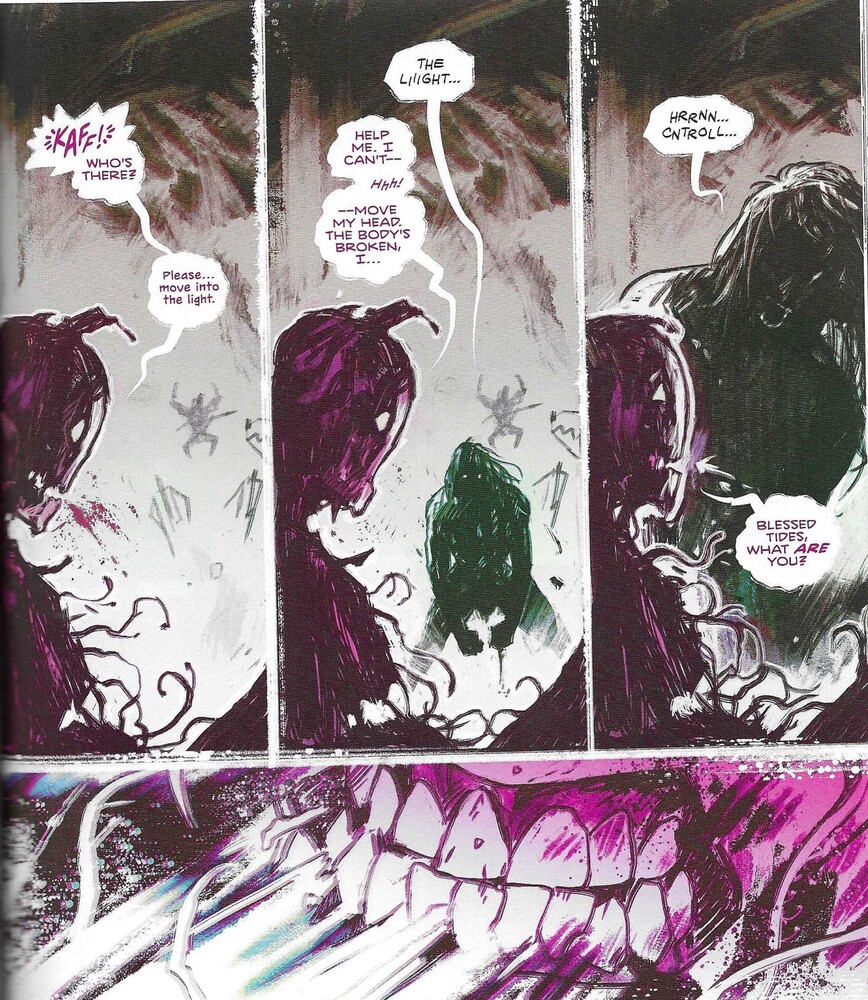 B’tay says, “You saw their world — what they did to themselves! I had to protect us.” Paknadel doesn’t go too much into the environmental problems the Earth is experiencing, but he does make it clear that even though Helpless is “helpless” and even might be the last of his kind, B’tay, at least, knows how dangerous he is. Cov’n, of course, doesn’t listen to him. He drags him into the habitat to find the human, which we might think B’tay would resist, given his cowardly reaction to the bear early in the story, but Cov’n understands that B’tay yearns to go back. Is it because B’tay wants a second chance to prove that he’s not a coward? The interesting thing about this is that Paknadel never really answers it — he hints at it, but leaves it ambiguous. We just have to go with B’tay on his journey.
Helpless rips B’tay’s body apart at almost the same moment that Cov’n is able to capture him, so the two threads of the story begin/diverge right at that moment. Helpless sets a trap for the soldiers, and as he springs it, B’tay stands frozen, watching his life’s work crumble around him. He whimpers, “Oh, Helpless … I tried. I led them in circles. Told them you were dead. But now they’ll never stop. Do you see? Never.” He hallucinates his wife again, but realizes that it’s Helpless, who remembers only that B’tay was the person who took away the gorilla, Helpless’s friend and protector. As he shreds B’tay’s body, Cov’n shoots him in the back and incapacitates him. Cov’n says, “I’m in control,” because Paknadel wants to show how these people — B’tay and now Cov’n — want to believe this statement is true, when really, they’re anything but in control.
B’tay isn’t dead, of course, because his body isn’t a real body — it was designed for him, and his real, jellyfish-like body has survived … he just needs another body to use as a vehicle. This is where Paknadel really begins to examine the body horror theme he’s been toying with. B’tay finds a wolf that investigates the scene of the carnage, and his tentacles wrap around the wolf’s head and delve into its brain, linking B’tay’s gelatinous body to the powerful frame of the canine. We’ve heard a bit about the amalgamation process from Cov’n before, but now B’tay experiences it, and it’s clear he’s fighting against losing his personality completely to the wolf. 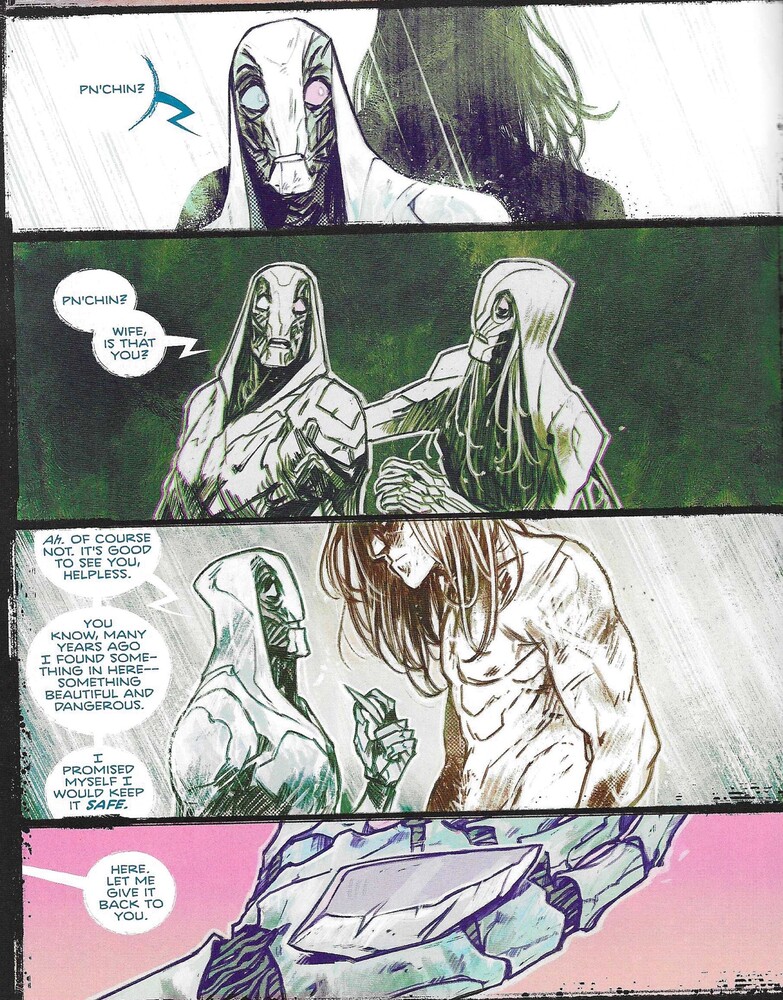 Eventually, he ends up on an alligator, which almost completely overwhelms him. His brain is breaking down — he continues to see his dead wife — and it’s becoming more alligator-like, until he comes across his daughter, who’s come into the biome searching for him. He almost kills her, but she’s able to kill the alligator and separate B’tay from his host. He is still without a body, though. She gets him back into a body of one of the soldiers whom Helpless killed, and they make it back to the research station, just in time to find out the Helpless has been busy wrecking everything. Cov’n wants Helpless’s brain and spinal cord, and he doesn’t want him sedated as they dissect him, because, as we’ve seen, “the pain is the point.” Unfortunately, they don’t think of something crucial (I won’t spoil it, because it’s a neat idea), and Helpless gets loose. He’s much stronger than they think he will be, and he carves a path of destruction through the station. Cov’n puts his brain into the body of the gorilla, which B’tay had kept on ice for years, and tracks Helpless back to the habitat, where they’re ready for their battle to the death.
There’s so much going on in this series — it’s impressive how much Paknadel manages to get into it but still keep it amazingly tense and tragic. B’tay’s wife, Pn’chin, suffered from some sort of dementia-like disease, and it’s from this that B’tay gets his pathological-like focus on control — he wants to keep V’lmann safe from whatever affected her mother, but he doesn’t know how to do that except by trying to control everything in his life. When B’tay is forced into the terrestrial animals, he’s shocked by the physicality of their bodies and the crudeness of their emotions, but at the same time, he’s entranced and seduced by it because it’s nothing like what his life is. He’s always in “control,” and giving into his animalistic urges makes him feel both free and terrified, especially when he almost kills V’lmann. Cov’n, of course, is also overwhelmed by the physical power of the gorilla’s body, but he believes that he’s still in “control” and using the body is a way to bring everyone else in line. It’s clear, though, that’s he gone insane, which makes him even more terrifying. 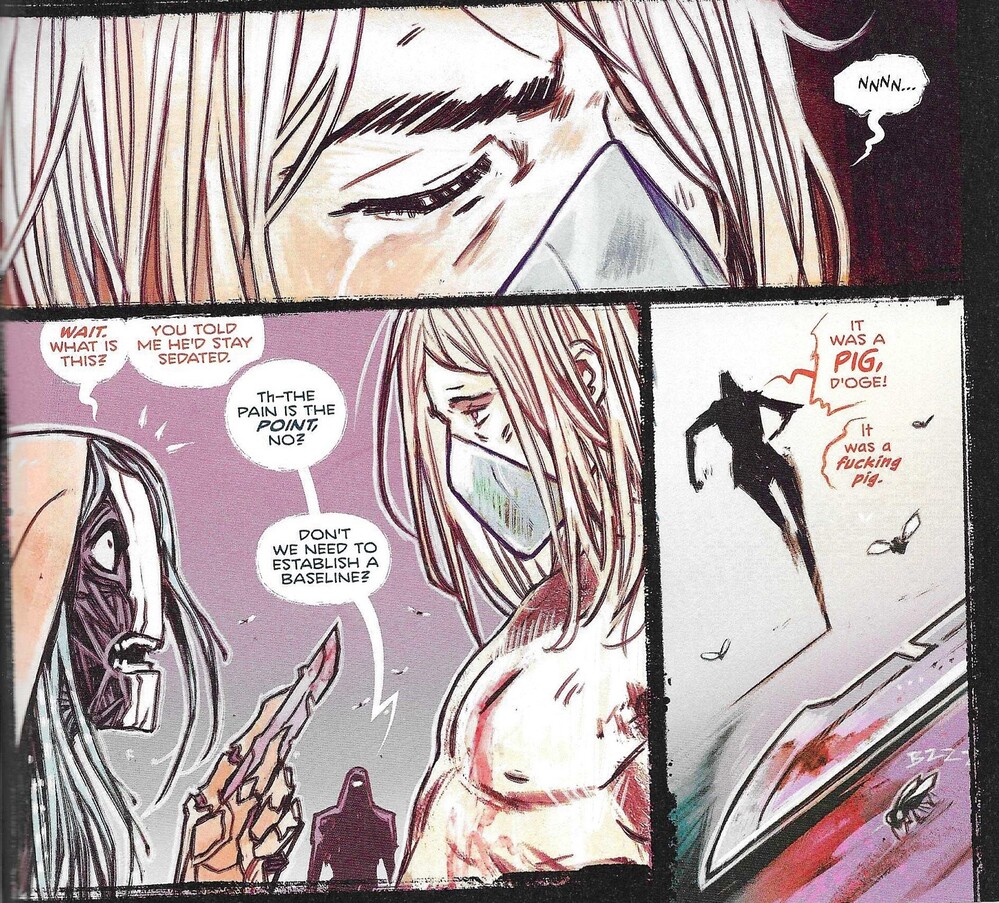 Paknadel has him paraphrase Kurtz in Heart of Darkness, and while it’s a bit on the nose, the irony of Cov’n believing that his fall into violent fury is what will save his race works. He thinks he can win the war using these bodies, but he can’t even keep himself in line. B’tay understands this, at the end, but Cov’n never does.
There’s also the idea of parenting and what that means. B’tay cannot connect with his own daughter, as we see in a flashback to when she was getting her first body. It seems as he links his wife’s death to his daughter’s birth — his species doesn’t give birth the same way humans do, so she doesn’t die in childbirth, but it does seem like B’tay associates the two, and even years later, their relationship is still icy. Despite having only the brief — and scary, for him — interaction with Helpless, he feels some kind of paternal emotion toward the human, hiding his existence from the general because he wants to “save” him. He and V’lmann have a devastatingly sad conversation once she finds him in the habitat and puts him in a body, during which he confesses why he did what he did with regard to Helpless. He understood that Helpless was unlike the other animals in the biome, that he was intelligent, and B’tay knew he would have to protect him, at least from experimentation, if not from the other predators in the habitat. V’lmann gets it all too well:
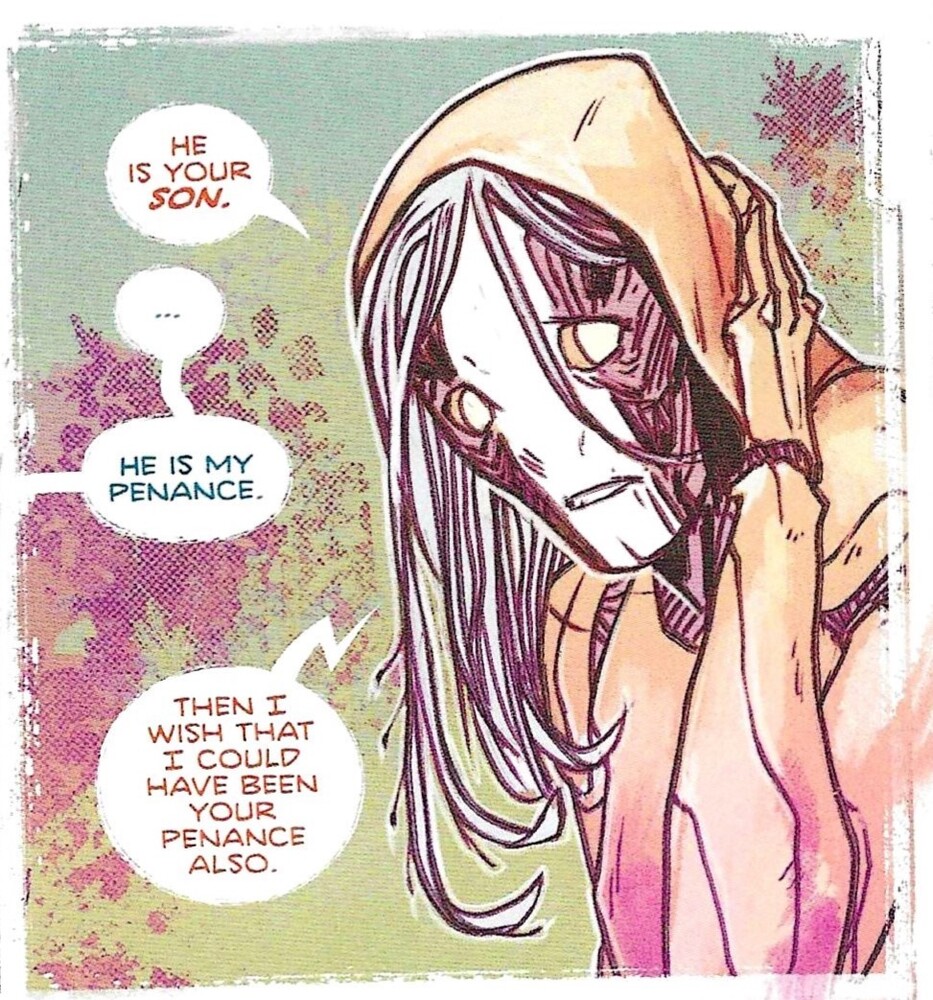
Obviously, the idea of power and control is a big one in the book, and Paknadel does a very good job with that, as we’ve seen. Paknadel links it, somewhat subtly, to the idea of nature-versus-nurture, which gets back to the parent-child theme running through the book. Both B’tay and Cov’n crave control, for different reasons, and they both find that control is something difficult to achieve and difficult to sustain. They both lose control, but B’tay is able to stay coherent, at least long enough to reconcile, somewhat, with his daughter. Again, Cov’n thinks he’s in control, but he has fallen completely out of control, and it costs him. Helpless remains in control, for the most part, as he schemes to get out of the station and return to the habitat. Is this his nature? 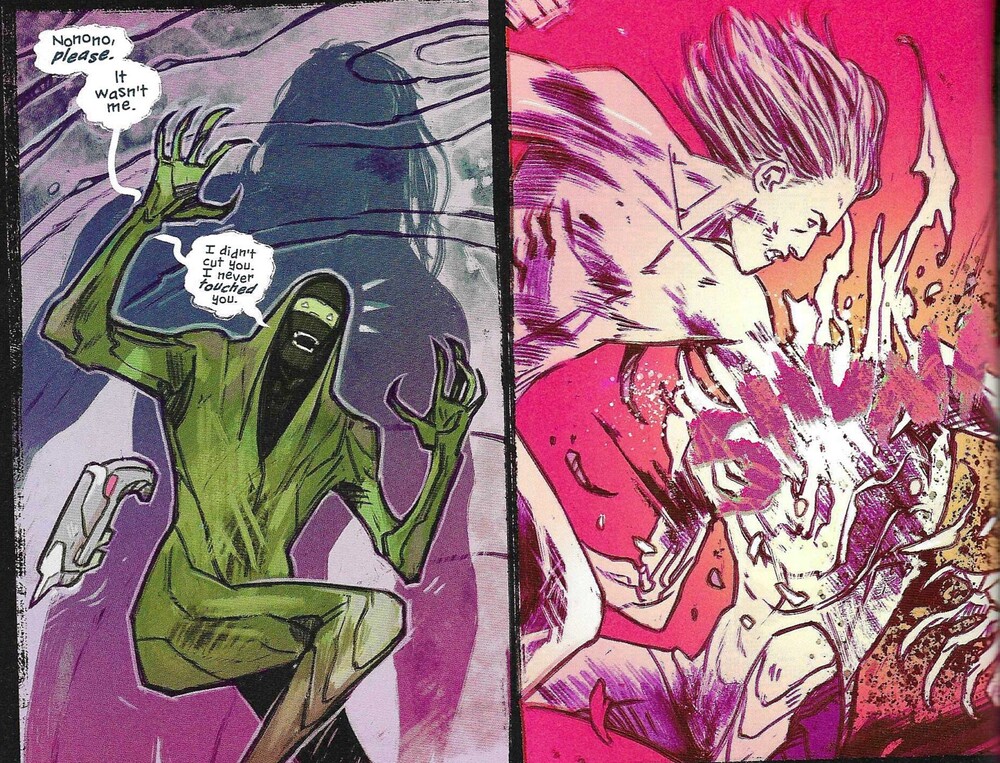 It’s certainly implied that as a human, he can outthink his adversaries, who don’t understand the physical nature of existence because their bodies are so weak and small. B’tay speaks of this early on, when he muses to V’lmann, “Do you know what the name of our ancestral homeworld means in the old tongue? ‘Water.’ It simply means ‘water.’ I’ve only been once, long ago. The tranquility was … stifling. As soon as my mother plunged me into the ocean, I wanted to dissolve. I couldn’t tell where it ended and I began. I’ve never been so frightened.” B’tay, it’s clear, is an anomaly among his species, as he wants to experience life as a fully embodied creature — he says he hasn’t replaced his decaying body because he wanted to live like Helpless and the other animals, as a being with an end date. It seems as if his species is functionally immortal as long as they can keep replacing bodies. So B’tay is going against the way his species nurtures their young, and he doesn’t know how to relate to someone like his daughter, who conforms more to the norm. He can’t deal with the pseudo-loss of consciousness his species experiences in the water, because it’s a loss of control. He finds more comfort in the bodies of the animals, because his world is more clearly defined. Meanwhile, simply because of the nature of the aliens’ species, Paknadel can use a metaphor of a puppeteer, and the idea of Helpless resisting this because he’s autonomous comes into the book. Cov’n, like all men who crave power, wants to be a puppet-master, but it’s not as easy when the potential puppet can fight back. B’tay finds this out the way all parents do — you can’t control your children when they grow up. Cov’n, who is not a parental figure at all, finds this out in a much more violent way.
What’s impressive, of course, is that Paknadel does all of this in a five-issue series, a good deal of which is taken up by violence. It’s a visceral book, and Wijngaard, who’s a terrific artist, has a lot to do with its success on that front. Earlier in his career, Wijngaard used a harder, more precise line, which worked perfectly well — his art from that time is quite good. 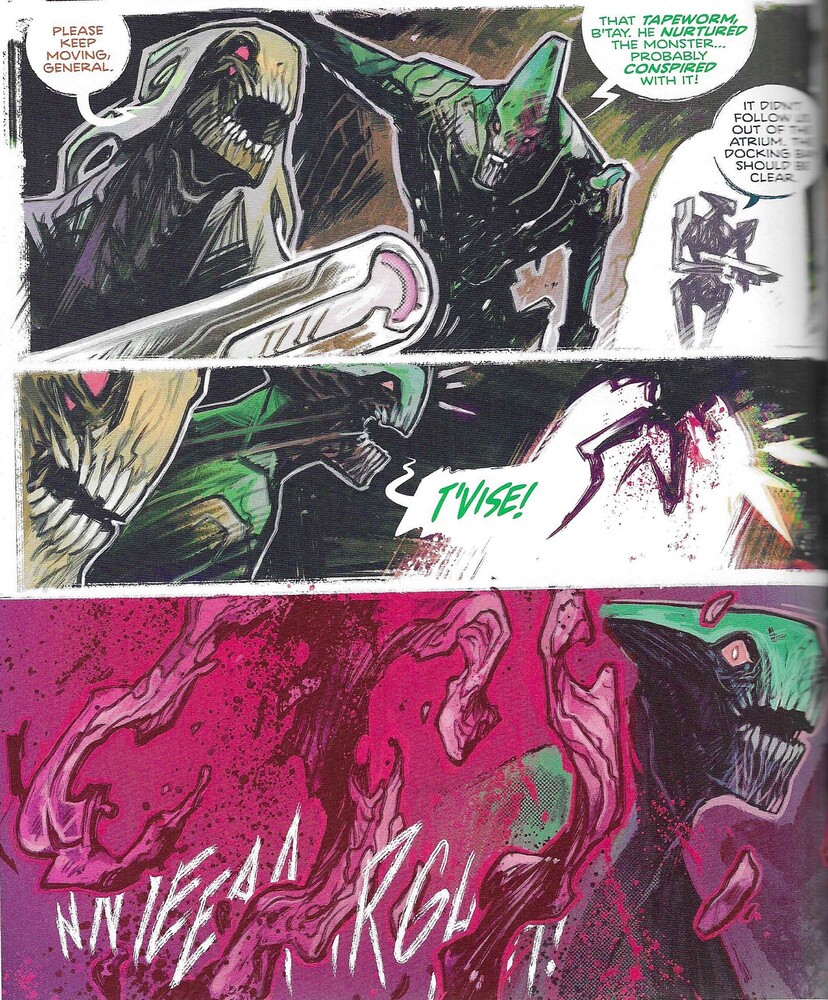 As he’s matured, he’s become a bit more impressionistic, and while he still uses the harder lines occasionally as a contrast (the general’s sleeker body looks more modern because Wijngaard uses a thinner, more precise line on it), his art has evolved — it’s a bit messier, which isn’t surprising, but much more emotionally resonant. He uses broader, rougher strokes, and he hatches a bit more to add texture to his work. This is particularly effective for the violence in the book, which is rough, fast, and scary — Wijngaard almost smears the artwork in some panels, to show the blur of fur and claws and teeth that explode into the hapless B’tay or the various “red shirts” who get dispatched in the book. This is a world of sudden and devastating violence, and Wijngaard depicts it very well. Wijngaard gives us wonderful animals, too, as they’re perfectly normal Earth animals, but because he gives the bear, say, one wide blue eye or uses long, streaked brush strokes on the wolves as they attack, they become slightly supernatural, which fits with the tone of the book, as B’tay and the other aliens have no idea how to handle them, much less an intelligent human.
Wijngaard creates such a wonderful sense of decay in the book, which fits with Paknadel’s theme of a decadent civilization coming into contact with something more vigorous. Helpless, despite coming from a civilization that destroyed itself, is the more vibrant of the species, as he had been cut off from his own civilization (Paknadel gives us a two-page scene where he comes across relics of Earth’s cultures and is mystified by them) and is more primitive, which in this metaphor means less decayed. Wijngaard always draws Helpless with stronger and fewer lines — there’s some roughening up, of course, as he’s lived in the wild, but his face and lean body are tougher and stronger than the aliens’, and his body is a work of art as opposed to the work of technology that the aliens’ “standard” bodies are. Wijngaard draws the decay superbly, and we get such a good sense of the crumbling going on around B’tay. 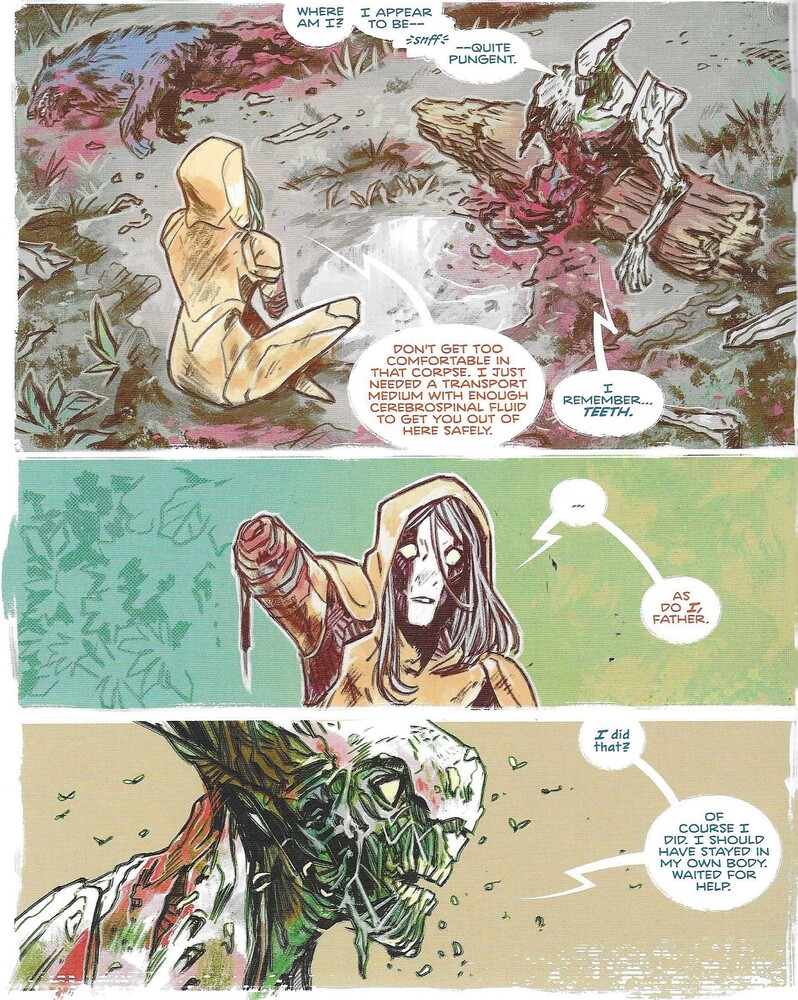 The animals are dying out, of course, which might be a factor in how Helpless, who’s not dying, is able to survive, and Wijngaard does nice work with that. But the real decay is in the aliens themselves and in the environment. B’tay peels off pieces of himself, the general’s face, as evil as it looks, is decrepit, and the research station itself looks ragged and worn. It’s interesting to contrast this with the few flashbacks to B’tay’s earlier life, as his home is a bit sleeker. The rot had not set in yet, it seems. When they get Helpless into the lab, even that looks broken down a bit, and Wijngaard designs a monstrous-looking operating table for the human, which fits the alien aesthetic but also looks a bit rickety. Wijngaard has fun drawing flies buzzing around the station — a result of the breakdown of the membrane between the research area and the habitats — and maggots infesting various places, and this sense of decay comes to the fore at the very end of the book, when the aliens are forced to abandon the station. He even uses ragged edges of panels, as we can see, showing the degradation in a more metatextual way. Wijngaard colors the book himself, which aids in the tone of it. He uses beautiful, lush greens and solid browns for the biomes, not forgetting to smear red across some of it because of the violence inherent in the habitat (“red in tooth and claw,” indeed). The coloring is cooler in the research area, with blues, darker greens, and dull reds predominating, but the consistency of using the greens and reds links the two areas together nicely, even if the brightness of the hues vary. He colors Helpless very lightly when the man isn’t engaged in violence, and there’s almost an angelic mien about him in some places, as if he’s come to release B’tay and Cov’n from the shackles their civilization has placed on them. Wijngaard uses blacks and whites very well, too. He doesn’t overdo it, but he uses silhouettes and the darker places in the station very well, especially when Helpless goes “full xenomorph” and is stalking the aliens, and there’s a wonderfully horrific drawing of the general when his brain is placed in the gorilla’s body that Wijngaard colors raggedly with white gouache, turning him into nightmare of negative space. The coloring on the book goes a long way in helping create Paknadel’s tone, as does the line work, and Wijngaard does each brilliantly.
 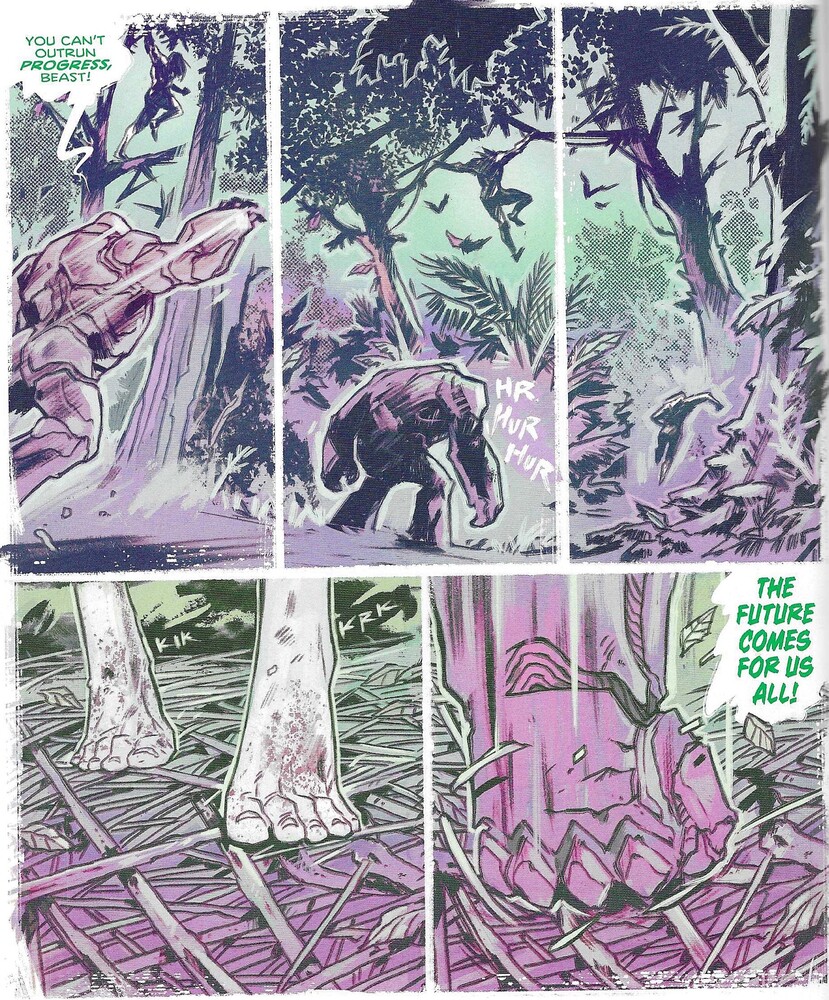 (I should also point out Otsmane-Elhaou’s lettering, which is also very keen. I don’t know whose idea it was to use different colors for the different characters’ dialogue, but it works very well, and Otsmane-Elhaou does a very nice job with some lower-case letters and some lettering that doesn’t stay on the horizontal to show the characters speaking at different more quietly or in a more upset manner, and it works without drawing too much attention to itself.)
All Against All presents itself a bit as “Alien-with-a-twist,” and that’s fine, because, sadly, you kind of need an elevator pitch (“What if … Alien … but species-switched?!?!?”) There is a lot more going on than that, however, and Paknadel manages to cram a lot into these five issues without slowing the pace or leaving things half-baked. He touches on environmental disaster, the folly of war, the death of civilizations, the decay of the mind and body, the contrast between “civilized” and “primitive” and how they are and aren’t different, imperialism, the barbarity of animal experimentation, the contradictions of parenting, and the horrific effects of violence. It’s astonishing that he’s able to get all this into the comic and still tell a gripping horror-esque story. The comic is powerful and thrilling and beautifully drawn. That’s not a bad combination at all. You can find it at this link, if you’re interested (and I think we still get a bit of money if you use that link for anything, even if it’s not this, but it’s been a while and I don’t know if we’re still doing that!). And you can always take a look at the archives if you want more suggestions for comics you ought to own!

Kismet – I just read this on my flight, earlier today!
Wijngaard is a genius, and Paknadel does a great job creating a story that leaves you wanting more in a good way, rather than a “this was rushed” one.
You’re always flying, sir! What’s up with that?
I like that description of the story. There is a LOT going on! 🙂
I live on a small island, Greg! I have to fly to get anywhere, ahaha
This looks really interesting. Have to find them in Holland.
MEDICAL UPDATE:
Nicoline had 2 scans last week (body and head) and the treatment works! Cells went down from 10 to 3 mm.
We’re halfway but this was more than we hoped for.
That’s amazing news, Erik!
I haven’t seen it in any comic shops over in Ireland, but it was on the Boston area Overdrive/Libby I use.
Very happy to hear that, Eric.
That’s great to hear, Eric. I hope it continues!
Excellent news Eric, this is very good news, thanks for sharing!
I did not like this nearly as much as you, but maybe I should give it another try. You seemed to find a lot in there. Maybe I was just expecting more of a Tarzen/Predator riff.
I think there’s a lot more than just that, but, I mean, some things just don’t hit you the right way!