

Roy Thomas transformed Earth-One’s comic books without even trying. Or probably even thinking about it.
Up until Thomas wrote All-Star Squadron, it was canon that Earth-One in the 1940s had a number of superheroes. Based on their appearances in the Silver and Bronze Ages, they included Vigilante (the Greg Sanders version), Zatara, Manhunter (Paul Kirk version), the Guardian, Plastic Man, TNT, the Blackhawks, Air Wave and Robotman. Thomas, however, used all these characters on Earth-Two and decided not to give them doppelgangers on Earth-One and Earth-X. Instead, the heroes associated with those worlds migrated from Earth-Two, the Xers during WW II and the One-ers afterwards.
 I’ve always thought this more cumbersome than duplicate heroes would have been, and it doesn’t work for all the characters. Earth-Two’s Vigilante, for instance, was lost in time from the late 1940s until Justice League of America #100. He can’t be the same guy who helped the JLA against the Doomsters in JLA #78. Earth-One probably had its own Blackhawks as they met the Justice League a couple of times.

If I’d been writing about comic books in comic-book universes back in 1980, I’d have assumed the Earth-One comics looked a lot like Earth-Two’s: comics about real-world superheroes mixed in with fictitious ones. Post-All-Star Squadron, I have to assume Earth-One was more like ours, where superheroes were entirely fictional. Okay, maybe one or two real adventurers. The Vigilante. The Shadow, established in the Bronze Age as an Earth-One hero.
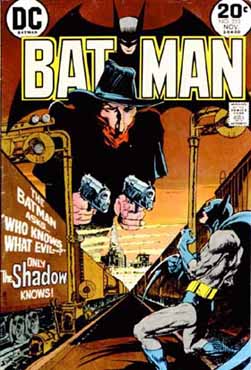
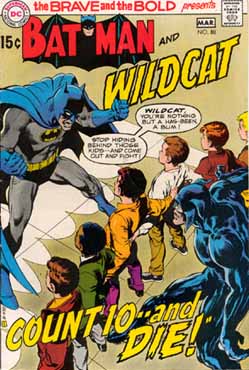 We know there was also an Earth-One Wildcat who teamed up with the Earth-One Batman on several occasions. Though while their first team-up shows Ted’s retired and older, it doesn’t necessarily follow he was fighting crime in the 1940s.
Earth-One’s Jerry Siegel and Joe Shuster conceived of Superman without knowing they were tuning in the adventures of a real, parallel-world hero. He was as big a hit on Earth-One as on Earth-Prime, and the comics industry exploded the same way after Action #1.
Even so, DC’s output on Earth-One wouldn’t have been identical to ours. As I noted in my previous “comic-books in comics” post, if Golden Age comics had revealed the identities of Batman, Superman, Wonder Woman, etc., it would outed Earth-One’s Bruce, Clark and Diana as superheroes in disguise. The comics either gave them different identities or dispensed with the secret identity angle.
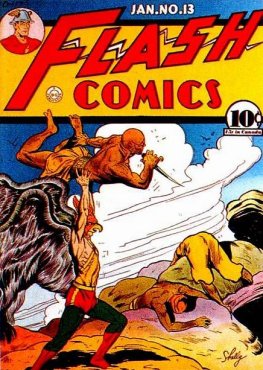
There were little differences too. We see Flash Comics #13 in Barry Allen’s origin story but that’s not the Sheldon Moldoff cover we saw in our world. It’s unlikely that’s the only divergence. And Earth-One had its own Golden Age characters such as the Pink Eyebrow who never appeared in our world’s comics.
By the late 1940s, Golden Age superhero comics were probably a dying genre on Earth-One as they were on our own Earth. Conveniently Earth-One’s own heroic age began around the same time. Superboy debuted (rumors of a Superbaby must have been circulating years earlier), prompting DC to launch a Superboy series (“What’s he going to do, sue us? We got the trademark!”). The immigrants from Earth-Two may have taken up crime-fighting here (we know Zatara did, at least); they’d probably have been seen as modeling themselves on DC’s “fictional” characters. That might have convinced DC to bring a few of their heroes back from limbo (“There’s a real TNT and Dyna-Mite out there now — think of the publicity!”).
 In 1951, Earth-One got a completely original hero, Captain Comet. A few years later, Barry Allen became the Flash just about the time Superboy became Superman (the Martian Manhunter was already around, but wouldn’t go public until 1959). True-life superhero comics had arrived.
The cover for Batman #199 shows that in 1968, DC-One’s Silver Age comics lineup looked exactly like ours. I’d write  that off as artistic license as the stories inside were very different. Writer-artist Rembrandt Dickens describes them as true-crime adventures based on police files and courtroom testimony (this may not have been the norm for all comics).
Some Silver Age heroes wouldn’t have appeared in comics at all. Science fiction buff Julius Schwartz would have loved a series about Adam Strange’s adventures, but nobody knew Adam was the greatest hero of Rann. And sockamagee, what would DC make of all those superheroes suddenly turning up around the Midwestern town of Smallville — crimefighters such as King Kandy, Radar-Sonar Man and the Cometeer who appeared once, maybe twice and never again. Not knowing about Robby Reed and his H-Dial, they might not have seen a bunch of unrelated one-shots had any potential for a series.
DC Comics undoubtedly sold better than on our world, and “their” characters did way better breaking into other media. Batman’s TV show was a serious look at his greatest cases rather than a campfest. Gregory Reed made Superman movies long before Christopher Reeve and the Green Lantern Corps got its own TV show.

As we know Spider-Man comics exist on Earth-One, Marvel presumably hopped on the superhero bandwagon as it did in our world. With the ability to showcase the personal lives and struggles of superheroes, it undoubtedly did well.
DC’s sliding time scale eventually pushed the start of Earth-One’s heroic age much later than 1956, but I no longer think that’s an issue. Due to the Crisis, Earth-One only has to exist until 1986; with a little fudging (like the life-extension the JSA underwent in All-Star Squadron Annual #3) it’s not crazy to imagine the JLA and others staying in action, with some slight changes (the Wolfman/Perez Titans would not have used “teen” as a name) until the world ended.
Art top to bottom by Gil Kane, Dick Dillin, Mike Kaluta, Neal Adams, Sheldon Moldoff, Carmine Infantino, Infantino again, Jim Mooney and Infantino once more.
