
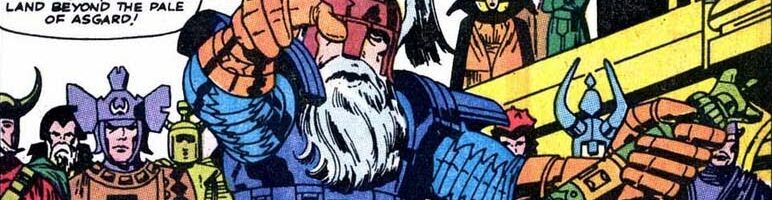
As I’ve mentioned many times, I didn’t read Marvel much as a kid. I came in late on the Fourth World, shortly before DC pulled the plug on New Gods and Forever People. I spent the Bronze Age wondering why people thought Jack Kirby was a genius. It sure as heck wasn’t evident in The Demon or Kirby’s Captain America or Devil Dinosaur so where did they get the idea?

After reading Marvel’s Epic and Essential and Masterwork collections of various series, I appreciate why Kirby was such a big deal. My Silver Age reread made me more appreciative: watching all the different Marvel series develop together showed me what an amazing team Stan Lee and Jack Kirby made. So does looking at Kirby alongside Don Heck, Werner Roth and the other artists working for Marvel at the time (which is not a backhanded insult at any of them).
Which makes it sad to think how frustrated and pissed off Kirby must have been when he made the jump to DC in 1970. He, Lee and Steve Ditko were, I think, the prime movers in Marvel’s success (yes, I do believe Lee brought something to the table). Yet Kirby saw his stories turned into TV cartoons without getting any reward (I’ve seen them recently and the degree to which they’re animated comic books is astounding). He had to rewrite and redraw stories Lee had approved without getting any extra pay. Like other artists, he didn’t get paid extra for co-plotting the books under the Marvel method, and Lee often (though not consistently) minimized how much of the writing was Lee’s. Kirby saw Lee take over Kirby’s creation, the Silver Surfer.
I don’t blame Kirby one bigt for jumping when Carmine Infantino offered him somewhere to land.
Unfortunately, things didn’t turn around the way they should have. The Fourth World series died before they could really get going, though they’d have longer runs under other creators. Much of Kirby’s later Bronze Age work was forgettable. He kept working steadily but outside of Eternals and Kamandi, nothing came close to the imagination he displayed in the Silver Age and the Fourth World.

All that being said, I think it was definitely time for Kirby to move on. His art in 1969 and 1970 is still good but when it came to plotting, his stories feel like he’s mostly phoning it in. Case in point, the last issue of Silver Surfer, which he wrote and drew (though the cover is Herb Trimpe). The plot is our old friend Hero Fighting Hero, as Maximus the Mad tricks Norrin Rad into attacking the Inhumans. It includes scenes where Maximus’ evil Inhumans set things up by fighting the Surfer, pitting his power cosmic against … a centaur and a guy who makes trees grow.

Given the power imbalance, that’s a pointless fight scene; I know Marie Severin created these Inhumans under pressure but they still suck. I think Daredevil could probably take them.
(For the record, I think Stan’s work is past its peak by this point too, though obviously not due to frustration with Marvel).
From what I’d heard about this issue of Silver Surfer, I’d formed the impression that before Kirby quit, he’d been set to take over the series and turn Norrin Radd into The Savage Silver Surfer. My impression was wrong. Kirby was only doing this one issue; the switch to Savage would have come next issue under Lee and Herb Trimpe. Which makes me wonder if the “savage” aspect was just a gimmick that Lee would have dropped after a couple of issues. It’s very much contrary to Lee’s view of the character (though as Alan Stewart points out, it may have had meaning for Kirby) though it’s equally possible he’d decided it was the only way to keep the book on the spinner rack. Except it got canceled before the savagery happened. Such is comics.
 After this Kirby moved on, though stuff he’d already worked on would be coming out from Marvel for a while; Lee would give up regular scripting a couple of years later. Their successors were a mixed bag: Archie Goodwin had a great run on Iron Man (cover by Marie Severin), followed by Allyn Brodsky who did not. Many creators followed the Lee/Kirby style without recapturing the magic of the team at their peak. Even so, I think new blood was needed.
The change was good for Kirby too. He’d been holding back a lot of ideas the past few years, rather than create new characters Marvel would own. The early Fourth World would unleash a lot of that. Next week (or so I plan now) we’ll witness Jack Kirby giving us Jimmy Olsen like we’ve never seen him before!

I’ve always found Kirby to be vastly overrated as an artist and his work looked horribly dated by the time 70’s rolled around.
His work on FF and Thor were pretty great but sadly never bettered.
For me, Kirby’s peak came in the 70s when he was scripting his own work, and his art looked stronger than ever once Mike Royer started inking it.
New Gods is arguably the greatest comic book series of all time. My other favorite from this period is probably OMAC. And I have a major soft spot for Devil Dinosaur.
I just tracked down all of the issues of 2001, so hopefully I’ll be digging into them soon. I think I’m only a few issues of Justice Inc, a What If, and an Ultimate Cosmic Experience away from owning all of Kirby’s 1970s work in one format or another. Next it’s onto the ’80s and Captain Victory.
I loved the first couple of issues of OMAC. After that it fell into the “why is this guy supposed to be so awesome?” side of the scales (https://atomicjunkshop.com/the-world-that-was-coming-fifty-years-ago-omac/)
I got a full set of the 2001 ongoing a few years ago, and really enjoyed it. Kirby wrote and drew whatever he felt like, as long as the story had sci-fi elements. It’s my favorite post-4th World Kirby series.
Growing up, I thought Kirby was leagues, leagues I tell you, above all the other comic book artists,
FF, Thor, then Kamandi, Jim, NG, Demon… SO DYNAMIC! SO VIVID! I felt like I was part of the action.
Fast forward… about 15 years ago I bought one of those enormous compilation hardcovers collecting a lot of Fourth World stuff, New Gods, Jimmy Olsen, Forever People, Mister Miracle, etc.
What was mind blowing to me as a teenager was near incomprehensible to me as a grown, growing older adult.
Ideas, big ideas, but where is the follow through? All those hundreds of tiny Jimmy Olsen clones parachuting into the room, where did they end up? Were the killed or just captured? Who feeds them, how did they get trained? Will the be a problem again later? (No.)
Made me think of the author AE Van Vogt – throws huge, huge ideas at the wall and if he gets stuck, that’s ok, move on in the next chapter without explaining why or dealing with a lot of consequences, just KEEP MOVING!!!!
When I bought John C Wright’s Null-A Continuum I was excited about reading the further adventures of Gilbert Gosseyn, and lots more pages than a Van Vogt book too.
But Wright didn’t bring a modern sensibility to AE Van Vogts ideas, the pastiche was too accurate, just moving from one high stakes/high drama moment to the next without actually applying logic, consequence or building narrative tension to what was going on. Which may have been the point, but I abandoned the book hundreds of pages in.
And back to Kirby, loved his contribution, his dynamic art, his big ideas. But I never was intrigued by his 90s work.
Funnily enough the Steve Ditko art I used to find ‘hideous’ has over time become strangely appealing.
I could never get into Van Vogt, though I tried a couple of times.
I love Mr. Miracle — the first nine issues work well as a complete story and he’s the most colorful, interesting character of the lot. The other books (last time I read them) were more uneven. Some stuff I love, like Inspector Turpin, who sees the New Gods as just mobsters with better armament; some stuff I hate, like the treatment of the Bugs in the Forager story (the New Gods kill them even though they’re clearly intelligent). I’ll see if anything changes this time.
Indeed, I think Kirby and Van Vogt have this in common – don’t think too deeply, don’t examine the implications, don’t get attached to that interesting side character who I just introduced but won’t be following up on, just follow the action and enjoy the ride!