

As I mentioned last week, Captain Comet could have jump-started the Silver Age, but instead he went nowhere, After debuting in 1951 in Strange Adventures #9, his series in Strange Adventures ran through #49 in late 1954 and then poof, he was gone.
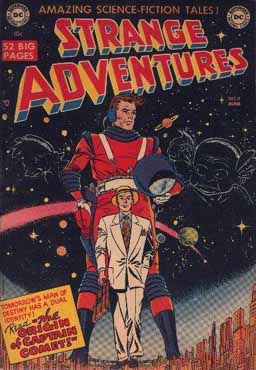
Not that that’s a bad showing, but it wasn’t enough to launch a superhero renaissance. That had to wait for Showcase #4 and the debut of the Silver Age Flash. Four tryout issues and three years later the Scarlet Speedster raced into to his own book and kept running until the end of the pre-Crisis universe.

That brings us to Nightmaster, who debuted in 1969 in Showcase #82’s “Some Forbidden Fate” by Denny O’Neil and Jerry Grandenetti. It was the Silver Age’s first attempt at a sword-and sorcery series (at least from DC or Marvel) but like Captain Comet it was a groundbreaker, not a trendsetter. Three issues of Showcase, then no more, and that’s despite Bernie Wrightson art on the second and third issue (Nightmaster did show up again, eventually. Everyone does)

Several years later, I acquired the third installment in a back-issue bin somewhere. I’ve never had the urge to hunt for the first two issues. Even though I love a good sword-and-sorcery yarn — well, this isn’t a good sword-and-sorcery yarn.
The story of Jan Rook, a rock musician who discovers he’s the son of an otherworldly champion and heir to the magical Nightsword is competent but ultimately rather bland. O’Neil did somewhat better adapting Fritz Leiber’s Fafhrd and the Grey Mouser a few years later in Sword of Sorcery; perhaps with stronger source material rather than creating his own character, O’Neil would have done better in ’69. Then again, Sword of Sorcery only lasted five issues.

Over at Marvel, Roy Thomas and Marie Severin were dipping their toe into sword-and-sorcery in ’69 with the Serpent Crown saga in Sub-Mariner. Some readers wanted more of the same but a later letter column in Thor said not enough did.
Nevertheless, readers began writing in suggesting Conan would make a great addition to the Marvel line-up. While Roy Thomas wasn’t a particular Conan fan at the time, he convinced Stan Lee and Martin Goodman that sword-and-sorcery would be a good bet. Roy then set out to secure the rights to … Lin Carter’s Conan knockoff Thongor, whom Thomas figured would be cheaper to license. When negotiations with Carter didn’t go well, Thomas contacted the Howard estate and this time worked out a deal (though Thongor would follow Conan to Marvel before long).

I don’t know what I’d have made of Conan the Barbarian #1 if I’d read it when it came out in 1970 (I didn’t, as that was my brief no-comics period). I liked fantasy but reading now, “The Coming of Conan” by Thomas and Barry Windsor-Smith is underwhelming. Conan takes part in a battle, gets captured by an enemy warrior and a scheming shaman and sees visions of both his future and the world’s. Would I have been more impressed at the time? Maybe, but I’ll never know.
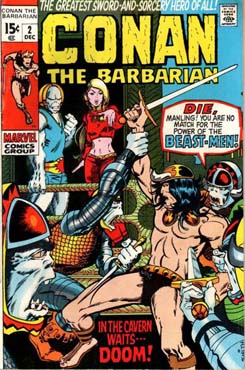
“Lair of the Beast-Men” by the same creative team, might have done the trick though. Wandering through a forest, Conan stumbles into a subterranean city ruled over by man-apes served by a cadre of human slaves. Conan wants out, and getting free involves rousing the Manling slaves to overthrow their rulers.

“Twilight of the Grim Grey God” in the following issue would definitely have sold me. Since the previous issue Conan has been shackled, then broken free, and now wants payback against his would-be enslaver. He gets involved in another war, which is also the final battle for the god Borri, as the last of his worshippers die. It’s a good story, the first adapted from one of Robert E. Howard’s original non-Conan tales — though not one I care for much. It’s a historical fantasy revolving around the battle of Clontarf in 1014 and Howard’s historical swashbucklers rarely have any characters as interesting as Conan or Solomon Kane. But the Marvel issue? It works.
Obviously not just for the alt.me who didn’t stop buying comics. Conan sold well; within a short while Marvel added Kull and Thongor to the roster, among others. None of the other swordsmen lasted as long as Conan, but the Cimmerian soldier of fortune had made sword and sorcery one of the distinctive features of the Bronze Age of Comics.
Nightmaster did not.
Art top to bottom by Carmine Infantino x2, Joe Kubert, Marie Severin and then Barry Windsor-Smth.
