

(Another repost from my own blog)
Pulp-reprint publisher Steeger Books has enabled me to buy a number of neat books such as Hades and Hocus Pocus. When they had a 2024 pre-Christmas sale I picked up the two sequels to Lester Dent’s Talking Toad and also bought the ebook of Paul Ernst’s The Complete Tales of Dr. Satan.
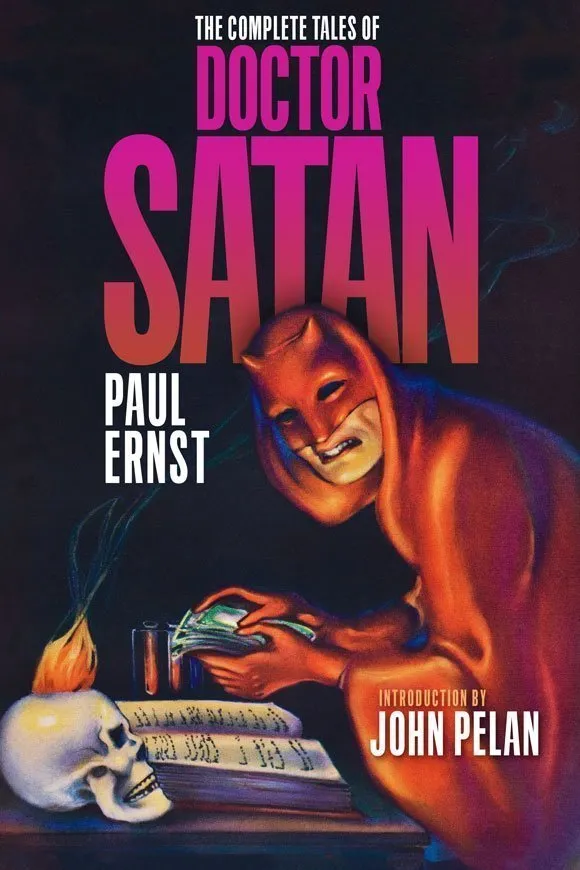
I know Paul Ernst primarily from writing the adventures of the Avenger, a pulp crimefighter from Street and Smith who appeared under the same “Kenneth Robeson” house name as the Doc Savage series. I like the Avenger; I do not like Doctor Satan at all, though I do love the concept of him. It’s true, as John Pelan’s introduction to the collection says, that reading the eight stories together makes the formula stale. However they don’t work well individually either.
Certainly the openings are impressive. In the first story, “Doctor Satan,” several wealthy men die when a small tree roots in their body and grows rapidly through their skulls. It’s the work of the eponymous villain, the son of one of America’s most prestigious and wealthiest families. Bored with the perks of his status, he itches for more thrills, and he’s getting them through crime. A master of weird science and the occult, his tricks in subsequent stories including summoning lightning bolts, turning flesh transparent (pay up or walk around like a skeleton), and contacting the dead to learn their secrets.
While he’s into crime for thrills, he does want the money: forcing his victims to pay up is proof he’s beaten them. Pelan finds Satan’s motivation inadequate. Reading in 2025, I find it entirely plausible some rich dude would inflict pain and death on others purely for kicks.
Opposing Satan is Ascott Keane, another child of wealth who lets the world think of him as merely a callow socialite. In reality Keane has mastered the same skills as Doctor Satan and wields them against men like the devil doctor. In the first story Keane deduces how Doctor Satan is growing those hell-trees inside his vicgtims and sets out to thwart his extortion plan. Keane succeeds, of course; from that point on, destroying him is the top item on Doctor Satan’s to-do list.

Like Dr. Satan, German mastermind Dr. Mabuse is driven to crime partly by boredom in his first film and it’s a classic. Mabuse, however, plays on a much bigger scale than Doctor Satan. Despite his spectacular murder methods, each of the eight stories deals with a single crime campaign. The villain never gets to build up any momentum.
A bigger problem is that much as I like his kill-for-thrills motivation, in practice Doctor Satan is interchangeable with any mad, cackling fiend from that era, whether in serials, comics or pulps. Keane has no personality other than being heroic, nor is there any Batman-Joker energy between them. Satan hates Keane and wants him dead; Keane wants Satan stopped. And as we never see Keane when he’s not on the job, his having a cover identity a la Bruce Wayne or Lamont Cranston doesn’t matter much.
Even Satan’s aides, a fur-covered monkey man (not literally, more like a sideshow freak) and a legless brute man, aren’t used well. I fully expected the brute would throw down with Keane at some point — that’s how such monstrous henchmen are usually used — but they never clash. The two goons are freaky looking but if they were ordinary hired muscle it wouldn’t have made a difference to the stories.
Overall, these stories are a useful guide in how not to do it.
