
In case you missed it, I’m trying something different this year with regard to my reviewing. I got a bit behind in January (which I always seem to do), and so decided to take each three-month chunk of the year and review the comics I got during that time in individual posts, starting in the third month. I didn’t quite do all of them, but the very few I skipped (I think there were three of them) weren’t that good, so I didn’t feel like anyone was missing anything by me not writing about them. But I still like writing about the books I read and the television shows I watch, so I decided to do all of those in a post that I would put up at the end of the three-month period — after I had gotten through all the comics, which is why this is showing up a few days into April (and I have no idea when it will show up in June/July — we’ll just have to see how many comics I have for the next three-month time period!). So, no comics below, but we all consume stuff beyond comics, right, so let’s take a look at the books I’ve read since the beginning of the year and the television shows I’ve watched. Plus, the world continues to circle the drain, so I’ll probably write about that, too! Let’s go!
BOOKS
The Master of Ballantrae by Robert Louis Stevenson. Originally published in 1889.
I mentioned last time I wrote about a Stevenson book that I was going to check out the four novels I have by Stevenson in a single volume, and The Master of Ballantrae is the next one! It’s an interesting adventure, as a long-time servant — Ephraim Mackellar — of one of the characters narrates the entire thing, which takes place over a couple of decades. Mackellar goes to work for the Durie family in Scotland, where he’s employed at first by Lord Durrisdeer, then by his son, Henry, importantly the younger son, who becomes the lord after the old lord dies. The older son, James, is the titular character, but James is, to be very frank, an asshole. The Master (as he’s usually called) joins the Jacobite rebellion in 1745, as the two brothers decide to each join a different side, and James, despite being older, joins the rebellion because he thinks it would be cooler. He is presumed dead (not for the last time) and Henry becomes the heir. Lord Durrisdeer insists that the Master’s main squeeze, Alison, marry his “surviving” son, but she and the lord continue to mourn the other son, who was somewhat charismatic despite being an asshole. Of course, he’s not dead, and once he makes this known, he begins to demand money from the estate. He gets into trouble in France, then returns to the estate after he gets out of prison, acts like an asshole again, and challenges his brother to a duel, which ends badly for him. Henry and Mackellar think he’s dead, but he’s not, and he escapes again. He goes to India, but comes back again because, well, he has no money again. Henry and his family flee to New York simply to get away from him, but he figures out what happened, and he takes Mackellar off to the New World, where he claims he once buried gold in the mountains to the west of Albany. Things do not turn out well, as you might expect.
It’s a good book — well-written, exciting, steeped in nice historical details — but it does bug me just a bit, because The Master is such an asshole, and nobody but Mackellar can really see it. Henry knows it, but he’s such a sad sack and has such low self-esteem that he doesn’t really care that much that his brother is an asshole. It is hilarious that people we don’t ever get to know see right through him, so he ends up in the Bastille, for instance, but everyone who Mackellar meets who has also met The Master falls under his charismatic spell, and his father and lover/sister-in-law are the worst. It’s very interesting to be living in a time when a confidence man is the most powerful man in the world and you read a book in which a confidence man tries to scam everyone he meets and often gets away with it. Mackellar is not fooled, but because of the societal constraints of the time period, nobody listens to him and he takes a long time to get the courage to speak up anyway (but still nobody listens to him, of course). It’s different, but not too different, from today, when you can speak truth to power but it often doesn’t matter. The Master can live a charmed life simply because an accident of birth. He should be dead much, much sooner in this book, but people keep giving him slack because he happened to be born a noble. The assholes still control society, unfortunately. If someone in power today could just go out like The Master does in this book, that would be nice.
Anyway, this is a fun book. I didn’t expect it to go to the Caribbean and India and Albany (where, according to Stevenson, the Albanians live, which is certainly right, but feels wrong), but hey, there you go!
Rating: ★ ★ ★ ★ ★ ★ ★ ½ ☆ ☆
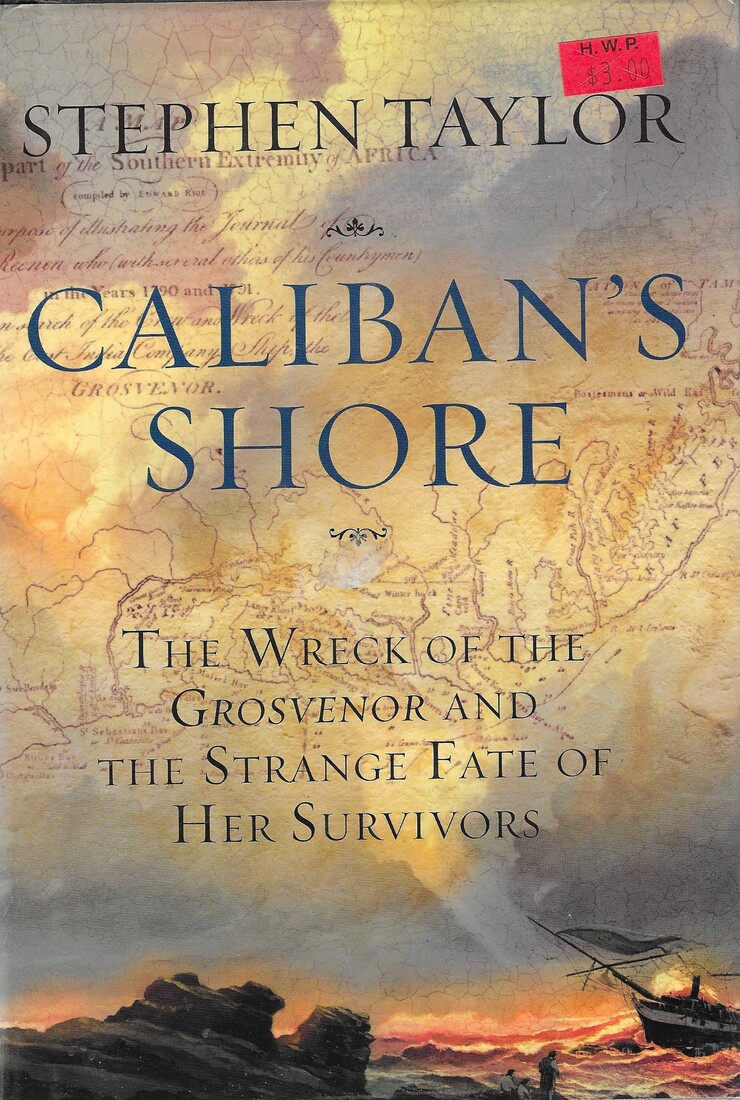 Caliban’s Shore: The Wreck of the Grosvenor and the Strange Fates of Her Survivors by Stephen Taylor. 297 pgs, 2004, W. W. Norton & Company, Inc.
Shipwreck stories are usually interesting and depressing as hell and often twisted, so I am here for this story, about a shipwreck on the southeastern coast of Africa in 1782. The ship, the Grosvenor, was property of the British East India Company, which was at the time pretty much a government unto itself (the British government believed strongly in letting corporations colonize places and then, once it was profitable, taking over, so the Company was the tip of its spear in a lot of places, most notably India). The ship was sailing from the east coast of India back to London, and it was carrying several passengers, including a Company official who was fleeing a political drama in India (and he almost missed the boat, too, which turns out would probably have been better for him and his family in the long run). Back in these days, it was harder to navigate, because although the way to figure longitude had already been invented, it was not in wide use and so sailors were often still using dead reckoning. The captain of the Grosvenor, John Coxon, was not the greatest sailor in the world, and his first mate left a lot to be desired, and they ignored the advice of wiser sailors who tried to tell them they were going to wreck. The waters around South Africa are notoriously hard to navigate, and there were plenty of wrecks along the coast, so it’s not surprising that the Grosvenor crashed, but it’s also clear that Coxon and his first mate were kind of dumb. Interestingly, there were a lot of survivors — of course, a good amount of people died when the ship went onto the rocks, but a large majority made it to the shore.
The reason this wreck gets a book is because, as the subtitle says, the fate of the survivors was pretty weird. This part of South Africa — near today’s Durban — was completely unsettled by whites at this time (there were Dutch settlers well to the south, but they were 400 miles away), and as the author points out, even today it’s pretty wild, scored by difficult-to-ford rivers, lots of heavy forests, and narrow beaches with angry water. They could have gone north to Delagoa Bay, where a Portuguese outpost was and where at least one other group of survivors reached some 30 years earlier, but they opted to go south, which was not terribly bright. The natives, interestingly enough, were far more interested in the metal on the ship than in harassing the survivors, whom they mostly ignored. Two of the sailors — one right away, one a bit later — fucked right off and tried to join the natives. The crew abandoned the passengers fairly quickly, and the crew broke up as some died and some wanted to go inland while others wanted to stick to the coast, and eventually 11 people made it back to civilization. What makes it so strange is that several survivors ended up with tribes, and Taylor uncovers evidence from the succeeding decades that many of them survived and even thrived among the natives. The two crew members who simply decided to go hang out with the natives did pretty well, and it’s pretty clear that the natives came and abducted the surviving women, but perhaps they did not treat them that poorly? I mean, women in the 18th century weren’t treated that well throughout the world, but from what Taylor can discover, there’s a lot of evidence that they were accepted into the tribes. There were a few young children on the ship, and at least one of them may have grown to adulthood in one tribe and had several children herself. He notes that there’s just not any way to prove any of this, but there is a lot of interesting anecdotal evidence from explorers and traders who went into the interior in the later decades. He also gets into how “civilized” society thought of the natives, as there was a distinct shift from the “noble savage” stereotype to the “brutish savage” that would just go around raping white women stereotype around this time, and of course British society would want to head into the wilderness to find the poor female survivors (which they never did) because they were going to be treated so abominably by the Africans. This stereotype would, of course, persist into the future, to the detriment of everyone involved.
Anyway, it’s a fascinating book. It’s always fun to read books about events that might not get into big textbooks, but are nonetheless fairly important. I dig ’em!
Rating: ★ ★ ★ ★ ★ ★ ★ ★ ☆ ☆
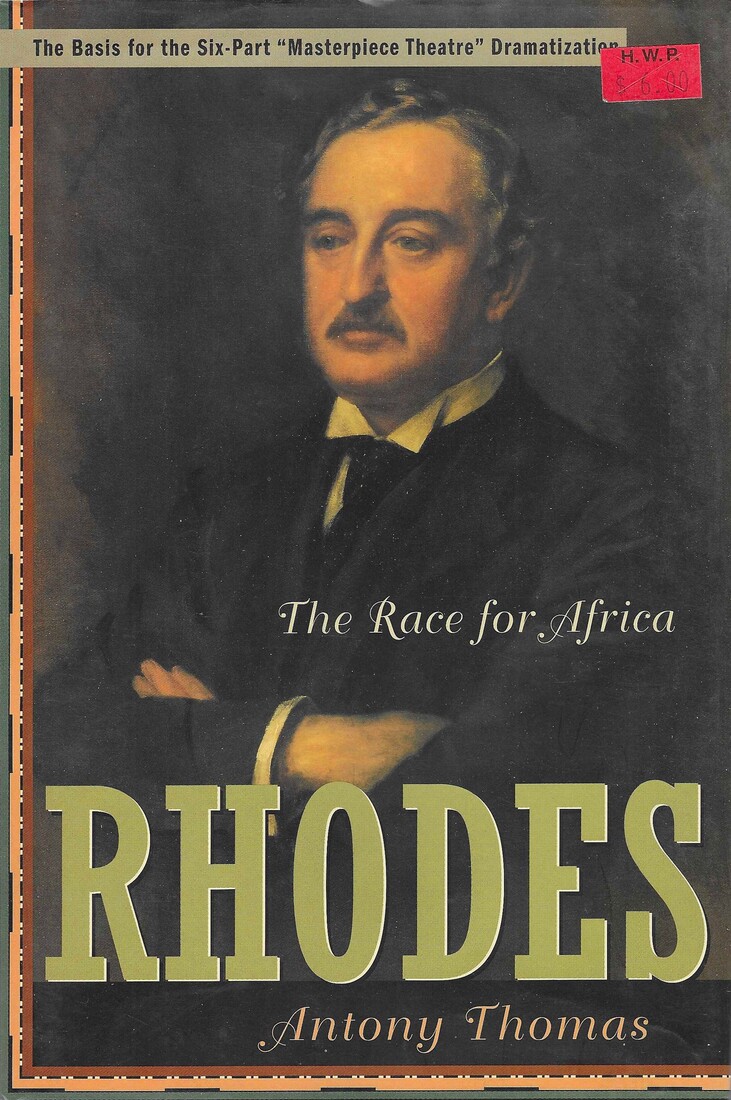 Rhodes: The Race for Africa by Antony Thomas. 368 pgs, 1996, St. Martin’s Press.
If the average person today has heard of Cecil Rhodes, it’s unlikely they even know they’ve heard of him, they’ve just heard of being a Rhodes scholar, which was one of his endowments (he did not mean for it to go to non-white non-males, but the people who hand them out have wisely ignored that). It’s a shame, because Rhodes was one of the most important people in the world in the 19th century, and even today, his influence can be felt … not in the best way, true, but still. The famous cartoon by Edward Linley Sambourne from 1892 is not far off, as Rhodes changed the face of Africa perhaps more than anyone, and he did it in a remarkably short period of time. Rhodes died when he was 48, but he packed a ridiculously large amount of accomplishments into those years. This biography, by South African native Thomas (who was exiled — exiled! — for criticizing apartheid in 1977), tells the story of the man, and Thomas does a very good job shattering the many myths about Rhodes. Rhodes was, not to put too fine a point on it, a monster, and it’s perhaps worse that he did it all for money. Some monsters — a certain German dictator comes to mind — have some principles — horrible and perverted as they may be — but Rhodes, very clearly, cared about money in lieu of anything else. That he did such monstrous things solely for the almighty pound is somehow, to me, worse than if he actually believed the things he did. Maybe you see things differently.
Rhodes arrived in South Africa in 1870, at 17, to farm cotton — his brother had set up a place a few years earlier — but he soon realized the real money lay in diamonds, so he headed to Kimberley and in less than 15 years controlled the worldwide diamond industry with De Beers (fun fact: the De Beers found diamonds on their farm and sold out for a nice sum very quickly; they never had anything to do with the diamond industry and one wonders why the company kept the name). He got into gold later on and realized that to control so many resources, he basically had to take over a huge swath of land, so in the late 1880s and early 1890s he organized military expeditions against the tribes in what are now Zambia and Zimbabwe. He became prime minister of the Cape Colony in 1890 at the age of 37 and used the office basically to enrich himself. Rhodes laid the foundations for apartheid basically so he could have cheap labor. He was certainly racist, but no more than the average Victorian Englishman — what was diabolical about him was how he used his own and others’ racism to create laws specifically indenturing Africans. The Boers were probably more racist than he was, but he used their racism to advance policies that would serve only himself, often to their detriment. Rich men bamboozling poor people never goes out of fashion, it seems.
Thomas does a good job grappling with Rhodes’s legacy. He notes that when he was growing up in Cape Town, his parents and grandparents admired Rhodes completely, because he embodied the mythical qualities every Englishman strived for. It was only when he was older and began to read more critical analyses of Rhodes’s career that he began to realize what the man was like, and he decided to write a definitive biography. He gets deep into why Rhodes was so successful — it did have a lot to do with being a white middle-class man in a time when that was paramount, sure, but Rhodes was, as Thomas notes, exceedingly cunning and charming, and he usually bought off his enemies before they could really do much against him. The few he could not buy caused him grief, but usually they were swimming against the tide of history, and he could marginalize them. He was usually at odds with the British government because he thought they would interfere with his ability to make money, except, of course, when it suited him to be on the side of the British government, when he became the most ardent patriot. In his lifetime, his reputation took a big hit with the Jameson Raid, in which a flunky of his invaded Transvaal (one of the two Boer republics) in an effort to overthrow their government. Rhodes was forced to resign as prime minister, but the Raid didn’t knock him down too far, and a few years later he was one of the major contributors to the Boer War. Thomas also points out his health problems — he had his first heart attack at 19 — that probably drove him to constantly work, because he feared — rightfully, as it turned out — an early death.
It’s an interesting book — Rhodes is one of those people you read about in history books, but it’s always after he’s already rich and basically fully formed, so it’s always neat to see how people like that grew up and got started. Thomas is writing in the 1990s, of course, and of course Rhodes set horrible precedents in many ways that others continued, but it’s interesting to read about him in the age of the Orange Baboon. Like our “president,” Rhodes saw no conflict of interest in running a government and a business at the same time, even as he steered his parliament and the colony into things that would benefit him rather than the people he represented. While the Child-Raper thinks nothing of bullying his enemies, Rhodes was far smarter and smoother, which is why he was able to accomplish far more than Someone Who Grabs Women By The Pussy ever has. Rhodes was a monster, certainly, but he was a charming monster, which is why his legacy was far more benign than others’ until people began to dig into his life much more closely. It’s a bit depressing reading this in 2026, when nothing has really changed over the past 150 years, but that doesn’t make it a bad book at all!
Rating: ★ ★ ★ ★ ★ ★ ★ ★ ☆ ☆
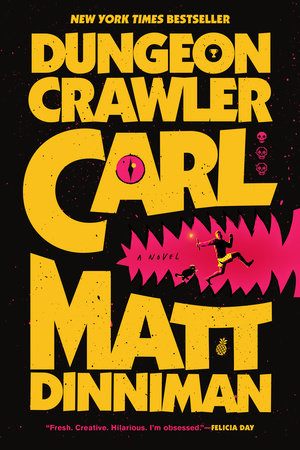 Dungeon Crawler Carl by Matt Dinniman. 450 pgs, 2020, Royal Road (this version printed by Ace Books, 2024).
A guy at my comic book store (whom I don’t particularly like, as I’m positive he’s a Trump voter thrice over) has been extolling the virtues of this book and series for a few months, and it sounded interesting, so he lent me his copy of the first book. My daughter’s PT has also said it’s a very good series, and then John Layman posted about it on Facebook, so, I mean, I guess it has a lot of fans! I, however, have only read this first book. I’m late to the party!
I’m not as enthusiastic about this book as, it seems, other people are. It’s pretty good, and I might read the rest of the series — the 8th (!) book is due in May — but I’m in no hurry. In this book, we get the premise: an alien conglomerate arrives on Earth and immediately kills everyone who’s indoors — anything with a roof smashes down flat, killing everyone beneath it, but people who happen to be outdoors survive. Carl, our hero, happened to be outside trying to rescue a cat — his ex-girlfriend’s cat, specifically, which was left in her apartment when she took off with another dude. So Carl and the cat survive, and they get inside the “dungeon,” which appears after the catastrophe, and it turns out … they’re in a reality game show/RPG/video game. They have to fight various creatures, gain experience points, get all sorts of items to help them, and move downward through a series of floors, all while impressing an audience that’s watching them so they can gain sponsors and followers and, perhaps, survive. Early on in the game, the cat — whose name is Princess Donut — gains sentience and the ability to speak, and she becomes a very popular player. That’s the premise. By the end of this book, Carl and Princess Donut have made it through two floors, and later books, of course, take them to different floors — I don’t know how quickly they move through the levels, but I do know the books get longer, which is never a good sign.
I think I don’t love it as much as some others is because I don’t really like video games. I never have, honestly, even when I was a kid. So the visceral thrill of reading a book that’s basically a video game isn’t there, nor is the fun of seeing something like Carl’s inventory and how he pulls weird shit out of it. That’s not to say that you can’t enjoy this unless you’ve played video games, but I have to think there’s that extra element that might push it over the top (I know that Layman and my daughter’s PT play video games, and I assume the dude at the LCS does too). It’s the same thing as when you recognize some obscure bit of comics trivia that a writer throws in — you get that bit of pride that you’re in on something, and it makes you like something just a tiny bit more. In this book, if you don’t play video games or RPGs, you can still enjoy the book — I certainly did — but that spark might be lacking a little bit, and instead of becoming a rabid fan, you’re just someone who likes the book. I fall into the latter category.
Dinniman keeps things moving along nicely. He has a good flair for creating very weird creatures in the dungeon, which is partly an alien’s idea of what Earth pop culture looks like blended with, well, monsters (I was a bit disappointed that the Krakaren wasn’t a bigger threat, because that’s a great name). Both Carl and Donut are interesting characters, as they have to figure out how to work together to survive. Carl is the more mature of the two, as Donut thinks the popularity contest is great while Carl views the audience and the sponsors and the reality show aspects of the dungeon with a severely jaundiced eye, and he tries hard to get Donut to rein it in a bit … except that the way for “crawlers” to survive is to get sponsors and viewers, so she’s not entirely wrong. They meet some other crawlers along the way, and one older one, in particular, is obviously up to something, but we don’t know what it is, yet. There’s a lot of that — there’s stuff going on behind the scenes that gets hinted at, but Dinniman obviously has a lot of content rattling around in his brain, so he’s not giving too much away yet! Mostly, this book is just setting things up (yes, it’s over 400 pages of set-up!), as we get a lot about the way the dungeon works and how the crawlers’ abilities work, presumably so that in later books, Dinniman can simply concentrate more on the machinations of the dungeon and what’s really going on. There’s a lot of violence, of course, and Dinniman does a nice job showing how Carl and Donut — and other humans in the dungeon — have to use their brains to figure out how to kill the monsters, because many of them are very hard to destroy. It’s fun to see how the crawlers come up with ways to defeat monsters that are much stronger than they are. The backstage intrigue will probably be more interesting in the long run, but for now, it’s fun to watch them fuck shit up.
I’m not sure what I’m going to do with the series. I don’t read particularly fast, and Dinniman says he’s planning ten books for the series, which will take me a while to read, especially as, I think, this is the shortest book in the series. I definitely won’t get to any more before he “finishes” the series (authors always claim they have an idea for when they’ll finish a series, but the money talks loudly, and far too many of them return to the well!), but in time, I will probably see if I can just blaze through them all. This is a tiny bit frustrating, because unlike, say, the Harry Potter books, which have a plot specific to the book even though they’re part of a larger story, this book just ends when Carl and Donut are about to enter a new level, and there’s not really a ton of closure of any particular plot specific to the book. For someone with no immediate plans to read the next book, it’s a bit frustrating. It doesn’t make this a bad book, to be sure, but it’s a bit annoying. For the most part, however, this is a good, solid, action-adventure. With, you know, a talking cat.
Rating: ★ ★ ★ ★ ★ ★ ★ ½ ☆ ☆
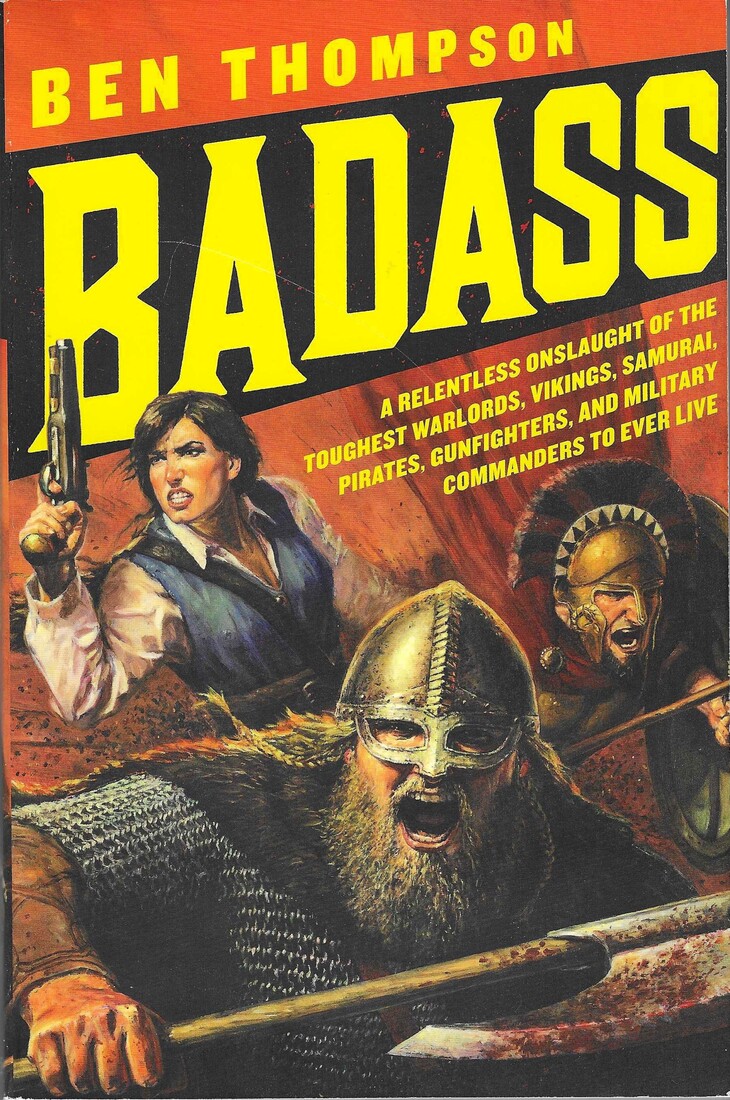
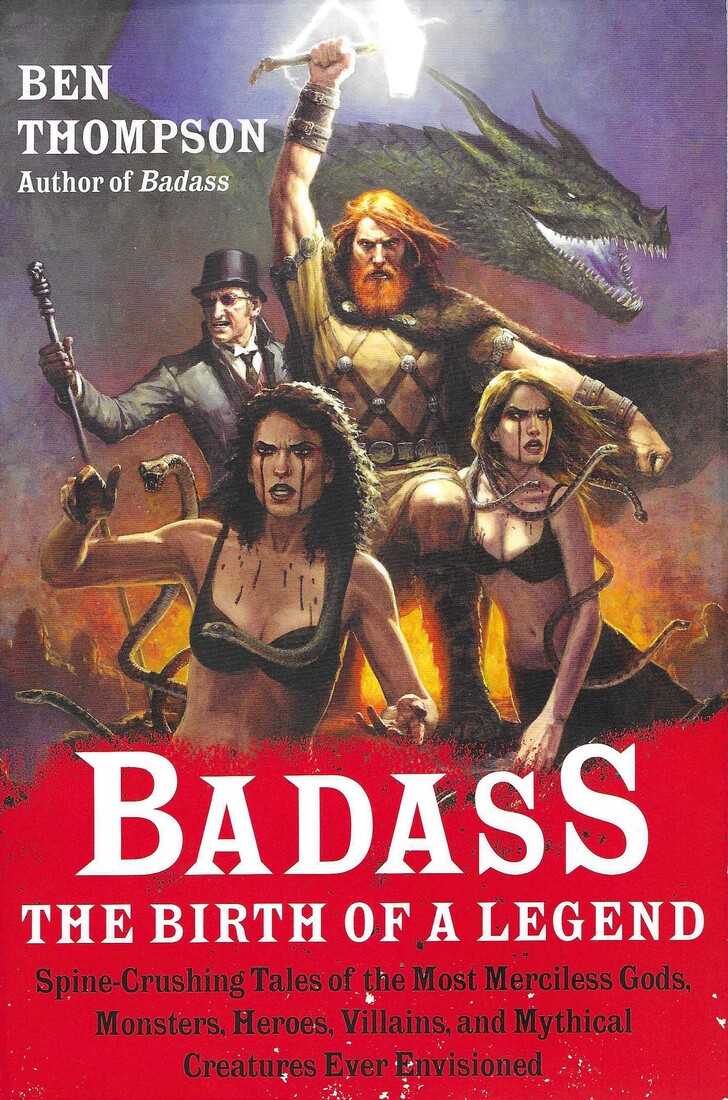 Badass and Badass: The Birth of a Legend by Ben Thompson. 335 and 367 pages, respectively, 2009 and 2011, respectively, HarperCollins.
I got these books some years ago at the San Diego convention, where the author was selling them, so that was fun. They’re basically 4- or 5-page mini-bios of “badass” people of history and legend, embellished humorously by Thompson. Not all of it is strictly historically accurate, but the broad strokes are, and Thompson goes a bit nuts with metaphors and comparisons to show exactly how badass these people are. The books are fluff, but fun fluff, and they come with fun illustrations, some by people I don’t know but some by comics artists such as Matt Haley, Jonathan Case, Ben Dewey, and Thom Zahler. Thompson doesn’t let the fact that some of the real-life people (who are featured in the first book) are despicable get in his way — he does note when they are, but he still highlights their badassitude — so you have to take some of his stuff with a serious grain or two of salt, but when he focuses on lesser-known figures from history, it can be pretty revelatory. His historical figures are: Ramses II, Leonidas, Xenophon, Alexander the Great, Chandragupta Maurya, Liu Ji, Julius Caesar, The Surena, Julia Agrippina, Alaric, Khalid bin Walid, Justinian II, Charles Martel, Wolf the Quarrelsome, William the Conqueror, Harald Hardrada, El Cid, Tomoe Gozen, Genghis Khan, Vlad the Impaler, Miyamoto Musashi, Peter the Great, Blackbeard, Anne Bonny, Peter Francisco, Horatio Nelson, Napoleon, Agustina of Aragon, Bass Reeves, Nikola Tesla, Manfred von Richthofen, Henry Lincoln Johnson, Eliot Ness, Jack Churchill, Irina Sebrova, Bhanbhagta Gurung, George Patton, Carlos Hathcock, Bruce Lee, and Jonathan Netanyahu (with some tangents to others, but those are the main ones). As you can see, some of these people were not very pleasant at all, and some were not quite as badass as Thompson makes them out to be, and I’m not sure why a movie star like Bruce Lee is on the list, but it’s pretty fun. The first book is better than the second, because the second one is all about myths and legends and fictional characters, and if you want to make a fictional character badass, you just write them that way. He does go over some myths and legends that might be a bit lesser known, and he has some more modern literary characters in there as well as an urban legend about a group of modern snipers who may or may not exist, but it’s still not as interesting because, you know, Mody Dick is badass simply because Melville wrote a badass whale, not because a real Moby Dick was going around being badass. The second book isn’t bad, certainly, but to me, it’s not quite as interesting as the first.
Anyway, they’re both fun. Thompson has turned this “badass” theme into a nice cottage industry for himself, as he’s written several more books featuring badasses throughout history. Go to his site and check them out!
Rating (Badass): ★ ★ ★ ★ ★ ★ ★ ☆ ☆ ☆
Rating (Badass: The Birth of a Legend): ★ ★ ★ ★ ★ ★ ☆ ☆ ☆ ☆
TELEVISION
Strangers Things (Netflix). One of the things that annoys me the most about the internet (and things do annoy me about the internet, even though I do love it) is that fans go a bit nuts with speculation, and they share it all, and then they get angry when things don’t align with their speculation. This probably ruined the final season of Game of Thrones, as nothing the showrunners did could have satisfied every single fan who had come up so many theories and possibilities over the years, and as a result, people hated the final season (I was not one of them; yes, the final season had significant problems, but overall, I still think it was the strongest season of the show). You knew Stranger Things was going to be subjected to this, as well, not only because it might be the last television show that attracted such a large and varied audience (although people said that about GoT, too, so maybe there will be something else coming along), but because of the vast amounts of time between seasons. Season 1 dropped (all at once) on 16 July 2016, while the finale showed up on 31 December 2025. There were only five seasons, remember, so 9½ years passed (let’s call it ten) between the premiere and the finale (only 4 years passed in the show’s timeline). The show inspired so many people, sure, and while that’s great, it also inspired people to talk about the show, and with talking about it comes speculation. The two biggest questions that anyone ever talks about with regard to shows like this are Who will end up together? and Who will die? Both questions suck, for different reasons. The second one is just ghoulish, and even more so when so much of the cast is made up of children/teenagers (yes, I know most of the cast had reached adulthood by the end, but they were still playing teens). Why would you want any of them to die? Is Mike’s story more interesting if Eleven dies? Is Eleven’s more interesting if Mike dies? Is Dustin’s story better if Steve dies? Does Max’s death make everyone more interesting? Even if it’s the adults, it’s still icky. I mean, Hopper is a douchebag almost throughout the entire run of the show, but he does love Eleven, so why would his death make her life better? Murray rules, so why would his death make anything more meaningful? I mean, of course some characters are marked for death from the moment they appear — R.I.P Bob and Eddie — but why do any deaths among the main characters make this a better show? The “shipping” aspect of the speculation is less creepy, but still kind of dumb. If we want characters to be “real” — or real-ish — then we have to accept that they grow and change, and sometimes they should not stay together, even if fans want them to, or they shouldn’t get together even if fans want them to, because they just don’t work. Fans were so mad that Jaime and Brienne didn’t get together in GoT, but that would never have worked, as Jaime — for all the atonement he did — still didn’t think he was worthy of her, and that was his tragedy. I don’t know how many fans wanted Nancy and Steve to get back together in Stranger Things, but it simply would not have worked, as they had both outgrown their attraction to each other, and I’m glad the Duffers did not put them back together. I’ve never been a fan of “shipping” anyway, but if you do it, don’t get angry when the characters you want to end up together don’t actually end up together!
I haven’t seen many reactions to the end of Stranger Things, but it does seem like some people are grumpy about it. There are certainly plot holes (the lack of water in the Upside Down, Steve’s plan kind of sucks, our heroes kill a lot of soldiers but aren’t punished for it, what the heck happened to Paul Reiser, what the heck happened to Derek’s family!), but another thing that annoys me about on-line speculation (and speculation off-line, of course, but I don’t engage in that as much) is that so many people want everything to fit together like a nice puzzle. I don’t really care about that — I didn’t even think about, say, the lack of water in the Upside Down until I was watching a podcast about the show — usually because I can’t remember little plot details like that because I’m not that obsessive about these kinds of things. I mean, do I care that Will and Max really didn’t have a friendship before Max went into a coma but when she wakes up, she acts as if they did? Not at all! I’ve always been more interested in the way characters deal with each other, and plot is somewhat secondary. Sure, if the plot sucks it bothers me, but nagging plot holes don’t, unless they’re very obvious (the fact that our heroes kidnap an entire family and we never hear about them ever again, for instance). Over the decade of the show, the relationships between the characters have become so strong, and the final season does a really nice job with pretty much all of them. The plot is fine — it’s clever, and it does what it’s supposed to do, and the Big Bad is defeated in fairly spectacular fashion (some of the effects in earlier parts of the season are a bit wonky, and it’s clear the Duffers were saving their money for the final showdown, because boy howdy, does it look cool) — but the point is, as has always been, that Stranger Things is about kids growing up and what that means. That means Steve Harrington going from jock douche to surrogate father to a bunch of kids. That means Nancy figuring out that she don’t need no man to be fulfilled. That means Mike and Hopper and Joyce learning to let go. That means Eleven understanding what needs to be done. That means Will figuring out who he is. And a lot more, of course, and mostly, the Duffers nail it. Some people have complained about the scene where Will comes out, because it’s too crowded, and that’s a point, but overall, it’s handled really, really well … not quite as good as Robin coming out to Steve (and Will kind of outs her, doesn’t he?), but that scene might be the high point of the series, so it’s hard to beat. The show has always done a marvelous job with the characters, and that’s why it’s so good. If the final scene of the show doesn’t absolutely lift you up and break your heart, I worry about your soul! It really is everything.
Anyway, the show works really well. Some of the cast isn’t great — Finn Wolfhard and Millie Bobby Brown try hard, but they’re up against three peers who have acted on Broadway (Gaten Matarazzo, Caleb McLaughlin, and Sadie Sink), not to mention Winona frickin’ Ryder, so their deficiencies come out occasionally, but it’s not terrible. I always liked Natalia Dyer, and while she’s hooked up with Charlie Heaton in real life, they never had much chemistry on the show. Joe Keery and Maya Hawke are superb, of course. The show is so funny so often that it makes the horrors of the Upside Down and even of the real world (the witch hunt in season 4 probably hit pretty hard in 2022, but it hit even harder in 2025, which is when I watched it) land with more impact. It certainly wasn’t perfect — everyone agrees that Eleven’s adventure in Chicago was a terrible (although, as it turns out, fairly important) episode, while the Russian adventure seemed like a kind of pointless diversion — but it was very good. I would rank the season thusly: 1, 3, 5, 4, 2, although, honestly, the quality never really dipped that much, even in season 2, which is pretty clearly the worst. If you haven’t watched it, fire up Netflix and check it out. It’s pretty darned keen.
Wonder Man season 1 (Disney+). Wonder Man is a charming series, mostly because Marvel resists the temptation to end the season with a big fight (they’ve resisted before, mostly to the betterment of the show, but often they don’t!). In fact, Simon Williams (played … well but a bit oddly by Yahya Abdul-Mateen II) gets in one (1) very short fight throughout the season, which is nice. This season is about art and what it means, learning how to be yourself without regretting it, and a really nice friendship. Given that Simon is an actor, Marvel has to have the most famous actor in the MCU in this series, and so Ben Kingsley as Trevor Slattery re-enters the picture, and pairing him with Abdul-Mateen is a stroke of frickin’ genius. Simon is a very struggling actor who has waaaaay too many thoughts about the scripts he gets, leading to him getting fired from bit parts. He meets Trevor at a showing of Midnight Cowboy, recognizes him instantly (of course), and then bonds with him over talking about acting. The big twist early on is that Trevor is working for the Department of Damage Control, which has been tasked with tracking down and neutralizing powered individuals, and they suspect Simon is one of them. This is revealed in the first episode, so I think it’s safe to spoil it here. I’ve never loved that Damage Control has been warped like this, but it does allow Arian Moayed to play Agent Cleary in a few different Marvel stories, and he has that kind of douchiness down pat that I think you need to have for an officious government functionary in a fictional world. Simon and Trevor audition for a part in a revamp of Wonder Man, which Simon watched with his dad when he was a kid, and the show tracks their friendship as they try to navigate the perilous world of acting and Trevor tries to teach Simon to lighten up a bit and enjoy the artistry of it all. Abdul-Mateen is good, but he seems a bit off-register, which might be a choice on his part but feels a bit weird … it’s hard to explain, but he occasionally seems too detached from what’s going on, which makes when he’s far too attached to what’s going not work quite as well. His chemistry with Kingsley is terrific, though, which makes the way he interacts with others kind of strange. Also, he has superpowers, of course, and he’s known about them for a very long time, since he was a kid. It seems to come out when he’s angry, which he knows, yet no one — not his family, especially, who might have a vested interest in this kind of thing — thinks to help him work with his anger so he doesn’t lose control? It’s clear he’s trying to hide his powers, so why didn’t he work harder to keep his cool? I assume Simon is about as old as Abdul-Mateen, and he’s almost 40, so why didn’t Simon work at it? Especially, as my wife pointed out, he’s a black man growing up in this time, so he has lots of reasons to be angry! It’s kind of strange. I also didn’t love the flashback episode to “The Doorman,” a dude who gains powers and shows up in movies and eventually things go wrong, which is why superpowered individuals aren’t allowed to be in movies. It’s not a terrible episode, and it’s neat that the showrunners go to a fairly dark place, but it still feels a bit superfluous. It’s generally a good season, and the movie biz part of it is quite fun, and I wonder where they’re going with the series, if they choose to do a second season. We shall see!
Spartacus: House of Ashur season 1 (Starz). Starz really likes the whole “Spartacus” brand they have going on, I’ll tell you that much. Consider: in 2010, they launched Spartacus, with Andy Whitfield in the lead role. It was a fun, bloody, nudity-filled season telling the story of how Spartacus was trained as a gladiator and how shittily he was treated by the Romans and what drove him to rebel, and it ended with his Roman masters dead in a glorious orgy of violence. It was a hit — I mean, it features a lot of nudity and violence, so how it could not have been? However, Whitfield was diagnosed with non-Hodgkin lymphoma before season 2 could shoot, so, while he was getting treatment, Starz did a prequel series with the series regulars … but no Spartacus, of course, even though they slapped the name on it. Sadly, Whitfield died in September 2011, and Starz went forward without him, casting Liam McIntyre in the role. My wife and I were bummed, because Whitfield was really good in the role (plus, as my wife certainly noted, he was more attractive than McIntyre), and McIntyre was … he was fine, I guess, but he lacked Whitfield’s charisma. The show ran for two more seasons, ending with, naturally, Spartacus’s death. Still, they managed to get 39 episodes out of it, and all was well. The show had a very nice cast — John Hannah and Lucy Lawless played Spartacus’s masters, Peter Mensah played the gladiatorial trainer, Manu Bennett was Spartacus’s main rival, Cynthia Addai-Robinson and Katrina Law play Strong Female Characters™, Jai Courtney is there for a while — and it had a pretty decent fanbase. Life went on.
But Starz had an itch they couldn’t scratch, it seems, and the series creator, Steven DeKnight, wanted to tell more stories in the world. What to do, what to do? Well, you can’t tell stories about Spartacus — he’s dead. You can’t do a prequel — you already did that. DeKnight had a secret weapon, though — the stealth MVP of the entire series, Nick E. Tarabay as Ashur. Tarabay is a terrific actor who’s never going to win any awards because he loves pulpy genre television too much, but if you get him on your show, you know he’s going to bring it. He’s of Lebanese descent, too, so he can always play the mysterious, exotic foreigner if you want him too. He’s fun as hell as a guest star, he was great in The Expanse, and he was brilliant in Spartacus. Ashur was a gladiator, but also a hustler, and he managed to survive even though he liked playing both sides and telling people what they wanted to hear. He was a rapist, too, which this new show ignores, which is probably for the best. He managed to survive until the end of season 2, when his double-dealings caught up to him and Cythia Addai-Robinson chopped his fucking head clean off. Does this fact thwart DeKnight? It does not!!!! At the beginning of Spartacus: House of Ashur, we find Tarabay in the underworld, where the shade of Lucy Lawless tells him that he’s getting a second chance at life, and in this reality, his was the spear that dispatched Spartacus, so he’s a hero and he’s taken over her dead husband’s gladiator school. Does this make any fucking sense at all? Of course not! Don’t worry about it!
It seems like a lot of people are grumpy about this “alternate history” take, as they have rosy memories of Spartacus and think this is pissing on its memory. And it’s true that this isn’t as good as the original series and that they’ve had to sand off some of Ashur’s rough edges (he’s not raping anyone here) to make him the protagonist. But Tarabay is magnetic as always, and because he’s an outsider in Roman society (he’s Syrian in the show), we get a good “us-vs.-them” thing with Ashur and his gladiators, who aren’t the best-regarded fighters in Capua. Ashur stuns everyone by training a woman, Achillia (played with angry intensity by Tenika Davis), whom he recognizes as a bit of a kindred spirit, as she’s a “Nubian” who was sold to the Romans long ago. Achillia is, of course, a superb fighter, and her appearance as a gladiator makes Ashur the talk of the town and creates nothing but bad feelings among his other, well-oiled male gladiators. Graham McTavish has a good time as Ashur’s “doctore” — trainer — and there’s plenty of violence and nudity, but a lot of people still think the violence and nudity in the original was somehow classier than it is here. I dunno — it’s not as good as the original, I’ll agree, but it’s still a lot of fun, and DeKnight and the writers have fun tweaking Roman history a bit — including introducing a major change that probably doesn’t sit well with all those dudes who think about the Roman Empire all the time — and it seems like there will be a second season, at least, so I will check it out. It’s just a fun place to see lots of creative killing (the three brother gladiators who happen to be little people are tremendous), lots of sex, and all kinds of intrigue. There’s nothing wrong with that!
A Knight of the Seven Kingdoms season 1 (HBO). For those of you who dug Game of Thrones but thought it got too sprawling, HBO has this show, which is a tight 6 episodes, none much over 30 minutes long, about one tournament in one location. Martin’s “Dunk and Egg” novellas, three of which exist (but he promises more, he swears!), are the basis for these stories, which take place about a century before GoT, and from them we get a pretty terrific “season” of television (I mean, 6 episodes doesn’t feel much like a season, but you work with what you have). Peter Claffey and Dexter Sol Ansell (holy crap, what a hipster name on that kid) are Dunk and Egg, and they do a marvelous job bringing the characters to life and forming a wonderful bond. At the beginning of the season, Dunk buries his master, Ser Arlan, who took him on as a squire when he was a boy (they age him up a bit, which works pretty well). Arlan was a “hedge knight” — a knight with no master — and no one witnessed him knighting Dunk, so he heads off to Ashford to participate in the tournament to prove himself. Along the way, he picks a squire, Egg, whom he initially doesn’t want hanging around but who won’t leave, and the two eventually become close. At the tournament, no one remembers his knight, so he won’t be allowed to compete, until the heir to the throne, Baelor, recalls Arlan and says it will be cool for Dunk to join. There are a lot of important people at the tournament, and the recent civil war between the Targaryens is still fresh in people’s memory, and other noble houses aren’t so sure they’re the right family to rule anymore, and there’s a bunch of intrigue going on, but Dunk just wants to prove himself. The show does a very good job with Dunk representing a true knight, even though everyone looks down on him because he’s a “hedge knight,” and the knights of the houses representing the corruption of the knighthood, as they sit around and drink, then get up, probably to rape women, and don’t look out for the little people. There’s the mystery of where Egg comes from (which I won’t spoil, although it’s not too hard to guess) and whether Arlan actually knighted Dunk at all, and there are just great performances all around — Claffey and Ansell are very good, Daniel Ings is having the absolute time of his life as Lyonel Baratheon, Bertie Carval as Baelor is a wonderful calming presence in the midst of some chaos, and Rowan Robinson in a small role as a prostitute does some excellent work. The violence is very bloody, as you might expect, and it’s clear that even on a smaller budgeted show like this one, HBO can bring the production values. I read an article recently about these sprawling franchises trying to go a bit smaller scale, and with this and Wonder Man above, it seems like Marvel and HBO are very much actively doing that. I don’t mind the sprawl too much, but I enjoy these kinds of shows more, especially because the showrunners can hint about things without getting into them too much. Like, in a flashback, Dunk is a kid on a battlefield, and if you didn’t immerse yourself in Westerosi history, you might not know it’s the final battle of the civil war. It doesn’t really matter too much, so if you don’t know it, it’s fine, but if you do, it adds a little depth to the story. You don’t need to spell everything out for us, showrunners! Some things can remain subtle, you know!!!! Anyway, this is a cool show. I look forward to season 2!
Bookish season 1 (PBS). Mark Gatiss’s new show (he’s the creator, writer, and the star!) is set in 1946 London, which is important as everyone in the show was affected by the war, and the mysteries are tied to the war in some way. Gatiss stars as Gabriel Book, who runs a bookshop in London, and at the beginning of the show, he hires ex-con Jack (Connor Finch) as his assistant. Book and his wife, Trottie (a delightful Polly Walker), have an unusual marriage, and we soon learn she’s his beard. Gatiss is gay, so I don’t know if he just wanted to create a gay character to play himself, but as it was illegal in Britain at the time, it adds some intrigue to the proceedings. Jack, meanwhile, never knew his father, but as we move through the season, we find out that Book knows something of his dad, and that’s why he hired him. It’s all very mysterious! Of course, it’s a “cozy mystery” series, so the cops come to consult Book when they have an unusual murder to solve, as he apparently did some unusual work for the government during the war (he speaks mysteriously of a “letter from Churchill” which we never get to see but which makes everyone defer to him — it’s kind of funny bit). The mysteries, as I noted, often have links to the war — the first episode begins in a street that was bombed and with the discovery of a large cache of bodies, which may or may not be recent — and it’s interesting to see how these people are adjusting to peacetime and the new world they’re living in. Gatiss is fun, Walker is excellent, Finch is fine although a bit annoying, Buket Kömür, a 27-year-old woman inexplicably playing a 14- or 15-year old, is fun to have around but she hasn’t had much to do yet, and Elliot Levey as the Jewish inspector who teams up with Book does nice work. It looks beautiful, with rich earth tones all over the place and interesting locations, from Book’s shop to the hotel where the third case takes place (it’s filmed in Belgium, which is neat). It’s not breaking any new ground, but it is a nice little show.
Miss Scarlet season 6 (PBS). Kate Phillips is back as Eliza Scarlet, Victorian London’s most infallible private investigator (I’ve mentioned this before with regard to protagonists in general, but it’s very specific to Miss Scarlet — she’s never even close to being wrong about something!), and things keep moving along. Last season, she began a romance with Tom Durant-Pritchard, playing the new inspector, Alexander Blake (after Stuart Martin left the show), and I wonder if the showrunner just wanted to chuck them together as quickly as possible to avoid the annoying will-they-or-won’t-they crap that characterized Phillips’s relationship with Martin. The cases remain interesting — of course there’s always murder involved, but at least that’s not always the focus. In one episode, the case is about a scandalous divorce between two horrible people and the missing racehorse they both want; in another, everyone is looking for a large diamond that might have been smuggled into the country. The best episode of the season (and maybe the entire series) is the fifth one, in which we get an “Assault of Precinct 13”-style thriller — a crime boss is locked in the Scotland Yard jail (or gaol, I guess) awaiting transport to prison, but his gang doesn’t seem to want that to happen, and it’s a very tense, almost scary episode (weirdly enough, Phillips is barely in it, as she’s not a police officer and so has no reason to be at Scotland Yard at night). We also get the return of Moses, the streetwise hustler who helped Eliza in the first three seasons before leaving the show (the character moved to Paris) — Ansu Kabia is an interesting actor, and Moses is a nice counterpoint to Clarence, who kind of took his place as Eliza’s Guy Friday. In the diamond episode, Kabia and Paul Bazely (who plays Clarence) are a fun odd couple team scouring London for the gem, and while I don’t know if Kabia will be back full-time going forward, it would be nice to see him every so often. It’s just another decent season of the show, and we’ll keep watching it because it’s neat. I do wish shows set in a specific time period would peg themselves to the time period a bit more — at one point, Durant-Pritchard mentions the prime minister, but we have no idea who that is at the moment. Technically, the show began in 1882, but I don’t know how many years are supposed to have passed since then. Gladstone was PM in the first half of the 1880s, and I suppose he still is in the show, but who knows. Also, there’s no mention of major news events, which seems odd. “Chinese” Gordon died in Khartoum in early 1885, an event which had a profound traumatic effect on Britain, and I wonder if the show will mention it (if they haven’t already passed that date in the show, which seems a bit unlikely but not impossible). Will they do a Jack the Ripper thing if they think we’re up to 1888? I don’t know why shows don’t do this more — they’re set well in the past, so who’s going to sue them if they mention someone in a disparaging way? I don’t want it to be obnoxious, but it would be nice if we got a sense of what was happening in the wider world while the show is going on. Bookish, above, uses World War II as a reference point, but even that event is definitely in the past already, so I wonder if, going forward, that show will mention events that actually happen contemporaneously with it. We shall see. Come on, showrunners, it’s not that hard!
The Nowhere Man season 1 (Starz). This is a fairly standard action-thriller with a protagonist who just wants to leave the past behind but can’t, damnit! made a bit more interesting by the fact that it’s set and filmed in South Africa, which adds a nice, unusual element to it. It still hits all the beats we expect, but in Johannesburg (and occasionally in Cape Town), so it looks slightly different than what we’re used to. Bonko Khoza stars as Lukas, an ex-soldier living in the basement of a homeless shelter, where he helps out and crafts animals made out of discarded metal. In the first couple episodes, he stumbles into a domestic dispute involving a doctor on the run from her gangster ex-boyfriend, so of course he white-knights it, rescues her, then goes after the gangster when said gangster escapes from prison and comes after the damsel. Soon, though, we learn that Lukas is battling demons from his time as a mercenary (which, presumably, he did after the army), as a mission to steal diamonds from smugglers went horribly wrong and his best friend was captured and tortured for years (without Lukas knowing he was alive, of course, because he would have done something about it). The over-arching plot involves the friend, who returns to Lukas’s life, and what happened on the mission, but Lukas solves some other problems, too, usually with serious violence. Of course, he and the doctor (played by Dineo Rasedile) fall in love, but that’s just par for the course for shows like this. Lukas has to either deal with the tough crap in his past or move forward, and of course, as you know, he chooses to return to his past for revenge instead of ignoring it and gettin’ it on, because the former path leads to more violence. It’s a decent enough show, and it’s weirdly Christian-leaning, weird because of the violence. The names — Lukas, Jonah, Lazarus, Dan — are Biblically coded, while Lukas’s new girlfriend — Neo — offers a new way for him. The woman who runs the shelter constantly talks to Lukas about what God wants for him and what he can do, and it’s clear the show wants to ground his redemption arc in a Christian framework, which is fine but also a bit strange, given that Lukas is very good at killing people. Anyway, the settings are neat (again, because it’s in South Africa, so it’s a place we don’t often see in television in the States), the acting is decent, and the plots are pretty decent. It’s pretty good.
**********
Ok, as you might recall, two years ago (!!!) I asked you to recommend some music for me, and I still haven’t finished listening to all the songs people suggested. But now I have, and I got a lot of cool selections, so I thank you. The final bunch come to us from daniel and bretsector, who only suggested one song (the final one here). Up first: “The Hunt” by Sepultura:
To be honest, I have never heard a Sepultura song before this. I’ve heard of them, of course, but I just had never heard the music. This is a pretty good song — I was worried it would be too fast and feature too much “cookie monster” vocals, but it trucks along at a good pace, and the singer’s vocals (I assume it’s Max Calavera, the co-founder) is growly but not ridiculously so. This is a cover, so I don’t know who the New Model Army was singing about, but they do not like the subject and plan to do extra-judicial things to him. The lyrics are pretty cool, though, although they’re quite dark. This album (Chaos A.D.) has a tremendous reputation, and this song is pretty keen.
Next up, daniel suggested “Cry” by Marmozets, which is from 2014:
I dig this song. The piano is very cool, the lyrics are decent, and I like the time and tone shifts from quiet to loud and back and despair to rage. The lead singer, Becca Bottomley, has a nice voice, reminiscent a bit of Sinéad O’Connor, and she handles the shifts well. Marmozets haven’t put out a ton of music, but I’m going to have to check them out.
The next song is Wolf Alice with “Sadboy”:
This is another cool song – it has a weird 1980s vibe (it’s from 2017) and nifty lyrics, although I don’t love the shift from a rolling, dark tune to a more deliberate, slushy march at the end. Ellie Rowsell has a nice, lilting voice that clashes (in a pleasant way) with the spacey, crunchy synthesizer, and the Joel Amey’s drums are very nice, keeping the beat moving nicely. The tempo change at the end isn’t bad, necessarily, just a bit odd. Still, a neat song.
Next is Partner with “Ambassador to Ecstasy”:
This is a decent song — I like the fluttery guitar during the instrumental portions, and it stomps along nicely. The biggest problem is that it sounds like a lot of other bands I know — Paramore, sure, but Element 101, too, as well as some others. I don’t really have an issue with the song, and I appreciate that it’s a bit harder than you might expect, but it’s also a bit forgettable.
Moving on, we get “On a Level” by Tove Styrke:
I kind of love this song. The lyrics are nothing great, but they’re fine. I love the herky-jerky nature of the music, which stutters and stops at odd moments, and the spacey vibe of the music is very neat, too. The singer, Ms. Styrke, is fine — she has that kind of breathy vocal that so many pop stars have these days (the song if from 2018, but it’s been a trend for a while), but for this kind of song, it works quite well. This is a nifty little tune.
Then we get a Third Eye Blind song, “Funeral Singers,” from 2021:
I have never been a fan of Third Eye Blind — I know a few of their songs, but they never did much for me, but this is a very good song. Really cool music, with an exotic-sounding guitar and a thudding snare beat, and the lyrics are nifty and a bit odd, which is keen. It’s a cover, and the original is a bit quieter and moodier, but they’re both good songs. I do like in the video for this one, there are two women singing back-up: one is Cassadee Pope, who looks like she is not enjoying herself at all, while Lilly Gardner is belting her part out. Fun stuff!
Here’s bretsector’s suggestion: “Spring Is Coming With a Strawberry in the Mouth” by Caroline Polachek:
This is another cover, but everyone loves covers, right? Polachek speaks the verses and adds a lot of weird sonic touches, which makes it an odd song to listen to, but it bops along with a very 1980s vibe (the original is from 1986, so that’s not too surprising). I don’t love this song, although it is interesting. I don’t mind weird, esoteric stuff, but it this one in particular doesn’t quite hit for me. Polachek is an interesting artist, it seems, so I’ll have to check out some of her other stuff. Maybe I’ll dig that!
**********
I know this is the “non-comics” edition of WIB, but I’m still going to check out the money I spent on comics! I’ve been doing this religiously for five years or so, and I’m not about to stop now!
7 January: $57.23
14 January: $39.87
21 January: $145.72
28 January: $155.26
Total for January: $398.09 (2025: $405.88; 2024: $429.40; 2023: $500.55; 2022: $765.86; 2021: $397.35)
4 February: $74.97
11 February: $227.31
18 February: $117.97
25 February: $158.78
Total for February: $579.03 (2025: $280.90; 2024: $526.81; 2023: $325.60; 2022: $765.35; 2021: $679.20)
4 March: $100.59
11 March: $196.07
18 March: $85.87
25 March: $121.39
Total for March: $503.92 (2025: $811.85; 2024: $299.88; 2023: $593.64; 2022: $1231.66; 2021: $562.89)
Year to Date: $1481.04 (2025: $2130.94; 2024: $1858.87; 2023: $1858.65; 2022: $3853.38; 2021: $2290.90)
I’m way down on my pace over the past few years. I know I’m getting fewer comics, but the prices remain elevated. We’ll see how this goes as we move through the year!
**********
So how’s everybody doing? What a decade 2026 has been already! Remember, it was in this calendar year that the Bloated Tangerine invaded Venezuela and straight-up kidnapped its (admittedly, scumbag) president, and it feels like it had to have been at least 5 years ago by now. It’s exhausting. In good-ish news, the No Kings movement seems to be continuing to gain strength; the Supreme Court (despite some horrific decisions, like the one that said Colorado couldn’t ban “conversion therapy,” which is just a terrible idea in all respects) has realized that even though some of them owe the position to the Child Rapist in Charge, he can’t actually do anything to them, so they’re saying that some of the unconstitutional things he’s done are, well, unconstitutional, which makes him so mad!!!! that he stomps out of court, where he shouldn’t be in the first place but, well, he wants to be a dictator who can do whatever he wants; his approval ratings continue to plummet as some diehards realize that aligning yourself with a feeble-minded pedophile isn’t the smartest thing to do; and every day brings him closer to death, which is true for us all but seems to be more true for him. Sigh. I really do not get why people in the government who were not appointed by him (the idiotic Speaker of the House, for instance) continue to lick his asshole — when he was a popular dude, I could see it, but now even white fratbros are turning against him, so why do politicians continue to open wide and suck when they know the people might actually vote them out? Maybe they’re so confident that Decrepit Don will fix the elections (he hilariously tried to ban mail-in voting — after he voted a week or so ago through the mail — and the Arizona Secretary of State, among others, told him to pound sand) that they don’t care, but I’m still stunned that after years — if not decades — of the Fat Führer throwing everyone he can under the bus when things start to go bad for him, why do they think he’d stick his neck out for them? I still don’t have confidence that he won’t fix the elections, but I’m very much hoping that anyone who opposes him will be able to thwart him. We shall see.
Anyway, the world keeps moving on. I don’t have much to say about my own life — the mortgage industry, apparently, is blowing up at this time, and my wife is working like crazy. She’s exhausted, but she knows not to look a gift horse in the mouth, as the industry is so cyclical, so she’s working 50-60 hours a week but getting paid pretty well. I’m still substituting every so often, but my older daughter is still at home all the time, and because my wife is working so much, I don’t want to leave her alone to run downstairs all the time to change the kid’s DVD and feeding stuff. We’re in the (very slow) process of getting Mia covered by the state, which will (we hope) mean we have more access to day programs, which means I can work more, but for now, I’m still a homebody. It’s fine, but my daughter is, unfortunately, a bit bored.
I hope everyone is doing well. We’re living in the stupidest timeline, I get that, but there is hope, as meager as it might be. While we resist, we can still read stuff and watch stuff and listen to stuff, right? Chime in and say hello! Have a nice day!

Well, I got fired with no warning in February…but just got an offer today (same day my target company of two years reaches out!).
Luckily, it’s given me time to read a shitload of Pratchett – been focusing on the Ankh-Morpork books, and now I’m on Raising Steam!
Separately, AKotSK is the first decent adaptation of Martin’s work since GoT S1…and Daniel Ings elevates it to the best Martin adaptation that’s ever been filmed!
Also, I just read the last two Phonogram trades after meeting Kieron in February…and holy fucking shit, Singles Club is a perfect comic and I love Kenickie.
Well, that sucks. I’m glad you got something — let’s hope it works out!
I’ve only been telling you and everyone else how good Phonogram is for 15 years or so. Come on, sir! 🙂
In Holland we have a minority government due to the results of the elections last year. I don’t think it will last very long. We have our first gay prime minister. Too bad it’s a real jerk. Not as bad as your guy but still…
Nicoline is getting better with small steps. She’s now working 3 hours a day on monday and thursday. In the second part of april that will be 4 hours. On tuesday and friday physiotherapy. She’s lost a lot of strenght in her legs. So still a long way to recovery.
We still go to concerts and it’s possible to arrange a seat for her, so we’ve seen a lot of cool bands and I bought a few new band shirts. 🙂 We’ve booked trips to Valencia and Berlin later this year to see Jean-Michel Jarre and Einar Solberg (singer of Leprous, our favorite band).
Nice that you liked The Hunt by Sepultura. The song isn’t really that much different than the original by New Model Army. I’ve seen both bands live, with NMA more than once, and them playing this live too. For Sepultura it was just filling the album.
Our king and queen will visit your dictator laster this year. Will the ballroom be ready by that time? 😉 Yes, we even get that news in Holland.
Glad you and Nicoline get to go out and have some sort of fun. It matters; recovery (as obviously you know) can be a real slog for the patient and their partner.
That’s excellent to hear about Nicoline, sir. It’s always nice to hear about her improvement, even if it is slow. Progress is progress!
The Supreme Court told the wannabe dictator that he can’t build his ballroom, so we shall see how he responds. Your monarchs will have to dance somewhere else, perhaps! 🙂
Ah, Jetten’s may be a soulless centrist…but it’s not like he’s Varadkar, haha!
(Wild how every other party on the island fumbled the post-crash implosion of Fianna Fáil).
Glad to hear Nicoline’s doing better!
Of these, I watched Wonder Man and Bookish. I quite liked the beginning and end of Wonder Man, but the middle dragged. Simon can be a jerk sometimes without realizing it, but his superpowered condition feels like anxiety to me. He can keep it in check, but not all the time, and it spills out when he’s overwhelmed. I can relate.
Bookish was goodish, but a little slow and repetitive even over just three mysteries.
The best new show I’ve been watching is The Fall and Rise of Reggie Dinkins. Very much a 30 Rock kind of show, where it’s just a barrage of jokes for 22 minutes. Big laughs from me every episode. The Scrubs revival is also really, really good for a nostalgia cash-in.
I haven’t made up my mind yet about Reggie Dinkins. It’s funny, sure, but something with it isn’t quite clicking for me. I’m going to keep watching, because I do like the cast and Radcliffe is so much fun as an actor, but we shall see.
I’ve got a solid set of shows to watch, at the moment:
Rooster on Monday, Reggie on Tuesday, Shrinking+Invincible on Wednesday, Scrubs on Thursday, Going Dutch on Friday…even with Frieren and Medalist’s incredibly short seasons!
Going Dutch may not be great…but it’s filmed in Ireland and Church-Cooper occasionally gets some Brockmire-level stuff through the network television of it all!
I like Going Dutch quite a bit, as well as Animal Control, which airs before it (and is inexplicably in its fourth season). Nothing revolutionary, but pretty funny.
Animal Control hasn’t inspired me to sort VPN Hulu on Fridays…but Heather and Jeff Winger getting that paper is forever cool with me.
Best wishes to Nicoline, Eric, and the amount of gigs you attend is unreal. Carlos: good news on the job after the bad news!
‘Real life’ got in the way & I’ve missed many of your music reactions, Greg, since there’s a backlog of stuff yet to read. If it doesn’t take much time, any chance of linking to your previous reactions? Cheers.
Pete: Let’s see what I can do …
June 2024: Leprous, Johnny and the Distractions, Grant Hart (that’s yours!)
August 2024: The Beths, Shinyribs
June/July 2025: Guilt Machine, And Also the Trees, Blur, Depeche Mode, Seafood Mama, The Hudson Brothers, Sequel, Crazy 8s, and your suggestions — Mission of Burma, Ash Ra Tempel, King Crimson, IQ
October 2025: Noah Kahan, The Midnight, Fugazi, Nick Lutsko, Jason Isbell and the 400
There you go! I think that’s all of them — I hope I didn’t miss any!
Bless you Greg. I missed nearly all of those due to various minor health and car problems which impacted on work, funerals, etc.
Sure, no problem. I’m sorry to hear about your travails — I hope they’re behind you. Real life sucks sometimes, not the least of which because it interferes with us enjoying pop culture, the stuff that really matters! 🙂
Love Jason Isbell!!!
Would you have listened to any Justin Townes Earle, William Clark Green, or Turnpike Troubadours?
No, I haven’t. I guess I have to get to YouTube and check some things out! 🙂
Oh wow, I forgot about song recommendations 🙂 Glad you liked some of my picks, Greg.
Yeah, that Wolf Alice song is probably the weirdest on that album. They’re generally a very catchy, throwbacky britpop/brit rock band, and if you like that sort of thing, I highly recommend them, but it does seem like they’re into doing goofy things with their music. One of their singles blatantly stole a hook from Tenacious D’s “Tribute.”
https://youtu.be/_lK4cX5xGiQ
https://youtu.be/etn4P80K5WU
@Eric van Schaik
Hey, Eric. It’s great your partner is doing better. (Sorry, I don’t remember if you’re married.)
Lately, I’ve been thinking of getting into Leprous. I’ve tried them before, when they put out MALINA, but I couldn’t hack it with that album. Now, I liked their A-ha cover and “Alleviate,” so I’m thinking about giving them another shot. Solberg really is a great vocalist.
https://youtu.be/FfU70_IvVJI
https://youtu.be/12eFq16CXSU
daniel: Yeah, sorry about that — I really do try to be timely, but, as you can see, sometimes I fail spectacularly. I do appreciate the suggestions (and the further ones!), because it’s so hard for me to discover new music these days, but I’m always looking!
“I think I don’t love it as much as some others is because I don’t really like video games.” There was a fantasy novel I read a decade back, “Last Call at the Nightshade Lounge,” and for a variety of reasons I couldn’t get into it. I noticed the glowing reviews loved the fact that it revolves around bars and bartenders; as I have no particular fondness for bars (I’ll go to them with friends, that’s about it) and almost never drink, that may have been a factor.
I read the Rhodes book back when he came out. As you say, a fascinating look at a very nasty but very intelligent, cunning dude.
It’s a bit weird what hits and what doesn’t and why. Things should resonate if they’re well done, and that’s it, but we absorb so much different stuff that it affects us in so many different ways. It’s weird.
Thank you all for the nice words. They mean a lot to us.
@ Daniel : we’re married 🙂
You should check out Leprous latest live album. Great stuff and we can be seen shortly in it. 😉