
(another rewritten post from my own blog).
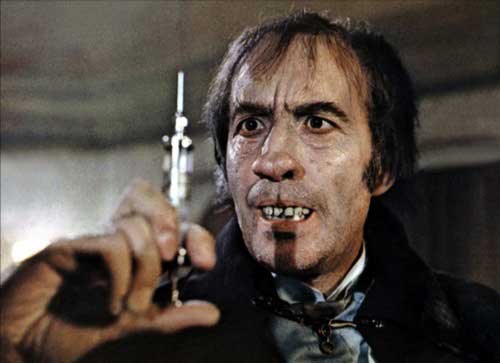
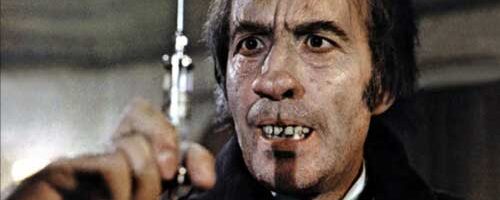
My book on Jekyll and Hyde adaptations is now with the publisher. It has a title, Watching Jekyll and Hyde, with a more detailed subtitle. Now it’s a matter of waiting for them to ask questions or send me galleys. I’ve recommended the Christopher Lee photo here from I, Monster for the cover image (I’ll defer to their judgment if they think another photo works better). Finishing the book does not mean, however, that I’m going to stop blogging about Stevenson’s Gruesome Twosome.
Robert Louis Stevenson is quite clear that Henry Jekyll is a hypocrite. Jekyll denies this in his final letter to his friend Utterson. According to Jekyll, he’s completely sincere in his saintly life as a public-spirited man doing philanthropic, charitable works. He’s just as sincere in his secret life of sin, though he assures Utterson they’re sins many other men would have bragged about.
Jekyll’s lying to Utterson, and perhaps to himself. Although he may be sincere in both endeavors he doesn’t want to be known for both. He goes to great lengths to hide his sins by becoming Hyde. That way nothing he does will tarnish his reputation as Henry Jekyll, Man of Stainless Integritude. His description of himself to Utterson reflects this: sure, he’s a sinner, but he’s not a bad sinner. Why compared to some men of his station, his sins are so trivial and he feels so bad about them, he’s virtually a saint!

Along with being a hypocrite, Jekyll is also an addict. As he wrote to Utterson, he’s the equivalent of a drunk who can’t give up alcohol even though he knows it’s killing him. As I blogged about previously, it’s not so much the drug itself but the feelings it gives him. The loss of inhibition (as in Jekyll and Hyde … Together Again, above), whether that translates into being charming and randy, the confidence to throw his weight around or uncaging repressed anger and cruelty. In one Dark Shadows plotline, the Jekyll figure Cyrus Longworth (Christopher Pennock) realizes he could never put a move on his best friend’s wife. If he turns into John Yaeger (the Hyde figure), he’ll have no qualms about kidnapping her and making her his.
Sure, there’s a downside to letting Jekyll’s inner self out of its cage. Killing people. Trampling small children underfoot. Abusing his mistress. The buzz he gets is worth it.
 Strange Case of Dr. Jekyll and Mr. Hyde isn’t just about addiction and loss of control. At the start, Jekyll almost always has control over whether he takes the drug or not; he is ultimately responsible for what Hyde does, much as some Jekyll’s deny it. In one TV adaptation, Michael Rennie’s Jekyll argues that every man has a Hyde inside him; Dr. Lanyon’s (Lowell Gilmore) response is “Yes, but I keep mine caged!”
Jekyll doesn’t have to cage Hyde. Part of the reason he becomes Hyde is because he believes there will never be consequences for his actions. Hyde likewise believes that if he gets into trouble he can simply transform back into Jekyll and disappear before the police can capture him.
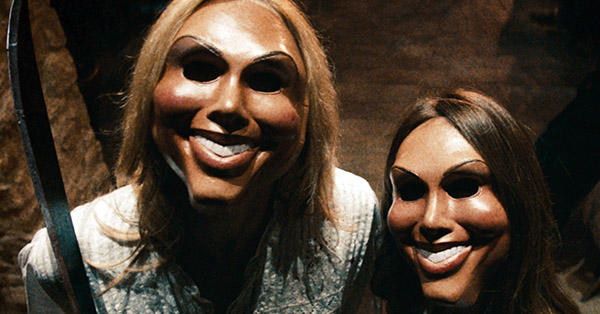
Which bring me to this post by Fred Clark of Slacktivist discussing people’s reactions to the Purge movies. The films exist in a dystopian future America where once a year everyone in the country has twelve hours to do anything they wish without fear of legal repercussion. In the first movie (2013) we learn the official reason is that keeping our darker sides locked up is the root of many social ills — let them out to play and the rest of the year we’ll be better people. The family at the heart of the movie finds themselves dealing with the daughter’s angry boyfriend whom the father has forbidden to see her (so if he kills dad, they can be together forever!) and a mob of angry thugs determined to break through the home’s state-of-the-art security.
Clark says he’s talked to a number of people who think that sounds awesome! They don’t see the horror of the protagonists, trapped and increasingly imperiled, they see a fantasy world where for a few hours they can do absolutely anything! Which suggests the only reason they’re not committing rape, murder or destruction is their fear of getting caught. Like Henry Jekyll, if they’re given a safe haven to be evil, they’ll be evil. And then, perhaps go back to their “real” lives and pretend like Jekyll that what Hyde does doesn’t really compromise them morally.
Not everyone’s like that. As I’ve written about on my own blog, there’s a small percentage of predators (Harvey Weinstein, Bill Cosby, Charles Manson, Ted Bundy), a small percentage of heroes and a large percentage who can go either way. Given an environment or leadership that pushes them to be good, they’ll be good; given an environment that sneers at virtue, they won’t go against the crowd. They may be on the border of actively doing good or actively doing evil but they won’t cross until they see it’s safe.
I would like to believe we’re better than that and that most of us wouldn’t let Hyde out to play, even if it was safe.
I would really like to.
