

“Just as every cop is a criminal, and all the sinners saints”
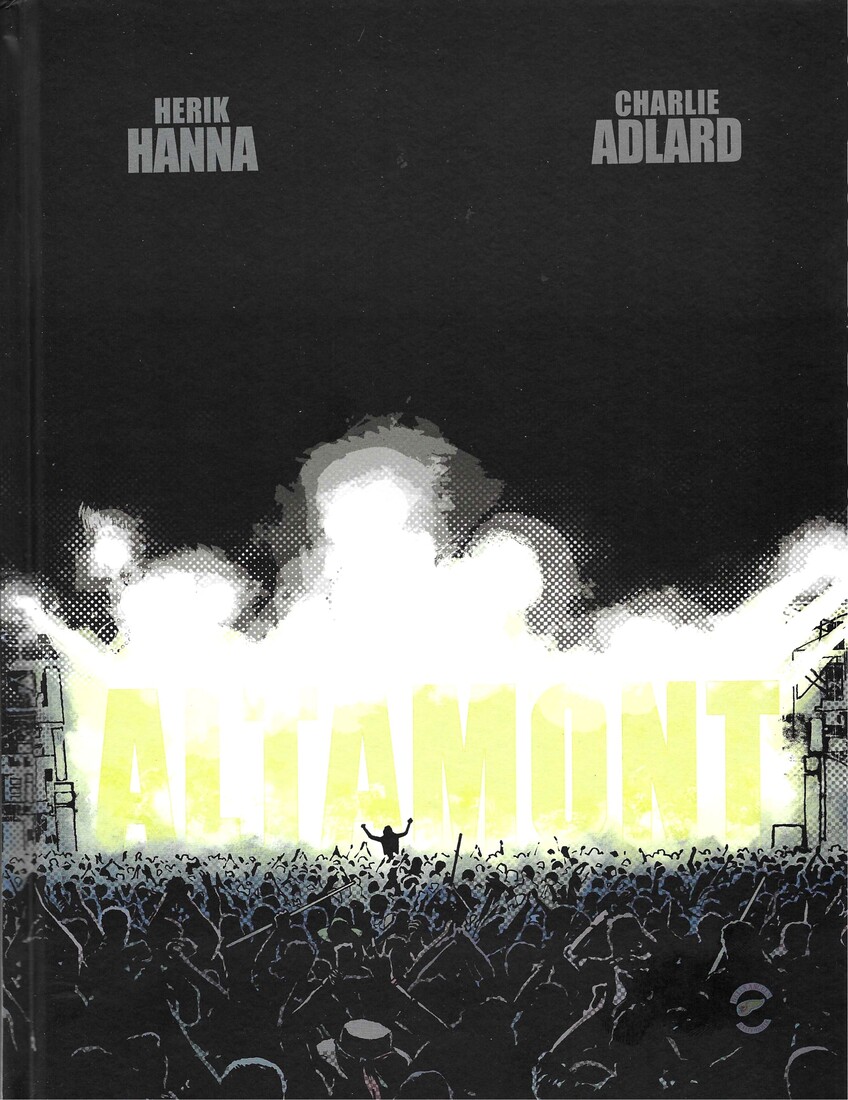
Ever since Charlie Adlard got out of the Zombie Salt Mine (where, yes, I know he probably made a good chunk of money, but still), he’s been doing some excellent work on a variety of things, and his latest is Altamont, which is written by Herik Hanna, translated by Alice Ray and Joe Casey, and lettered by Rus Wooton. 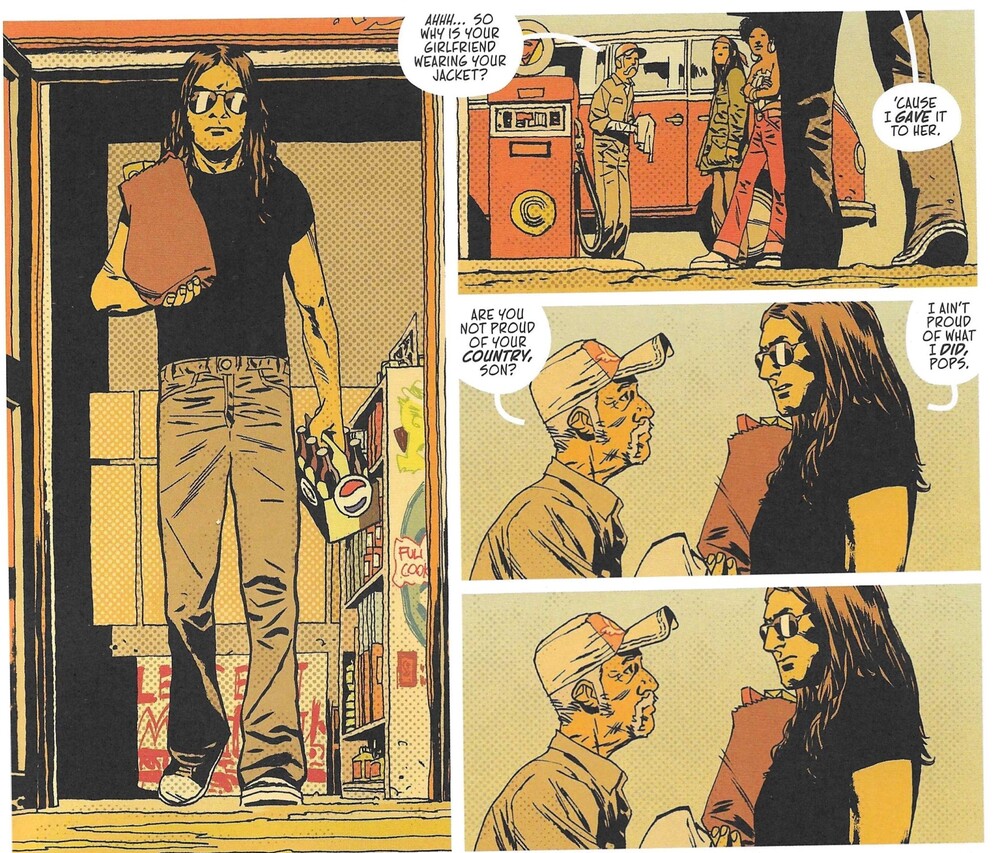 It will run you $24.99 (it’s a nice hardcover, though, so there is that), its 124 pages long, and Image published it.
Obviously, Altamont is a story centered around the concert, which took place on 6 December 1969 (decades don’t always begin or end on the official years, but it’s weird how “the Sixties” ended in December 1969). A group of friends — Doc, Jenny, Leo, Schizo, and Samantha (who’s not a friend; she’s new to the group) — head north from Los Angeles in a VW microbus to see the concert. Things, as you might expect, do not go great. How could they, after all?
The journey to the concert takes up the first half of the book (almost exactly), and it allows Hanna to take his time with the characters and give us a really good idea of what the country was like in 1969 and how these young people fit into it. Because he takes his time, they aren’t silly hippie stereotypes, as they have a lot of different facets. They’re united a bit by tragedy — one of their group overdosed a few years back, and they all miss him — and by their love of music, about which they have spirited discussions on the drive north. When they stop at a gas station, on old man starts to harass Jenny because she’s wearing an army coat, saying that she can’t say “fuck the world” and wear that jacket, but it turns out that Doc — who’s the spiritual leader of the group — served in Vietnam, and he gave Jenny the coat. Doc has seen some shit, and the old man can’t quite understand it. Later, Leo visits his mother, who wants him to more like his brother. Leo’s brother didn’t “burn up his conscription letter,” which makes Leo angry. Much like Muhammad Ali, he doesn’t see the reason to invade Vietnam when the Vietnamese never did anything to him. Leo asks Doc to show his mother his eyes — up until then, Doc hasn’t taken his sunglasses off — and we see that he lost one in combat, and he has many more scars than that. 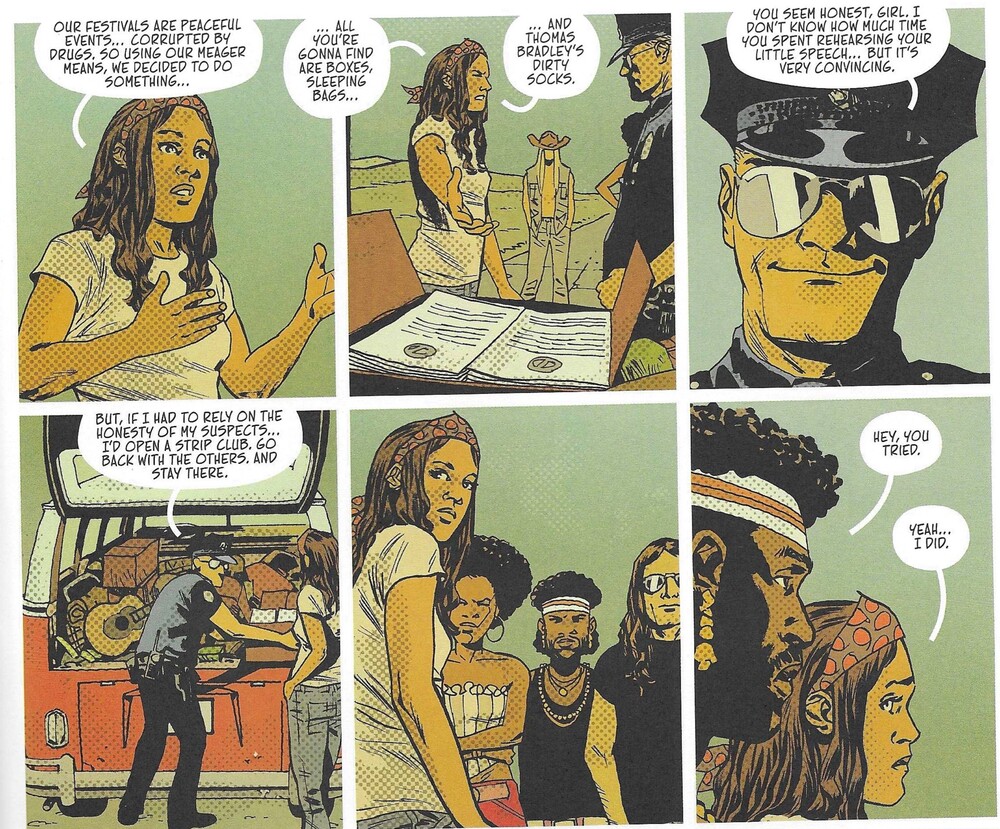 Leo didn’t want to fight, but his mother didn’t want that, necessarily, just that he not abandon his family. When a cop stops them, he seems reasonable, even if he makes them empty the van so he can find their drugs (which he doesn’t find, because they’re hidden so cleverly). Hanna is a solid writer, so he does a nice job keeping the book lively even though not a lot is happening. The group is serious a few times, which gives them some depth, but they also talk a lot about pop culture — who’s the best guitarist, why Jenny loves the Oscars — and it makes the first half of the book a fun read. Hanna does a good job making them all interesting and likable.
Of course, they have to get to the concert, and things go horribly wrong. They meet some interesting people, of course, but they come across the Hell’s Angels, too, which isn’t a good thing. Doc meets an old army buddy who’s a boss of the Angels, so an altercation is avoided early on, but later, of course, the boss isn’t around. Doc is incapacitated because Jenny slipped him some LSD (which he pointedly did not want to take), and he begins flashing back to ‘Nam. When Jenny tries to find him, she comes across the same Hell’s Angel she and Doc almost got into a fight with a day earlier. This time, of course, no one is around to help her. What happens to her drives the rest of the book (she doesn’t die, but something does happen to her). Hanna does a good job building the tension, as we know something bad is coming, but we don’t know what. We also get a good sense of the “death of the Sixties” thing that Hanna plugs into — obviously, setting a book at Altamont can’t help but tap into that, and Hanna links the awfulness of the concert with the way the group comes apart. 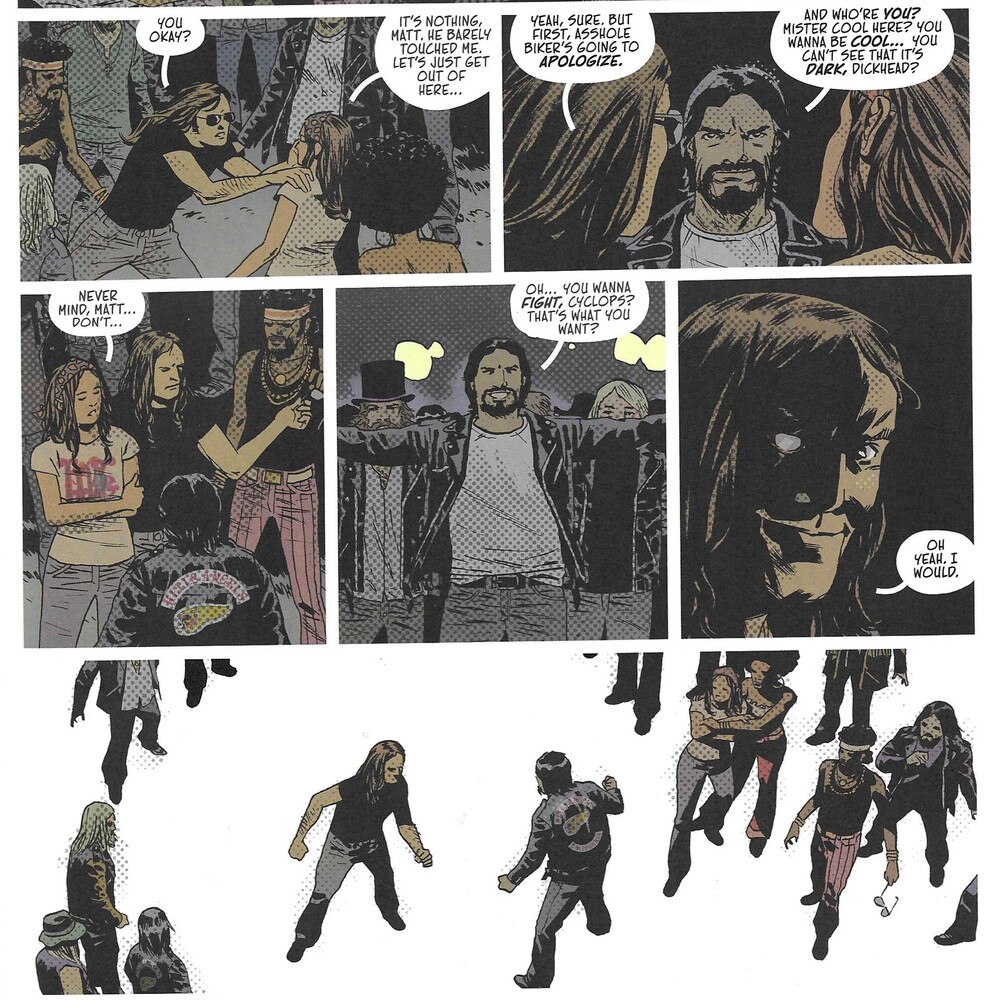 Schizo is out of his mind on drugs, Jenny experiences the very dark side of the “peace and love” movement, Doc can’t shake his past, and Leo finds out that Sam — who he digs — is definitely not interested in him. It’s disillusionment, sure, but the way Hanna restricts it to the characters and the choices they make is well done. The tension flowing through the concert is noted, as we check in on the stage occasionally, where things are going worse and worse, but Hanna wisely keeps the focus on his group, which is affected as much as anyone. He doesn’t comment directly about the betrayal of the principles of the “Sixties,” but it’s there in the background, and the coda — which takes place in 1982 — hammers that home without Hanna making it too bald-faced. It’s a more harrowing story than we expect, even with the anticipation that comes with the name of the book, and Hanna does a nice job building that tension and paying it off cleverly if in a kind of depressing way.
Adlard, unsurprisingly, is terrific. His characters feel real and lived-in, with definite Sixties vibes but without being clichés. Their clothing fits the fashion of the time without being obnoxious, and he does a nice job showing us other parts of American culture, as well — the hippies of the “Sixties” were a fairly small minority, so it’s nice to see a wide variety of other people, too, who don’t dress like flower children. He does a marvelous job with the characters’ expressions, specifically Doc, who rarely takes his sunglasses off and therefore Adlard has to do other things with his face, and he nails Doc’s stoicism and sadness without showing his eyes too much, which is hard to do. There’s an interesting contrast between Doc, the quasi-leader of the hippies who also did the most “establishment” thing any of them have done — join the army — and the policeman who pulls them over, as they both wear sunglasses, but Adlard makes the cop’s glasses just slightly bigger than Doc’s, so they seem to obscure his face a bit more and make the policeman a bit less open. 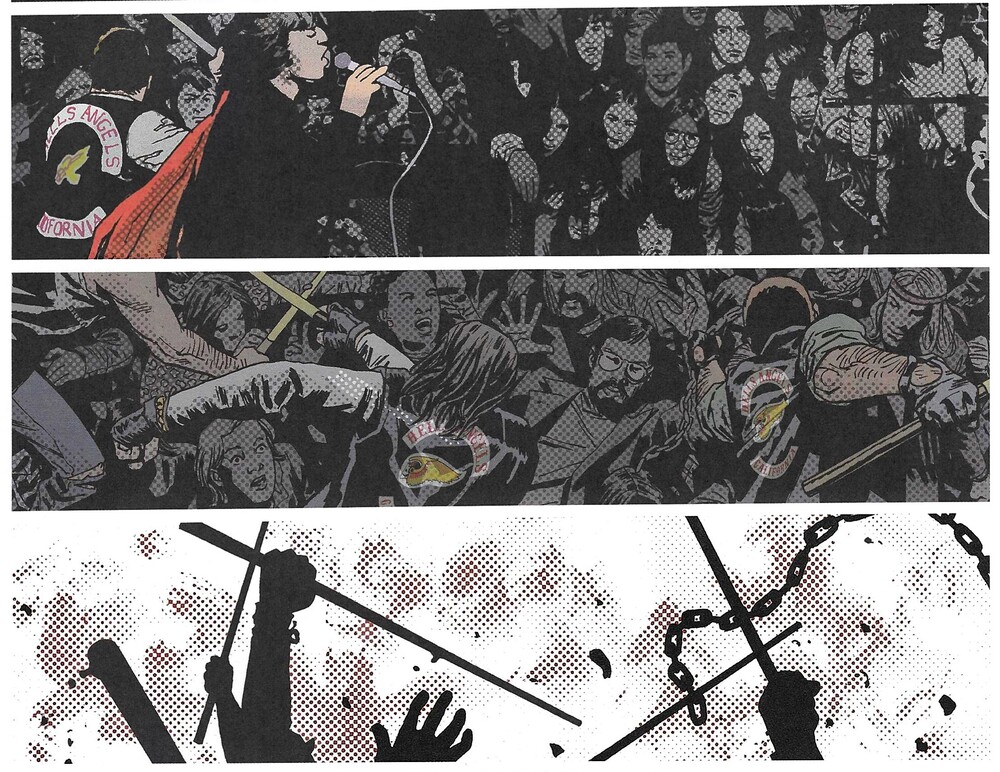 When they get to Altamont, Adlard adds more characters, all interesting and unique, and obviously, things become a bit darker, both literally (a lot of it takes place at night) and figuratively. When Doc gets his dose, Adlard does a wonderful job showing how he perceives the world, as he uses Day-Glo colors and some off-registers lines and hues to make Doc’s world a bit unsteady. His depiction of the early 1980s is also terrific, as the contrast between the earthy-crunchy days of Altamont with the slick, yuppie-infused 1980s stands out. The shift in the characters’ appearance is very well done, too. Adlard uses a lot of Zip-a-Tone effects throughout, too, which add some nice grit to his pencils but also allow him to slide into smoother drawings occasionally, which then stand out a bit more. Adlard was working in black-and-white for so long, so it’s nice to see his recent work in color, because he knows how to color as well as draw very well.
Altamont is a dark story, sure, but because the characters are so well defined, it doesn’t wallow in that darkness, but shows us a varied society struggling with its own identity. The fact that it ends in a more evil fashion doesn’t negate all the good stuff Hanna does early on in the book, just makes it hit a bit harder. It’s not exactly a tragedy, but it’s certainly not a happy book, either. It does work very well, though, and through it all, it looks great. That’s not a bad thing!
Rating: ★ ★ ★ ★ ★ ★ ★ ★ ☆ ☆

Nice review Greg, I have this sitting on my shelf waiting to be read. I’m sure I’ll get around to it one day….soon.
Thanks, sir! Go read it! 🙂
I absolutely adored this book – Adlard’s obviously a genius, and it recalled BruPhillips in the best possible way.
(Am I seeing a Gillen/Hitch/Phillips(x2) panel in London Monday? You bet!)
I’d give it 8.5 at minimum.
Man, that’s a good panel. Damn you, sir!!!!! 🙂
If I had known about this event earlier I would have been there.
Unfortunately it’s my Birthday on Sunday and I had already made plans.
Hah, it’s my birthday on Saturday, so I’m having my drinks tomorrow night, and flying over Sunday.