

Onward to our next installment!

After I bought Wizard #14, I didn’t get one for another four years, almost, until #60 — their fifth anniversary issue — came out. Why didn’t I get an issue? Well, in October 1992, I was still in college, so I couldn’t afford to buy the magazine too often — I bought issue #14 because of the X-Men-related articles — and then I got out of college and was a bit unsettled for a few years as I moved cross-country and we found decent jobs. I was still buying comics, but I didn’t have a ton of room to store things, so I didn’t want to start getting magazines as well as comics. So, no Wizard. But I was tempted by the fifth anniversary issue, so I dove back in and got it fairly regularly for the rest of its run. So let’s take a look at Wizard #60, with that great, ridiculously veiny Hulk on the cover!
Garb Shamus has his opening “letter from the editor” in which he crows about the magazine reaching five years (which, I mean, that is a decent achievement). He tells us that in this issue, they’ll make some predictions for the next five years, and boy, I can’t wait to get to those! There’s a Jim Lee/Rob Liefeld sketchbook for “Heroes Reborn,” and they have a list of 100 comics “you gotta own.” There’s a sneak peek at the “Spawn” animated series and an interview with Marvel E-i-C Bob Harras. In a postscript, he mentions that readers should get on “Wizard World” on America Online. Damn, that’s a 1996 sentence if there ever was one! On the opposite page is an ad for Youngblood/X-Force by Liefeld and Eric Stephenson. There’s something else listed that will blow your fucking mind:

Moving on, “Magic Words” — the letters column — has been moved to the front (I don’t know when this happened, but as I noted, there was a big gap for me between issues), and weirdly enough, Jim McLauchlin, who’s in charge of the column, specifically mentions that they don’t get many letters anymore about who the X-traitor was or whether Iron Man could beat all the X-Men at once, which, as you recall, was a big deal in Wizard #14 — did McLauchlin happen to open that one issue and use those examples, or was it just such a big thing for so long that it stayed on his mind? Anyway, the first letter is from “Paula,” who apparently had a letter printed in issue #56, along with a photo of her in a homemade Razor costume — you all remember Razor, don’t you? Of course you do (apparently, Shi first appeared in a Razor comic, and Eric Powell drew some issues, too!)! Paula provided her address, and she got letters from readers, which she breaks down in her latest missive:

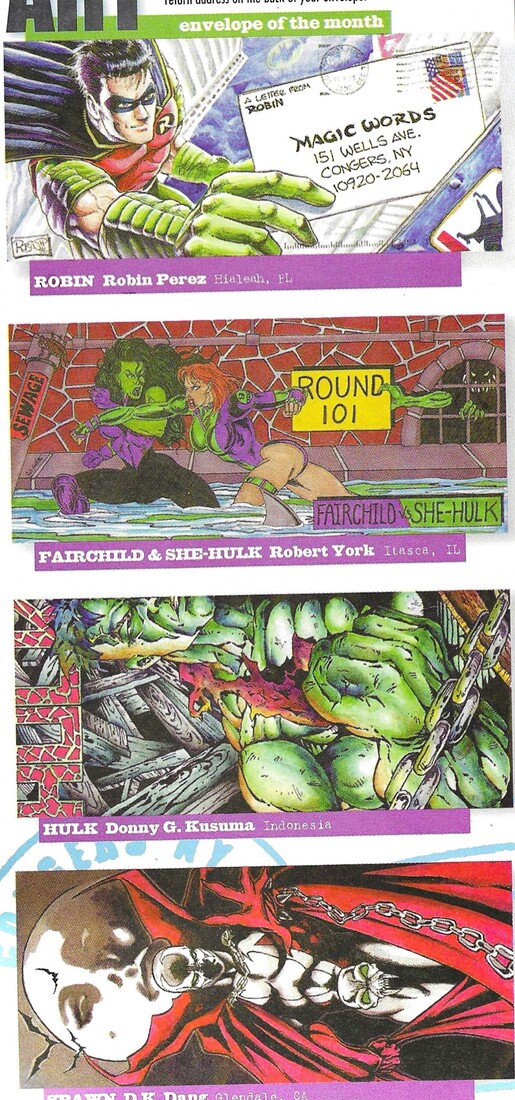
A “James Rugg” of Indiana, Pennsylvania (who has to be future comics creator Jim Rugg, right?), argues that instead of gimmicks, companies should lower their prices, citing Untold Tales of Spider-Man as an example, and McLauchlin agrees … whereupon Gareb Shamus beat him with a sock full of quarters because Wizard exists to sell variant covers featuring women with big boobs, damn it! A writer wonders if there are any Space Ghost comics, and interestingly enough, back then there weren’t many. That has been rectified in the new century, but it’s weird that in 1996, Space Ghost comics were few and far between. Someone else writes in and actually asks if the Big 8 Conference becoming the Big 12 is a good thing (this person does not). Raging about college conference realignment seems so quaint these days, when it’s all damn the torpedoes and such. We also get the artwork that people put on their envelopes, which was always very cool:
There’s an advertisement for Deathblow/Wolverine, which is by the all-star pairing of Aron Wiesenfeld and Richard Bennett (weirdly enough, Bennett — the inker — is listed before Wiesenfeld, who wrote and drew it), and there’s an unfortunate tag line at the top:

Yeah, that did not age well at all.
We get news on page 17, with Mark Waid leaving X-Men because of “incompatibility” with Scott Lobdell. It’s weird — it’s a full page about why Waid is leaving, when it just seems like … he and Lodbell write comics differently? Why that would be a problem — I know that they wanted to have the two books work together at that time, but it still seems like there’s more to the story (I don’t know if Waid ever spilled more beans about this, but I’m not looking for it!). This exit comes on the heels of Waid leaving Captain America, and he did wonder if he’d get a bad reputation, but, I mean, Waid has been working steadily for the past 30 years, so I guess it didn’t hurt him that much.
Lots of news over the next several pages. Fabian Nicieza was named editor-in-chief of Acclaim Comics, which was basically Valiant, and, as Wizard points out, he was tasked with saving Valiant. Dang, back in issue #14, Wizard couldn’t stop praising Valiant … how the mighty have fallen! Marc Silvestri left Image with Top Cow due to “irreconcilable differences” with one of the partners. It turns out it was Liefeld, but he left Image not too long after this, and Silvestri went back, so we’re all good! Garth Ennis, meanwhile, was super-hot, and Wizard has news about some of his stuff coming up — Saint of Killers, Unknown Soldier, Enemy Ace, Bloody Mary, Heartland, Pride and Joy, and The Darkness. Dang, he was working! James Robinson and Joe Jusko were doing a Vampirella story, which I don’t know if it ever came out. We also get an announcement of the X-Men/WildC.A.T.s crossover, which was really dang good, as it happened.
Jerry Siegel died, so Wizard has a nice short eulogy, with various creators chiming in. He died, we know, a vastly rich man because DC paid him so well over the years whenever they used Superman. Wasn’t that nice? We also find out that Barb Wire, the excellent Pam Anderson movie, did terribly at the box office. I haven’t seen Barb Wire, but I’ve seen clips of it, and boy howdy, it looks terrible. There’s a poll about which character will be the big one in the next five years, and most people predicted it would be an X-character. I’m not sure who was the biggest character of the latter half of the Nineties. Batman, maybe? I dunno. Manga was overwhelmingly selected as the next big trend, which was interesting, because manga has become even bigger now than it was even then. The big choice for next superstar artist cracks me up a bit (58% of respondents): Ian Churchill. Churchill isn’t a bad artist, but he never became a big superstar, did he?
There’s a sidebar that goes on for several pages letting us know what each comic company is up to. It’s always interesting seeing the companies, some of which are still around, some of which died quickly. This was right around the time when DC was ramping up their ill-fated Helix imprint, which they needed to rename because it was originally called Matrix. The Matrix came out in March 1999, and I assume that’s why DC changed the name, so I’m just amazed how long it was in the pipeline. Here are some of the companies that were around in 1996: Chaos! Comics, Coppervale Press, Crusade Entertainment, Entity Comics, Event Comics, Fireman Press, High Impact Studios, Lightning Comics, London Night Studios, Maximum Press, Topps Comics. Good times!

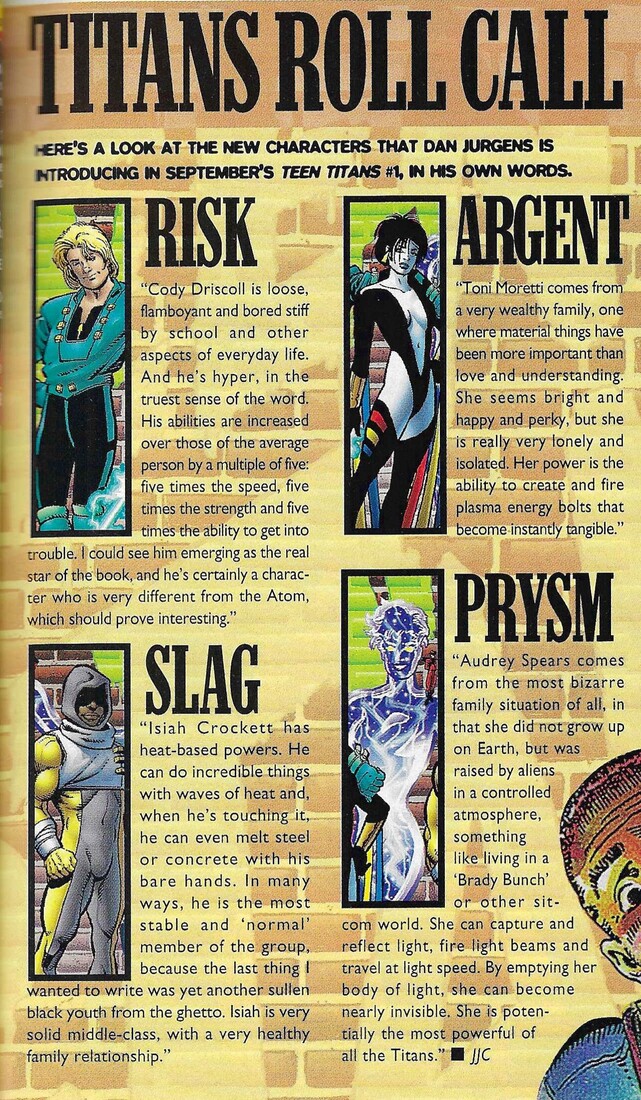
We get an article about Dan Jurgens’s Titans relaunch, which lasted two years. The names ring through DC history: Risk, Slag, Argent, and Prysm! They’re … half-alien? Oh dear. I never read this, so I have no idea about the quality (although it’s Jurgens, so it’s probably mediocre but not completely terrible), but despite the push from Wizard, two years doesn’t seem like a great run. Oh well.
Wizard then casts a Hulk movie. I loved when Wizard used to do this. They thought Ferrigno would be good for the Hulk, which was interesting. Ferrigno was only in his mid-40s at the time, so it probably would have worked pretty well. They think Duchovny would be good for Bruce Banner. Sure, I think so. Sandra Bullock as Betty Banner would have been keen — Wizard lists her as the actor of The Net, which cracked me up, as I guess that was her most recent movie, but dang, that’s not a good flick. Bullock is only four years younger than Duchovny, so that would have been ok. They put bodybuilder Cory Everson as She-Hulk, which .. why? I mean, sure, a bodybuilder would be fine, and she had been in some movies, but why put She-Hulk in the movie? Johnny Depp as Rick Jones does not work for me. He would have been a bit too old for it, and I get that he has a rock-and-roll vibe, but I think DiCaprio or Joaquin Phoenix at that time would have worked better. They cast Stacy Haiduk, one of Greg Hatcher’s favorite, as Marlo Jones, which … fine. For the Abomination, they think Ralph [sic] Moeller, another bodybuilder. Again, that’s fine. They think Alan Rickman would be good as the Leader, which I think would be pretty keen. Seymour Cassel was an odd choice for General Ross, but he probably could have worked. A few years later James Cromwell played an officious and cold general/father in The General’s Daughter, so he probably would have nailed Ross. They want Kevin Sorbo for Doc Samson, which doesn’t feel right. Not because Sorbo has gone around the bend in later years, but even back then, he kind of had the wrong vibe. Maybe, but it feels like there could be a better choice. They have the U-Foes in there, which is a weird addition, but here are their choices: Corbin Bernsen as Vector, Marcia Cross as Vapor, Matthew Perry as X-Ray, and Andrew Bryniarski as Ironclad. I guess. I don’t know enough about the U-Foes to know if those choices work. Of course, we didn’t get a Hulk movie for some time, but that never let Wizard stop them!
On pages 38-39, we get some information about Spawn, the animated series, which I guess was a pretty good show. Then, on pages 40-42, we get a nice article about Rob Schrab and Scud. It’s pretty interesting. I know that Scud had a moment for a bit, but it’s always fascinating to read when Wizard goes seriously indie instead of focusing on Marvel and Image and Valiant and the hawt books all the time. A couple of things: Schrab came up with the character in the aftermath of a failed relationship. He tells Wizard: “I was ga-ga over her, and she thought I was a psychotic stalker.” Wizard passes this by, but given what we know now about male behavior, it’s probably closer to “psychotic stalker” than not. Second, Dan Harmon collaborated on the writing of this comic. Harmon, of course, is the creator of Community and Rick and Morty, so good for him! There’s also a Scud drawing contest on pages 44-45 … I wonder who won it and if their pin-up is included in my giant-sized Scud collection. It’s too far away from me to check!
On pages 46-48, we have an article about the new Hulk cartoon on UPN (ah, UPN). I never watched it, but I don’t think it had much of an impact on the zeitgeist — we still hear about the early 1990s X-Men and Batman cartoons, but not the Hulk one. Len Wein was a writer, so it couldn’t have been that bad, right? I don’t know — did anyone watch this? The cast is so very 1990s, though. I mean, they got Ferrigno for the Hulk, which, duh, but then we get Neal McDonough as Bruce Banner, Luke Perry as Rick Jones, John “Dean Wormer” Vernon as General Ross, Mark Hamill as Gargoyle, Matt Frewer (fucking Max Headroom!) as the Leader, Genie Francis as Betty (she was replaced later, it seems), Kathy Ireland as Ogress, and fucking Shadoe Stevens as Doc Samson. I gotta put on my acid-washed jeans before I watch this!!!!

Wizard has an article on pages 50-52 about Jim Lee’s launch of Homage, with Astro City, Leave It to Chance, and Strangers in Paradise the first three books from the imprint. I do like how Lee is quoted as saying, “Homage projects are books that we won’t do through WildStorm Productions,” which begs the question: Why not? I mean, there doesn’t seem to be much difference between these imprints, and while Wizard does have Lee explaining the difference between Homage and just regular Image, it doesn’t seem like there’s much difference there, either. I think all these Image founders were just kind of bored by 1996, so they were just creating shit to create shit. I mean, good for them, though, because those are neat comics, but it’s goofy to consider the “differences” between these imprints.
Pages 58-65 feature one of those articles that used to annoy me about Wizard, as it shows that they know what they’re talking about with regard to comics, but they choose to slurp all the “hawt” artists of the day and pump up the price on shitty books that led to the speculator crash of … hey, 1996! This article is about 100 comics you should own, and I actually got some very good suggestions from it: Amazing Spider-Man #229-230, for instance, is their first choice (the books are in alphabetical order). There’s nothing terrible surprising here (Batman: Year One, The Dark Knight Returns, Marvels, “The Anatomy Lesson,” The Proteus Saga, Watchmen), but on page 65, they list some under-the-radar books, such as The Books of Magic, Elementals #1-5, The Golden Age, Hawkworld, Jon Sable, Freelance #1-6, and Miracleman. It’s not a bad list if you’re diving into comics for the first time in 1996!
We get to check out some of the sketches for Lee and Liefeld returning to Marvel with the “Heroes Reborn” thing, which became a nice clusterfuck, didn’t it? “Both creators,” we’re told, “want to reinject the original 1960s ambience into their books, but with a 1990s sensibility.” I guess that’s how we get Liefeld’s reimagined Red Skull:

In a case of “Really Bad Timing,” Wizard interviews Bob Harras, the E-i-C at Marvel, who has to be one of the worst executives in the history of comics, doesn’t he? I mean, I know there’s a lot of competition, but man, Harras is no good. This issue, let’s say (I can’t find it exactly), came out in June or July. Under Harras’s stewardship, Marvel filed for bankruptcy in December, so six months after this interview was published. In the introduction to the interview, Wizard notes that Marvel laid off Carl Potts, Bob Budiansky, and 16 other edit staffers and asks, “[A]n omen of something bigger, something darker? Hardly.” WHOOPS! It’s not the most insightful interview — Wizard isn’t going to bite the hand that feeds it — but it’s not bad.
Wizard then has a “coming attractions” section, which is fun. “Onslaught” is the big thing for the X-books (and the Marvel U. in general) in the summer of 1996, while the Bat-books are dealing with the aftermath of the “Contagion” story. There are plans for tie-ins to the new movie, about which we will not speak (although Wizard asks the rhetorical question, “[W]ho wouldn’t go nuts for Alicia Silverstone as Batgirl?” which turned out to be a bad question to ask). The third book on the first pages of this article, the first two of which are the X-books and the Bat-books, is … Gen13. Really? I know it was popular for a hot minute, but really? Anyway, they mention the 13th issue, with that stupid gimmick of them being 3 different books, each 13 pages long and costing $1.30 and featuring 13 guest stars. Sigh. Gimmicks are so fun, aren’t they? Moving on, Superman: Red Son gets a mention in his section, while Flash returns to the 20th century from the future. Spawn is going to hell, which seems doesn’t last, of course, the original Dr. Light will be returning to the DCU in the pages of Green Lantern. Just in time to be mind-wiped, although I guess that already happened by now. In the Spidey books, the Clone Saga is finally ending, and I still don’t know exactly what happened, because I was avoiding Spider-Man books like the freakin’ plague by this time. Karl Kesel and Cary Nord were on the underrated Daredevil run, although it (and the comic) were nearing its end, which came in 1998, I believe, so Kevin Smith and Joey Q could take over and kill off Karen Page because a girl like her wouldn’t date either one of them when they were kids. The Legion of Super-Heroes, meanwhile, had some members stuck in the 20th century, which had to suck for them. I assume they got back! Wizard also has a “what’s coming up” in Preacher, which seems weird. I don’t know why, but it seems weird, because Ennis had a long-term plan that wouldn’t change, unlike the corporate characters, where creative teams or editorial shake-ups could change plans. It just seems weird to talk about what’s coming up in a creator-owned, “limited” series, although Wizard does mention that Heartland will show up in mid-1997, so that’s nice.
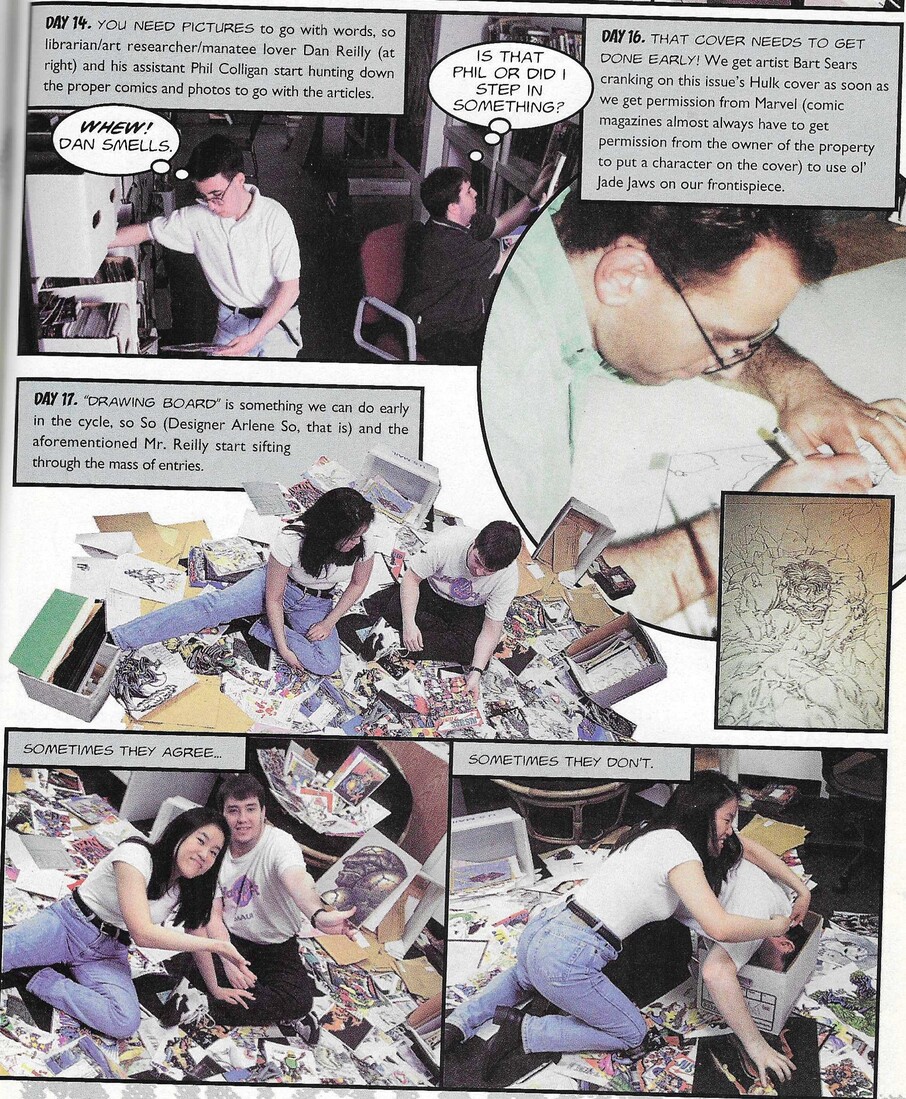
On pages 88-93, we get an actually informative article about how Wizard puts together its magazine. It’s accompanied by fumetti-style photos that are often goofy, but it’s still a pretty good essay about what it takes to get an issue out.
Up next is a retrospective of the previous five years. It’s a nice, if occasionally embarrassing, snapshot. Let’s go through it!
1991: The “hot writers”: D. Michelinie, H. Mackie (I guess for Ghost Rider, but really?), C. Dixon, F. Nicieza, M. Baron (coke-fueled, no doubt), N. Gaiman, P. David, J. Byrne, C. Claremont, J. Starlin.
The “hot artists”: M. Silvestri, J. Valentino, G. Pérez, J. Saltares, S. Bisley, T. McFarlane, J. Lee, R. Liefeld, R. Lim, E. Larsen.
“On the rise”: W. Portacio, T. Lyle, B. Sears, D. Keown, S. Kieth.
They list movies, shows, and songs, but we’re concerned about the hot “pop culture trend,” which was “sideburns à la Beverly Hills 90210.” Good stuff!
The events of the year include: the release of X-Men #1 (I still own all my many copies!); the debut of The Mask; McFarlane leaving Spider-Man; Claremont leaving X-Men; Gene Roddenberry dying; David Lapham debuting in Harbinger #1; Judge Dredd meeting Batman; Batman meeting the Predator; Paul Reubens pleads “no contest” to charges of indecent exposure (watch the Pee-Wee documentary on HBO, everyone — it’s very good and will definitely piss you off when it comes to this mess); Magic Johnson tests positive for HIV; Liefeld announces Youngblood from Malibu; Joey Q debuts on The Ray; Evil Ernie and Lady Death debut in Evil Ernie #1.
1992: The “hot writers”: N. Gaiman, P. David, J. Starlin, C. Dixon, J. Byrne, J. Shooter, L. Hama, B. Layton, F. Nicieza, D. Michelinie.
The “hot artists”: T. McFarlane, J. Lee, R. Liefeld, R. Lim, E. Larsen, M. Silvestri, S. Bisley, R. Liefeld (he’s so hawt that Wizard listed him twice!!!!), J. Valentino, W. Portacio.
“On the rise”: J. Quesada, J. Lee (Jae, that is), A. Thibert, D. Lapham, M. Texeira.
The pop culture trend was Lollapalooza. Interesting.
The events of the year include: Image Comics was announced, as an imprint of Malibu Comics; Jeffery Dahmer is sentenced; Youngblood #1 ships … two months late; Spawn #1 set sales records; Jay Leno replaces Carson; “In one of comics’ lamer gimmicks [which Wizard promoted heavily!!!!], DC release Eclipso: The Darkness Within #1, complete with a purple plastic “Eclipso diamond” attached to the cover”; Batman Returns weirds people out; Cannon Films releases a Captain America movie, in which the Red Skull is Italian; Vertigo launches; Valiant fires Shooter; Batman: The Animated Series premieres; Marvel purchases Fleer; “Marvel 2099” debuts (with Stan Lee scripting Ravage!); Joe Shuster dies; Superman dies.
1993: The “hot writers”: N. Gaiman, P. David, F. Nicieza, W. Messner-Loebs, J. Shooter, D. Jurgens, C. Dixon, M. Wagner, B. Choi, F. Miller.
The “hot artists”: T. McFarlane, J. Lee, R. Liefeld, M. Silvestri, E. Larsen, J. Quesada, M. Texeira, M. Bagley, B. Sears, S. Kieth.
“On the rise”: S. Platt (PLATT!!!!!), J. Balent, M. Allred, G. Capullo, J. Smith.
The pop culture trend: Saying “No way” followed by “Way” from Wayne’s World.
The events of the year include: Image left Malibu; Angela debuts in Spawn #9, and you know you should sell that issue and make many moneys; “Knightfall” begins; Jack Kirby signs with Topps Comics; Harvey Kurtzman dies; there was a terrorist attack at the World Trade Center; Brandon Lee dies on the set of The Crow; Malibu creates the “Ultraverse,” which doesn’t do much; Dark Horse creates “Comics’ Greatest World,” which was not; Marvel merges with Toy Biz; Image kills most of the titles not by the founders, including Shaman’s Tears, Trencher, Tribe, and WildStar; Stephen Platt draws Moon Knight (the biggest news there is!!!!!); Byrne and Miller create the Legend imprint for Dark Horse; Joel Schumacher is announced as the director of Batman Forever, which … man; Marvels comes out; “Penthouse Comix” debuts; “Emerald Twilight” — the best Green Lantern story EVER!!!! — comes out.
1994: The “hot writers”: F. Miller, N. Gaiman, D. Jurgens, B. Choi, R. Marz, S. Lobdell, J. Smith, P. David, F. Nicieza.
The “hot artists”: T. McFarlane, J. Quesada, F. Miller, M. Silvestri, J. Smith, S. Platt, G. Capullo, B. Sears, J. Romita Jr., An. Kubert.
“On the Rise”: J. S. Campbell, B. Tucci, C. Bachalo, J. Madureira, M. Deodato Jr.
The pop culture trend: “Forrest Gumpisms.”
The events of the year include: Kirby died in February; Gen13 ships five months late; both Batman/Spawn stories show up several months late; the Fantastic Four movie is shelved, and Wizard claims that’s fine, because it sucked; Shi debuts; Acclaim agrees to buy Valiant, basically; Zero Hour shows up; Michael Jackson marries Lisa Marie Presley; Star Trek: The Next Generation ends; the Spider-Clone returns!; Liefeld … proposes to his girlfriend in a comic book?; Neal Pozner dies of AIDS-related illnesses; WetWorks ships after a two-year delay; Marvel agrees to publish Harvey Comics characters, and what the heck happened with that?; Generation X launches; Tom DeFalco gets ousted as Marvel’s editor-in-chief, with five E-i-Cs taking over various Marvel enclaves; the “Age of Apocalypse” begins; Marvel buys Malibu and then the distributor Heroes World.
1995: The “hot writers”: P. David, R. Marz, S. Lobdell, B. Choi, F. Nicieza, K. Busiek, A. Moore, M. Waid, C. Dixon, N. Gaiman.
The “hot artists”: T. McFarlane, J. Quesada, J. Lee, G. Capullo, An. Kubert, B. Tucci, J. S. Campbell, J. Madureira, S. Hughes (really?), Ad. Kubert.
“On the Rise”: R. Garney, H. Ramos, T. Kaniuga, G. Ennis, W. Ellis.
The pop culture trend: Jennifer Aniston’s hairdo.
The events of the year include: David Lapham forms El Capitán to publish Stray Bullets; Marvel cancels a bunch of titles as they downsize; Diamond becomes the exclusive distributor of DC comics, beginning their ascent to Monopoly of All Distributors; Peter Parker is revealed as the actual Spider-Clone; Sovereign Seven debuts; Jim Valentino kills ShadowHawk (his death was due to AIDS, so it was news); Christopher Reeve is paralyzed; Batman Forever does really well at the box office, but, I mean, come on, it’s pretty lousy; Stallone’s Judge Dredd comes out, which, yuck; Heroes World is unable to handle all of Marvel’s comics, which wasn’t hard to foresee; Alan Moore inexplicably takes over WildC.A.T.s (which is a fun comic, but really?); Marvel and DC announce a big ol’ crossover; Astro City debuts; DC and Dark Horse announce a Batman/Aliens crossover by Ron Marz and Berni Wrightson; “Todd McFarlane is cornered by TV’s “A Current Affair” for his treatment of satanism and racism in Spawn” might be the MOST NINETIES SENTENCE EVER!!!!; Lee and Liefeld announce that they’re returning to Marvel; Marvel versus DC #1 sells well.
1996 (so far): The “hot writers”: P. David, S. Lobdell, M. Waid, C. Dixon, K. Busiek, G. Ennis, K. Kesel, J. Robinson, R. Marz, N. Gaiman.
The “hot artists”: T. McFarlane, J. Quesada, B. Tucci, G. Capullo, J. Madureira, A. Ross, J. Linsner, M. Wieringo, J. Lee, J. S. Campbell.
“On the Rise”: T. Daniel, P. Olliffe, C. Nord, I. Churchill, A. Conner.
The pop culture trend: George Clooney’s matted haircut from ER.
The events of the year include: Jerry Siegel dies; Bob Harras is named Marvel’s editor-in-chief and proceeds to drive it into the ground; Malcolm Jones III dies; Burne Hogarth dies; George Clooney takes over as Batman; the Generation X show airs on Fox; Hitman debuts; Marvel announces a theme restaurant at Universal Studios Florida; DC and Marvel create Amalgam Comics; Gaiman signs with Avon Books to write three books for one million dollars; Peter Parker returns as Spider-Man; Marvel and Image announce plans for a crossover; Batman: Black and White shows up; Kingdom Come shows up.
Now, Wizard moves on to predictions for the next five years, on pages 118-121. First, they claim that McFarlane will return to Spider-Man. A nice thought, but it has yet to happen. Toddster was too busy buying baseballs in the next few years to draw Spider-Man! They predict a huge shakeup at Image, as they claim Lee, Liefeld, Silvestri, and McFarlane will “divest themselves from the company.” I mean, Lee left for DC’s greener pastures with WildStorm, so I guess they were right? They don’t say Image is going away, just changing. I guess we can count it as a good prediction. They say there’s going to be a “comics” channel on television, which didn’t happen. They think a lot of it will be cartoons, with some shows about comics, and it sounds nice, but oh well. Cartoon Network existed in 1996, so I don’t know why Wizard doesn’t mention it. They predict that artists will study the work of Masamune Shirow a lot more, as manga’s influence continues to spread. I guess this came true — I don’t know if artists particularly studied Shirow, but manga-like art has certainly become much more prominent in DC and Marvel superhero comics. That wasn’t hard to predict, though, although they did get it right.
Marvel’s bankruptcy, it seems, must have taken Wizard by surprise, because at this point, they could not stop talking about Marvel’s inexoribility. They predict that there will be “Marvel Entertainment Stores” in malls, much like Disney stores (oh, the irony!). “Unlikely, you say?” writes Wizard. “Not at all. Considering the comics juggernaut that Marvel’s become over the years, the fact that the company owns its own distributor and that it recently made a deal with Planet Hollywood to open a Marvel Comics-themed restaurant in New York City, opening Marvel Stores is just plain profitable.” Everything in that sentence became laughable in a very short time. They move on to claiming that Superman will be the next big media juggernaut, and they’re waaaaaay off. I mean, sure, Lois and Clark was a big deal at the time, but there was no 5th Superman movie in 1999 or 2000, and his ascension to the top of media never really happened. He still has juice, of course, but he wasn’t the huge star that Wizard said he would be. They also say that you will get “carded” when you try to buy “mature” comics, as ratings on comics will become a thing. I mean, sure, but that wasn’t hard to predict, and it’s kind of lazily enforced, isn’t it?
They go on to claim that novel writers will begin to write comics much more than they have, and everything about this prediction feels weird. I can’t really summarize it as well as what Wizard writes, so here it is:
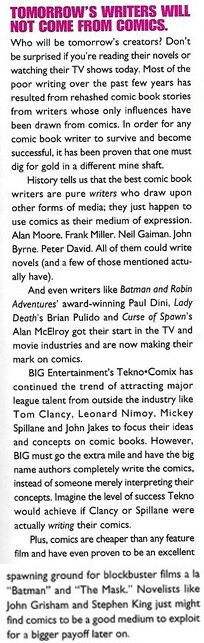
I mean, it didn’t really come true, but it’s such a weird, kind of condescending prediction. If anything, comics writers became more insular than ever. It seems odd that Wizard would get this so wrong, as it feels more like wishful thinking on their part rather than actually reading the tea leaves. Finally, they make the point that artists will have to use more digital technology. This is another easy prediction, but I guess Wizard nailed it. Well done!
On pages 124-128, Joey Q writes about creating a good cover, the one he did for Wizard #59. This is actually pretty keen, as Quesada does a really nice and detailed look at the process. It’s always neat when Wizard does shit like this.
Tom Hart’s The Sands gets a two-page article on pages 132-133. I’ve never read Hart’s work, but, as usual, Wizard will drop these articles about weird shit into their mags that shows that they know more stuff is going on in comics than the latest Bad Girl comic, but they simply don’t want to write about it!
We get some news about television and movies on pages 134-136. Michael Jae White was cast in Spawn, which was nice for him. Lance Henriksen was starring in Millennium, which would debut in the fall. There’s an interesting sidebar about Kevin Smith filming Chasing Amy, which is nifty. We learn that a live-action, made-for-cable movie based on Vampirella in in production in Las Vegas. This came out in 1996, with Talia Soto as Vampirella and co-starring … Roger Daltrey?!?!? Meanwhile, Welsey Snipes was in final negotiations to star in Blade. Wizard relegates this to a small news item buried deep in their issue, because they couldn’t have known how important this movie was to Marvel and superhero movies in general, but there it is! There were some “short takes,” none of which are that interesting, except that Joel Schumacher said that Val Kilmer was fired from being Batman because he was an “asshole.” You tell it, Joel!
All righty-o, we move on to pages 138-144 and Wizard‘s picks. Justice League: A Midsummer’s Nightmare is the first one, which is a good one. They highlight Monkeyman and O’Brien by Art Adams, which I’ve never actually read. Then we get a nice alphabetical listing of interesting comics. Wizard lists Kane, which at that time was coming out from Dancing Elephant Press. It’s always strange when Wizard slips one of these into their listings, which are mostly all DC/Marvel/Dark Horse books.
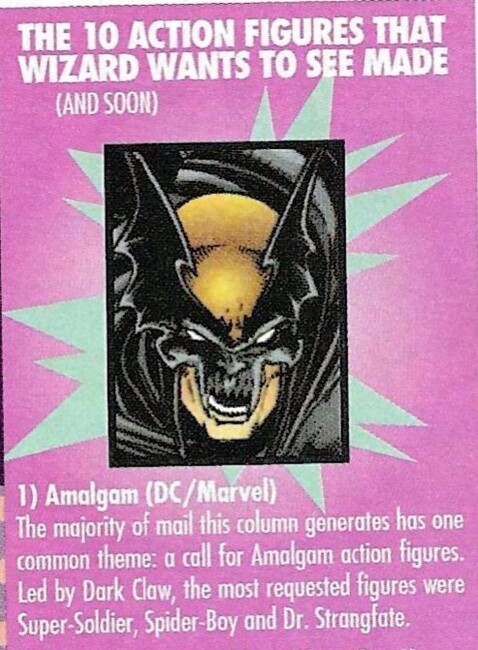
Wizard has its toy article on pages 146-147, with a sidebar listing the ones they would like to see. They want Amalgam action figures, a Princess Leia in a metal bikini figure (which, yeesh), Mystique, a better Bane, Quicksilver, Lock-Up, Ventriloquist, Parallax, a Romulan from the classic Trek, and Kingdom Come heroes. They point out that some figures they’ve requested in the past are in production, so they have some clout!
On pages 148-150, we get an article about anime/manga, which is interesting. They point out that in 1989, MTV, of all channels, Kurt Loder did a report on anime that included sound from Bill Sienkiewicz, who was doing covers for Lone Wolf and Cub at the time. They note that MTV has remained at the forefront of presenting anime to an American audience, and they highlight the Star Blazers magazine and the Ghost in the Shell anime. Keen stuff.
 We’re on to readers’ artwork, which is always nifty. Leinil Yu makes an appearance (right there on the left!), which is fun to see. There’s a brief article about cards, which isn’t that interesting. Then we move on to the “hot” back issues. Preacher #1 tops the list, followed by Hitman #1. Ennis was having a good run the mid-1990s! Witchblade #1 is third, while Witchblade #2 is fourth. Well, dang. The X-Files #1 (with Charlie Adlard on art!) in #5, Wolverine #100 is #6, and Lady Death in Lingerie #1 is #7, and I’m just depressed that an issue called “Lady Death in Lingerie” exists. Linsner’s Dawn #1 is eighth, Shi #1 is ninth, and Angela #1 is tenth. That’s six out of ten comics that exist solely to show scantily-clad women. It’s a good thing the stereotypes about comics nerds aren’t true!!!! The “Market Watch” section tells us to check out Kingdom Come and the Onslaught crap, while keen fans should check out Marvel Team-Up #53 (Byrne’s first work on the X-characters), Cerebus Bi-Weekly #17 (the first appearance of Hepcats), and Greed, which has the first (?) Milk & Cheese story. According to them, Amalgam titles are “cooling off” because one-shots don’t stay hot, as collectors want series to collect. Silver Age comics are also good to collect. Who could have guessed? Wizard also lists the Top Ten Hottest Writers and Artists: P. David, N. Gaiman, M. Waid, G. Ennis, K. Busiek, K. Kesel, J. Robinson, R. Marz, S. Lobdell, C. Dixon; T. McFarlane, J. Madureira, J. Lee, J. S. Campbell, A. Ross, B. Tucci, J. Linsner, J. Quesada, Ad. Kubert, G. Capullo. Not terribly surprising lists! Then we get the Top 100 of ordered books for May. Spawn #50 was #1, followed by X-Men #34, Uncanny X-Men #334, Wolverine #103, X-Man #17, Kingdom Come #1, Gen13 #1, Cable #33, Generation X #17, and Medieval Spawn/Witchblade #2. That’s a murderers’ row of mid-1990s goodness, that is!
After that, it’s the price guide, which I’m not going to delve into but which is always kind of fun to check out, especially as Wizard highlights a lot of books, and not always the ones you’d expect. They have a list of conventions coming up, which includes the very small one in San Diego. The confirmed guests at that point included Peter Bagge, Paul Chadwick, Steve Dillon, Evan Dorkin, Ben Edlund, Garth Ennis, Dave Gibbons, Jim Lee, Alex Maleev, Dave McKean, James O’Barr, Paul Pope, Alex Ross, and Marie Severin. Sounds fun! I hope that con did well in later years!
We’re about at the end — Wizard gives us a few pages about random items and then four pages about video games before finishing with a profile of McFarlane. Because he was so unknown!
As it’s an anniversary issue, Wizard adds some quotes by people from the previous five years. Here are some of them! (With no comment whatsoever!)
“Double-covers, bagging and other gimmicks seem to have a positive effect on sales.” (John Davis, Capital Cities Distributors, 1991)
“Yeah, well, I like drawing big naked people with big lumps of metal in their hands.” (Simon Bisley, 1991)
“A lot of publishers are becoming like the Franklin Mint; they’re no longer publishers, they’re making collectibles — period.” (Jim Shooter, 1992)
“If we create great entertainment and it happens to be collectible too, then we really have accomplished our purpose.” (Steve Massarsky, Valiant Comics, 1992)
“I think I’d get a kick out of writing Lobo.” (Stan Lee, 1996)
“I’d rather you ruin sex than ruin Wonder Woman.” (Marc Wilkofsky, Wizard contributing editor)
“I don’t think writers have discipline. That’s why they become writers.” (Chuck Dixon, 1995)
“I figured, since the comic industry is dominated by the male consumer, they’d do just about anything to get their hands on a Hellina nude variant cover.” (Steven Zyskowski, Lightning Comics, 1995)
“Everything that’s wrong with the world, and everything that’s wrong with the industry, can be distilled down to having no sense of history.” (John Byrne, 1995)
“I look at the X-Men and I think, ‘This is my entire working life, and it’s taken them 18 months to gut it like a fish.’ ” (Chris Claremont, 1993)
“If you’re looking for highly intellectual, thought-provoking, stimulating material, I’m probably the wrong guy to go to.” (Rob Liefeld, 1992)
“I don’t regard Marvel as a creative force anymore. So my Marvel-bashing days are over, because there’s nothing there to bash.” (Frank Miller, 1996)
“We’re young, we’re dynamic. If we can be what Valiant Comics is now in a couple of years, I’ll be happy.” (Meloney Crawford Chadwick, Harris Comics, 1993)
“This isn’t a trend or fad. Let’s recognize it for what it is: a genre.” (Brian Pulido on Bad Girls, 1996)
“I do hate Lobo … Lobo was created as an indictment of the sort of mindlessly violent characters you find in too many comics, and instead, he became a role model for them.” (Keith Giffen, 1995)
So that’s the fifth-anniversary issue of Wizard. It’s a big ‘un, obviously, so next time, I’m sure this will be shorter. But this was a fun snapshot of what was happening in the comics world in the early 1990s, wasn’t it? Come back next time for more wacky nostalgia!

Maybe there are two comics-loving Jim Ruggs from Western PA. Who’s to say?
I’ve been meaning to watch the Barb Wire movie ever since I heard it has the same plot as Casablanca.
Wow, Rob Liefeld did a Battlestar Galactica comic?
Based on his Harmontown podcast appearances, Schrab is way saner than Harmon. But who knows?
I did watch the Hulk cartoon, but I was young and didn’t follow it closely and therefore don’t remember it very well! Same with the Fantastic Four and Iron Man cartoons of the time. None of them loom as large as the Batman or Spider-Man animated series.
That prediction to me sounds like they figure film/TV writers will use comics as ‘pitches’ to sell as film and TV, which– is definitely the case these days!
They never did a Just Imagine Stan Lee’s Lobo, did they?
Yeah, I think that prediction about writers from outside of comics doing comics work is at least 2/3 right. I don’t think the field is dominated by successful novelists or TV writers today, but it’s absolutely more common to use comics as a pitch for movies/TV. And there are a lot more cases of people who first achieved notoriety outside of comics doing high-profile comics work today. Alan Moore and Peter David, for instance, did their first notable writing for comics and then went on to write novels alongside or after their comics career. Sure, you had the occasional Harlan Ellison or Samuel Delany pop-in, but when this article was first published, there was a little crossover between sci-fi authors and comics OR creators cutting their teeth in comics and then getting recognition elsewhere.
Since this article was published, we’ve had lengthy Marvel runs by Ta-Nehisi Coates, Jonathan Lethem on Omega the Unknown, Michael Chabon writing back-up strips for Matt Fraction, and Chuck Palahniuk doing multiple graphic novel sequels to Fight Club. We’ve also had Joss Whedon and Kevin Smith pen some perennial short superhero runs, John Lewis doing his memoirs with Nate Powell, Tenacious D publishing through Fantagraphics, Joe Hill writing arguably the best horror comic of the current century, etc. And arguably 3 of the biggest writers in the mainstream in the 2000s/2010s got noticed by DC for their work outside comics and then got famous as comics writers (Geoff Johns was a PA, Greg Rucka had a few modest crime fiction successes, and Tom King wrote a superhero novel that wasn’t great shakes).
I started reading Wizard with issue 64 so I just missed this issue by a few months unfortunately.
Those Casting Calls were always hilarious as they were obvious filler but it seemed like the staff enjoyed doing them. The one constant was that they were always trying to cram as many characters as possible into each movie. Also they would move on from casting straight up bodybuilders to using WWF and WCW wrestlers instead regardless of how wrong they were for the role.
Looking at back 96 in comics, Marvel & DC were on two completely different trajectories quality wise. DC were having a creative renaissance, especially with Kingdome Come and JLA around the corner while Marvel seemed to be on some race to the bottom with Heroes Reborn which turned out to be a whole lot of nothing. Thankfully Marvel really started to turn things around in 97 with books like Thunderbolts and the Heroes Return relaunch.
They did nail one casting choice in a future issue, which I will note when it comes up!
It’s got to be Patrick Stewart as Professor X, right?
I’m not going to spoil the surprise!!!! (Ok, it totally was Stewart as Prof. X!)
I didn’t buy comics press or fanzines due to channelling all my hard earned teen and student shekels towards the floppies themselves. Therefore all things Wizard passed me by, as did the likes of Platt and Cruz (by this time I was 99pc buying Vertigo related, plus back issues).
Judging from that ‘kewl’ steroidal Hulk cover, I’m glad I stayed away from all that Image lite stuff which eventually made me leave comics. I liked Sears’ work on JLI/E/whatever, but that style did and does turn me off.
That stats breakdown of the letters writers by Paula is both hilarious and sad, and you didn’t let me down with your caption, sir!
In today’s internet age, would a female comics or geek culture fan leave her home address like that at the mercy of mum’s basement dwellers on their PCs? Dread to think the result in some cases… cynical, but probably true.