
[Not a lot of comments in the original post, but the first one is pretty informative! Enjoy!]
Apparently, I was remiss by not picking up the latest issue of Robin, drawn by Frazer Irving and starring our favorite little witch-boy himself! I doubt if it will disappear too quickly from the shelves, but if you’re interested, go find it today!
We learn a LOT about the saga in this issue, so I will do my best to SPOIL it for y’all. Don’t be like Klarion on the cover, all shocked at what you find!
I love that cover. Melmoth is everywhere! Even in the pavement. Now that’s neat-o keen-o.

On the first page, Mister Silencio, one of Melmoth’s underlings, explains the Croatoan mystery to his other underlings. Silencio, we’ll learn, is an East Coast mob boss involved in a gang war with the recently-deceased Don Vincenzo. Silencio is standing in front of the same map in front of which the Submissionaries became the Horigal, and telling the others about the Puritan colony at Roanoke, Virginia, which vanished in the summer of 1590. 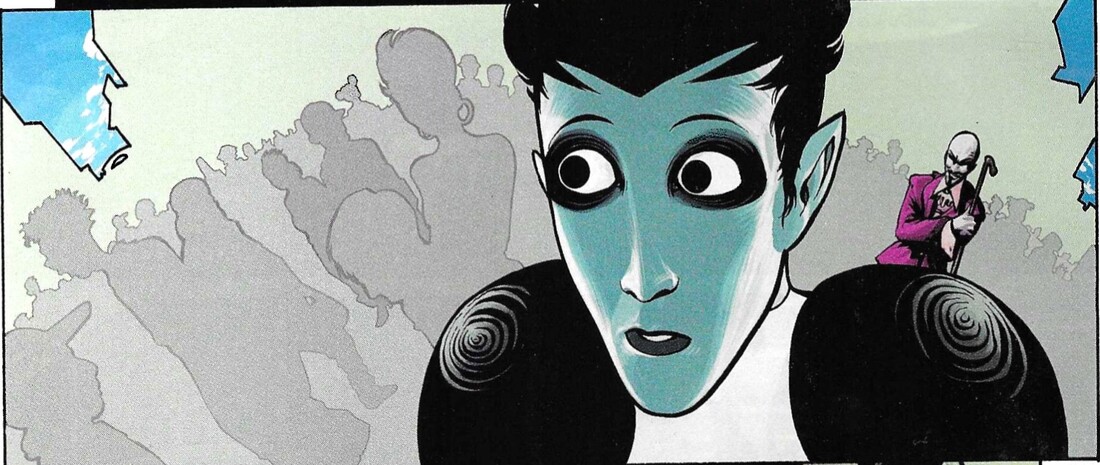 The only clue was the word “Croatoan” scratched in a tree, and Silencio says nobody ever really found out what happened to them, but now they know. Even though we never found out what happened to them, we’re fairly certain, but it’s not dramatic enough for The God of All Comics! Silencio says that the Puritans had “intimate” contact with something not entirely human, and when the “changelings” were born (remember Olwen from Shining Knight #1 is a changeling), the people reverted to an older, darker religion and burrowed deep underground to “hide their sins.” He then turns the floor over to their consultant, Melmoth. Silencio’s brief history explains many things about Klarion’s world, not the least of which is why they’re all blue. It sets the stage nicely for Seven Soldiers #1 and Klarion’s actions, as Sheeda blood runs in his veins, so why wouldn’t he act like one occasionally? It also begs the question again of what the Sheeda actually are. They’re ”not entirely human,” okay, but if they’re not entirely human, a part of them is human, and the mystery deepens.
So Melmoth takes over, and says that he runs a hostel for underprivileged children, a fine euphemism if there ever was one. He tells them about Klarion, who is now under his ”protection,” and how he experiences the new culture into which he has come. To him, everything is new and, more significantly, “holy.” Klarion has become a newborn, and this is crucial as he transforms, as we’ll see.  Melmoth (who in one panel on page 2 appears over Klarion’s shoulder, as if he’s the “devil” tempting him) says that by using Klarion, they can find Limbo Town. As he leaves the details of his plan a secret, we see a close-up of his neck, which appears to have stitching in it. We know that Frankenstein will be appearing at some point in the saga. What is his connection with this stitched-up Melmoth?
Klarion, meanwhile, is riding in a Pumpkin taxi, which we first saw in The Manhattan Guardian #1. There’s a connection, obviously, to the fairy tale nature of this epic — for these children, midnight strikes when they turn sixteen and go through to the Red Place. The children he is with are punks like Klarion, splashing a group of prostitutes and drinking beer. Hooligans! They end up at a museum of superhero history, which has to remind us, just a bit, of the Hall of Justice from the Super Friends. Or is that just me? Klarion pukes because of his experience in the taxi, but then asks to do it again, which the gang thinks is great. The driver, Billy Beezer, who is all pimped out (making the splashing of the prostitute somewhat ironic), mentions Goldenboy, who taught the gang members. We’ll see Goldenboy soon, but his name reminds me — again, it could be just me — of Sir Justin, who is, after all, decked in golden armor. Klarion tries to prove his worth by sending Teekl into the museum. One of the gang is a girl named Murderella-rella — another reference to Cinderella. We also learn that Billy’s gang is called the Deviants, and when they turn sixteen, they go to Team Red. More interesting stuff we’ll get to in time. Klarion looks through Teekl’s eyes and sees “a great empty hall of light, filled with flags for men and women to wear.” According to the annotations, the costumes on the left are for Stripesey, the Star-Spangled Kid, and the Crimson Avenger, all members of the original Seven Soldiers of Victory. The one on the right is Miss America from the Invaders. A Marvel character! What the heck? [Edit: According to the comments on the original post, this is the DC character, although their costumes look awfully similar.]  Teekl informs Klarion about the guards, two of them, one of whom smells like cheese, the other of brine. What significance there is in that I don’t know. Then Billy Beezer leads the rest into a robbery.
So the kids fool the two old guards with misdirection. They appear to know the Rules of Magic quite well. Murderella-rella mentions an “avenging ghost,” which doesn’t exist, but fits a few characters in the saga, such as Ali Ka-Zoom (sort of). The kid who looks like Frankenstein (I can’t remember if he gets a name, and if he does, I’ll figure it out later) breaks into a glass case containing a “weather generator.” Hey, remember Hurricane Gloria, raging down in the Gulf of Mexico? I wonder if it’s a coincidence. I’m sure it is, because Morrison nevers does stuff like this, right? In another panel we see an “Iron Hand” on display, which also comes up again. This is why reading a Morrison comic is fun — nothing is wasted. Billy Beezer gets the keys to the room displaying “Super Machines of the Golden Age and Beyond.” I like how in Morrison’s DCU (and, I suppose, the DCU at large, considering the presence of the JSA), they are as self-conscious about the “ages” of heroes as we are. Billy and Klarion enter the room and are confronted with the “sapper drill” from World War II. Although we see Batgirl’s motorcycle and a Blue Beetle flying bug in the room, apparently the sapper drill, which would have been used to undermine trenches and perhaps dig under fortifications, is a Morrison creation. Billy hands Klarion a manual (presumably the operating manual of the drill) and a map. Klarion is to drive the drill to a given location. On the next page, Klarion and Billy arrive at Melmoth’s underground headquarters, where two of his toughs have been discussing movies from a feminist viewpoint. I love stuff like that, and Morrison does it very well — humanizes ancillary characters just a bit. Klarion does not look happy, but it’s unclear if he’s not happy because Billy is a jerk (how do you like it, Mr. Dish-It-Out-But-Can’t-Take-It?) or because he realizes Melmoth is going to subjugate Limbo Town. Probably the former.
Billy doesn’t think Klarion is good material for the Deviants, but Melmoth isn’t so sure. He says a few interesting things.  He tells Billy that “curses come to this one [Klarion] as naturally as breathing does to you and me.” We know he knows quite a bit about Limbo Town, but it’s interesting that he knows so much about Klarion. Is he already subtly grooming a replacement? Then he tells Klarion that “we keep our familiars small and we keep them inside where I come from,” which I’m sure many people (including people at the annotations) took as a reference to Philip Pullman’s excellent His Dark Materials trilogy (The Golden Compass, The Subtle Knife, and The Amber Spyglass). There’s no reason to go that far, however. We see at the end that Teekl serves as Klarion’s conscience, so Melmoth could just mean that our moral compass is inside us, rather than externally as a talking cat. It’s still interesting to hear Melmoth talking of ”familiars” so, if you’ll forgive the pun, familiarly. Billy gets all grumpy and throws a can of Coke at the cat (product placement!), and one of the Deviants trips him as he chases Teekl. The Frankenstein kid says, “William, fear is anger, anger is failure and the beginnings of being a grown-up.” Billy turns sixteen at midnight, so he will “become” an adult then and join Team Red. This is another interesting statement that I’ll get back to. You’ll notice there are seven Deviants now that Klarion is there, even though they will lose one at midnight. Is six the optimal number because they aren’t “good guys”? This seems to be the idea throughout — “good” teams have seven members, but “bad” ones have six. Billy fights Klarion, and when he gets him on the ground, Klarion’s eyes light up with an unholy glow and he asks Billy, “Shall I tell you the hour and date of your death?” Billy, not surprisingly, backs down. What does he care? He’s sixteen in three hours! This is just another clue that Klarion plays very, very nasty. Melmoth likes it.
That night, Billy lies in bed as the clock strikes midnight. While Teekl watches, he goes out into the hall and sees Goldenboy, who wears a mask and goggles and carries what looks like a pickaxe. He falls forward toward Billy, who asks him if he’s okay. Goldenboy says that all their dreams were lies, and that Team Red is a hard labor gang, mining gold in the “red place.” Goldenboy looks prematurely aged. Melmoth comes out into the hall as Goldenboy grabs Billy. Melmoth smiles and tells him it’s “time to put away childish things.” This is a direct quote from 1 Corinthians 13:11: “When I was a child, I spake as a child, I understood as a child, I thought as a child: but when I became a man, I put away childish things.” Melmoth takes what is a nice chapter (it’s the “faith, hope, love” bit) and twists it into something sinister.  He tells Billy he’s going to go through an Erdel gate (named after the scientist who brought J’onn J’onzz, the Martian Manhunter, to Earth) to Mars, where he will work to make money for Melmoth, because “a man needs a job.” Goldenboy, who was faking his distress, drags Billy through the gate. Teekl sees the whole thing. Klarion is watching through Teekl’s eyes, and tells the rest of the gang that Melmoth is “a liar, a devil, and a betrayer, as I suspected.” His experience with Ebeneezer Badde has made him suspect all adults, which is a good thing here. Teekl follows Melmoth down to the drill, where Melmoth says they’re going to plunder a society unchanged since the 16th century. Good times! The gang wants Klarion to lead them, but Klarion walks away, telling them they’re free to do what they want (just like he rejected Leviathan’s offer to stay). Teekl tells him that evil will come to Limbo Town, but Klarion doesn’t care. He walks away, but Teekl stays, drawing Klarion back to him. Klarion knows that he has to go back to protect his home, so he walks back down into the subways.
The big theme of this issue is, of course, growing up. We have seen that Klarion wants nothing to do with growing up (he’s gleeful when he realizes that Croatoan doesn’t exist, because then he can remain a witch-boy forever!), but in this issue, growing up is forced upon him. In the beginning of the issue, Melmoth makes the point that everything to Klarion is new, because he’s in a completely new situation. This idea of Klarion, rising from the earth to be reborn (more Christ allusions, although probably not worth going into), means that he has another chance. He has left the old world behind, and is now a newborn. How will he grow up, and will he? We see him go through a sped-up adolescence until he reaches the crucial point at the end, when he must decide between his own selfish desires and doing what is right. He is forced, by his “conscience,” to take responsibility for his actions — he stole the drill, after all. It’s interesting that he takes this action pretty much on his own, if we accept that Teekl is part of his personality. The more “heroic” of the soldiers, Jake and Zatanna, have still not taken this step, as they are busy out playing hero. Jake is further along the road than Zatanna is, but Klarion passes him in this race to “true heroism,” which is surprising, as Klarion began as the most immature of them all. 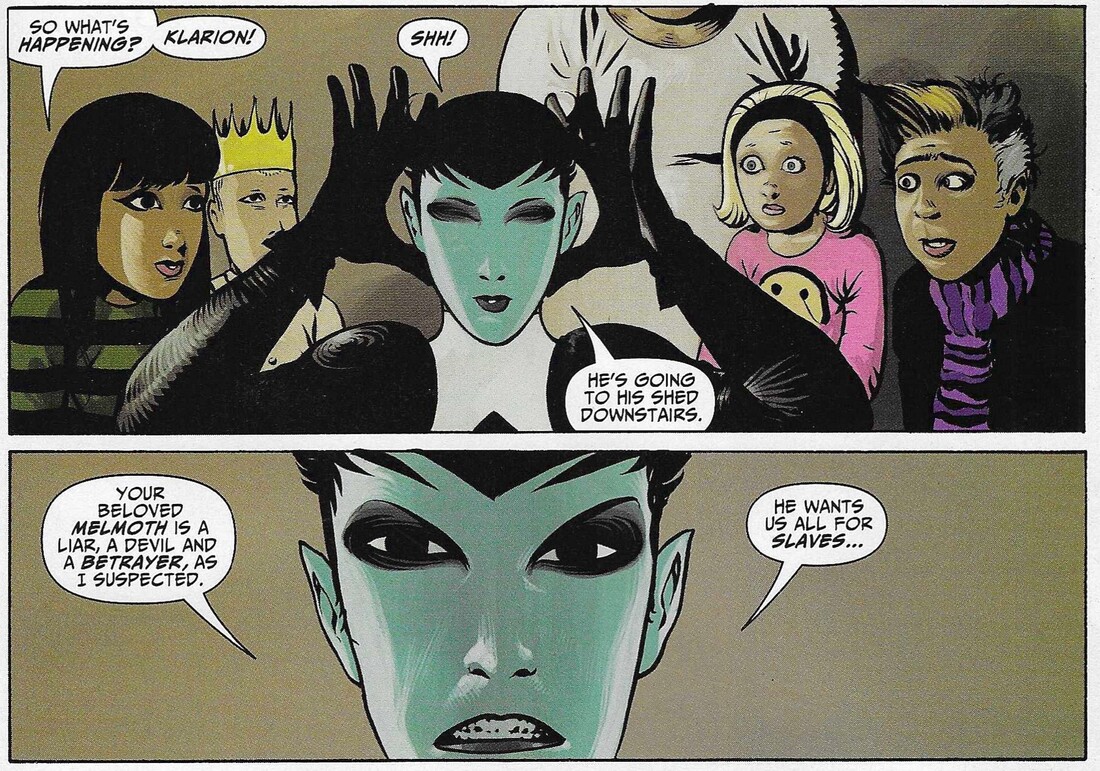 Klarion’s not perfect, certainly, but he is coming to the realization that we can’t always do what’s easiest, because the right thing isn’t always easy.
Klarion isn’t the only one who grows up. Billy also grows up, in a much more horrific way. We have seen that Morrison seems to think that “growing up” equals a total loss of imagination, but in this issue, things are much more subtle than that. On the surface, this appears to be their message. Melmoth tells Billy that a man has to get a job, and the job for this man is awful, back-breaking, repetitive work. Morrison might as well have put the children in cubicles for all the subtlety inherent in Melmoth’s statement. There’s also Kid Frankenstein’s statement about how fear equals anger, which equals failure, all of which means you’re an adult. Children fear nothing — hence Klarion trying to experience all these dangerous things, plus the kids stealing the drill — and they can’t fail because of this lack of fear. Kids are, of course, angry all the time, but it’s a fleeting anger and has to do with frustration, not with failure. Children don’t fail, because they have no idea of what it means to fail. This is the loss of imagination that Morrison associates with becoming an adult — we understand failure, and therefore don’t attempt as much because we fear failure. The moment Billy becomes an adult, he fails — he fails to escape his fate. Klarion fails, too, but in a different way — he also fails to escape his fate, but he makes the choice not to. It’s this choice that makes Morrison’s presentation subtle. Klarion wants to remain a child, and as a child, he would go off and have many adventures. But he understands that an adult has responsibilities, and maybe an adult doesn’t always want to take care of them, but he has to. This is the “good” side of becoming an adult — you can fix your mistakes, if you take responsibility for them. Klarion does, and therefore heads down instead of up.
There’s plenty of fairy tale stuff in here, naturally, which ties into the whole “growing up” thing. Billy is taken at midnight, the hour when his Cinderella childhood turns into a pumpkin reality.  The other children can continue to exist in this fairy tale or seize responsibility and get out. The idea of Klarion replacing either Billy (as leader of the gang) or Melmoth (as ruler of the Sheeda) is also part of fairy tales, which often deal with children (usually girls, but Klarion is kind of androgynous anyway) replacing the older generation, and that generation fighting back. We have seen Gloriana Tenebrae freak out when Misty is coming of age. What is Melmoth’s game with regard to Klarion? We’ll find out eventually.
This is the most clear example of the transformation of our soldiers into something else. The others have been struggling along the way, even though Justin doesn’t have far to go, as he began as the most heroic of the four (yes, there are three more, but we haven’t seen them yet). Each one of them has grown, but Klarion, it seems, has gone the farthest. The problem with Klarion growing up is that he’s not necessarily becoming a hero. Despite doing the right thing and going back to help Limbo Town and despite this being a mark of his maturity, he’s doing it not because he loves the people of Limbo Town, but because it’s his fault. He feels guilt (yes, there it is again) for giving Melmoth the means to attack the town, and he doesn’t like Melmoth, so he wants to thwart him. This may negate everything I’ve written before this, but I don’t think it does. He does the right thing, but people do the right thing for the wrong reasons all the time. It’s still the right thing, and it’s still not always the easy thing to do.
By the way, what happened to Klarion’s die?
The annotations have a lot of good information that, while interesting, is not part of what drives the issue. But they’re still neat!
Next: Justin reveals himself! Eeeewwwww! Not like that!

I don’t know why yesterday’s entry didn’t post. It’s still sitting there, in the “publishing soon” section, but the blog is acting wonky again, and I can’t force it to publish at this moment. Stupid wonky blog! I hope it will be in its place soon, but who knows!
Why do you think the group splashed by the cab are prostitutes, rather than just some women hailing a cab?
When I was redoing these, I thought about that, too, because I was pretty confident back in the day about the women being prostitutes, and now I don’t know why I thought that! I don’t know if I just assumed it or if something I had read led me to believe it, but you’re right — there’s no reason to think they’re prostitutes just from what we see in the issue. I don’t know what 2006 me was thinking. I may have just been stereotyping, which would have been disappointing!