
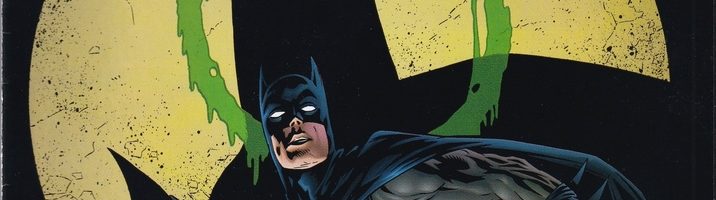

Hi, and welcome to Comics You Should Own, a semi-regular series about comics I think you should own. I began writing these a little over fifteen years ago, and I’m still doing it, because I dig writing long-form essays about comics. I republished my early posts, which I originally wrote on my personal blog, at Comics Should Be Good about ten years ago, but since their redesign, most of the images have been lost, so I figured it was about time I published these a third time, here on our new blog. I plan on keeping them exactly the same, which is why my references might be a bit out of date and, early on, I don’t write about art as much as I do now. But I hope you enjoy these, and if you’ve never read them before, I hope they give you something to read that you might have missed. I’m planning on doing these once a week until I have all the old ones here at the blog. Today let’s take a look at a conspiracy tale from Doug Moench? That’s crazy! This post was originally published on 6 April 2010. As always, you can click on the images to see them better. Enjoy!


Legends of the Dark Knight by Doug Moench (writer), J. H. Williams III (penciller), Mick Gray (inker), Dan Brown (colorist), and Willie Schubert (letterer).
Published by DC, 3 issues (#86-88), cover dated September – November 1996.
Doug Moench, throughout his career, has loved conspiracies. He’s incorporated them into several of the titles he’s written, to the point where it seems he just can’t help himself. 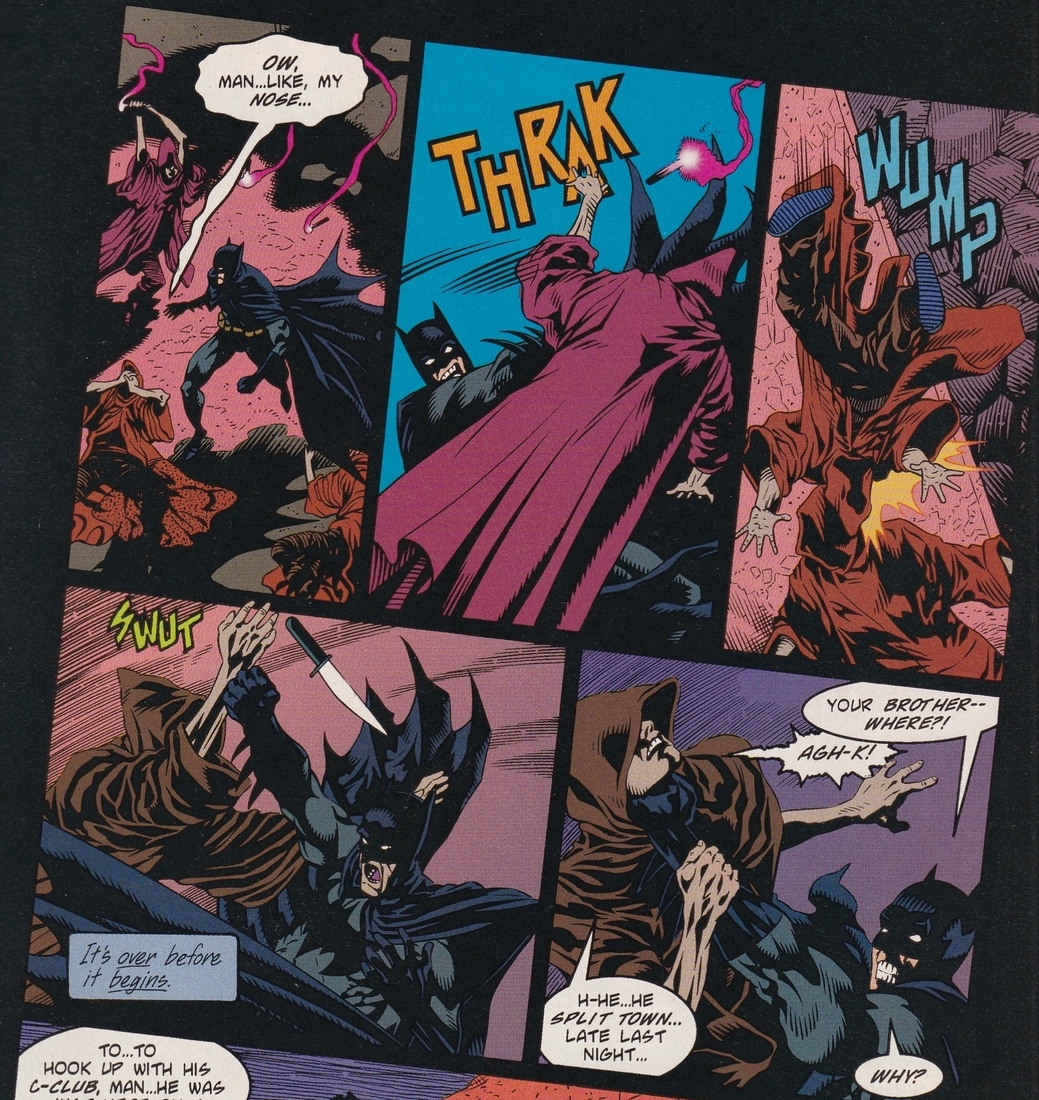 Occasionally this predilection toward conspiracies becomes a bit wearisome, even to someone (like me) who digs the idea of conspiracies (despite not believing in them). So why would this arc, which is titled “Conspiracy,” be a Comic You Should Own? Isn’t it just another crazed fever dream launched from Bucks County, Pennsylvania (hey! I grew up there!), where Moench reportedly lives?
Well, of course it isn’t! If it were, it wouldn’t be so keen. First of all, it has J. H. Williams III on art, and while the J. H. Williams III of 1996 isn’t quite as spectacular as the J. H. Williams III of 2010, he’s still an excellent artist, with enough experimentation with panels and layouts that you can see the explosion of boundary-breaking that was soon to come. Second, Moench is having some fun with his obsession – he keeps reminding us, relentlessly, that Batman is caught up in a conspiracy, to the point that we realize he’s poking fun at the entire thing. Batman keeps finding more and more layers to the plot, which becomes almost kookily self-referential, and then, at the end, Moench pretty much pulls the rug out from under us (in a way I shan’t reveal). The symbol that shows up constantly throughout the arc – the ouroboros, a serpent devouring its own tail – becomes a parodic device, and in issue #88, when Batman says the snake “brings us full circle,” we wonder what the point is. Moench has a point, of course, but he gets to it through an almost subversive Batman story. This appears to be a deadly serious tale, and some readers may have missed the point – Moench is taking the piss, which is why this is a great comic.  [I was told a decade ago when I published this that I shouldn’t use British slang if I don’t know what it means, so if you’re offended by my use of “taking the piss,” which I don’t think is as harsh as some commenters thought, I apologize to your delicate sensibilities.]
The plot, as labyrinthine as it is, remains fairly simple. Batman is tracking a serial killer who drapes the intestines of his victims over their left shoulders and paints – in the victims’ blood – an ouroboros on the wall above them. Batman discovers a bunch of teenagers who call themselves a cult about to sacrifice a dog, so he busts them up. One of the cultists tells Bats that his (the cultist’s, that is) older brother, a biker in a gang called the Satans, taught him the ouroboros symbol, and that this brother is in Wisconsin (Rhinelander, to be exact, which actually exists). Now, the ouroboros is a fairly common symbol from antiquity, so why a) Batman has never heard of it; and b) why he naturally assumes the biker dude has anything to do with the killings is never explained, but that’s part of the fun – of course Meeks is involved in the bigger plot! We also look in on an office in Los Angeles, where a fat man is hypnotizing a man named David Lee Shotwell to believe he’s “Morningstar, King of Hell.” The man, naturally, has an ouroboros tattooed around his bald head. Note the name, too – not only the surname, but the fact that he’s referred to by all three. Remember – all good serial killers/assassins have three names! We learn that the fat man’s name is Tryon, and he reports back to some called “Jessup,” and they’re preparing him for something that will occur on the 23rd, in Gotham.
Meanwhile, Batman finds the bikers, who are of course dealing drugs and receiving them from the Solucci family of … Los Angeles!  Handy! Even more handy, Gordon tells Bats that another murder victim with an ouroboros drawn next to the body has turned up in (wait for it) Los Angeles! When Batman arrives at the crime scene, he’s met by Sharon Kraft, an investigative reporter, who tells him two things: Manny Clove, the head of the homicide division of the LAPD, is an ex-CIA agent and may be covering up the Soluccis’ drug ring; and the victim was a member of a secret society called the Order of the New Dawn. Batman remembers that the three murderers of Hiram, the architect of Solomon’s temple, were ritually executed in a similar fashion as the victims (but he doesn’t know an ouroboros?), so he decides to enter the Order’s temple, where he’s confronted by some gun-wielding weird-looking dudes. Meanwhile, Shotwell is training to kill a Senator Judson. Good to know!
One thing stands out so far: All of this takes place in one issue. Moench loves dense plotting, and he does it fairly well, so he moves Batman through the story quickly. He has a lot to get to, after all! Batman escapes from the weird dudes, and Alfred calls him and updates him on the Order – they were created by a pulp fiction writer named J. Michael Jessup, who is supposed to be dead (but we, keeping careful track of who’s who, know he’s not). Batman visits the address of the murder victim and finds one of the dudes who caught him at the temple – his name is Joshua Rankin, and he lived with the victim. Before Batman can get any information out of him, Rankin’s shot in the head – oh dear!  The next day, Batman, in his guise as punk biker, finds out from a bookseller that Tryon is a big fan of Jessup’s work, and Bats finds Tryon’s name in a Rolodex he stole from the Order’s temple. Meanwhile, the biker, Meeks, confessed to some but not all of the murders, saying they were necessary to open a gateway to “the other side.” And we learn who Senator Judson is – he’s cracking down on organized crime. A motive becomes clear! Sharon Kraft tells Batman she has a person who was almost killed in a ritual murder at a Derek Ridpath’s house, so Bats pays him a visit … right in the middle of a sacrifice! Cool! However, it turns out Ridpath is “financing a movie” – in this case, a bad horror movie, and he tells Batman that he’s trespassing. And the cops show up awfully quickly for Batman’s liking, which is explained when the cop is Manny Clove, and they were simply laying a trap for our hero. Sharon Kraft has more information – Tryon was bragging to some hookers about some of the assassins that the CIA used in the past, as well as mind-control programs they had initiated. Batman, in the meantime, decides to check out the Solucci connection, which is when we learn that Manny Clove is paying Solucci to kill Judson. Makes perfect sense, right?
It all comes to a head in the third issue of the arc, as Batman uncovers secret after secret but still seems to be one step behind. 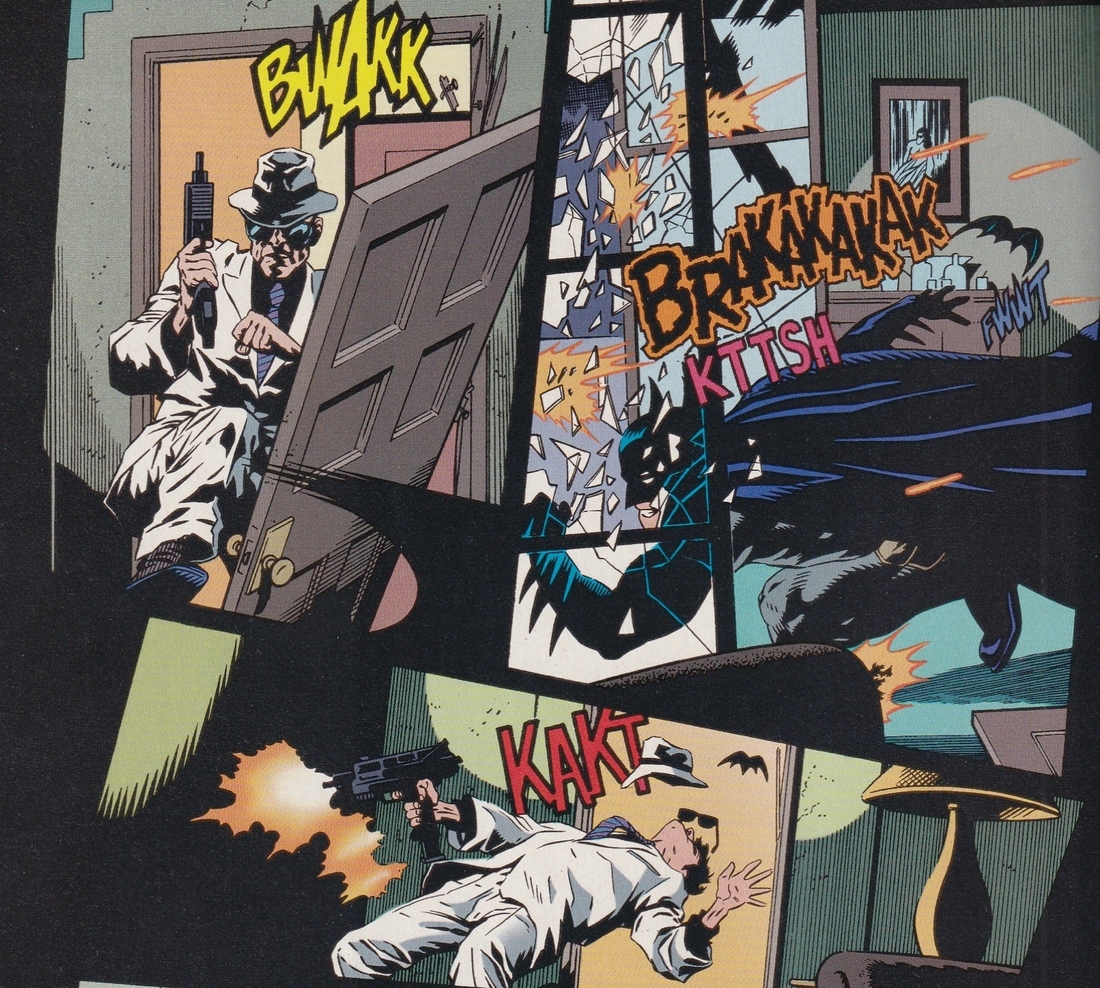 I apologize for recapping so much of the plot, but I wanted to give you an idea of what Moench is trying to do here, because a few characters mention that Batman himself might be part of the conspiracy. This is an inspired idea, because we wonder how much of this is Batman, his brain on hyperspeed, finding connections where none exist. Moench always walks the fine line between poking fun at his subject and taking it extremely seriously, which is really an excellent way to parody something and which many writers tend to forget. Despite satirizing the idea of conspiracies, “real” people were murdered, and Batman does bring the murderers to justice (he’s Batman, after all). This isn’t, however, a straight-forward case, and it ends with Batman unsatisfied and perhaps even beaten. Moench is asking us if his attempts to see everything as connected, which is a staple of superhero comics, is somehow blinding him to the randomness of life. Moench leaves some of the answers inconclusive, which might make this more frustrating than a regular superhero comic but adds some nice tension to the way Batman lives his life. Without being obvious about it (and never referencing it), Moench ties this back into the murder of Bruce’s parents – sometimes you simply can’t stop random crimes. Should we hold Batman accountable for that?
Part of Moench’s tone comes through because of Williams and Brown, who turn this book into a lurid, paranoid nightmare.  It’s a very dark book visually, with shadows everywhere, including all over the faces of the characters. Eyes are either hooded or hidden behind sunglasses (including Bruce’s when he’s incognito). Moench gives Williams a ton to draw, so the fact that the pace of the prose is fast means the art speeds up, as Williams packs panels onto pages and speeds Bruce all over the country and all through the plot. Williams’s layouts aren’t as inventive as they are today, but he’s still a wonderful storyteller, and he keeps all of Moench’s feverish plot points perfectly coherent. Williams designs very distinctive characters, which helps in this story as Moench likes throwing them into the story, and we are able to be clear on all of them throughout. Williams’s Batman is more emotional than we expect, too – he smiles at one point, which is unnerving enough, but Williams draws him baring his teeth quite often, which makes him seem almost monstrous. It’s part of Moench’s theme – the conspiracy is driving Batman to be more and more reckless, and Williams does a nice job showing that without Moench being too obvious about it.
“Conspiracy” is one of those books that works on a textual level but also works very well on a metatextual level because of the writer. If you’ve read Moench’s paranoid stuff in the past, you go in expecting this to be more of the same, and you’re pleasantly surprised when he starts messing with you. If you don’t have a history with Moench, it still works … but perhaps the wry humor doesn’t come through as well.  I’m not sure. Even if you don’t get the humor, Moench’s final issue does such a nice job showing how these ideas take on a life of their own and how even Batman is ineffective against them that this becomes a grand, ornate tale of Batman’s simultaneous triumph and failure. His life is a double-edged sword, of course, but rarely does a writer do such a nice job expressing that.
According to that most reliable of all sources – the Internet – “Conspiracy” has not been collected in a trade. Three issues of a Batman title, however, shouldn’t be too hard to find, right? This is a beautifully drawn comic with a lot of interesting ideas floating around in it, and it’s always nice to see Batman starring in a perverse comedy. Seek it out! Seek, too, the archives! Nothing but goodness there!
[Well, DC reprinted this in one of those “100-Page Spectacular” things they used to do to “collect” stuff that wouldn’t exactly fit in a trade, but it was still just a standard comic, so it’s in back issue boxes somewhere instead of on a nice shelf. I don’t know if it’s still easier to find the individual issues. As usual, I wish I had written a bit more about the artwork – we are getting to the point where I’m happy with what I wrote about the art, but we’re not quite there yet! – but I hope you get the gist. Williams and Gray and Brown really do make this book amazing to look at, and it would have been nice if Williams could have worked on more Batman stories, because he’s so good at them. (DC could do a trade of Williams’s Batman work – it’s not much, but it would probably make a nice 20-dollar collection!) Such is life. Moench still doesn’t get enough credit for being a great Batman writer – I know his work in the early 1980s on the character wasn’t the greatest, but by the time he came back to the character in the 1990s, he was really good at getting into Batman’s weirdness really well. This is just a good example of that!]

Hi Greg
DC already released a nice collection of Williams Batman work in one of the excellent Tales of the Batman books
https://www.amazon.co.uk/Tales-Batman-J-H-Williams-III/dp/1401247628
Hey Greg, DC did do a hardcover for Williams work which includes this story:
https://www.amazon.com/Tales-Batman-J-H-Williams-III-ebook/dp/B00KWNBE2S/ref=sr_1_1?dchild=1&keywords=jh+williams+batman&qid=1622057689&sr=8-1
These issues show why LOTDK was secretly the best Batman book along with Batman Adventures in the 90s.
I remember Chase launching about a year later and I was wondering if you ever read that. I think it’s right up there with Aztek as hidden gem from that era.
Hmmm … I wonder if this is collected in a nice hardcover?!?!? 🙂
Thanks, both of you – I wasn’t sure how to search for it, and didn’t think to do Williams’s name, because I didn’t think he did enough Batman to warrant a nice hardcover! That’s pretty cool, though.
DarkKnight: Yeah, LotDK was pretty consistently great. This and the Wagner Two-Face story are the only ones I think are transcendently excellent, but they were consistently very good comics. And I didn’t own Chase when I first went through the alphabet, but then DC released a nice trade, so I’ll get to it eventually! 🙂
They managed to get enough Williams Batman for a big ol’ hardcover on the technicality that there’s a five-part LotDK arc that he co-wrote but didn’t draw (“Snow” in issues 192-196, with Dan Curtis Johnson and Seth Fisher, so it still looks great.)
Shoot, that’s right. Dang, DC probably has enough material to do a Fisher hardcover. They should get on that!
I came across a copy of Green Lantern: Willworld in a second hand store a couple years back and then didn’t buy it, and I’ve been kicking myself for it ever since, because I’ve never seen it anywhere else.
So yeah, a Fisher collection would be super cool.
I was going to mention this on your write up of LOTDK 28-30, but now that you have moved on to 86-88 it makes more sense to mention it here; you forgot Legends of the Dark Knight 38 is a comic people should own ; )
https://atomicavenue.com/atomic/item/121369/1/Batman-Legends-of-the-Dark-Knight-38
LOTDK was never a favorite of mine, I always preferred the regular three Bat-books (in part because I like continuity and never felt that Crisis changed that much for Batman). I went through my LOTDK issues and pulled out the ones I did not care about so I could sell them off some day. I don’t recall this story so it must be in that pile. I have had second thoughts about selling those issues that I pulled, but I don’t know where I put them…
I like a lot of LotDK, but most of them are just good-to-very-good, and not great (I skipped the Morrison one in this column, and I love Morrison!). The Bat-Mite issue falls into that category. It’s good, and O’Neill’s art is terrific, but I just don’t think it rises to another level.
The great thing, for me, about LotDK, is that you could just dip in and out based on the creative teams. You can do that with the regular books, sure, but I agree with you that I like continuity. The nice thing about most superhero comics today is that continuity means nothing, so they’re far easier to drop! 🙂
Yeah current comics are pretty soul destroying due to continual re-starts whenever a new creative team takes over. Kind of makes me wonder why the big two make such a fuss when a long time book like FF hits a milestone and suddenly it’s back to its original numbering, it’s just a clusterfuck.
My favourite LOTDK stories were Gulacy’s Prey and Tim Sales which featured The Cavalier, I can’t quite recall the name of that particular arc though.
That Tim Sale arc was “Blades” – written by James Robinson. Highly underrated story! My favorite Sale Batman story for sure, and one of my favorite Robinson stories.